Moscow Metro fire sees 45,000 people evacuated and two dozen passengers injured

m4A rush-hour fire in Moscow’s subway today injured dozens of people, forced the evacuation of thousands of commuters and closed parts of the network.

The fire started after a power cable caught fire in a tunnel leading to the Okhotny Ryad station adjacent to Red Square, the Emergencies Ministry said in a statement.

The ministry said more than 45 people sought medical help and seven were hospitalised.

Most of them suffered from smoke inhalation and thousands were evacuated.
As firefighters were putting out the fire, authorities closed one of the subway lines that cuts through central Moscow.

Eyewitnesses say central Moscow streets were thronged with crowds who ended up walking to work.

The subway resumed regular service by noon Moscow time, but half an hour later officials again shut part of the line after they found a smoldering cable at another tunnel next to the Okhotny Ryad station.

Moscow’s subway is an essential transport link, serving up to 7 million people a day.


Iran Presidential Candidates Debate Freedoms

i1Eight presidential candidates running in Iran’s June 14 elections are taking radically different stands on personal freedoms, women’s rights and censorship in the country’s second round of televised debates, with moderates vowing to loosen restrictions and hard-liners backing strong state intervention in people’ lives.

Centrist Hasan Rowhani says he will form a women’s affairs ministry if elected but Saeed Jalili, Iran’s top nuclear negotiator, says the best job for women is to be a mother.

The four-hour debate on Wednesday tackled cultural issues. A previous round covered the economy and an upcoming round is on foreign policy and security.


More radioactive leaks reported at Fukushima plant

2Ֆուկույամայի ատոմակայանում ռադիոակտիվ ջրի արտահոսքի մեկ այլ դեպք է ÕThe operator of Japan’s Fukushima Daiichi nuclear power plant on Wednesday admitted it had found another leak of radioactive water, the latest episode in a growing catalogue of mishaps.

Tokyo Electric Power (TEPCO), said one of its workers spotted drips coming from a tank used to store radioactive water at the site on Japan’s tsunami-wrecked coast.
Water was leaking at the rate of one drop every three or four seconds, the company said, adding that absorbent material had been placed under the leak and workers were trying to stem the flow.
An increasing volume of water made radioactive after being used to cool the melted cores of broken reactors has become a growing headache for TEPCO, which has hundreds of tanks on the site.
On Monday TEPCO announced it had detected radioactive cesium in groundwater samples taken from the site, reversing an earlier announcement that the water was harmless.
The company had been intending to release the groundwater into the sea but suspended the plan in the face of strong protest from local fishermen.

EU gives Latvia green light to join euro

1Լատվիան կարող է մտնել եվրագոտիThe European Commission on Wednesday gave Latvia a green light to join the 17-nation eurozone in January, saying the country met the conditions to join the single currency and had successfully overcome its 2008-2009 crisis.

“The Commission concludes that Latvia is ready to adopt the euro in 2014,” said a report from the EU executive commending the country’s economic management over the last few years.
The report will be handed to the European Parliament and to finance ministers from the 17 nations sharing the currency, who in July will formally hand down a decision on Latvia becoming the 18th member of the euro area.
The Commission said “Latvia has achieved a high degree of sustainable economic convergence with the euro area and proposes that the Council decide on Latvia’s adoption of the euro as from 1 January 2014.”
The EU said Riga satisfied the economic conditions to join — in terms of price stability and sound public finances — and that its national legislation was compatible with the rules of Economic and Monetary Union (EMU).
But the government also won praise for its handling of a deep recession in 2008-2009.

Breezy rider: Daring Saudi man sends texts while sitting on bonnet of a car as it speeds along highway at 50mph

This is the unbelievable moment a Saudi man is filmed texting on his phone from the bonnet of a car as it speeds along a motorway at 50mph.

The fearless stunt shows the man stretching out, relaxing and even kicking his feet in the air as he sits on the front of vehicle.

The incredible footage has quickly become a hit online and has been viewed more than 1.1million times since it was posted on YouTube last week.
The footage appears to have been shot from another car as it approaches the vehicle travelling in the outside lane of a highway in Saudi Arabia.

As the camera pulls alongside, the daredevil performer can be seen, wearing traditional Saudi dress, hunched over a mobile phone on the bonnet of the car.

The car has to move over as traffic begins to build up, but in a final death-defying stunt the man turns around and kneels up with arms on the roof.

It is unclear whether those filming the performance were part of the act or passed it by coincidence.

Recently young men have taken to ‘sidewalk skiiing’ – a new craze which involves gripping onto the outside of a car as it drives along on two wheels.

A large middle-Eastern country made up largely of desert, Saudi Arabia has plenty of open road for fearless riders to practice.

The Contraband Cat: Feline tries to smuggle mobile phones and chargers into Russian jail just months after similar attempt in Brazil

c1Prison inmates been known to bribe guards so they can smuggle in mobile phones.

But – for the second time in five months – a cat appears to have been used as an accomplice.

Guards patrolling a prison colony in Russia’s north saw a cat on the fence that was apparently carrying something.

On a closer look, they found two mobile phones and chargers taped to the male cat’s belly.

The federal prison service said the incident happened last Friday evening at Penal Colony No 1 near the city of Syktyvkar in Komi province, 600 miles north-east of Moscow.

It was not immediately clear how the cat was supposed to drop off its loot.

A spokesman for the jail said: ‘Two packages were taped to the animal’s back.

‘When the packages were unwrapped, guards found objects prohibited in the penitentiary facility – two cell phones with batteries and chargers.

‘Obviously we can’t question the cat, but someone somewhere knows who he was delivering these items to and we will hold him until we find out.’

It follows an incident in north-east Brazil in January when a cat carrying a saw and mobile phone was ‘detained’ as it entered a prison gate.
Guards at the jail in Arapiraca city, in the state of Alagoas, were surprised when they saw a white cat crossing the main gate of the prison, with its body wrapped with tape.
A closer look showed the feline also carried drills, an earphone, a memory card, batteries and a phone charger.

‘It’s tough to find out who’s responsible for the action as the cat doesn’t speak,’ a prison spokesman said following the incident on New Year’s Day.


Dr. Charny Dismantles Prof. Gunter’s Deceptive Genocide Denialism

SasunyanBy Harut Sassounian

Publisher, The California Courier


As the Centennial approaches, Turkish officials and their cohorts are searching for more subtle approaches to deny the Armenian Genocide. Realizing that their past practice of outright denial is no longer credible, they have initiated a more sophisticated campaign that intends to raise subtle questions about the Armenian Genocide, sowing seeds of doubt among uninformed masses.


It is not very often that I refer to book reviews in this column, but I could not ignore the masterful way Dr. Israel Charny, Executive Director of the Institute on the Holocaust and Genocide in Jerusalem, dismantles Prof. Michael Gunter’s book, Armenian History and the Question of Genocide, which illustrates the latest revisionist approach at genocide denial.


Here are brief excerpts from Dr. Charny’s derisive review of Gunter’s book:


“This is the BEST book I have ever read — which means it is the best of the whole terrible world of books that are devoted to ridiculous and ugly denials of absolutely factual known genocides. It is, therefore, a TERRIBLE work…. This is the best DENIALIST work I have ever seen insofar as it is written with a quietness, and solidity of coverage of issues, and even more as if with an apparent fairness of representing ranges of ideas and opinions about issues rather than strong-arm statements of single opinion-truths.


“Gunter, a professor at Tennessee Tech, opens the book with a clear acknowledgment-disclosure of his significant period of lecturing in Turkey, and even as he says ‘I have long wanted to present an objective analysis of the Turkish point of view,’ he clearly conveys that he is very much on the side of Turkish denial of the Armenian Genocide….


“Gunter is nonetheless a kind denier who continuously throws us bones for our respite — and thereby of course it would seem proves and reproves his announced objectivity. Thus in the same poisonous ‘Foreword’ he quickly adds to his core statement of denial crocodile tears: ‘Of course in no way does this excuse the horrible excesses committed by the Turks.’


“Perhaps the highest praise I can give Gunter is that unlike other great deniers he cites a large number of scholars and writers, who have published the now wonderfully strong literature confirming the Armenian Genocide — and I would add genocides of other peoples alongside the Armenians, specifically the Assyrians, Greeks, and Yezidis, and also the beginning moves of the Ottoman government toward a potential genocide of the Jews in Palestine. Deniers generally stay away like the plague from writers who confirm the Armenian Genocide….


“How does our intrepid ‘objective’ scholar conclude his book? Of course, he wants to be helpful in curbing the denial that fuels ‘continuing fear and revenge.’ So he offers strategies beginning with splitting the ‘more affluent Armenian Diaspora’ that is so concerned with ‘allegations of genocide’ from ‘the nation in Armenia’ and the ‘immediate economic reality of Armenia.’ Yes, he wants to be large-hearted and he calls on Turkey to help Armenia with its economic problems, and thus in eternal realpolitik ‘Turkey may begin to split the two Armenian actors.’ But all is not lost in deception. Goodhearted Gunter also includes a proposal to Turkey to open the borders it has lockjammed with Armenia for so many years.”


Charny concludes his incisive review by suggesting that Gunter’s book “should be studied by all students of denial for its artful stratagems of sounding fair, acting fairly, citing scholarship that covers divergent and contradictory points of view, speaking consistently softly, and of course calling for justice and peace, all in the course of organizing a disarming, deceitful, anti-history and anti-value-of-life work that should frighten anybody who is concerned with integrity in intellectual and scholarly works, and genuine valuing of human life.”


Taking one last jab at Gunter’s insidious denialism, Charny gives him a parting underhanded praise: “Once upon a time, deniers were so wild and obvious buffoons that they claimed that the Ottoman Turkish government protected and took care of the poor Armenian exiles in their forced march out of Armenia…. Now increasingly we have a whole series of recognized academicians who write in our contemporary language of scholarship and make their points in the name of open discussion and fairness. Gunter can be congratulated that he has risen to the top of this group….”


Mumbai to ban lingerie mannequins in bid to stop rape epidemic

i2Mannequins displaying lingerie could be banned in Mumbai in a bid to halt India’s rape epidemic.

Mumbai’s municipal council passed a resolution barring stores from displaying scantily-clad mannequins outside city shops.

The ruling will come into effect if it is approved by the muncipal commissioner.

It comes as news emerged that two western women were raped in India in the last two days.

The resolution  to ban mannequins wearing lingerie was suggested by city councillor Ritu Tawde who said that such displays not only degrade women but could also encourage men to attack them.

Although the ruling will ban mannequins from going on display outside shops, retailers will still be able to display them how they wish inside stores.

Business officials have criticised the proposals, saying that they will have no impact on violence against women.

Viren Shah, president of the Federation of Retail Traders’ Welfare Association, said: ‘We are living in the 21st century where these kinds of things, all porn, the movies, the pictures, all these things are available on websites, available on mobiles. (A) mannequin hardly makes any difference to the people.’

But Tawde said pornographic internet images are very different than the mannequins.

She said: ‘If someone wants to watch pornography on the net, that is a conscious choice that he is making. In this case, the mannequins are everywhere and people don’t have a choice.


Pucker up! The Australian coffee shop that lets their customers pay with KISSES

s1Forget cash, cheques or credit cards, one cafe has a different way of charging its customers for a cup of coffee.

Metro St. James, a French style cafe in Sydney, is running a unique and romantic promotion this month.

Between the hours of 9 and 11am, the cafe is letting customers pay their bill by giving each other a kiss.

While some may find this concept somewhat creepy, the French-themed shop, which opened its doors three months ago, has included a video featuring several couples earning their cups of coffee by way of their lips.

‘We’ll watch you. It has to be a real kiss, I can see if it’s a fake kiss,’ the proprietor says in the video as he hands over the coffees.

He adds that if they try to fake a kiss, he’ll know because he’s ‘kind of a specialist.’


66-year-old man discovers he is actually a WOMAN after visit to doctor in Hong Kong

ch1A Chinese man who went to the doctors with a swollen stomach was told that he is actually a woman.

The 66-year-old, who even has a beard, had lived his entire life as a man but was told by doctors in Hong Kong that his enlarged abdomen was caused by an ovarian cyst.

Tests revealed the patient suffered two rare genetic disorders that had gone undiagnosed.

They showed the patient had Turner Syndrome, a genetic condition that affects about one in 2,000 baby girls, and congenital adrenal hyperplasia, which increases male hormones.

The Hong Kong Medical Journal, which published the information yesterday, said only six cases of people with both disorders had ever been reported in medical literature.

The patient had grown up an orphan and stopped growing after puberty at the age of 10 and was just 4.5ft tall.

Girls with the disorder have normal female reproductive organs but can suffer with fertility problems.


Queen marks 60th anniversary of coronation

3Թագուհին տոնում է թագադրման 60-ամյակըQueen Elizabeth II marked the 60th anniversary of her coronation on Tuesday with a service at Westminster Abbey filled with references to the rainy day in 1953 when she was crowned.

More than 2,000 guests crammed into the abbey for the service, attended by all the senior members of the royal family including Prince William and his heavily pregnant wife Catherine.
The 86-year-old monarch, in an oyster-coloured outfit by Angela Kelly, was accompanied by her husband Prince Philip, 91, who was at her side despite pulling out of a public engagement on Monday because of ill health.
Prince Charles, the heir to the throne who was just four when his mother was crowned, sat next to his parents on the front row, alongside his second wife Camilla.
Next to them sat William and Catherine, who wore a daisy lace dress and a peach silk jacket by British designer Jenny Packham.
Charles recalled last year that the queen practised wearing the crown around Buckingham Palace in the weeks before her coronation, even popping in to say hello to her children during their bath time.

Salvadoran doctors perform C-section in risky pregnancy

2Սալվադորցի բժիշկները ռիսկային հղիությունից հետո կատարել են կեսարյաÕDoctors performed a C-section on a chronically ill Salvadoran woman who was denied an abortion despite her high-risk pregnancy, the head of a support group said.

“What we have been told is that Beatriz is well. She had a girl but we are told it is very painful to see her,” said Morena Herrera, the head of a group that advocates the decriminalization of abortion.
El Salvador’s Supreme Court rejected the request, however, saying the rights of the mother cannot take precedence over those of the unborn child.
With the approval of Health Minister Maria Isabel Rodriguez, doctors then proceeded to deliver the baby prematurely by C-section after 26 weeks of gestation.
“It is very clear at this time that the pregnancy intervention is not an abortion, it is an induced birth, which is something else,” Rodriguez told a news conference last week.

NATO takes up cyber-defence as threat grows

1ՆԱՏՕ -ն կքննարկի  կիբեռ-պաշտպանության հարցերDefence ministers from NATO’s 28 member states meet on Tuesday with cyber-defence top of the agenda, amid concerns about the threat posed by increasing cyber-attacks, many blamed on China.

“The challenge evolves all the time, probably (much faster) than any other type of threat we face at the moment,” said one senior NATO official who asked not to be named.
Newly appointed US Secretary of Defense Chuck Hagel, who will be attending his first NATO meeting since taking office, has made the issue a priority.
In Singapore on Saturday he accused China of waging cyber-espionage against the US after a US report found evidence of a broad Chinese spying campaign against top US defence contractors and government agencies.
“The United States has expressed our concerns about the growing threat of cyber intrusions, some of which appear to be tied to the Chinese government and military,” he told an annual conference known as the Shangri-La Dialogue.
Hagel pressed Beijing to adhere to “international norms of responsible behaviour in cyberspace”, while acknowledging that the establishment of a joint cyber security working group was a positive step in fostering dialogue.
NATO head Anders Fogh Rasmussen made clear earlier this year that cyber-security is a key issue.
The US-led military alliance had been forced to upgrade its defences after several attacks, among them by Anonymous, the hacker group, he said.

Unions join forces with Turkish protesters

130603192324-pkg-walsh-turkey-ankara-protests-00002308-story-topIstanbul (CNN) — Trade unions claiming 240,000 members are throwing their weight behind anti-government demonstrations across Turkey.

The KESK confederation of public sector workers was calling a two-day strike starting Tuesday to protest what it called the “fascism” of the governing party of Prime Minister Recep Tayyip Erdogan, who has become one of the focal points of demonstrators’ anger.

They have united demonstrators from across the political spectrum against a common foe: security forces who unleashed tear gas and water cannon on them in response to what had been largely peaceful protests against Erdogan’s government.

Read more: Turkish protesters decry ‘unprecedented violence’
Anti-government riots erupt in TurkeyAnti-government riots erupt in Turkey

Turkey’s political situation deteriorates

Turkish protesters target prime minister
Erdogan: Powerful, popular, polarizing

Turkish Deputy Prime Minister Bulent Arinc on Tuesday apologized “for the police aggression against our citizens who were involved in the initial protests and acted with environmental concern,” Turkey’s semiofficial Anadolu news agency reported. But, Arinc said, “I don’t think we owe an apology to those who caused destruction on the streets and who interfered with people’s freedom.”

The Turkish Medical Association said that at least 3,195 people were injured in clashes Sunday and Monday. Of them, 26 were in serious or critical condition, it said.

One protester, Mehmet Ayvalitas, died of his injuries, the association said. And the governor of Hatay in southeastern Turkey said that a 22-year-old man, Abdulah Comert, was killed with a firearm by unknown people during demonstrations late Monday, Anadolu reported.

The medical association reported that the bulk of the injuries occurred in Istanbul, where the protests began before spreading to Ankara, Izmir, Adana and other places.

What’s driving unrest and protests in Turkey?

Relative calm

After chaotic scenes in the streets Monday that continued late into the night and sent tear gas wafting through the air, the situation was relatively calm Tuesday morning in Istanbul’s central Taksim Square, near the park where the protest movement began.

Barricades remain up around the square, and Erdogan’s opponents appear determined to continue the demonstrations despite the prime minister’s comment Monday that he expects the situation to return to normal “within a few days.”

The protests began after plans were made to raze Gezi Park, the last green space in central Istanbul, and replace it with a replica of 19th-century Ottoman barracks. The development would contain a shopping mall.

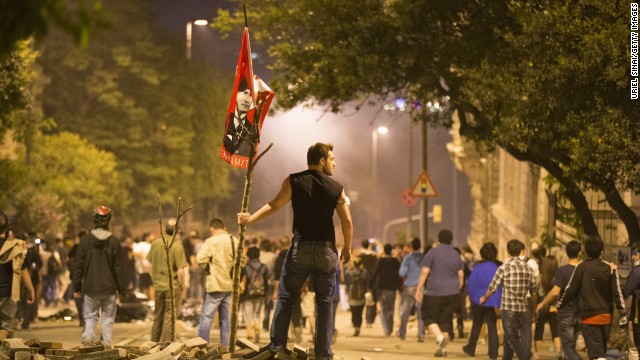
What began as a sit-in by a handful of angry residents quickly grew into a larger protest. Riot police moved in, using tear gas and pepper spray. Protesters responded by hurling bottles, setting up barricades, blocking bulldozers and burning trash in the middle of the street.

Then, outraged by the behavior of security forces, demonstrators began attacking police. The protests have since morphed into larger complaints against Erdogan, whom protesters call paternalistic and authoritarian.

Despite economic boom, Erdogan targeted by protests

Police criticized

Park protest triggers national response

Update on Turkey’s unrest

Turkish citizens want PM to resign

International groups including Amnesty International have criticized the police response as excessive. In Ankara on Sunday night, a CNN crew witnessed authorities roughing up at least one protester. One police officer kicked a CNN videographer, CNN’s Nick Paton Walsh reported, and a CNN crew in Istanbul on Sunday also witnessed bloodied protesters.

Erdogan, who left the country Monday on a four-day trip to North Africa, has responded by dismissing the demonstrations as the work of “extreme elements” and marginal groups.

“My smart citizens will recognize this, then they will give them the right lesson,” he said.

But Turkey’s president, Abdullah Gul, took a somewhat more conciliatory tone Monday, saying “the messages sent in good faith have been received.”

In Istanbul, the crowds have been chanting “Tayyip resign” — referring to Erdogan — and “Shoulder to shoulder against fascism.”

The protests have spread to 67 of Turkey’s 81 provinces, according to Anadolu.

Opinion: Is Turkey on the verge of a meltdown?

Opposition pushing back

Hugh Pope, a senior Turkey analyst with the International Crisis Group, called the protests “completely unprecedented” and said Erdogan was caught off guard. Most demonstrators, Pope said, are “overwhelmingly ordinary people” who simply want their voices heard.

“However, there are other demonstrators who are somewhat more opportunistic in the left-wing factions who normally don’t get much in the way of airtime in Turkey and are camped on Taksim Square,” Pope said.

Erdogan has defiantly praised his government’s accomplishments in overseeing a decade of strong economic growth in Turkey.

His party has won the past three elections, most recently securing 49.95% of the vote in 2011.

“What you have is essentially a large group of Turks who feel alienated from this government, in power for 10 years,” said Richard Haass, a Middle East analyst at the Council on Foreign Relations in Washington.

“It’s increasingly a one-party country. All the politics happen within it. The opposition is weak, divided, feckless,” he said. “You have a lot of people in Turkey who feel both alienated and intimidated by the government, and this is the way they decided to push back.”

CNN’s Ivan Watson and Talia Kayali contributed to this report.

Baku police prevents a rally in support of demonstrations in Istanbul

1On Monday at 4 o’clock, police prevented a group of young people trying to hold a rally of solidarity with the protesters in Istanbul. About 50 people gathered in front of the Turkish Embassy in Baku, calling to meet the demands of demonstrators in Istanbul. They called on the Turkish government to stop pressure on the protesters, and to abandon plans for the restructuring of Taksim Square, according to correspondents from the scene.

The police pushed the crowd away from the embassy. Young people told reporters they continue to hold solidarity actions in other locations in central Baku, without naming specific addresses. -03В-

U.N. nuclear chief: Iran talks ‘going round in circles’

3ՄԱԳԱՏԷ-ի ղեկավարը գոհ չէ Իրանի հետ բանակցությունների արդյունքիցThe U.N. nuclear watchdog chief said on Monday talks with Iran have been “going around in circles” – unusually blunt criticism pointing to rising tension over suspected nuclear arms research by Tehran that has increased fears of a new Middle East war.

Yukiya Amano, director general of the International Atomic Energy Agency, vented growing frustration at the lack of results in getting Iran to address suspicions of military dimensions to its atomic energy program. Tehran denies the accusations.
In hard-hitting comments to the IAEA’s 35-nation Board of Governors, he also said Iranian advances in building a heavy-water research reactor and in its uranium enrichment work were in “clear contravention” of U.N. Security Council resolutions, dating to 2006, calling for a suspension in such activities.
The IAEA has been trying since early 2012 to engage with the Islamic state over what the Vienna-based U.N. agency calls the “possible military dimensions” to Iran’s nuclear program.
But ten rounds of negotiations in the last 17 months have failed to achieve any breakthrough. Western diplomats accuse Iran of stonewalling the IAEA, an allegation Tehran rejects.

Pistorius family ‘shaken’ by leaked images

2Պիստորիուսի ընտանիքը ապշել է տարածված նկարներովThe family of Oscar Pistorius say they are “shaken” by the leaked graphic photos of the blood-spattered bathroom where the world-renowned athlete shot dead his girlfriend on Valentine’s Day.

Images of the crime scene appeared in the media last week, just days before the double amputee’s court appearance on Tuesday for a brief pre-trial hearing.
On Friday, Britain’s Sky News television released leaked images showing the bloodied bathroom of Pistorius’s luxury Pretoria home where he shot his 29-year-old girlfriend Reeva Steenkamp three times in the early hours of February 14.
The 26-year-old “Blade Runner” claims he shot Steenkamp through a locked bathroom door in the middle of the night after mistaking her for an intruder.
But the prosecution argues it was premeditated murder, a crime that carries a maximum sentence of life in prison.

WikiLeaks film director ‘lost perspective’: Assange

1WikiLeaks-ի մասին նկարահանված ֆիլմի ռեժիսորը հեռանկար չունի. ԱսսանժWikiLeaks founder Julian Assange has accused an acclaimed filmmaker of losing objectivity while making a documentary about the whistleblowing organisation.

Assange, who is holed up in Ecuador’s embassy in London, refused to cooperate with Oscar-winning director Alex Gibney’s “We Steal Secrets: The Story of WikiLeaks”.
“WikiLeaks has never co-operated with Universal or Alex Gibney,” Assange said in an email to The Sydney Morning Herald Monday.
“This US filmmaker has lost objectivity and perspective, probably as a result of WikiLeaks’ decision to not engage with them.”
WikiLeaks said on its website that Gibney’s film about the organisation, due to screen at the Sydney Film Festival this month, contains errors of fact, selective editing and misrepresentations.

3 Firebombs Explode in Athens. 1 Woman Wounded

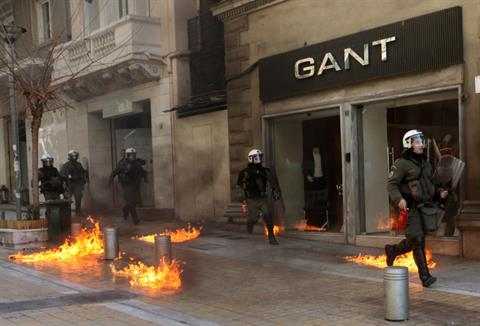
147999_mainimgThree firebombs exploded at different locations in central Athens Monday morning, authorities said, with one wounding a woman as she emerged from her apartment.

All three devices consisted of camping gas canisters, police said in a statement.

One exploded at about 8 a.m. in the fifth floor corridor of an apartment building in central Athens, near the political office of the country’s Transparency general secretary, wounding a woman who had just emerged from her apartment. The woman was transferred to a hospital for treatment of slight burns.

The other devices detonated several hours earlier, one outside a building housing the Foundation for Economic and Industrial Research and one outside a branch of the Environment, Energy and Climate Change Ministry.

Firebomb attacks against government offices, banks or symbols of wealth are common in Greece, where several small, generally anarchist groups operate. The bombings are usually carried out late at night and rarely cause injuries.

Kim Kardashian: I’m Having a Girl!

gty_kim_kardashian_nt_130531_wblogKim Kardashian celebrated her baby shower on Sunday, and a few hours later, the fans of her E! reality show got in on the fun, when it was revealed on the show that she and rapper Kanye West are expecting a girl.

“I’m so excited we’re having a girl. Who doesn’t want a girl?” Kardashian said. “They are the best and I know that’s really what Kanye has always wanted. He wanted a little girl.”

Kardashian, 32, learned the news during a doctor’s appointment that she went to with her mother, Kris Jenner, and her sisters, Kourtney and Khloe. So where was West?

“The baby was always in a position where you couldn’t tell the sex, and this time that you’er going to see on the show, [Kanye] was in London or Paris,” Khloe explained to Ryan Seacrest last week. “He had a concert.”

Before the announcement tonight, the couple worked hard to keep the baby’s gender a secret.

Now, she’s just preparing herself for the delivery in a few weeks.

“At the beginning that was what I feared the most, and now, I mean, it’s inevitable,” she told the website. “It’s gonna happen. I’m really not worried or nervous.”