|
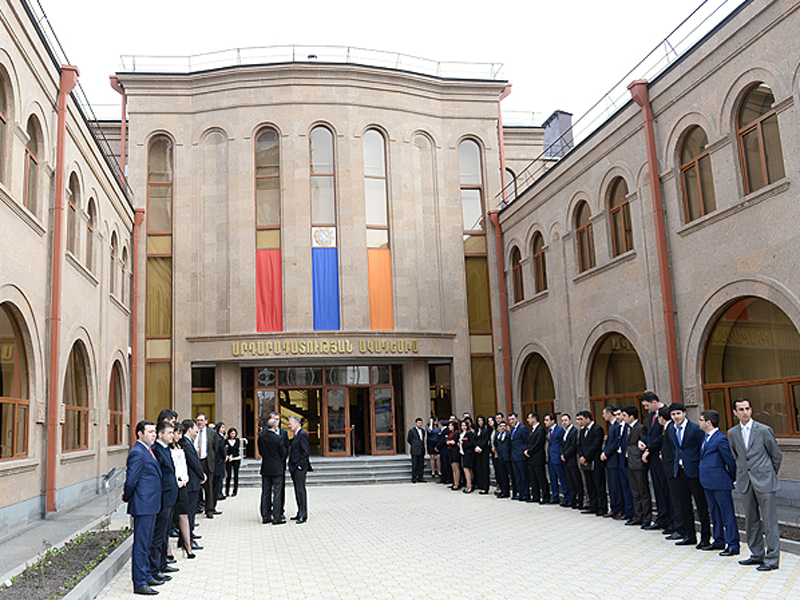
The President attended the opening ceremony of the Academy of Justice
Reply
|

The Council first reviewed the status of previous meeting’s assignments. Then the meeting discussed issues related to public procurements and VAT problems arising during the implementation of grant programs. Regarding the latter, the Prime Minister ordered to hold an extra consultation and find appropriate solutions. The Council next heard a report on the launch of robotics groups under the “Robotics start at school” project.
60 such groups were said to have been set up nationwide, which are supposed to triple in number in the near future. The speakers noted that the project may help attract thousands of young people into the labor market. The private sector has turned to the government for financial support, and the Prime Minister has approved the request. Various donors are expected to be involved in the project.
The meeting approved a proposal to post all the corresponding draft laws in RSS format at the Ministry of Justice official website. Tigran Sargsyan instructed the relevant authorities to discuss the issue and submit recommendations.
The meeting agenda featured items concerning the minimum wage, warranty service-related customs rules and regulations, as well as the launch of computing skills testing and attestation centers under the “Usum” (Learning) system.
Summing up the meeting, the Prime Minister stated in part, “The IT Development Support Council features representatives from the private sector to get feedback from private operators regarding the existing problems and bottlenecks. Such feedback is a must for the government to understand and address the threats in a timely manner, which are given a prompt response.”
In conclusion, the Prime Minister urged the IT sector representatives to identify and report back all the problems in order to find coordinated solutions and implement new programs.
 Men! Useless at discerning a woman’s true feelings, deaf as a post when a baby is crying and utterly incapable of performing more than one task at a time.
Women! Forever getting overemotional, completely hopeless at map-reading and liable to go into meltdown at the prospect of parallel parking.
Men and women moan continually about the supposed shortcomings of the opposite sex – but now brain scientists have found a real reason for the stereotypical differences in male and female behaviour.
Women’s and men’s brains are wired in fundamentally different ways.
Neurologists used magnetic resonance imaging (radio-wave scans that produce detailed images of the inside of the body) to study the brains of almost 1,000 volunteers.
The differences between the genders were so profound that men and women might almost be separate species.
Men generally have more connections within each hemisphere and between the front and back of the brain.
In women the stronger connections usually run from side to side, between the left and right hemispheres.
In essence, what this means is that men are more logical and better at coordination and spatial awareness. Women are more intuitive, have greater ’emotional intelligence’ and better memories for words and faces.
The research was published in the journal Proceedings of the National Academy of Sciences. Ragini Verma, of the University of Pennsylvania, who led the study, concludes that male brains are geared ‘to link perception with doing’ – so men would be better at, for example, learning a new sport.
Female brains, meanwhile, are configured to handle matters of heart and mind and to study others’ behaviour, then interpret it using intuition and analysis.
In November 2013, UWC Dilijan has become fully accredited as an IB World School.
This means that it is authorised to offer the IB Diploma Programme (taught in English), to students aged 16-18, starting in September 2014.
The IB Diploma has become a symbol of academic integrity and intellectual promise throughout the world of international education, and is a sound preparation for students seeking entrance to the best universities and colleges in the world.
In the full Diploma programme, each student studies three Higher Level (HL) and three Standard Level (SL) subjects. IB candidates are also required to write an Extended Essay, complete a course of Theory of Knowledge (TOK), and actively engage in Creativity, Action and Service (CAS) components. See the Academic section of this website for the subjects to be offered at UWC Dilijan.
In October, 2013 DilijanInternationalSchool became a UWC school (United World Colleges) under the name of UWC Dilijan.
DilijanInternationalSchool is a large-scale philanthropic initiative which will put Armenia on the world educational map. DIS will open its doors in September 2014 for 90 students.
By 2023 the school will host 650 students from at least 60 countries. 90% of gifted students will receive full scholarships granted by the DIS benefactors.

Located at the very border of the Armenia and Azerbaijan, Kayan-avan of the Tavoush region is a tiny village with 306 people living there. Yet, the Kayan-Avan secondary school N1 has about 140 schoolchildren actively participating in various events, contest and Olympiads all over the country. These were the main factors influenced the decision making about the project, since CRONIMET believes that improving conditions in such school at the border villages and regions would at least to some extent prevent people leaving their communities.

Thus, the assistance project was designed and launched with Kayan-Avan in September 2012, having its main goal of supporting educational activities in the regions to encourage children and youth to pursue and complete their education. The building adjacent to the school has been planned to be fully renovated to serve as a pre-school for about 50-60 children.
Starting May 2013, major renovation of the pre-school building is undergone. The process has been is divided into two phases. The first phase included renovation of the roof and some preparatory works; while during the second phase the capital renovation of the full building has been carried out and concluded by October 2013. The investment made by the CRONIMET Charity Foundation totals to AMD 40 million.

As Mrs. Lena Vardanyan, the Director of the Kayan-Avan School N1 has told, this is very important project done by the CRONIMET Charity Foundation, since it supports bordering community and allows children from other nearby communities to come and study in the newly renovated pre-school, and this project significantly improved their living conditions and creates favorable environment for their education.
CRONIMET Charity Foundation has been established in June 2011 having its main goal of supporting children and people in need throughout the country. The Founder of the CONIMET Charity Foundation is the German CRONIMET Mining AG.
The Representation of CRONIMET Mining AG in the Republic of Armenia

Kaspersky Lab announces that Eugene Kaspersky, Chairman and CEO of Kaspersky Lab, received an honorary doctorate from the State Engineering University of Armenia (SEUA), the country’s leading technical university. Eugene Kaspersky and the company’s top IT security experts met representatives of the education and the business community, as well as students from local technical universities during the recent visit to Armenia. They spoke about current cyber threats in Armenia and the wider world and discussed ways to combat them.
“The number of cyber threats is constantly growing, so it is especially important to train more experts who can combat them. The world’s next generation of specialists needs more than just good knowledge of the IT security field and strong practical skills – they also need to be able to think one step ahead and come up with something really new. I am glad to see that today’s students in Armenia are interested in cyber security and are willing to improve and develop in this area. And I’ll be doubly happy if Kaspersky Lab can help them do that,” said Eugene Kaspersky.
One of the highlights of Eugene Kaspersky’s visit was the presentation ceremony where he received a doctorate for his outstanding services to science. The Chairman and CEO of Kaspersky Lab also took part in the official opening of the Kaspersky Lab Training and CertificationCenter within the State Engineering University of Armenia. The Center will help bridge the gap between theoretical and practical education. It also provides future IT security professionals with the necessary knowledge of contemporary technologies, enabling them to gain Kaspersky Lab certification while studying at the university.
“We are deeply appreciative of the role that Kaspersky Lab is playing in the development of information security and the personal contributions Eugene Kaspersky has made as one of the leading experts in information protection. We are sure that Kaspersky Lab’s expertise will help our students become excellent IT professionals,” said Ara Avetisyan, Rector of the State Engineering University of Armenia.
Kaspersky Lab’s successful association with Armenia began four years ago following the signing of a memorandum of understanding entitled ‘Safe Armenia’ with the Ministry of the Economy. This information security project led to the implementation of a number of educational programs in Armenian schools, specialist training for IT administrators in state and commercial organizations and discounted licenses for some Kaspersky Lab products used within government structures.
The cooperation between Kaspersky Lab and the State Engineering University of Armenia began in 2009 when a student of the university won first prize in that year’s edition of the international conference CyberSecurity for the Next Generation. After that, the university registered as a member of Kaspersky Lab’s educational program and signed an agreement on cooperation within the KasperskyAcademy program which remains in effect. In February 2013, SEUA hosted the latest regional round of CyberSecurity for the Next Generation for Russia and other CIS countries.
About Kaspersky Lab
Kaspersky Lab is the world’s largest privately held vendor of endpoint protection solutions. The company is ranked among the world’s top four vendors of security solutions for endpoint users*. Throughout its more than 16-year history Kaspersky Lab has remained an innovator in IT security and provides effective digital security solutions for large enterprises, SMBs and consumers. Kaspersky Lab, with its holding company registered in the United Kingdom, currently operates in almost 200 countries and territories across the globe, providing protection for over 300 million users worldwide. Learn more at www.kaspersky.com.
 The iKettle might have a terribly cliched name, but it makes up for that unoriginality with loads of novel functionality that might just be enough to justify its $160 price tag. Maybe. After all, how many kettles do you know that politely ask if you’d like a piping hot cup of tea when you get home at night?
The crux of the kettle’s capabilities is its ability to connect to your home’s Wi-Fi network. This puts it in contact with an accompanying mobile app on your smartphone that gives you complete control over all of the kettle’s functionality — including multiple temperature options for different hot beverages — from wherever you have access to your home’s wireless network.
Starting the kettle boiling before you get up and head to the kitchen is a wonderful feature, for sure. But it’s the iKettle’s ability to monitor its internal temperature and alert you when the water is ready that most coffee and tea fans will love — especially since it sends you notifications instead of an ear-piercing whistle. And last but not least, when you walk through the door at the end of the day and your smartphone rejoins your wireless network, the iKettle will even offer to start a fresh brew like your own personal butler who really has only one skill.
|
During today’s tour of the University, Serzh Sargsyan familiarized with the investment projects, conditions created in compliance with the program, capacities of the laboratories and prospects of the program. The creation of the Armenian National Engineering Laboratories is aimed at the enforcement of the educational capacities and research potential in the area of engineering in Armenia through the development of technologies and innovations, modernizing the educational and research structures of the Engineering University in accordance with international standards. During the tour, the President was informed that the laboratories will service students of 24 specialties from six departments of the University (nearly 2000 students each year), who will have the opportunities to combine technical courses and research work. It was noted that through the efforts of the partners and co-sponsors of the project – the Government of Armenia, Engineering University, USAID and the world’s largest engineering National Instruments Company and as a result of the state-private sector-international organizations link there will be created a contemporary scientific, educational and research base. According to those responsible for the program, it is a groundbreaking project in the area of technical education and has been the largest and most significant investment for the improvement of the infrastructure of the higher education establishments and laboratory bases. |
Today UN office in Armenia marked the International Literacy Day stressing the importance of literacy in modern world and called for greater efforts to enable children, youth and adults to read, write and transform their lives, emphasizing the fact that literacy is a universal right.
Over fifteen school pupils, including children with disabilities were invited to the UN House to discuss the role of literacy and attend a master class taught by famous Armenian aquarellist Peto Poghosyan.
This year’s International Literacy Day, observed annually on 8 September, focuses on the “literacies for the 21st century” to highlight the need to realize basic literacy skills for all as well as advanced literacy skills as part of lifelong learning.
The goal of the observance of the International Literacy Day is to raise awareness about the role of literacy as a human right and a foundation for lifelong learning, better well-being, sustainable and inclusive development.
“Literacy is much more than an educational priority – it is the ultimate investment in the future and the first step towards all the new forms of literacy required in the 21st century. We wish to see a century where every child is able to read and to use this skill to gain autonomy,” said Irina Bokova, UNESCO Director General.
Maria Dotsenko, the Representative of the UN Department of Public Information Office in Armenia, said: “Our young guests have learned that literacy is a human right, a tool of personal empowerment and means for social and human development. I am confident that after today’s class, they will share with their peers that the literacy is at the heart of basic education for all, and is essential for eradicating poverty, reducing child mortality, achieving gender equality and ensuring sustainable development, peace and democracy.”
“Thanks to the efforts of the Armenian authorities, the adult literacy rate in Armenia is 99.6 per cent, according to the Human Development Report 2013. The UN supports their efforts to further promote the inclusive education. Even though Armenia enjoys high enrolment and literacy rates, some social groups face disadvantage in the education system. UNICEF survey revealed that 18% of children with disabilities do not attend school. UNICEF is working with the Armenian government to strengthen the inclusive education system”, she added.
After the master class, a 14years old Hasmik B. said: “Tomorrow I will tell my school-friends how important the literacy is. I wish to become a good professional and contribute to the development of my community”.
The event was organized by the UN Department of Public Information Office in Armenia with the support of the non-governmental organization “Bridge of Hope”.
For over 40 years now, UNESCO has been celebrating the International Literacy Day by reminding the international community that literacy is a human right and the foundation of all learning.

|
Today, at the National Library of Armenia, President Serzh Sargsyan met with the leadership and members of the advisory bodies for the Program of Assistance to the Young Scientists (PAYS) which is being carried out under the patronage of the President of Armenia. At today’s meeting, the PAYS officials presented to Serzh Sargsyan the main results and achievements of the Program for the period of July 2012- April 2013, spoke about the ongoing works, and future programs. Noting that expediency of the Program is indisputable, the President suggested that for the future the young scientists develop also a system for the evaluation of the dynamics and efficiency of the Program. Serzh Sargsyan expressed readiness to continue to support the PAYS and to allocate another 100,000 AMD for year 2013. The President also tasked the Minister of Education and Science, next year to assign to the PAYS another 100,000 AMD from the funds provided to the Ministry from the state budget thus doubling the funding of the Program. Young scientists express thanks to the President of Armenia for the attention toward their problems and assistance and promised to increase the number of projects, their efficiency and the number of benefactors. |
 (CNN) — The winter of 1609 to 1610 was treacherous for early American settlers. Some 240 of the 300 colonists at Jamestown, in Virginia, died during this period, called the “Starving Time,” when they were under siege and had no way to get food.
Desperate times led to desperate measures. New evidence suggests that includes eating the flesh of fellow colonists who had already died.
Archaeologists revealed Wednesday their analysis of 17th century skeletal remains suggesting that settlers practiced cannibalism to survive.
Researchers unearthed an incomplete human skull and tibia (shin bone) in 2012 that contain several features suggesting that this particular person had been cannibalized. The remains come from a 14-year-old girl of English origin, whom historians are calling “Jane.”
 Scholar: Settlers ate each other
There are about half a dozen accounts that mention cannibalistic behaviors at that time, although the record is limited, said Douglas Owsley, division head of physical anthropology at the Smithsonian National Museum of National History.
The newly analyzed remains support these accounts, providing the first forensic evidence of cannibalism in the American colonies.
What we know from the bones
Jane’s remains were found in a 17th-century trash deposit at the former site of James Fort. William Kelso, chief archaeologist at the Jamestown Rediscovery Project said at a briefing Wednesday that the fort was built in 1607, but has been washed away. Kelso and colleagues began digging in 1994 and have been excavating the site on Jamestown Island ever since.
Owsley and colleagues can tell quite a bit about what happened to Jane when at least one starving settler in the fort apparently tried to feed off of her.
If it’s any consolation, it appears that she was already dead at the time.
Researchers say it looks like someone had tried, but failed to open the skull with four shallow chops to the forehead.
The back of the skull contains markings that could have been made by a small hatchet or cleaver striking it. The cranium cracked open from the last hit. Forensic experts say it appears the person striking the skull was right-handed.
The skull’s mandible contains cuts all over it and inside, which experts say reflect an attempt to take tissue off of the face and throat with a tool such as a knife. The cheek area reflects a “sawing action” of a tool going back and forth, Owsley said. There are also sharp passages of a knife.
At some point in the process, the head was removed, Owsley said.
The damage done to these remains indicates that whoever inflicted it was not a skilled butcher, he said.
“Instead, what we see is hesitancy, trial, tentativeness and an absolute total lack of experience.”
The shin bone that archaeologists recovered also appeared to have been chopped, but in a way that more resembles classic butchering techniques, Owsley said.
“The person doing this was clearly interested in, based on what would have been accepted cuisine in the 17th century, in cheek meat, muscles of the face — that area — and tongue, and also in terms of 17th century traditional cuts, would also include the brain,” he said.
It is possible that more than one person was involved in this, given the disparity in butchering practices seen in the head compared to the shin bone.
What we know about the colonists
In the summer of 1609, the settlers experienced two significant setbacks, said James Horn, vice president of research and historical interpretation at Colonial Williamsburg.
The first was that a large fleet bringing supplies and settlers to Virginia was scattered. It had been carrying 500 settlers from Plymouth along with provisions.
“The fleet represented a new beginning for Jamestown, which had struggled over the previous two years,” Horn said.
A hurricane scattered the ships a week before they were supposed to arrive. The flagship with the leaders of this pack ended up in Bermuda. Shakespeare’s play “The Tempest” takes its inspiration from this event.
Six ships reached Jamestown in August 1609, with spoiled or depleted food, and many settlers in poor health. “On one of those ships was Jane,” Horn said.
At the same time, the relationship between the Jamestown colonists and the native Powhatan Indians had broken down. The existing settlers were already experiencing disease and a shortage of food, and the demands they made on the Powhatans strained their relations.
That was the environment into which 300 additional settlers arrived at the James Fort.
One of the leaders of the group, Captain John Smith — the same one who was famously friends with Pocahontas — returned to England in October 1609 because he was injured, Owsley said, leaving a leadership vacuum.
In the fall, the Powhatans waged war against these colonists, and launched a siege against the fort.
With no way to get food from the outside, the colonists resorted to eating horses, dogs, cats, rats, mice and snakes, Horn said, according to the accounts of George Percy, who was the president of Jamestown during this time. There are even accounts of people eating their shoes and any other leather that could be found. Anyone who left to try to scrounge for roots in the woods was killed by the Powhatans.
Percy wrote, according to the Smithsonian, “thatt notheinge was Spared to mainteyne Lyfe and to doe those things which seame incredible, as to digge upp deade corpes outt of graves and to eate them. And some have Licked upp the Bloode which hathe fallen from their weake fellowes.” In other words, cannibalism.
It’s not clear how many deceased colonists were cannibalized. Only 60 of 300 of the original colonists survived, described as “looking like skeletons,” Horn said.
In May of 1610, the settlers finally arrived who had been shipwrecked in Bermuda, effectively saving the colony. Lord Delaware brought even more colonists and enough provisions to last a year.
There are still more pits at the fort to be excavated, and only 10% of Jane’s body has been recovered, Owsley said.
“I think there’s going to be other examples,” Owsley said. “Whether that will be found — with archeology you never know what’s going to be under the next shovel.”
A special exhibition will begin at the Smithsonian about Jamestown and Jane’s story on Friday.
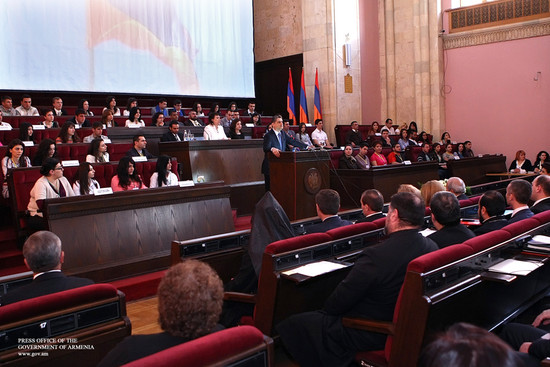 Prime Minister Tigran Sargsyan attended the opening of Diaspora Ministry-hosted “Armenian language is in my heart” pan-Armenian youth conference in Yerevan.
Welcoming the participants on behalf of the Government, the Prime Minister said. “We attach great importance to all pan-Armenian events. This is why the Ministry of Diaspora was et up at the initiative of the President of the Republic of Armenia for the first time five years ago to unite Armenians around the world. Every week a language dies in the modern world, which means that the bearers of a specific language, alias an ethnic group disappears on the globe. Competition is growing keener in the 21st century, especially among and between nations, with the language proving to be the main pledge for keeping one’s ethnic identity. Our language will bring us together to make a unified fist, which can help us defy many challenges ahead.”
According to the Prime Minister, the modern world has entered a new stage, which is characterized by rapid changes and our young people should be able to keep track of their identity. As the chief driving force behind the Armenian identity, our statehood has helped us overcome many global and regional threats and challenges over the past couple of decades.
“We are building a statehood to implement our youth’s desire to preserve national values and ethnic identity. From this perspective, Nagorno-Karabakh is struggling for survival. The Artsakh issue is that of the future of our nation. The perception of this problem by young Armenians is the key to a safe future because we cannot achieve a fair settlement of the problem without unity,” the head of government emphasized.
Tigran Sargsyan believes that having a powerful army, for the first time in history our people can provide for the nation’s security.
“The modern world is a world of knowledge, where the Armenian nation has a competitive advantage. It is time our youth proved that we are part of the global competition among nations. In the 21st century, competition has moved to the intellectual field of knowledge, and this means that the number one problem is the formation of such an educational system that will give you the opportunity of getting competitive knowledge,” the Prime Minister said.
The Prime Minister stressed the importance of the activities of Luys Foundation, which was established at the initiative of the President of the Republic of Armenia. Note that the Foundation subsidizes the scholarship of Armenian students at the world’s top 10 universities.
Scheduled for April 22-24, the conference is attended by 500 young people from 30 countries. Issues of nationwide importance will be discussed, including new approaches to achieving international recognition of the Armenian Genocide, peaceful settlement of the Karabakh conflict, language and culture-related problems etc.