Iraq, Iran Top World’s Unhappiest Countries List

դժբախտ


Do you live in one of the world’s unhappiest places?

A new study released this week by Gallup cited Iran as the country with the highest negative emotions — a close second behind Iraq.

Just last month, six Iranians were arrested in the country for dancing to Pharrell’s “Happy” in the country’s capitol, Tehran. They have since been released.

Gallup measured negative emotions in 138 countries in 2013 by asking people whether they experienced a lot of anger, stress, sadness, physical pain and worry the previous day. Gallup compiles the “yes” results into a Negative Experience Index score for each country. The higher the score, the more pervasive negative emotions are in a country.

In another Gallup study ranking positive emotions, Paraguay ranks first in positive experiences, and Syria was the least likely country worldwide to report positive experiences.

Giving Iran a run for its money — at least as far as unhappiness is concerned — are these other countries:

  1. Iraq
  2. Iran
  3. Egypt
  4. Greece
  5. Syria
  6. Sierra Leone
  7. Cyprus
  8. Northern Cyprus
  9. Cambodia

10. Lebanon

 Անկախ

Iran nuclear deal on track as country slashes highly- enriched uranium by 75% ahead of schedule UN watchdog has reveals

մահմուդ ահմադինեջադ


Iran has slashed its nuclear stockpile by almost 75 percent the International Atomic Energy Committee has confirmed.

The IAEA has spent the past six months investigating whether the Tehran regime has complied with its international obligations.

In a report to the United Nations, the IAEA has confirmed that Iran halted aspects of its nuclear programme on January 20 opening the possibility of the easing of international sanctions.

As a result of Iran’s compliance with the international agreement it is now possible for Tehran to access foreign currency reserves frozen since the dispute arose.

It is understood that over the past three months Iran has diluted 155kg of its higher-grade uranium gas – less than the 250kg necessary to build a bomb.


 Անկախ

Troops Join Rescue Effort in Snow-Hit North

Իրանի զորքեր միացել են ձյան տեղումներից տուժած հյուսիսային շրջանների փրկարարական աշխատանքներին

Iran 

Iran has sent Revolutionary Guard and army troops to two northern provinces struck by heavy snowfall that trapped thousands on the road and cut off water and power supply in the remote region.

The country’s state television says troops joined the Red Crescent and other rescue teams in Gilan and Mazandaran provinces where the snowfall left many households without power for nearly 72 hours and forced schools and universities to close their doors.

The TV says electricity was mostly restored by Tuesday morning. There were no reports of any casualties.

The TV also says that President Hassan Rouhani formed an emergency ministerial team to supervise relief assistance to the provinces.

Heavy snowfall in 2004 killed several people in Gilan and caused about $300 million in property damages.


Անկախ


Iran begins to halt uranium enrichment as landmark nuclear deal goes into effect

րոհանի


Iran started suspending high levels of uranium enrichment Monday as an interim deal struck with six world powers went into effect, state media reported, making way for more talks and less financial sanctions.

The nation stopped enrichment of uranium to the 20% purity level and disconnected cascades of centrifuges enriching uranium in Natanz, a top nuclear official told Press TV.

International inspectors were present when Iran started implementing the historic deal, Press TV said.

The action is part of a six-month interim agreement that gives Iran and six other countries — the United States, Britain, China, France, Russia and Germany — more time to negotiate a permanent solution.

Iran struck the deal with the nations on November 24 in exchange for lighter sanctions.

If all conditions are met, Iran will get sanctions relief totaling about $7 billion, including access to $4.2 billion in frozen assets, during the six months the interim deal is in effect.


 Անկախ

Iran Arrests Man on Charges of Spying for Britain

iran-arrests spy


Iran’s media says authorities have arrested a man on charges of spying for Britain.

The semiofficial ISNA news agency said Saturday the man was arrested in the town of Kerman in southeastern Iran after authorities spent months tracking him down.

A Kerman judiciary official, who was not named by ISNA, said the man had exchanged information with four British intelligence operatives. The man has not been identified but the report says he is currently standing trial and has confessed.

Iran periodically announces the arrest of alleged foreign agents. Often few further details are released.

The arrest comes as Iran and Britain are patching up ties following the election of moderate President Hassan Rouhani in June. The British Embassy in Tehran was closed in late 2011 after hardliners overran the building.


Iran Says New US Sanctions Violate Geneva Deal

Իրան,ԱՄՆ,պատժամիջոցներ, Ժնևի համաձայնագիր

A senior Iranian nuclear negotiator says new sanctions by the United States on Iranian companies and individuals violate the spirit of a deal made between Tehran and the West over its nuclear program.

Abbas Araghchi told official news agency IRNA Thursday that “this is a game of double standards — it is not in accord with the talks we have had and it is against the spirit of the Geneva agreement.”

He strongly criticized the sanctions, calling them “unconstructive and against good intentions.”


Աբաս Արգաչի

The United States has targeted more than a dozen companies and people for allegedly evading sanctions against Iran.

Last month Tehran agreed to cap its uranium enrichment in exchange for an easing of Western sanctions.


Iran Detains 2 Saudi Fishing Boats

ձկնորսական նավ


An Iranian news agency says two Saudi fishing vessels have been seized after allegedly entering Iranian waters in the latest dispute over maritime boundaries between Iran and Gulf Arab states.

Fishing boats and other craft are occasionally held for apparent violations of territorial limits in the Gulf, but the disputes are usually ended quickly. Saudi Arabia and Iran are main regional rivals and any conflicts have the potential to escalate.

The semiofficial Fars news agency reported Wednesday that nine fishermen from various nations were on the two vessels detained off Bushehr province. No other details were given.

In January, Saudi Arabia detained 21 Iranians on two commercial boats that allegedly ended Saudi waters.


Iran Launches Its First Submarine for Tourists

Իրան,զբոսաշրջիկներ,սուզանավ

Iran has launched its first submarine for tourists in the Persian Gulf waters, an all-Iranian-made undersea vehicle.

State TV says the sub has been dubbed Morvarid, or Pearl in Farsi, and has the capacity to carry four people per voyage. It says the vessel is four meters (13 feet) long and three meters (9.8 feet) in both width and height.

Friday’s report says the submarine will serve tourists in Kish Island, Iran’s prime tourist spot in the Gulf.

Morvarid has been entirely designed and manufactured by Iranian experts. The TV also says it has a speed of up to 12 knots, has a diesel generator but can be electrically-powered for up to six to 10 hours.


Iran passes a law allowing men to marry their 13-year-old adopted daughters just as the country’s new president touts himself as a moderate

iran-children


A new law in Iran that allows men to marry their adopted daughters at the age of 13 has caused major concern that the country’s new president is not as progressive as originally thought.

President Hassan Rouhani has been hailed as a new moderate voice in the controversial Middle Eastern government but the approval of the new law shows that the extreme beliefs in the intolerant country have not evaporated.

The law was approved by the Iranian members of parliament and maintains that girls can marry with the permission of their father at the age of 13 and young boys at the age of 15.

The law in question pertains to the legal marriage age, but the concern about incest is an additional factor for human rights advocates.

‘This bill is legalizing pedophilia,’ lawyer Shadi Sadr, who works for the group Justice for Iran, told the paper.

‘It’s not part of the Iranian culture to marry your adopted child’

There is some question whether the law will get the final stamp of approval by the country’s Governing Council, but the prospect has activists outraged.


Rouhani: Nuclear weapons have no place in Iran’s security

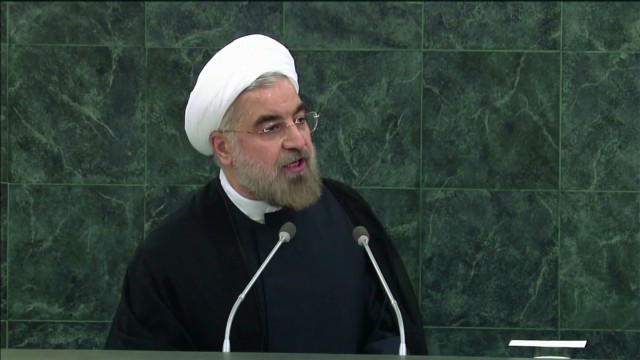
130924174554-rouhani-nuclear-weapons-00001801-story-top(CNN) — Iran is prepared to engage in nuclear talks and nuclear weapons have no place in his country’s security, Iranian President Hassan Rouhani said Tuesday.

In a speech at the U.N. General Assembly, he said that Iran would be willing to “engage immediately in time-bound and result-oriented talks to build mutual confidence and removal of mutual uncertainties.”

“Nuclear weapons and other weapons of mass destruction have no place in Iran’s security and defense doctrine, and contradict our fundamental religious and ethical convictions,” Rouhani said.

He decried international sanctions against Iran.

“Sanctions, beyond any and all rhetoric, cause belligerence, war-mongering and human suffering,” he said.

Iran president: Holocaust ‘condemnable’

Rouhani: Age of ‘zero-sum game’ over

Israel: Iran goes by ‘N. Korea playbook’

Iran ready to make a nuclear deal?

“Iran seeks to resolve problems, not to create them,” Rouhani said, pushing for the “rejection of violence and extremism.”

Alongside fears facing the world, there are “new hopes,” he said. “The hope of universal acceptance and the elite all across the globe of yes to peace and no to war. And the hope of preference of dialogue over conflict, and moderation over extremism.”

Striking a conciliatory tone, Rouhani said that Iran “does not seek to increase tensions with the United States.”

Rouhani said he listened carefully to U.S. President Barack Obama’s speech and hoped that the United States “will refrain from following the short-sighted interests of warmongering pressure groups” so that the two nations “can arrive at a framework to manage our differences.”

Earlier Tuesday, two senior administration officials said that Obama and Rouhani wouldn’t be shaking hands or meet on the sidelines of the U.N. General Assembly.

Such an encounter proved too complicated for Iran back home, the officials told reporters.

Both presidents spoke on the first day of the annual gathering of world leaders in New York. Obama made clear in his morning remarks that the United States was committed to preventing Iran from developing a nuclear weapon.

“We will not tolerate the development or use of weapons of mass destruction,” he said.

At the same time, Obama welcomed what he called positive signals from Iran that it was ready to negotiate with the international community on how it can develop a peaceful use of nuclear power without creating any weapons.

“We are not seeking regime change, and we respect the right of the Iranian people to access peaceful nuclear energy,” Obama said. “Instead, we insist that the Iranian government meet its responsibilities under the Nuclear Non-Proliferation Treaty and U.N. Security Council resolutions.”

He noted that Iranian Supreme Leader Ayatollah Ali Khamenei issued a fatwa against the development of nuclear weapons, and Rouhani “just recently reiterated that the Islamic Republic will never develop a nuclear weapon.”

“These statements made by our respective governments should offer the basis for a meaningful agreement,” Obama said, adding that “to succeed, conciliatory words will have to be matched by actions that are transparent and verifiable.”

Israeli Prime Minister Benjamin Netanyahu welcomed those comments, but said that his country “will not be fooled by half-measures that merely provide a smokescreen for Iran’s continual pursuit of nuclear weapons.”

“Iran thinks that soothing words and token actions will enable it to continue on its path to the bomb. Like North Korea before it, Iran will try to remove sanctions by offering cosmetic concessions, while preserving its ability to rapidly build a nuclear weapon at a time of its choosing,” Netanyahu said.

Secretary of State John Kerry will join his Iranian counterpart, Foreign Minister Mohammad Javad Zarif, at a Thursday meeting of the five permanent members of the U.N. Security Council, plus Germany. Discussions will surround restarting talks on Iran’s nuclear program.

One European Union official expressed optimism over the chance for concrete progress.

“In terms of whether we’re on the verge of a breakthrough, I would put it like this: I was struck as I said by the energy and determination the foreign minister demonstrated to me,” said Catherine Ashton, high representative for foreign affairs and security policy of the European Union.

But no one is expecting an overnight solution to Iran’s alleged effort to build a nuclear weapon, an effort Tehran has so far denied, insisting its nuclear program is for peaceful purposes.

“The roadblocks may prove to be too great, but I firmly believe the diplomatic path must be tested,” Obama said.

Iran president brings ‘charm offensive’ to U.N.

Syria a point of contention

Iran’s recent overtures signaling cooperation, though, likely stop short at the topics of Palestine and Syria. Iran is Syria’s closest ally in the region.

In his speech Tuesday, Rouhani blasted what he described as the “structural violence” against Palestinians. While he never mentioned U.S. ally Israel by name, the intention of his comments was clear.

“Palestine is under occupation; the basic rights of the Palestinians are tragically violated, and they are deprived of the right of return and access to their homes, birthplace and homeland,” he said. “Apartheid as a concept can hardly describe the crimes and the institutionalized aggression against the innocent Palestinian people.”

On Syria, he said that the common objective of the international community regarding that country “should be a quick end of the killing of the innocent.”

“We defend peace based on democracy and the ballot box everywhere, including in Syria, Bahrain and other countries in the region, and believe that there are no violent solutions to world crises,” Rouhani said.

“While condemning any use of chemical weapons, we welcome Syria’s acceptance of the Chemical Weapons Convention,” he said, stressing that extremists’ access to chemical weapons was the “greatest danger to the region.”

Syria is under U.S.-led pressure to give up its chemical weapons arsenal in the aftermath of the August 21 attack on suburban Damascus that Washington and its allies blame on the al-Assad regime.

Obama said Tuesday that Syria’s use of chemical weapons tested the relevance of the United Nations in the modern world, and he rejected contentions by the al-Assad regime and its main ally, Russia, that rebel forces were responsible for the attack.

“It is an insult to human reason — and to the legitimacy of this institution — to suggest that anyone other than the regime carried out this attack,” Obama said.

Russia has blocked U.S. efforts to secure a strong Security Council resolution authorizing possible military force if Syria fails to comply with international regulations on turning over its chemical stockpiles. Obama argued Tuesday that such a resolution was vital.

“There must be a strong Security Council resolution to verify that the Assad regime is keeping its commitments, and there must be consequences if they fail to do so,” he said. “If we cannot agree even on this, then it will show that the U.N. is incapable of enforcing the most basic of international laws. On the other hand, if we succeed, it will send a powerful message that the use of chemical weapons has no place in the 21st century, and that this body means what it says.”

At the same time, Obama announced an additional $340 million in U.S. aid “to meet humanitarian needs in Syria and surrounding countries,” referring to war refugees and other victims. The additional money increases the total U.S. commitment in humanitarian aid to $1.3 billion.

But Farah Atassi, activist with the opposition Syrian National Coalition, said Obama did not go far enough.

“The president did not address the core issue behind the Syrian crisis, which is holding the Assad regime accountable” — including for its use of conventional weapons, she said in a CNN interview. More than 100,000 people have died in the conflict, the vast majority from conventional weapons, according to U.N. figures.

Obama is letting Syria’s ally Russia lead, she said. “We don’t trust the Russians.”

“We want the U.S. to step forward and take the leadership right now to push for Assad to step down and allow for a transitional government from the opposition.”

Emphasizing that the opposition has not asked for “boots on the ground,” Atassi said U.S. military action should remain “on the table.” And, she said, the rebels are looking to Washington for help empowering moderate elements of the opposition.

“We are not terrorists,” she said.

Militant groups make up part of the Syrian opposition.

In his remarks to open the General Assembly on Tuesday, U.N. Secretary-General Ban Ki-moon called for the Syrian government to “fully and quickly” honor its obligations under the Chemical Weapons Convention, which calls for turning over control of its stockpiles.

Ban also appealed to all sides to stop supplying any weapons to all parties in the Syrian civil war while urging both the Syrian government and the opposition to respect international humanitarian law.

Russia and Iran, as well as Hezbollah in Lebanon, are providing military backing to the al-Assad regime while the United States and some European allies have started supplying light arms to rebel fighters.

Meanwhile, U.N. weapons inspectors will be back in Syria on Wednesday to assess at least six claims of chemical weapons use in Syria by the regime or rebels, a spokesman for Ban said Tuesday.

Al-Assad hinted at potential trouble for inspectors coming into Syria, saying other countries may order terrorists to attack them.

“Those militants might want to stop (the) experts’ arrival. We know that those terrorists are under the control of some countries,” he said in an interview Sunday with Chinese television. “And those countries may encourage the terrorists to stop experts from arrival, so that they could accuse the Syrian government for violating the agreement.”

Despite al-Assad’s veiled threat, positive progress has been made on the Syrian chemical weapons deal brokered by the United States and Russia in Geneva. Over the weekend, the United States said it was pleasantly surprised by the extent of Syria’s initial declaration of its chemical weapons stockpile reported to the Organisation for the Prohibition of Chemical Weapons.

The United States is pushing for a U.N. Security Council resolution this week in New York to enforce the Geneva deal.

Opinion: Can Iran’s President Rouhani deliver change in relations with U.S.?

Brazil outrage over U.S. surveillance

Obama faced criticism Tuesday from Brazilian President Dilma Rousseff, who used her U.N. speech to call allegations of U.S. surveillance of her country “totally unacceptable.”

Rousseff referred to classified leaks by former National Security Agency contractor Edward Snowden that made public how the U.S. government had access to phone and Internet records, including foreign information.

She said the U.S. surveillance intercepted private details of Brazilian citizens and businesses, along with “communications by Brazilian diplomatic representation offices, including the permanent mission of Brazil with the United Nations and even the very presidency of the republic of Brazil.”

“Meddling in such a manner in the life and affairs of other countries is a breach of international law and such is an affrontment to the principles that should otherwise govern relations among countries, especially among friendly nations,” she said, adding Brazil would propose U.N. action intended to prevent the manipulation of cyberspace as “a weapon of war.”

Because of the surveillance controversy, Rousseff postponed a state visit to Washington that had been planned for next month. The White House said the postponement was a joint decision.

President Rouhani says Iran won’t develop nuclear weapons

hassan-rouhaniIranian President Hassan Rouhani vowed Wednesday that his country will never develop nuclear weapons, telling NBC News that he is open to diplomatically resolving issues surrounding his country’s controversial nuclear program.

In an interview with NBC’s Ann Curry, Rouhani said that — even with Supreme Leader Ayatollah Ali Khamenei, a looming presence in Iranian society — he has “full power and has complete authority” to make a deal with others on nuclear matters.

Yet Rouhani appeared relatively optimistic Wednesday. He spoke about getting a letter from U.S. President Barack Obama after his recent election and inauguration, saying the U.S. president congratulated him and raised certain issues. Rouhani said he wrote back offering Iran’s viewpoint, describing the tone of the exchange as “positive and constructive.”

If they do and there are “negotiations without threats,” Rouhani added, then “the way for interaction is open.”


A Call by Iranian Economists, Lawyers, and Journalists to their Colleagues across the Globe for Support of the Campaign against Sanctions on Iran

ԻրանDear Colleagues,

Our purpose in writing this open letter is to highlight the disastrous effects of the economic and financial sanctions passed against the people of Iran. These sanctions are by no means helping the cause of international peace and, indeed, their catastrophic humanitarian consequences are contributing to worsening international tensions.

The United States of America and its European allies have publicly announced that the goal of economic and financial sanctions is to control and make transparent Iran’s nuclear activities.  Judging the content of the dispute over Iran’s nuclear program requires technical knowledge and assessments that go beyond the expertise of signatories to this letter. However, we are voicing our concerns regarding the means being employed to achieve the declared goals of the international sanctions.

Through the suspension of financial transactions and transportation of goods, the basic human needs of Iranians – specifically those of more vulnerable groups such as children, the sick and the elderly – have been taken hostage. As such, sanctions take the basic human needs of the people of a country hostage and cause them definite and irreparable harm in order to deal with the alleged potential threats that are yet to be examined. Continuation of the current state of affairs will result in a human tragedy of substantial scale, whose outcome will undoubtedly be neither forgiven nor forgotten. While this letter cannot address all relevant cases, we would like to point out widespread harms, which in the past few months have included the worsening situation of surgical procedures in hospitals and the increased hardship in obtainment of medicine for critically ill patients.

In today’s globalized world where markets can be reached in many different ways, the imposition of sanctions leads to the proliferation of black markets, reduced transparency, increased corruption, and unsound and inefficient resource allocation. This is quite contrary to the global efforts to improve transparency, accountability, and governance and to ensure free and fair access to resources and information. Indeed, sanctions undermine international law and encourage rent-seeking and corruption at the cost of productive entrepreneurship and fair trade. Such maladies are not just problems limited to the sanctioned country; they also easily spread to other countries. The experience of at least the past year clearly shows that instead of giving up their transactions, many enterprises doing business with Iran resort to black market practices that are becoming entrenched and it may take many long years before this undesirable phenomenon can be eradicated from the economy of region and beyond.

A look at the history of sanctions reveals that the countries imposing sanctions have seldom reached any of their stated goals and in many cases, the end results have been military conflict and colossal human tragedy. There is no rationale in repeating such bitter experiences, especially in the current state of affairs in which the Middle East is experiencing one of the most turbulent periods of its history. Under such conditions, how can sanctions against Iran possibly contribute to world peace?

Historical precedent shows this laudatory reality that the people of Iran are peace-loving and have always resisted all types of force and aggression. A notable fallacy of those enforcing sanctions, at least in the case of Iran, is that in doing so, i.e. by adopting an aggressive approach towards the Iranian population, the civilizational and cultural capacities of Iran in solving this standoff are ignored. The jubilant atmosphere after the Iranian presidential elections on the 14th June of this year has provided a special opportunity for the countries that have been imposing sanctions against Iran to revisit their policies and adopt a new and peaceful approach, so that calm and tranquility can return to the people of this country and the region in general; an approach is needed that aims to lift sanctions and resolve international differences.

We therefore call on the global elite—especially the eminent economists, lawyers, and journalists—to support the peaceful and humanitarian campaign against sanctions and to persuade the leaders of their respective countries to take the first steps towards an innovative and effective resolution of this complex dispute.


Iran Mulls Persian Cat as Next Animal Astronaut

persianwhite_01Iran’s hunt for its next animal astronaut may turn to the distinctive and locally named Persian cat, an official said Monday, in another possible step by the country’s ambitious aerospace program that has also raised Western concerns about spillover military applications.

The report by the official IRNA news agency comes seven months after Iran claimed it launched a monkey out of earth’s atmosphere and successfully returned it home. The account, however, faced international questions after photos appeared to show different monkeys in pre- and post-launch images.

A senior space program official, Mohammad Ebrahimi, said Iran’s next space capsule could carry the Persian cat, a long-haired, flat-faced breed named after Iran’s former name of Persia. He said the launch will happen by the end of Iran’s current year, which ends March 21. The report said a mouse and rabbit also are under consideration.

Iran says it wants to put its own satellites into orbit to monitor natural disasters in the earthquake-prone nation, improve telecommunications and expand military surveillance in the region.

Earlier this year, President Mahmoud Ahmadinejad said he wanted to be Iran’s first astronaut.


Iran Calls on UAE Not to Deport Its Nationals

Ali_Akbar_Salehi_pic_1An Iranian news agency says the foreign minister has called on the United Arab Emirates not to deport its nationals.

The Iranian media has reported that the UAE has repatriated an unspecified number of Iranians amid tensions between the two countries linked to Syria’s civil war. Shiite Iran backs Syrian President Bashar Assad, a member of a Shiite offshoot sect, while the Sunni-majority UAE and Saudi Arabia support the mostly Sunni rebels.

The UAE has not reported any deportations. The UAE has in the past denied renewal of residency visas without giving reasons.

A Friday report by the semi-official Mehr agency said Iranian Foreign Minister Ali Akbar Salehi raised the issued in a phone conversation with his Emirati counterpart. It didn’t elaborate.

An estimated half-million Iranians live in the Emirates.


Strong Quake Jolts Southern Iran, 15 Injured

i1Iranian state TV says a strong 6.2 magnitude earthquake has jolted the south of the country, injuring at least 15 people.

The report said the quake struck the Arabian Sea port town of Jask at 6:38 a.m. (GMT 2:08 a.m.) Saturday damaging hundreds of homes.

Even moderate quakes can be deadly in the Iranian countryside, where houses are often built of bricks.

A 6.1 magnitude earthquake killed at least 37 in southern Iran last month. Some 26,000 people were killed by a 6.6 magnitude quake that flattened the historic southeastern city of Bam in 2003.

Iran is located on seismic fault lines and, on average, experiences at least one slight quake every day.