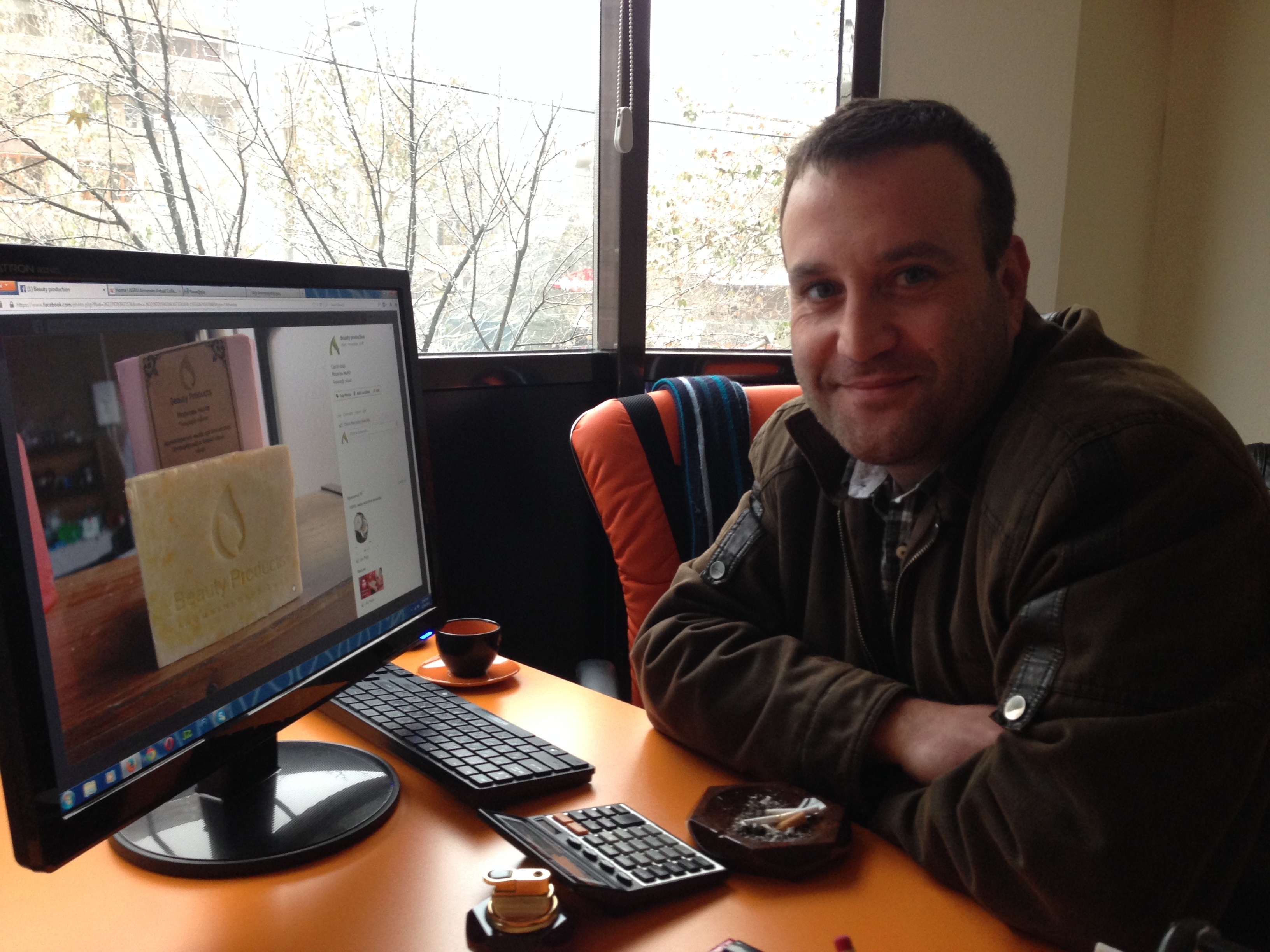
 Shant Khayalian was born in Aleppo in 1976. He attended Armenian school there, and continued his education in England attaining a degree in Advertising and Marketing.
After returning to Syria, Shant established several of his own enterprises, each one different from the other – an automotive spare parts shop, olive oil production, an advertisement company and a car repair center. Shant struggles to recall all of his businesses. For curious, restless, and innovative Shant, even Sundays were boring, so he decided to fill this day of rest with something new and asked his friend, a chemist, to suggest something interesting for him to learn and practice. The friend suggested making soap and Shant liked the idea. He learnt how to make soap, and he started creating soap using the olive oil he produced.
Around three months later, Shant managed to produce his first soaps. He also developed his production and invented new kinds of soaps using milk, carrot juice, parsley, chamomile, honey and other items. “I would produce the soaps not to gain an income, but because I enjoyed doing it. It was like a hobby – I would make gifts for my relatives and friends”, says Shant.
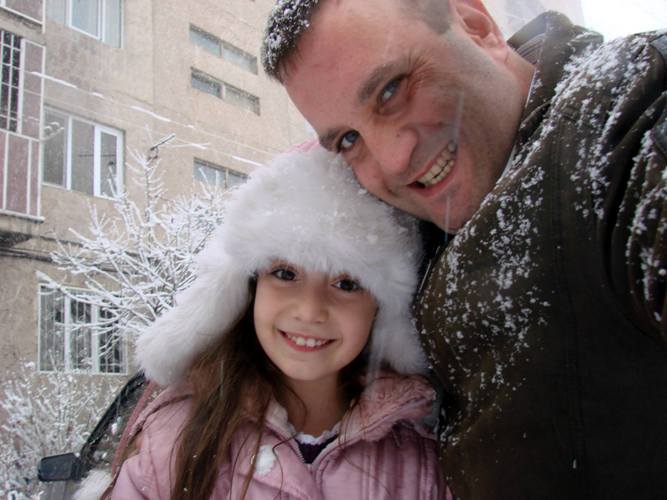
Shant could never imagine that this hobby would one day become his main source of income.
The organic soaps produced by Shant do not contain chemical colors or aromas. They are entirely natural. However, in Armenia organic products are not fully appreciated. Shant noticed that when buying soap, people in Armenia smell it and if they like how it smells they will buy it. Shant thinks that this is the wrong attitude, because a good smell does not mean good quality. Instead, it shows existence of additional chemicals.
In 2012, when the situation in Syria became critical, Shant left his birthplace and moved to Armenia with his wife and daughter. Luckily, years ago Shant had bought an apartment in Yerevan, with the thought that his children might live there one day. “When we left, it had already been a month since I had closed the shops, because it was impossible to work in those conditions. Even on the last day, when I went to work I witnessed terrible scenes – burnt bodies in the streets”. “Before that, my car had been shot at twice by a sniper trying to kill me. Once there was such a huge blast near our house which injured my back due to the pressure it created. Another time, when we were sleeping, the window of our house broke because of a bullet. So we understood that it was the time to leave the country.”
While arranging his family’s move to Armenia, Shant’s friend from Jordan suggested he move there to begin a soap production business, so Shant left for Jordan alone. “My friend’s wife had a business of non-natural cosmetics and soap. I suggested to them that I produce my own soaps and we develop the business together.”
“I participated in a charitable fair in Jordan where I presented my production. After a month, I received a call from the Royal Palace informing me that the Queen liked our soaps very much and had invited us to the palace for a dinner reception”. But there was not only a dinner invitation. The soap makers also received appreciation letters, royal souvenirs and badges. They tried to convince Shant to stay and develop their soap business in Jordan, but Shant was determined to move to Armenia.
Observing the soap market of Armenia, he has met many people who produce soap and discovered that they all work in house and kitchen conditions – they bring the material from abroad, melt it, add colors and aromas, shape the soap and sell them. “I do everything myself. I even make the essential oils myself. The glycerin is also natural, and as far as I understand no one produces glycerin in Armenia – I am the first to do so.”
As Shant left Syria without financial means and there was no money to start a business, he applied to Small and Medium Business Development Center for a loan. He introduced his business plan and it got approved. The money was transferred six months later, during which Shant could hardly bear the idleness – he tries to do different jobs: teaching at the Eurasia University, giving private English lessons, even driving a taxi with his own car. “Life is hard, you have to run here and there. If you sit back you’ll get nothing. There are people who had a good life in Syria, but after losing what they had, they are not able to adjust to the idea that they will earn less in Armenia. I used to live well – I would spend several thousands of dollars within a week, but now I cannot earn that money in months. What should I do? Get disappointed? Do nothing? On the contrary, one shouldn’t get disappointed, one should act, be flexible and adjust to new situation.”

Shant’s first product in Armenia – the Beauty Products – is already out. It has 8 kinds of soaps with olive oil, lemon and glycerin, apricot and blackcurrant. In Armenia, doctors advised him to also use frankincense flower, which is very beneficial for skin.
The label of the soaps note that they are handmade. Indeed, doing everything by hand is very difficult, but Shant considers it to be the uniqueness of his produce. He uses the technologies of 1688, so everything is done by hand.
Despite the huge volume of work and high quality, Shant wants to make the price of his produce available for the consumers, so that many people can use them in Armenia. A 110 gram bar of soap will cost around 600 AMD.
This is indeed wonderful. But Shant has not made it to the market yet. Currently he is looking for specialists to help him with marketing because he will not be able to manage it on his own. If his business is well established in Armenia, then Shant will seriously consider exporting his produce to external markets. Currently he has exported his products to Norway, France, Korea, China, Ukraine and other countries, where he received positive responses.
Despite the fact that the social and economic situation is not wonderful in Armenia, and starting things from scratch is very difficult, Shant still does not want to move to another country. He doesn’t want to return to Syria either, because he thinks that even if the war stops and businesses re-open, the situation and the atmosphere will not be the same as before. “I have chosen my path. I don’t need much. If I can provide for my family to a decent level, then I will not leave Armenia”, he says.
Shant thinks that the Syrian crisis has given him an opportunity to return to the homeland and live there. “History teaches us lessons, but we still don’t take them into consideration. After the massacres of 1915, we were scattered and during the 1988 events we scattered again. Then, with the war in Iraq, the Armenians came and left again. Now the Syrian Armenians are arriving here… Eventually, everyone should understand that we don’t have space in a foreign land. Indeed, we are born and raised there, we lived there and are thankful for that, but an Armenian should live on Armenian land”, says Shant Khayalian, who is already a member at Repat Armenia and considers himself a true repatriate.
Translated by Irena Grigoryan
Edited by Liz McFadden