Minister of Foreign Affairs visited Latvia

 Էդվարդ Նալբանդյան

On June 26 by the invitation of the Minister of Foreign Affairs of Latvia Edgars Rinkēvičs, the Minister of Foreign Affairs of Armenia Edward Nalbandian arrived in Riga.

On the same day a meeting with the Speaker of Latvia’s Saeima Solvita Aboltina took place.

Welcoming the Foreign Minister of Armenia, the Head of the Latvian Parliament noted that Armenia is an important partner of Latvia in South Caucasus, and that an open and constructive political dialogue, and the willingness to develop the relations feature the relations between two states. Solvita Aboltina stressed, that the Inter-Parliamentary Friendship group of Armenia’s National Assembly with the Latvian Parliament is the largest one. She attached significance to the establishment of cooperation between the Committees of the Parliaments of two states.

Expressing gratitude for the reception, Edward Nalbandian mentioned that Armenia attaches importance to the parliamentary diplomacy as an important framework of interaction of countries and peoples.

Both sides expressed satisfaction with the active Armenian-Latvian interaction on the parliamentary level and mutual visits, which considerably supports the development of interstate relations. The establishment of the Intergovernmental commission on trade cooperation 2 years ago and the efficient holding of its first session were highlighted.

The Speaker of Latvia’s Saeima and the Foreign Minister of Armenia exchanged detailed views on the steps to develop cooperation in various areas, in particular, giving an importance to the seeking of the ways to develop trade and economic cooperation.

During the meeting, the sides touched upon Armenia-European Union relations, priorities of Latvia during its Presidency of the EU Council in the first half of 2015.

The sides also exchanged thoughts over the Ukrainian crisis and ways of its settlement.

The meeting with Ivan Klementiev, the Head of Saeima Inter-parliamentary Friendship Group Latvia-Armenia, and the members of above mentioned group was on the agenda of Minister Nalbandian.

During the meeting with the parliamentarians the Minister of Foreign Affairs of Armenia presented the main directions of Armenia’s foreign policy, discussed the Armenian-Latvian relations, issues of further development of bilateral cooperation in different fields.

On June 27 Edward Nalbandian met his Latvian counterpart Edgars Rinkēvičs.

Welcoming Armenia’s Foreign Minister the Foreign Minister of Latvia noted, that he recalled with warmth his visit to Yerevan and that the arrangements reached then are being implemented.

During the conversation the Ministers Nalbandian and Rinkēvičs commended that relations between Armenia and Latvia are being developed dynamically recently – mutual visits by the Presidents and Foreign Ministers of the two states were paid during the last years, a number of meetings were organized within the international conferences.

Edward Nalbandian and Edgars Rinkēvičs touched upon the organization of high-level mutual visits, anticipated steps on the development of cooperation in political, economic, cultural areas and that of education, the expansion of legal framework.

The Ministers highlighted that periodic consultations conducted between the Ministries lay sound grounds for further development of the collaboration.

Cooperation and the support of each other’s candidacies in the framework of international organizations were on the agenda of the talks.

Both sides mentioned that the legal framework of Armenia and Latvia expanded recently and that the agreements on deepening of interaction in the fields of education, science and culture should be supplemented to it.

In the context of Latvia’s Presidency of the EU Council in the first half of 2015, the sides discussed Armenia-EU cooperation.

Issues of further strengthening and expansion of trade and economic cooperation were on the agenda of the ministerial meeting. On that matter the importance of organization of business-forums was stressed.

Edward Nalbandian presented to his Latvian counterpart the efforts exerted by Armenia and the OSCE Minsk Group towards the peaceful settlement of Karabakh issue.

The sides exchanged views on current regional issues – the Ukrainian crisis, situation in Syria, developments in Iraq, talks on nuclear program of Iran.

Edward Nalbandian invited his Latvian counterpart to visit Armenia.

Ministerial meeting was followed by a joint press conference.

Edward Nalbandian visited Saint Gregory the Illuminator Church in Riga, where he met the representatives of the Armenian community of Latvia.

THE SECRETARY-GENERAL — MESSAGE ON WORLD DAY TO COMBAT DESERTIFICATION

պանգի մուն

“Land belongs to the future, let us climate-proof it”


Land degradation, caused or exacerbated by climate change, is not only a danger to livelihoods, but also a threat to peace and stability.  The warning signs lie in conflict between pastoralists and subsistence farmers competing for more productive land and communities fighting over increasingly scarce water resources.  We see the symptoms of insecurity in global food market volatility, internal displacement and mass migration.

While land degradation is acutely felt in the world’s arid lands, some 80 per cent is actually occurring outside these areas.  More than 1.5 billion people subsist on land that is degrading – the majority of whom are small farmers.  Climate change directly threatens their productivity.  In many regions, freshwater resources are declining, food-growing areas are shifting and crop yields are faltering.

Globally, unpredictable and extreme weather is predicted to have an even greater impact on food production.  With world population rising, it is urgent that we work to build the resilience of all productive land resources and the communities that depend on them.  We need to manage the land sustainably, avoid further degradation, and reclaim and repair that which has been damaged.  More than 2 billion hectares of land have potential for restoration and rehabilitation.  We need to inspire action that will prompt the recovery of these areas.

Recovering land that is degrading will have multiple benefits.  We can avert the worst effects of climate change, produce more food and ease competition over resources.  We can preserve vital ecosystem services, such as water retention, which protects us from floods or droughts.  And a comprehensive and large-scale approach to land recovery can create new jobs, business opportunities and livelihoods, allowing populations to not only survive but thrive.

The theme of this year’s World Day to Combat Desertification is “Land belongs to the future, let’s climate-proof it”.  It can be done, as communities in Burkina Faso, Niger and Mali have shown by recovering more than 5 million hectares of degraded land.  Let us take inspiration from these and other examples and protect and nurture the land for this and future generations.


President took part in groundbreaking ceremony of new figure skating school and visited companies of Grand Holding

Սերժ Սարգսյան, Իրինա Ռոդնինա

MHM88371


 Today, President Serzh Sargsyan took part in the groundbreaking ceremony of a new figure skating school to be built in Yerevan’s Malatia-Sebastia administrative district. The thrice Olympic champion in figure skating, the multiple world and European champion, the Russian public figure and State Duma Deputy Irina Rodnina also participated in groundbreaking ceremony of the school to be built in the vicinity of the new velodrome. She has been directly engaged in the school establishment program and expressed readiness to promote the development of figure skating in Armenia after the school is put into operation. The school construction is financed by Chief Executive Officer of Monarch Group of Companies and the Armenian businessman Sergey Hambardzumyan who is going to donate the school to Yerevan. Head of that construction company Sergey Hambardzumyan was also present at the ceremony. The total construction value is close to 5 million US dollars. It is to start in June and according to the executives, will be finished in a short space of time – in 2015. The school will have a skating-rink with 500 seats and auxiliary buildings.

Սերժ Սարգսյան, Գրանդ Քենդի

Later on, the President of Armenia visited Grand Tobacco and Grand Candy companies which make part of Grand Holding. The president toured the workshops, familiarized with the investments made by the company being considered as one of the leading native manufacturers, as well as with its recent years’ works aimed at putting new modern workshops in action and increasing the factory’s production potential. Serzh Sargsyan was told that the companies making part of Grand Holding keep on successfully implementing all the programs and abide by Hrant Vardanyan’s business traditions. This is proved by the economic indicators of the first five months of this year. The executives assured that they plan to maintain the same growth rates throughout the whole year. The acquisition of new production lines by Grand Tobacco during 2014 will lead to the creation of 100-130 new jobs. At the other company of Grand Holding, Grand Candy, the President of Armenia was informed that the number of the company’s 410 types of products will increase at least by 15. Currently, Grand Candy employs 3100 workers whose number is going to increase by 150 by the end of this year. All in all, Grand Holding employs around 6500 people.

At the end of the tour, Serzh Sargsyan held a meeting with the leadership of Grand Holding. The president welcomed the steps being taken to promote the company and wished Grand Holding further successes.
Անկախ

President Serzh Sargsyan held meeting with leadership of diplomatic service

big_1359955418_5816729Today, at Karen Demirchyan Sports and Concerts Complex President Serzh Sargsyan held a meeting with the senior staff of the Armenian Foreign Affairs Ministry’s central apparatus and the heads of the Armenian diplomatic missions abroad, talked about the vital issues of our country’s foreign policy agenda.

“Enough time has passed since my last meeting with the leadership of the diplomatic service of the Republic Of Armenia despite the fact that you have regularly held regional meetings and I visited the MFA central apparatus 2 months ago. Besides, in recent times I have had numerous opportunities to hold meetings and talk with many of you. This gathering offers us a great chance to touch upon our foreign policy agenda, the traditional, as well as newly emerging international and regional challenges and the ways to respond them.

Unfortunately, I have to state that serious tendencies of instability can be noticed in the international arena. Tensions and uncertainties keep on increasing. It necessitates further improving the activities of our diplomatic missions, the Ministry of Foreign Affairs and other relevant bodies, as well as reinforcing inter-ministerial collaboration. A diplomat should be able to thoroughly examine, analyze and assess the situation, forecast future developments and offer solutions stemming from national interests. We often mention that human capital is the most valuable resource. Thus, an expectant and reactive diplomat who dodges his responsibilities is an inadmissible luxury for a state like ours. We expect you to be actively engaged in all the areas in which Armenia and Armenians have direct or indirect interests,” said the President of Armenia at the meeting with the leadership of the RA diplomatic service.

In his address, Serzh Sargsyan touched upon the urgent issues of the Armenian foreign policy agenda, the works carried out by the Foreign Affairs Ministry in a number of directions and the coming activities, the implementation process of the programs having strategic importance for our country, the existing challenges and the Ministry’s steps to respond to those challenges. Serzh Sargsyan also presented the current level of Armenia’s relations with partner countries and talked about their prospects. He touched upon the resolution process of the Nagorno-Karabakh conflict in the format of the OSCE Minsk Group Co-Chairs and the present situation 20 years after the ceasefire was concluded. The president stressed the importance of diplomacy in the negotiation process and the everyday persistent work of each diplomat present at the meeting.

Serzh Sargsyan talked about the joint efforts and concerted works all Armenians should implement ahead of the Armenian Genocide Centenary, taking a comprehensive and thorough approach to that issue and the need of organizing the multifarious events dedicated to the Armenian Genocide Centenary at a high level.

In his address, the president touched upon regional issues, the Armenian-Turkish relations, the process of Armenia’s membership in the Customs Union and the economic relations.

Serzh Sargsyan stressed the importance of Armenia’s assistance to the large Armenian community of Syria who are running all the dangers of the Syrian crises and suffering the worst outcomes. The president highly praised the activities of the Armenian Embassy to Syria and the consulate-general which have rendered great assistance to the Armenians in Syria throughout this time and thanked the Armenian diplomats working in that country for their brave and devoted service.

The president spoke about the active measures being taken by our country to ensure regional and international security and underscored that Armenia performs its duties in a full-fledged manner prioritizing allied relations.

Serzh Sargsyan stressed the importance of activities aimed at consolidating the collaboration between Armenia and the European Union, as well as at further reinforcing and advancing the bilateral relations with European countries.

The President of Armenia drew the attention of the RA diplomatic service leadership to the need of reinvigorating the economic component of diplomacy. The president underscored that in order to attract foreign investments in our country, it is necessary to make the Armenian economy more popular and offer a chance to take the full advantage of making an investment in Armenia. In that context, Armenia’s decision to join the Eurasian Economic Union is of great importance.

Serzh Sargsyan also touched upon the quality of consular services and stressed that despite important reforms have been made in the consular sphere in recent years targeted at facilitating the procedures of rendering consular services to citizens, there are still a lot of works to do. The president assured that Armenian citizens are the first to assess each reform and innovation, and the primary indicator of consular services is measured only by their positive grades and satisfaction. According to the president, rendering quality services requires high quality human resources and there are works being implemented in that direction as well. Serzh Sargsyan highly emphasized the role of the Diplomatic School of Armenia in recruiting high quality personnel to our diplomatic service. Concluding his speech, the president wished the leadership of the diplomatic service successes and answered their questions.

The State Commission on Coordination of the events dedicated to the 100th anniversary of the Armenian Genocide held its fourth session

6503

Today the 4th session of the State Commission on Coordination of the events dedicated to the commemoration of the 100th anniversary of the Armenian Genocide held at Karen Demirchyan Sports and Concerts Complex. The session was presided over by the Chairman of the Commission and the President of the RA Serzh Sargsyan.
Today’s enlarged session was aimed at finalizing the schedule and the strategy of the Commission’s actions in the run up to the official launch of the Centenary events. The members of the commission were joined by the representatives of regional Centenary committees from different communities, experts, diplomatic representatives of the Republic of Armenia, leaders of the Armenian Apostolic Holy Church dioceses and members of the clergy from the Armenian Catholicosate of the Great House of Cilicia, Armenian Catholic Church of Cilicia and Armenian Evangelical World Council.


unnamed

President Serzh Sargsyan informed the participants that a conference of regional committee representatives took place the day before that discussed the preparations and upcoming projects in various countries in the world.

In his opening speech the President mentioned that after the first session, in the past three years, enormous organizational and preparatory work has been carried out within the framework of the Centenary events of the Armenian Genocide both in Armenia and in Diaspora and Artsakh. The Ministers of Foreign Affairs and Diaspora were assigned to support the creation of regional committees in different countries and coordinate the efforts in organizing local events.

“I appreciate that the regional committees have brought together representatives of various organizations and have engaged foreign scholars, state and political figures. Clerical organizations, traditional political parties, Pan-Armenian organizations and NGOs carry out focused work. Mass media make a big contribution with their role of raising awareness.
I attach great importance to the role of lobbying and advocacy structures, as well as to close cooperation with local authorities to carry out diverse activities. Armenian lawyers are compiling a legal package on the Armenian Genocide covering issues at individual, community and national levels.

This year Komitas Museum will open its doors; the renovation of the Tsitsernakaberd Memorial and the enlargement of the Armenian Genocide museum and the arrangements for the new exhibition will be finalized by next April, just a few examples out of numerous Centenary events to mention.

Dear colleagues,

There is no need to specify the order of the Armenian Genocide Centenary for each Armenian. Mets Yeghern is both a collective and an individual tragedy – one can hardly find an Armenian who has not learnt about the genocide from his or her family’s own tragedy. The order of the Centenary and its moral, psychological and political meaning is extremely important for current generations. This is why I think that each of us should have a personal sense and share of responsibility to ensure the success of the Centenary events and provide a new level of international awareness.

The order of the Armenian Genocide Centenary is strong both for all Armenians and the entire humanity. April 24, 1915 is not only the beginning of unprecedented extermination and dispossession of an entire people in the history of mankind, a date that of course is symbolic, but also the precursor of other genocides of the 20th century, proved by the later events.

The statutory limitation cannot be applied to the crimes against humanity. There is only one formula to prevent genocides and that is the recognition and condemnation of horrendous pages of the history of humankind. As a nation who has survived through genocide, we have a special mission to rule out repetition of such cataclysms.

On the eve of the Armenian Genocide Centenary we once again openly urge all the states and the international community to recognize and to condemn this unprecedented crime.

We, as a state and people, will carry on our struggle for both the international recognition and condemnation of the Armenian Genocide and against this most horrible crime committed against humanity in any corner of the world.

I would not disclose a secret by saying that Turkey’s decades-long official stance contrary to the simple, clear and evident truth has ultimately failed triggering countless questions on the official position among skeptical Turkish youth with increasingly growing numbers: thousands of Turks demand from their own government truth and justice. Many calls can be heard from different corners of the world urging the current Turkish authorities to put an end to their hopeless policy of denialism. Turkey has to understand that there is no alternative to facing the history and recognizing and condemning the Armenian Genocide, not to become an accomplice of the Ottoman Empire.

This circumstance and the undeniable facts force Turkish authorities to take steps. Official Ankara takes new measures that are sometimes unprecedented in terms of form, yet unfortunately display Turkey’s century-long policy of denialism in terms of content. They replicate the well-known Turkish positions that seek to distort the history, equalize the victim with the perpetrator, compare the incomparable. There is only one possible step Turkish authorities can take to free themselves from the heavy burden of the past and that is the recognition of the Armenian Genocide. Half a step is not enough to achieve a tangible result.

I would like to inform you that I have sent invitations to a number of heads of states to visit Armenia in 2015 and especially on April 24, to join us in paying tribute to the memory of one and a half million innocent victims of the Armenian Genocide, to speak out against the crime of genocide in general and to state that the Armenian people has not only survived through this hardship but also took the road of rebirth. Not only did we survive but also managed to unite and pave the way for an independent statehood – free Armenia.

Official Ankara continues talking about establishing a committee of historians and disclosing the archives. First and foremost it is known that Armenian archives have always been open to the researchers who have been interested in the scientific aspects of the issue. The materials in scientific institutions and museums have also been available. However, the whole point is that there is no need of archival research to face the truth of the Armenian Genocide. It is just enough to enter any Armenian house, any family and the testimonies will touch the heart of any listener. It is enough to be present in Tsitsernakaberd on April 24 and perceive the counsel of the day for each Armenian, be they in Armenia or Diaspora. It is enough to visit any community of Diaspora and to ask how their ancestors have appeared there. If the Turkish authorities are interested in the truth they should arrive in Armenia and stand next to Armenian people on April 24. I don’t think they will be able to raise the idea of visiting archives then. Availing myself of this opportunity I officially invite the Turkish President, whoever will win the upcoming elections, to visit Armenia on April 24, 2015 and to face the vocal evidences of the history of the Armenian Genocide.

Mindful of all this, we do not feel hostile towards the Turkish people. Moreover, we try to lay grounds for Armenians and Turks to communicate to find the way to reconciliation. This is why we made efforts and we remain committed to normalization of relations with Turkey without preconditions and opening of the Armenian-Turkish borders, even though Turkey’s desire is only limited to statements. If the desire is indeed sincere, Turkey knows well enough the road to the Armenian-Turkish reconciliation.

Dear colleagues,

Let no one hope that the Armenian Genocide Centenary is the endpoint of our cause. It is a particular destination to mourn our sorrow, to become morally stronger and to achieve justice. The Armenian Genocide Centenary will give birth to renewed objectives, a new Pan-Armenian agenda and plans to build a more powerful statehood and more consolidated Diaspora. With the Centenary we will sum up a historical period and will herald a new phase of struggle for the restoration of justice.

We have an important message to the entire world: we will continue our fight for the recognition and condemnation of the crime against humanity – the Armenian Genocide- with new vigor, enthusiasm and determination,” said President Serzh Sargsyan.

Underlining that there are a few months left before 2015, the President urged to make the most of this representative meeting to exchange constructive ideas and present valuable proposals.

In the framework of the State Commission’s session, the political context of the Armenian Genocide Centenary was discussed. At the session, NKR President Bako Sahakyan, the Supreme Patriarch and Catholicos of All Armenians His Holiness Karekin II, the Catholicos of the Great House of Cilicia Aram I, Catholic Patriarch Nerses Petros XIX of the House of Cilicia , the Chairman of the Armenian Evangelical World Council Hovel Mikayelyan, the President of the Constitutional Court of Armenia Gagik Harutyunyan, the Minister of Foreign Affairs Edward Nalbandian, representatives of the traditional parties – the ARF, the DLP, the SDHP, as well as leaders of the largest Pan-Armenian structures made statements touching upon the fundamental approaches the Commission aims to include in the text of the Pan-Armenian Declaration to be adopted on the occasion of the 100th anniversary of the Armenian Genocide.

The second item on the agenda referred to works implemented by local bodies and to coming programs. Reports were made by the Minister of Diaspora Hranush Hakobyan, as well as by the committee representatives of the largest local structures in Russia, US, Lebanon, France and Argentina.

The commission members and the other participants listened to the report of the Commission’s Secretariat on the multi-dimensional activities carried out since the previous session, as well as on the current organizational works, discussed the proposals made to the State Commission and the 2015 events program.

The participants of the session were also presented the logo of the 100th anniversary of the Armenian Genocide, Forget-Me-Not Flower, designed by a working group established by the State Commission. The etymology of the flower’s name in different languages shows that it conveys the same meaning – “REMEMBER!” The latter is exactly the main message of the 100th anniversary. The working group chose such a logo because its color range is associated with the main motives underlying the concept of the mentioned date, and finally, in the Middle Ages Forget-Me-Not was considered the symbol of God’s presence. Five leaves of the flower symbolize the five continents where the Genocide survivors found shelter being deprived of the opportunity to live in their homeland. The flower has four main colors: violet, light violet, yellow and black. Each color conveys a certain meaning. The color of black symbolizes horror and the memories of the Genocide. The inner light violet stands for a unifying idea. The color of violet is suggested as the main color of the symbol. It is widely used in vestments worn by the priests of the Armenian Apostolic Church which is a basis of Armenians’ self-consciousness. The yellow color symbolizes the sunlight which gives a hope to live and create. It is represented by cyclically ordered 12 stylized pillars symbolizing the Genocide Memorial.
 

6500


Comment by the Minister of Foreign Affairs of Armenia Edward Nalbandian on the address of American Co-Chairman of the OSCE Minsk Group at the Carnegie Endowment in Washington D.C.

Minister-Nalbandian-meets-Azerbaijani-FM-and-cochairs

In the speech of the American Co-Chairman of the OSCE Minsk Group at the Carnegie Endowment in Washington D.C. it is underlined, that, “together with France, the United States and Russia share a common commitment to peace and security in Nagorno-Karabakh” and they would continue working through the Minsk Group for peacefully resolving this conflict.

Unlike Azerbaijan, Armenia on numerous occasions has commended and stressed the importance of the consistent efforts of the heads of the OSCE Minsk Group Co-Chair countries – USA, Russia and France, in supporting the sides to the conflict to reach exclusively peaceful settlement of the Nagorno-Karabakh issue.

The American diplomat is correct, that the parties have almost reached agreements on a number of occasions, and brings  2011 Kazan Summit as the latest example.

It is well-known that because of Baku’s backtrackings, its attempts to snatch one-sided advantages made it impossible to achieve progress in Kazan in June 2011, at the summits  in Sochi in March 2011, in Astrakhan in October 2010, in Saint-Petersburg in June 2010, even though the sides were close to reaching agreements. I would like to recall that Baku backtracked several times in the past as well, for instance – 10 years before Kazan, in 2001.

The American Ambassador rightly finds sniper shootings  along the Line of Contact, the human losses as unacceptable, highlighting that the OSCE monitors were not able to have neither the mandate nor the resources to identify those responsible, to reduce the reported thousands of ceasefire violations every year.

As the Co-Chair states, we have many times urged to respect ceasefire agreement reached in May 1994. Unlike Armenia, Azerbaijan has rejected and continues rejecting numerous proposals made by Co-Chair countries to consolidate ceasefire, withdraw snipers from the Line of Contact, and create a mechanism of investigation of incidents and ceasefire violations.

Azerbaijan not only rejects those proposals, it continuously commits gross violations of ceasefire, masterminds provocations, does not respect even its own commitments on maintaining and strengthening the ceasefire – not only according to the provisions of the cease-fire agreement, reached between Azerbaijan, Karabakh and           Armenia on May 12, 1994, but also the ceasefire consolidation agreement, reached in the same three-party format on February 4, 1995, according to which Azerbaijan was obliged to refrain from statements that could escalate the situation and to immediately notify to the Armenian sides and Co-Chairs about violations, instead of increasing anti-Armenian propaganda by false accusations. For decades Baku has been violating those commitments.

In two days the 20th anniversary of the establishment of cease-fire is marked, and I hope that the Co-Chairs would use this important occasion to deliver a special statement containing a strong  message. It is vital to exclude the use of force, thereby creating utmost favorable conditions for the success of the negotiation process.

We resolutely agree that peoples should be prepared for peace, not war. Unfortunately until now the Azerbaijani leadership has been doing just the reverse. In spite of the several appeals of the international community to refrain from provocative rhetoric and actions, Azerbaijan continues its bellicose statements, the glorification of murderers and persecution of peace advocates, the propaganda of xenophobia, intolerance and hatred, which leads to raising tension and escalation of the situation in the region.

The elements of the conflict settlement presented by James Warlick in general reflect the proposals of Co-Chair states.

As the Co-Chairs, we continue to believe that the elements outlined in the statements of the heads of the Co-Chair countries in L’Aquila, Muskoka, Deauville, Los Cabos and Enniskillen over the last years can be the foundation of reaching a lasting peaceful settlement of the conflict.

The American diplomat stresses that any enduring peace must reflect the views of all affected parties if it is to succeed. We have several times emphasized that without the full fledged involvement of Nagorno-Karabakh in the negotiation process, it will be impossible to achieve the resolution of the conflict.

The OSCE Minsk Group American Co-Chairman justly observed that any attempt to select some elements over others will make it impossible to achieve a balanced solution.

We share the Co-Chairs’ opinion, expressed many times, that those elements must be seen as an integrated whole and the attempts to give priority to some elements will make it impossible to reach the settlement.

Unlike Azerbaijan, which on the occasion and without makes references to only one principle of international law, in response to the appeals by the heads of Co-chair countries, Armenia has on several occasions reiterated and once again re-affirms its commitment to the principles of international law, particularly the non-use of force or the threat of force, equal rights and self-determination of peoples, and territorial integrity.

Тogether with the OSCE Minsk Group Co-Chairs Armenia will consistently continue to exert joint efforts towards exclusively peaceful settlement of the conflict between Azerbaijan and Karabakh.


Congratulatory address by President Serzh Sargsyan on occasion of Victory and Peace Day

սերժ սարգսյան

 Dear compatriots,

I cordially congratulate you on the occasion of Victory and Peace Day.

For the Armenian people, May 9 holds great significance because it heralded the beginning of a new and peaceful life. During World War II, hundreds of thousands of Armenians fought in the trenches of justice and freedom and came out with credit.

For us, this is first of all a holiday of peace which afforded us a historic opportunity to give the fatherland a new start in life with our honest work.

The destiny gave us one more historic opportunity – one more May victory. On May 9 of 1992, we were once again in the trenches of justice and freedom fighting against national discrimination and genocide.

With the liberation of Shushi, not only Stepanakert avoided physical annihilation, but also Artsakh, as well as Armenia and Armenians’ future in the broad sense.

Today, we bow with gratitude to the memory of all the brave fighters who paid for peace by their own lives.

Long live the peace – the mother of all blessings of the world!
Glory to our heroes!


Address by President Serzh Sargsyan on remembrance day of Armenian Genocide victims

Սերժ Սարգսյան


Dear compatriots,

Today we bow to the memory of the innocent victims of the Armenian Genocide. One and a half million Armenians fell prey to such a crime which did not have a name at that time. Nor had a human language coined such an expression or a term yet. They were killed simply because they were Armenians. The crime designed minutely and in advance pursued a clear goal: to take possession of the home country, the property and the millennium-old heritage by exterminating the native people living there. By this they committed a monstrous crime seeking to once and forever annihilate Armenians as a political factor.

Today, nearly a hundred years after the Genocide, it is obvious that we as a nation were not ready to undergo those hardships neither psychologically nor in terms of an organization degree. Up until now, all the parts of Armenian people and all generations have known what the outcomes of the Genocide feel like. It is true. However, the reality is that we have built our state and today, in contrast to the past, we are ready to confront such calamities both psychologically and in terms of an organization degree especially in our homeland. Nowhere in the world is as safe for an Armenian as it is under the auspices of his own state.

Dear compatriots,

The 24th of April is just a symbolic date: it is clear that the Armenian Genocide was not initiated and put an end in one day. Moreover, it is alive as far as the successor of the Ottoman Turkey continues its policy of utter denial. We are convinced that the denial of a crime constitutes the direct continuation of that very crime. Only recognition and condemnation can prevent the repetition of such crimes in the future.

Today, we stand on the threshold of the 100th anniversary of the Armenian Genocide. This can afford Turkey a good chance to repent and to set aside the historical stigma in case if they make efforts to set free their state’s future from this heavy burden.

At the same time, I publicly reaffirm: we do not consider the Turkish society as our enemy. Bowing to the memory of the innocent victims we remember all those Turks, Turkish families who lent a helping hand to their Armenian neighbors, friends being annihilated by the barbarians and helped numerous Armenian children escape from the clutches of the mob. God bless the memories of those who gave plenty of our compatriots a helping hand by risking even their and their families’ lives. Every society including Turks should be proud of their ancestors who rescued lives and threw down the gauntlet to the Genocide. We remember this.

We express our gratitude to all the countries and peoples who granted asylum to our compatriots having had a narrow escape from the Genocide. Armenian people will remember this forever. Our sisters and brothers have kept showing their gratitude for decades by becoming devoted citizens of those hospitable countries.

Today, the Armenians of Syria have got into trouble. This is our open wound and the issue of our primary concern. We do our best to re-establish peace for Syrian people and our compatriots of Syria.

Dear compatriots,

We are approaching the 100th anniversary of the Armenian Genocide with a straightening back, open-faced and having a state whose name is the Republic of Armenia. It is the homeland of entire Armenians who despite the decade-old illegal blockade and the “neither war nor peace” reality continue to make progress.

The year 2015 should convey a strong message to Turkey. The attitude toward Armenia can no longer be measured by words because it presumes clear steps: the opening of the closed borders and the establishment of normal relations. Our position on the Armenian-Turkish protocols has not changed and the idea of “reasonable terms” is becoming more urgent than ever.

Անկախ

Draft of Concept Paper on RA Constitutional Amendments Was Presented to RA President

սերժ սարգսյան, սահմանադարական

Today, the President of the Republic of Armenia Serzh Sargsyan held a meeting with the members of the Specialized Commission for Constitutional Amendments adjunct to the RA President. At the meeting, the Chairman of the Commission and the President of the Constitutional Court Gagik Harutyunyan informed the President of Armenia that the preliminary version of the Draft of the Concept Paper on RA Constitutional Amendments was ready and was put in the official website of the RA Ministry of Justice. The Chairman of the Commission introduced the main provisions of the Concept Paper and the ways to deal with the pivotal issues touched upon there.

Taking into account the fact that the Draft of the Concept Paper is preliminary and should enter a mandatory public discussion period, Gagik Harutyunyan mentioned that in this period they did not intend to form common and final points of view on all the issues. Particularly, the issues regarding the protection of human rights and fundamental freedoms, the functional and institutional effectiveness of the judicial system, as well as the form of government and the conduct of elections were underlined.

The President of Armenia thanked the Chairman of the Commission and its members for doing a large-scale work and presented his position on some pivotal issues.

Remarks by the President of the Republic of Armenia at the Meeting with Members of the Specialized Commission for Constitutional Amendments
I thank you, Mr. Harutyunyan, and all the Commission members, for doing this large-scale work. I am convinced that the Commission members’ high professional qualities have allowed highlighting and working on all the most important issues, which are of concern to our state and society today. I am also convinced that the Commission possesses both scientific and practical justifications concerning the issues of purely legal nature. I have no doubts about it.

Touching upon the separate set of problems raised by you, I think that all important issues related to the judiciary, all pros and cons should be discussed by engaging the very representatives of that system. Our decisions will be based on your conclusions.

As far as the form of government is concerned, my point of view on this question is well known and I have had an opportunity to speak up on that matter stating that the present form of government for our country, at least for this period, is the most acceptable one. In any case, that is my view of it.

However, I think that the issue raised by the Specialized Commission, should become, inter alia, a matter of public discussions. Yet, it is important to take into account the fact that the positions of our country’s political forces should not be ignored or unappreciated while assessing the issues of political importance.

For this matter it is important to hold public discussions and to ensure the active and effective participation of specialists, the representatives of civil society and political parties in those discussions in order to make balanced decisions. Those decisions should be targeted at ensuring the sustainable development of the state instead of pursuing the narrow interests of separate groups.

Together we should be able to establish solutions, which are not circumstantial and are beyond the interests of any person or any political force since they might be about our country’s development process and its future. People, political forces and today’s passing interests are all short-lived; the Constitution is for generations.

To launch our movement on this path, I would like to make the first step of my own to set up the discussion on the constitutional amendments in a free vein. Before kicking the discussion off I declare that I, Serzh Sargsyan, will never more seek nomination for the position of the President of the Republic of Armenia.

If the concluding discussions would result in a path to be chosen not coinciding with my own vision, and by this I refer to the parliamentary model of government, I will neither display any claim on the position of Prime Minister. I strongly believe that one person should not pretend on the helm of the state in Armenia for more than two times in his lifetime. I am the leader of Armenia’s largest political force – the Republican Party of Armenia – and whatever the constitutional arrangements we adopt, the Republican Party of Armenia will abide to play by those rules remaining a decisive and vital actor in Armenia. By all means, that is the road we confidently embark upon. I state this since I am very well aware of the Constitution’s role and importance of the democratic traditions for our country. That is much more important than all possible speculations, which simply pertain to the genre of light-mindedness. I state this today in order to guarantee you both your freedom in carrying out the process of amending the Constitution and in general to act freely.

As a matter of principle, I certainly agree with your proposal to extend the period of public discussions on the Concept Paper. I think that as an author of this document the very Commission should accomplish the complex and responsible mission of initiating proper discussions and summing up their results.


Անկախ

President Serzh Sargsyan made a press statement concerning the events in Kesab

5827

 President Sezh Sargsyan made a press statement concerning the events in Kesab at the World Forum Convention Center in The Hague. The President expressed his deep concern over the events in Kesab. “All of us perfectly remember the history of Kesab, which was unfortunately, full of hellish realities deportations in the last century,” said Serzh Sargsyan.

The President of Armenia reminded that the first scourge was back in April 1909 when the Turkish armed detachments invaded Kesab. The Armenians took shelter in mountain Garaturan and on the coast. After setting Kesab on fire and plundering it, Turks made their way to Garaturan, burned and looted the houses of the upper district. A French ship transported Armenians to Latakia. After living in Latakia for one year, the emigrants returned to Kesab and reconstructed their houses.

When touching upon the historical facts Serzh Sargsyan also recalled another date – events of 1915, when the Kesab population also experienced migration and exiles of the Armenian Genocide. Armenians of Kesab were exiled in two directions: to Der Zor and to the south up to Jordan. Thousands died en route, the majority perished in Deir Zor Desert.

“The third deportation of Kesab Armenians today is a serious challenge to ethnic minority rights’ protection mechanisms of the 21st century. I think that everyone should realize that these parallels should sober all the sides”, underlined the President of Armenia.

President thanked the Syrian authorities for the steps being taken to protect the Armenians in Kesab at this difficult moment.

“I have already instructed the diplomatic missions at the UN Headquarters in New-York and Geneva to raise the issue of ensuring the security of the Armenians in Kesab and their safe return to their permanent places of residence at the structures dealing with human rights and ethnic minorities,” said President Sargsyan.

Today the President of Armenia also had consultation with the Catholicos of the Great House of Cilicia Aram I in connection with the current situation.

President Serzh Sargsyan assured that the Embassy of the Republic of Armenia in Syria worked on the program of measures to support the Armenians in Kesab. The program will be implemented in a full scale.

The Deputy Foreign Minister received Ukraine’s Ambassador

Շավարշ Քոչարյան


On March 21 Deputy Foreign Minister Shavarsh Kocharyan received Ivan Kukhta, Ambassador of Ukraine to Armenia, by the latter’s request.

 During the meeting the Deputy Foreign Minister reaffirmed that Armenia’s principled stance on the right to self-determination is unaltered and during years has been expressed on numerous occasions.

The Deputy Foreign Minister stated that the centuries-old relations between the friendly peoples of Armenia and Ukraine form the solid basis on which the interaction between the two countries are being built.

Անկախ

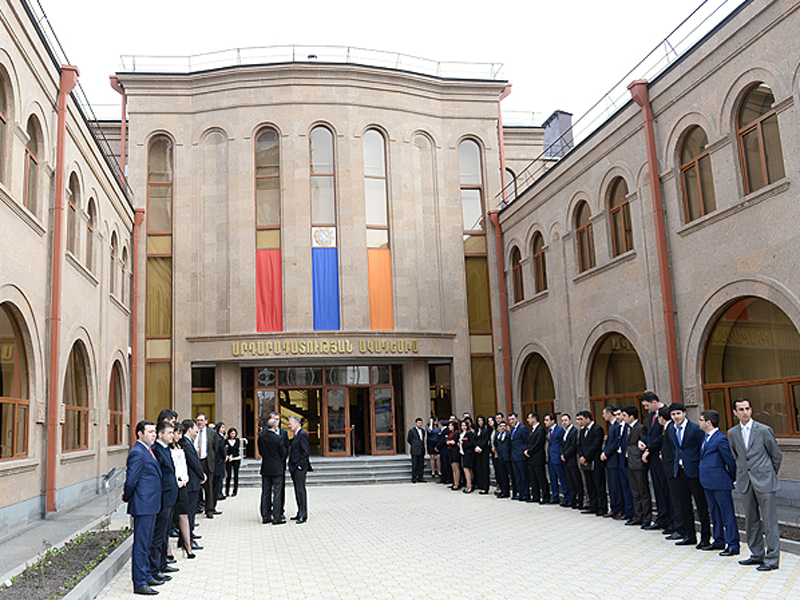
The President attended the opening ceremony of the Academy of Justice

 5739_b
 President Serzh Sargsyan today attended the opening ceremony of the Academy of Justice in the capital city. The President of Armenia toured the newly erected building of the Academy, familiarized with conditions, talked to the executives managing the Academy and implementing current activities, as well as to the first participants involved in educational activities. The Academy of Justice was established through the RA Government’s N990-A Decree of September 13, 2013. The founder is the Republic of Armenia, while the authorized government body representing the founder is the Ministry of Justice. The goals of the Academy’s activities are to foster obtaining the necessary skills and widening the professional knowledge of the persons included in the candidate list of judges and prosecutors, continual improving the competence and the professional knowledge of acting judges, prosecutors, judicial officers, civil servants of the Staff of the Prosecutor’s Office and judicial managers, gradual approaching the educational programs of the persons included in the candidate list of judges and prosecutors, as well as the implementation of joint educational programs. The objective of the Academy of Justice is to bring to life completely new approaches pertaining to the professional training and retraining of judges and prosecutors and stemming from the 2012-2016 Strategic Program of Legal and Judicial Reforms endorsed by the RA President.

Անկախ

President held a consultation with the leadership of the Ministry of Health

սերժ սարգսյան, առողջապահություն

President Serzh Sargsyan today visited the Ministry of Health. The President of Armenia toured a number of structural units of the Ministry staff, including the Division of Pharmaceutical Activities Organization, Medicine and Technology Supply, the Department of Mother and Child Health Protection and the Division of Emergency First Aid Policy. Sarah Sargsyan familiarized with working conditions, talked to employees about their functions, projects being implemented and existing problems, inquired about the results of the single-window system introduced jointly with the State Revenue Committee in order to make the process of medicine import more transparent and easier. After finishing the tour, the President of Armenia held a consultation with the leadership of the Ministry.

The Minister of Health, the Deputy Ministers and the Head of Staff reported on the works implemented in specific fields under their supervision, the existing problems, the measures taken to deal with those problems, as well as on the forthcoming projects.

The RA Minister of Health Derenik Dumanyan presented the main results of the 2012-2014 activities of the Ministry. Apart from talking about the achievements and the reforms implemented in health service system, the Minister also touched upon the existing problems, the measures taken to deal with those problems, in particular stressing the importance of the works directed to the quality of medical aid, ensuring accessibility and the supervision of corruption risks. In his report Derenik Dumanyan also presented the works being implemented in order to raise the effectiveness of public management in the field of medicine circulation.

The Deputy Minister Sergey Khachatryan’s report touched the issues of mother and child health protection, the results obtained in that sphere and the future projects.

The Deputy Minister Tigran Sahakyan introduced the issues of human resource management and the sphere of certification in health service system, touched upon the disproportionate distribution of human resources and the other issues existing in the field, as well as the possible solutions to those issues.

The other Deputy Minister Arman Babloyan’s report embraced the issues of proportionate development of Marz health service system and the projects directed to overcoming those issues in the framework of international cooperation, as well as the forthcoming works.

The Head of Staff of the Ministry Suren Qrmoyan presenting the organizational structure of the Ministry and the saturation level of human resources reported on the works regarding the human resources and the current management, as well as the steps being taken to raise the effectiveness of the personnel management activities.

The President gave questions to the speakers about separate issues touched in the reports, presented his observations and remarks and gave relevant instructions to the staff in charge.

The President stressed the importance of the consistent work directed to the continual retraining of medical personnel and the improvement of specialists’ qualification considering the modern approaches existing in the world, the achievements and the progress.

Touching upon the issue of the existence of substantial number of vacancies mentioned by the Head of Staff, the President considered incomprehensible and inacceptable the works of the Ministry’s staff in charge for not recruiting those vacancies as soon as possible and not informing unemployed qualified professionals about the vacancies widely and in the due manner. “I think that the Ministry of Health has a peculiarity because doctors first of all always want to work in their profession, want to engage in practical medicine, rather than look for work at other structures. You should always find the people who possess knowledge and are ready to serve in their profession,” said President Serzh Sargsyan.

In his remarks Serzh Sargsyan touched upon the works accomplished by the Ministry within the accounting period, the forthcoming problems, the top-priority directions of the activities and the policy carried out by that government body in the relevant sphere. “I wish all of you success in your hard, responsible and gratifying labor hoping that that honorable work is occupied by the people who have a desire, because having mere knowledge is not a sufficient, but a necessary condition. Moreover, one should have a desire to serve the work for which he has chosen that work,” said President Serzh Sargysan wishing successes and expressing hope that every time summing up the results of activities, new achievements will be touched upon, positive new results will be obtained at work and urged not to be afraid to mentioned also those issues or to bring out the regress in those issues on which the efforts should be concentrated in order to succeed henceforth.

The President of Armenia also answered the questions of the participants of the consultation related to the social problems of health service system employers, the continual work directed to the proportionate development of Marz health service system, the foreign policy of our country and a number of other issues. Particularly, answering the question on what he thinks about the decree of the Swiss Government on appealing the 17 December 2013 verdict of the European Court on the case of so called “Perinçek versus Switzerland” Serzh Sargsyan underscored, “I think it is excellent and inspiring. All of us should express our positive attitude to the decree adopted by the Swiss Government. Everybody knows that Switzerland has always been one of the active protectors of human rights in the international arena, one of the most active Governments in the struggle against racial discrimination attitude, one of the most active Governments in the struggle against the structures sowing xenophobia, the people and the phenomenon in general and we expected Switzerland to make a positive and right decision regarding this issue as well which we witnessed. That decision was expected and anticipated. Of course, the role of the Swiss authorities in making that decision is immense. The Swiss Government issued the decree by itself but here we should assess the contribution of the Swiss Government and different people or their attitude toward the verdict of the European Court, their appeal to the Swiss Government, the engagement of the International Association of Genocide Scholars, different individuals and various structures.

The decree of the Swiss Government is only a start of a big process because the European Court of Human Rights should still make a decision on bringing the case to its proceeding to investigate in essence. However, we are sure that the European Court of Human Rights will make such a decision which will not insult the people surviving in genocide and will not revile the memory of the millions of people who just became innocent victims. However, any activities need vigor and struggle and I am sure that the Swiss Government will pursue its own decision. It is clear why that issue is important for us. On the other hand, the question is that the European Court to some extent finds a drawback in the sphere administering justice in Switzerland. However, all of us know that Switzerland is a country which has passed a great path and professes high values. Thus, the Swiss should also prove by themselves the integrity of their judicial system and the entire government system in general.”

At the end of the consultation, a group of employees of the Ministry were awarded encouragements for their conscientious and effective work: the Head of the Division of Mother and Reproductive Health Protection of the Department of Mother and Child Health Protection Gayane Avagyan, the Head of Secretariat Zaruhi Darbinyan, the Chief Specialist of the Department of Personnel Management Rosa Eritsyan, the Chief Specialist of the Division of Hospital Medical Aid Policy of the Department of Medical Aid Policy Tamara Ghukasyan were awarded Letters of Commendation.

Անկախ

THE SECRETARY-GENERAL — MESSAGE FOR INTERNATIONAL WOMEN’S DAY

  պանգի մուն  This International Women’s Day, we are highlighting the importance of achieving equality for women and girls not simply because it is a matter of fairness and fundamental human rights, but because progress in so many other areas depends on it.

Countries with more gender equality have better economic growth. Companies with more women leaders perform better. Peace agreements that include women are more durable. Parliaments with more women enact more legislation on key social issues such as health, education, anti-discrimination and child support.


The evidence is clear: equality for women means progress for all.

This simple truth must be central as we work to accelerate progress towards the Millennium Development Goals by next year’s deadline and craft an agenda for the years beyond 2015.

Important gains have been made in access to primary education for girls and political representation by women. But progress remains far too slow and uneven.

A baby girl born today will still face inequality and discrimination, no matter where her mother lives. We have a common obligation to ensure her right to live free from the violence that affects one in three women globally; to earn equal pay for equal work; to be free of the discrimination that prevents her from participating in the economy; to have an equal say in the decisions that affect her life; and to decide if and when she will have children, and how many she will have.

I have a message for every girl born today, and to every woman and girl on the planet: Realizing human rights and equality is not a dream, it is a duty of governments, the United Nations and every human being.

I also have a message for my fellow men and boys: play your part. All of us benefit when women and girls – your mothers, sisters, friends and colleagues — can reach their full potential.

Together, let us work for women’s rights, empowerment and gender equality as we strive to eliminate poverty and promote sustainable development. Equality for women is progress for all!

82. Minister Nalbandian delivered a speech at the UN Human Rights Council 05.03.2014 (2)

STATEMENT BY


H.E. Mr. EDWARD NALBANDIAN


MINISTER OF FOREIGN AFFAIRS OF THE REPUBLIC OF ARMENIA


at the High Level Segment of the

United Nations Human Rights Council in Geneva


Tuesday, 4 March 2014


Mr. President,

Excellencies,

Ladies and Gentlemen,


I would like to join previous speakers in congratulating Mr. Baudelaire Ndong Ella on his election as the President of the Human Rights Council, and to wish him success in this important endeavor.

In today’s world, where human rights are praised more than ever, and at the same time violated not less than in the past, in this Palace of Nations the words of one of the world’s most dedicated personalities to human rights Nelson Mandela is more than relevant: “to deny people their human rights is to challenge their very humanity.”


The Human Rights Council has addressed many questions in attempts to respond to the situations of gross violation of human rights in various parts of the world.


It is vital to concentrate on the concept of prevention. The UN Secretary-General’s Five-Year Action Agenda draws special attention to the issue of prevention. Early prevention can surely stop escalation of conflicts, tragedies and crimes against humanity. Implementation of this Agenda allows us to address the issue of prevention at a global level through regular assessment of possible risks.


One of such risks leading to the most dangerous consequences is the propaganda of hatred on racial, ethnic or religious ground. This propaganda is often accompanied with aggressive bellicose rhetoric. The South Caucasus region in the past witnessed and now is witnessing this kind of risks. Such propaganda preceded anti-Armenian massacres in Azerbaijan – in Sumgait, Baku, Maragha and many other places, when thousands of Armenians were tortured, killed, thus starting the ethnic cleansing of Armenians living on the territory of Azerbaijan. Twenty five years later, in today’s Azerbaijan, similar, and even worse hate-speech, war propaganda emanating from the highest level of Azerbaijani authorities often results in the escalation of the situation and loss of innocent lives.


The European Commission against Racism and Intolerance (ECRI) in its report on Azerbaijan noted with deep concern the “constant and negative official and media discourse concerning the Republic of Armenia” and recommended the Azerbaijani authorities to “adopt an appropriate response to all cases of discrimination and hate speech against Armenians.” Responsive nature of our organization entails proper assessment and adequate reaction to this behavior.


Mr. President,


The UN treaty bodies do an important job to monitor human rights situation worldwide and help countries improve their human rights record. We especially appreciate the work of the UN Committee on the Elimination of Racial Discrimination, which recently elaborated Recommendation No.35 on racist hate speech. In particular, the Committee underlined the role of hate speech in processes leading to mass violations of human rights in conflict situations and genocide. The Committee members issued the above-mentioned Recommendation being fully aware of the role of hate speech in instigating racial hatred and discrimination, and reflected at length on the dangers it posed.


The Universal Periodic Review became a good tool in protection and promotion of human rights. It is a known fact that efficiency of human rights protection international mechanisms depends on the political will and readiness of Member States to implement their commitments by respecting the adopted rules and procedures. Since its launch in 2008, the UPR was meant to focus exclusively on human rights and avoid politicization of the raised issues. During Armenia’s UPR review, the Armenian side accepted the recommendations made by Member States. Azerbaijan during its UPR turned the entire review into a politicized show, selectively interpreting international community’s perception of human rights, refusing to accept any of recommendations made by the Armenian delegation – just because they were “recommended by Armenia”. Such behavior undermines the whole concept and the foundations of the UPR. This was a violation of rules of procedure. I call upon the Member States to strongly react to such cases in order not to create such destructive precedence.


Last year Armenia assumed chairmanship of the Committee of Ministers of the Council of Europe. The priorities of the Armenian Chairmanship have been defined in response to the challenges that the world faces today with regard to the protection of human rights, strengthening of democracy and respect for the rule of law. Racism and racial discrimination, xenophobia and intolerance grossly violate human dignity and give rise to tensions within and between societies. That is why the fight against them became one of the main priorities of our chairmanship.


Mr. President,


We often speak about universality and indivisibility of human rights. All human rights are equally important and must be equally protected. In this context I would like to mention the right of peoples to self-determination. In accordance with the founding purposes of the UN Charter, Article 1 of the International Covenant on Civil and Political Rights recognizes that all peoples have the right to self-determination, which is of particular importance because its realization is an essential prerequisite for the effective guarantee of human rights. This inalienable right unequivocally belongs inter alia to the people of Nagorno-Karabakh.


82. Minister Nalbandian delivered a speech at the UN Human Rights Council 05.03.2014

Mr. President,


Speaking on the situation in Syria that still continues to remain complex and in the centre of attention of international community, I would like to welcome the unanimous adoption by the Security Council of the Resolution that speaks about the urgent need to increase humanitarian aid access in Syria, calling to immediately cease attacks against civilians and lift the siege of populated areas. We welcome all efforts towards the peaceful solution of the crisis. Armenia has already received over 10.000 refugees from Syria, and our Government tries to do its best to assist them.


Mr. President,


Prevention of genocide and crimes against humanity should be amongst our priorities. Last year, during the 22nd session of the Human Rights Council, Armenia initiated a resolution on Prevention of Genocide, which was adopted by consensus. One of the aims of that Resolution is genocide prevention through joint efforts of the UN Member States. I would like to take this opportunity and thank all those countries that co-sponsored the Resolution. In two days, on March 7th, the Human Rights Council will convene a high-level panel to mark the 65th Anniversary of the Convention on the Prevention and Punishment of the Crime of Genocide. The panel is organized in accordance with the requirements of the said Resolution. I call upon all Member States to actively participate in this important panel discussion.


Thank you!

 Անկախ

President Serzh Sargsyan held a meeting of the National Security Council

անվտանգության խորհրդի նիստ


Today, the President of the Republic of Armenia (RA) and the President of the RA National Security Council Serzh Sargsyan held a meeting of the National Security Council.

At the meeting the draft of the “Conception of the Introduction of Probation Services in the RA” was discussed and approved. The draft was reported by the Minister of Justice Hrayr Tovmasyan.

The RA Minister of Defense Seyran Ohanyan presented the Council members the development of the Collective Security Treaty Organization’s Military Component, the status of the Collective Forces Grouping, as well as the issues pertaining to the adoption of conceptual and normative legal acts.

The members of the National Security Council also discussed and approved the draft of the “2014-2015 List of Measures for the Implementation of the European Neighborhood Policy’s RA-EU Action Plan.” The draft was reported by the Secretary of the National Security Council Artur Baghdasaryan.

Senator McCain Offends Visiting Syrian Church Leaders

Հարութ Սասունյան


By Harut Sassounian

Publisher, The California Courier


Sen. John McCain is a prime example of how U.S. officials so often have misjudged overseas crises, believing that the best way to bring democracy to a country is through massive US bombing and invasion.


The Arizona Senator has been highly critical of Pres. Obama’s ‘arm the rebels strategy,’ urging a more direct US military intervention in Syria. Sen. McCain does not seem to understand that toppling Pres. Bashar Al-Assad would result in more deaths and destruction, and turn Syria into a major hub of international terrorism. Over 30,000 Islamic Jihadists from dozens of countries currently are fighting the Syrian government and each another — surely, not to bring democracy to Syria!


In fact, the former Republican presidential candidate is so obsessed with beating the drums of war that reportedly he behaved in an ill-tempered and discourteous manner with a group of high-ranking Christian Syrian leaders, just because they were not advocating violent regime change. The church delegation had come to Washington last month seeking a peaceful resolution to the Syrian conflict and protection for Christians numbering around two million — 10% of the country’s population.


The visiting Church leaders included Bishop Armash Nalbandian, Primate of the Armenian Apostolic Church of Damascus, and representatives of the Presbyterian, Evangelical, Syrian Orthodox, and Greek Orthodox churches of Syria. The delegation met with members of Congress, State Department officials, U.S. NGO’s, academics, religious leaders, and members of the media.


The Syrian clergymen were gratified with their Washington visit, except for their unpleasant encounter with Sen. McCain, as described by Judicial Watch:


“Hell-bent on arming opposition forces in Syria — despite strong evidence that they’re run by Islamic terrorists — John McCain displayed behavior unbecoming of a United States Senator during a recent meeting with Syrian Christian leaders touring Capitol Hill.… Senator McCain, an Arizona Republican, evidently doesn’t want to hear negative stories about the rebels he’s working to arm. So he stormed out of a closed-door meeting with the Syrian clergy officials last week…. McCain marched into the committee room yelling, according to a high-level source that attended the meeting, and quickly stormed out. ‘He was incredibly rude,’ the source told Judicial Watch…. Following the shameful tantrum, McCain reentered the room and sat briefly, but refused to make eye contact with the participants, instead ignoring them by looking down at what appeared to be random papers.”


During their meetings in Washington, the Syrian Christian leaders informed U.S. officials about the unfolding massive human tragedy in their country and the precarious situation of Christian communities; kidnapping of Christian Bishops, priests, nuns, and parishioners; attacks on Christian villages; desecration of churches and holy sites; and violations of religious freedom by armed Islamists.


Given the escalating bloodshed in Syria, the Church leaders asked the United States to:

— End all military and financial aid to armed rebels;

— Demand from U.S allies — Saudi Arabia, Qatar, and Turkey — not to support the terrorists;

— Ask that all sides of the conflict stop the violence, including bombings and terrorism;

— Resolve the conflict through dialogue, not military action;

— Ensure the Syrian people’s security;

— Protect the Christian minorities;

— Protect the churches and mosques;

— Protect religious, historical, and cultural monuments;

— Assist in the distribution of humanitarian aid in Syria.


The website of the Syrian Armenian Committee for Urgent Relief and Rehabilitation (SACURR) — www.syriashdab.com — reported that as of Sept. 30, 2013, the war caused serious harm to the Armenian community: 64 civilians murdered, 172 injured, 110 kidnapped, and 15 soldiers killed in action. Moreover, various Armenian institutions were damaged: seven Apostolic and three Catholic churches; 13 schools; and 10 community centers.  Close to half of 65,000 Syrian-Armenians has fled to Armenia, Lebanon and elsewhere.


SACURR, composed of nine major Armenian social, religious and political organizations in Syria, reported that by the end of September it had received $1.7 million from overseas Armenian entities. Even though this is a small fraction of the amount needed, SACURR has been able to provide food, shelter, security, and medical and educational assistance to Syrian Armenians, including $500,000 in tuition aid to 6,436 students in 38 schools.


Sen. McCain and other foolhardy U.S. officials would do well to heed the wise counsel of the visiting Syrian Christian leaders. Dispatching more weapons to Syria would only exacerbate the fighting, resulting in endless bloodshed.


 Անկախ

PRESIDENT SERZH SARGSYAN ANSWERED THE QUESTIONS OF THE PARTICIPANTS OF THE 10TH CONVENTION OF THE VOLUNTARY HOMELAND DEFENDERS UNION

Հո ախմախ չե՞նք, որ այդ վատ բանի վրա ռեսուրս ծախսենք. Սերժ Սարգսյանը կուտակային կենսաթոշակային համակարգի մասինBefore the question and answer session, the President congratulated all the members of the newly elected Board of the Voluntary Homeland Defenders Union (VHDU), including the President of the Union and Deputy Presidents, on the occasion of taking the responsibility once more and stressed that that it was indeed a big responsibility for them. Serzh Sargsyan wished the VHDU Board good luck and expressed his willingness to answer all the questions of the participants of the convention.

Question – Sona Rechelyan – a student of the Economic Department of YSU, a member of the “Young Homeland Defender” structure
-Mr. President, in what condition is the Armenian economy today?

Serzh Sargsyan – It is already a long time that the relevant structural unit of the Government sums up the results of 2013, and all of us will have an opportunity to discuss those results, but I should say immediately, that in 2013 the economic growth of our country is going to yield to the economic growth in 2012. If you remember, in 2012 we had a 7 percent economic growth, while this year we expect 3.5 percent. In general, this tendency is typical to the world economy and it is no accidence that after the first semester of 2013 the international structures and experts began to give more modest assessments and forecasts about the growth of the world economy and the economies of different countries. If you are familiar you should remember, if not, be aware that the International Monetary Fund forecasted 3,8 percent economic growth for the CIS. Today the real one is assessed 2,1 percent. For the Russian Federation the forecast was 3,7 percent, while the real and preliminary ones were 1,5 percent. The forecast for the European Area was -0.2 percent, the preliminary one was -0.4 percent. As you see, in every place depending on both the world processes and on the internal problems of a concrete country, the growth has stopped. Now, is this good or bad? If we compare it with others it is good, but if we compare it with our needs, it is bad. Thus, of course we should work much harder this year in order to have good results. Surely, there are troubling tendencies in our economy. For example, I am concerned with the decrease of investments. Certainly, there are specialists who explain this from the perspective of world tendencies when the investments are transferred from developing countries to developed countries, and secondly, they consider 2013 year as a year full of uncertainties in our country, and wherever there are uncertainties there are little investments. But in any case, the uncertainties are overcome, the decisions are made, and in this regard, certainly, I expect a higher economic growth in 2014. You know most people, even our comrades in arms present here, may think that if it is already so many years that we have an economic growth, then why the society is in such a mood that the situation is becoming worse. You know in many circumstances it is a matter of perceptions. Indeed, we have had an economic growth, a stable economic growth during the last six years, except for one year. The average salary in Armenia has increased vigorously, more vigorously than inflation. When I suggested that you give questions, I naturally have materials, I have all the analyses of years, and I can say immediately that if we look through the prism of six years we have had average year inflation. You are an economist and you should understand what the average year inflation means and not the twelve months one. I can tell the twelve months one as well. Throughout six years the inflation in our country has comprised 140 percent. Accordingly, during these six years the inflation has comprised 40 percent. The average salary comprised 160 percent, as a result, the average salary increases in higher rates, and, of course, in many cases it is a matter of perceptions. The people who criticize us think that they have such an invulnerable argument and always bring that argument. When we speak about favorable numbers, good numbers, they say that those numbers are pictured and those numbers are fabricated. But it is very surprising that when the RA National Statistical Service speaks about bad indicators, they say it is right. Thus, in case of bad and negative numbers they are right, while in case of good numbers they are pictured. But I do not say for this reason, I say this for another reason. I want to bring a concrete example which will have a serious importance for any economist. As you know, last year in the second half of September, we issued currency securities, that is, securities not in the Armenian Dram. Of course, we issued not alone, but together with the three world-famous companies, and during that time those ill-willing critics said that nobody would lend Armenia. As you know, issuing securities means borrowing. They said that the Armenian debt was so big that nobody would lend, and even if they lent, the percentages would ne very high. And on September 3, when we made a decision to join the Customs Union, everybody started to say that in this case nobody would lend Armenia at all. As a result, our country was offered a debt of three billion US dollars. We took only 700 million because more debt could deteriorate our economic situation and our indicators. In addition, during this period from September to February, those 6 percent securities became 5.8 percent one. Hence, they became more expensive. As you know, the more the percent decreases the more expensive the securities become. If our situation is bad, if our debts are a lot, if our economy precipitates, how it happens that the world’s largest 60 investors offer us such a huge amount – three billion US dollars. Is there anybody in the hall who can say that he is ready to lend somebody knowing that he is not going to give it back. It is impossible. Who do you lend? The one who you know will give back or the one who you just want to give a hand, and if he won’t return you will not feel any regret. Could it be that the world’s largest 60 investors feel sorry for us and give money for no particular reason in order for us to spend. Our economy is healthy, our economy is firm, our economy has experienced substantial changes, and these are very good foundations to make a good economic growth in the future as well.


Question  – Karen Grigoryan – a member of the VHDU Board, the Mayor of Echmiatsin
-Good evening, Mr. President. My question is the following – in recent days it is often touched upon the issue pertaining to the pensions and the 5 percent. What is the problem?

Serzh Sargsyan – Certainly, it is spoken a lot about the pension reforms and it is obvious that it should have happened like that. There has not been a state in the world, where pension reforms have made in peace and without protests for simple, very simple reasons. The reason is that the outcomes of those reforms will appear within a long time, while people right now want that their situation improves, and secondly, it is clear again that we put people in a difficult situation for some period of time and say that, yes, you must save 5 percent in order to receive back that 5 percent multiplied. It is evident that we have discussed a lot and have knowingly taken that step since that step is directed to the future of Armenia, that step is taken for our children and for our grandsons. Nobody can say that we do not need these reforms. Even our severest critics say that we need reforms but this one thesis is wrong, that one thesis is not right or you have chosen wrong time, you should do it in six months, in one year, in five years…

You know that I have worked in the Government of the Republic of Armenia (RA) for a long time since 1993, and all the Governments of the RA, without exception, have dealt with this issue, and this issue has made them worried. Today’s Government has decided to deal with this issue right today, and I express my whole support to that solution, because this is, indeed, a necessary solution. I do not exclude that there may be complicated legal formulations in that law or some words should be changed. I do not exclude. But if somebody says he is ready to write an ideal document and to immediately take and put it to public discussion and nobody will discover any complication there, I will say that I do not believe in that. It is a large document, and I repeat, there may be failed formulations, but we are ready to correct those failed formulations. The meaning, I am sure, is not going to change, and that decision is a necessity for all of us.

I repeat once more, yes, today we put people in a difficult situation to the extent of the 5 percent of their salary. But let us notice that this year a lot of people’s salaries have increased – at the law enforcement bodies by 10 percent, at certain companies by 10 percent, 15 percent, and in some companies by 25 percent. You are aware that from July 1 the salaries of all the state employees will increase by 40-80 percent. What is the problem? Think as if they have increased by 35 or 75 percent. Do not expect that 5 percent. That 5 percent will be of use by all of us, all of us.

There is the other side of the issue. Those funds will foster our economic development. Long-term and low percent money will appear in our country which is vital for our business entities. Ask any businessman, talk to the Business Union and to any non-governmental organization – what is the problem of the Armenian economy today? It is the cheap and long-term money. We must have that money in order for our economy to develop and to direct the fruits of the development to raise pensions. We will do it by all means, dear Karen, and I do not see any big problem here, yet I know that today the 80 percent of the country’s population complains about that decision. We, sorry for my word, to say in a homeland defender’s language, are not idiots to spend resources on that bad thing. We spend political resources. People are dissatisfied with us, we do not have any political interest in that and do not obtain any resource. We erode resources for the time that will come in 20 years, for our children.

Question  – Anan Voskanyan – a member of the VHDU Board, the President of VHDU Artik Regional Division, the Head of Pemzashen community.
-Mr. President, I think all of us are worried about the fate of the gas treaty with Russia. Would you please introduce in a few word?

Serzh Sargsyan – Sure – at first, dear Anan, I think that that conviction should have already passed because we signed that treaty on December 3 last year and the National Assembly ratified it and that treaty has come into effect. But I totally share your opinion that there are various conversations among the public, because a lot of people, depending on many reasons, do not want to tell the truth and try to blacken that great achievement. Some people, driven by the anger that we succeeded in having such a good treaty, try to turn everything on its head and present this as unsuccessful. To be able to prove my words, let us on by one touch upon the issues which according to them are very logical. But before touching upon the issues on by one, I want all of us to see what the substance of this gas treaty is. In my opinion, the substance of the gas treaty is first of all the gas price. Have you heard during this time that those debaters speak about the price. At first, let them speak about the price and say that if it is expensive we negotiated very badly, they gave us a bad price, let them criticize us here, let them say that, in addition, this one is also bad, the other one is also bad and the other one also. If we have been able to obtain a good price, let them say that-yes, the price is good, but here, here and here they have failed. Nobody speaks about that price, because that price is the lowest which Russia gives to any state. Hence, we have gas for the lowest price inside the borders of the RA. Secondly, in that treaty the gas price is related the Russian internal price system for five years, and if there are not rises in price, and you have seen the decision of the Russian Government according to which prices will not go up, we will have a stable price for 5 years. Is this good or bad? Surely, it is good for us, but bad for our ill-willing persons. Next issue is about debts. And they give different assessments. There are people whose memory already betrays them to some extent. There are people who can’t read well and try to say that to the violation of our laws, some debts have been augmented, that those debts should be reflected in the budget etc., that as if we have run secret negotiations. I think that most of our citizens should remember that I have made at least about one dozen statements on that topic since 2011 and have always said the following that the gas price will not go up for the consumers of the RA. What does it mean? It is clear that if you say such thing, the Armenian should understand that it is possible that the imported gas gets expensive for the state and for an entity, but the gas is not going to get expensive for the consumers of the RA, and it has been like that for two years. This is in the first place. In the second place, everybody is aware that we have been negotiating with the Russian side since 2011 and have made a conclusion that the payment price of gas does not change, instead the calculation price changes, but when the negotiations are over we will made a final conclusion about the price. The negotiations lasted for three years. Taking into consideration all the aspects, the Russian side suggested that we pay the 50 percent of that calculation price. Has it treated badly? Hence, where from do those about 300 million US dollars generate? If we had not run such long and hard negotiations we would have had to raise the price since 2011 and that 300 million would have been taken out of people’s pocket, the private sector’s pocket, the economy’s pocket etc.. We are yielded to the 50 percent of that amount. Thirdly, as for the 20 percent – why did they sell, they sold for cheap price etc.. I wonder what that 20 percent gave us. If we as a state have sold the 80 percent throughout these years, we might sell the 80 percent, while the 20 percent might not be sold? Is not it strange? Let anybody tell me what that 20 percent gave us and how many pennies of dividends it delivered. Or did that 20 percent give us an opportunity to appoint a director there or to do what, to influence upon decisions? Moreover, we do not need to be able to influence upon decisions because we have a very good legal field in that sphere and it is sufficient that a company be it Russian, American, Indonesian, will act in the framework of our laws and for our interest. As for the price of the 20 percent, I can now announce that if there is anybody who will pay 100 million US dollars, I am ready to negotiate with the Russian side, take back and give it to the man for that 100 million who will want that 20 percent. They say why you have not conducted a contest, why you have not asked others. I do not have the right to say publicly but my desire to say is so big that I must say that imagine we conducted a contest, that 20 percent valued 30 million, how we would realize that 20 percent for 150 million. Then who would be responsible for that? Is not it clear that the 20 percent which has not given a penny of dividend throughout these years, can’t cost that much. Anybody who talks on different platforms from the National Assembly to the Opera Square, if he can go and negotiate with the Russian side and bring cheaper gas and with better conditions, sure, let him do, let him bring. I will nullify the treaty in one day, I will ask my party members in the National Assembly and friends to immediately invalidate all that. But is there anybody? Or they just talk? Talking is easy, so easy. Do you remember how many talkers there were during years of the war? How many fairy tales they told, how many myths they told? But when there was a need to occupy a concrete village, one of them got a headache, one of them went to his nephew’s forty days after death, the other’s car wheel leaked. Talking is so easy.

Is there anything else there? Why did you sign for 30 years? The people are so blinded by the evil that do not understand what they say. Instead of criticizing us that why you signed for 30 years and not for 60, they tell us why you have signed for such a long time. Is not it clear for any economist that the return of investments in a longer time has a much milder effect on the economy. We have signed for 30 years in order for the Russians to return their investments in 30 years. If we signed for 5 years, they would return them in 5 years. Which one is better for us?

Question  – Edik Minasyan –the Department of History of YSU
-Mr. President, I want to ask about the emigration. What is the solution?

Serzh Sargsyan – Indeed, the emigration is one our most painful and most acute problems, and nobody should not think that he is more concerned with the emigration problem then I. Indeed, it is one of the big problems which makes me worried. On the other hand, I do not accept the manipulation of this issue for political purposes and I do not accept the solution to this problem by beating the knees and crying. It is clear to all of us that this process is temporary and it displays different development trends in different periods. Although in 1992, 200 thousand people left our country that process has paced down. Assume, in 2001, 60 thousand left, but, thank god, that process slowed down during subsequent years and not only slowed down, but also transformed into immigration. According to 2013 data, the passenger transportation has decreased in comparison with 2012, the negative difference is almost 25 percent and that negative difference comprises 31 thousand people. Surely, the 31 thousand is not the right number of emigrants, it may differ by 5, 10 or 15 thousand, but is a reliable number, and that number is certainly big, it is big because there are only 3 million people living in our country. If we were at least 10 million, 12 or 15 million, that fact could not be the subject of any concern. On the other hand, the 31 thousand is no the number against which it will be impossible to struggle, decrease and nevertheless come to immigration. We will definitely reach that. But I am saying again, and all the more it should be clear for this audience that the problem does not stop to be a problem if you stop to speak about it. On the other hand, never a problem is solved by crying, by manipulation, a problem is solved by work. We should work all together, all together. Once more, I want to bring the example of the times when we or each of the present here lost one village, he did not beat the knees, did not blame others, did not manipulate, and contemplated what to do in order to occupy both this village and the one beside it. This was the thought of all of us, am I right? How much did we retreat in 1992? What has changed? Nothing has changed. Neither the performers have changed, nor the situation. You will see that we will come to a positive balance.

Question  – Mesrop Manukyan – a lecturer of the Economic Department of YSU
-Esteemed Mr. President, during the answers of one of the questions you spoke about the present condition of our economy. My question is the following. What will you predict, how will our economy develop? Thank you.

Serzh Sargsyan – I think it will be good, dear Mesrop, surely, it will be good. Why because I think that we have already entered the field of certainty. Even if we say that the membership to the Customs Union has been smooth, without any problems, nevertheless, there was uncertainty for the society and investors about what direction we would choose, to what it will lead etc. We already have certainty, have concrete programs, and this certainty and concrete programs tell us that we will be able to make much more progress. If we had a 7.2 percent export growth in 2013 on the scene of the decrease of the economic development in our partner countries, then by joining the Customs Union we will be able to make a much bigger growth because the lion’s share of that 7.2 percent goes to the Customs Union countries, the Russian Federation. More precisely, in 2013 we have increased the export to the Russian Federation by 20 percent, that opportunity has now become inexhaustible – a huge market. A 200 million market with almost same opportunities has opened for 3 million people and for our economy. We will definitely make use of it. Besides, we have programs in the sphere of technologies for this period which traditionally increases by 15-20 percent every year in Armenia. In 2014 we will finish a program, a big program on the sphere of mining on which we have worked for years which will give an opportunity to produce 80-100 thousand tones of concentrate in Armenia. And that is the critical quantity which gives an opportunity to have a copper foundry, a big copper foundry which in, its turn, is possible only by having a sulphuric acid recycling factory. If we will not have, we can’t do. Accordingly, we will have a substantial growth in the sphere of mining. If some provocateurs do not mislead the “Nairit” employees, then regardless of any circumstance, most probably this year we will start to build a new “Nairit”. At least we have the calculation works and the preliminary treaties and at the first opportunity we will set the old “Nairit” in motion. This will give us a very big opportunity as well. Next is the creation of a big fish industry complex in Gegharquniq Marz – a program which started in 2013 and will materialize in 2014. It pursues a goal to produce and recycle 50 thousand tones of fish in 2019. And this is a big economic turnover and a creation of lots of jobs. We have serious programs in the development of greenhouse construction. We had certain progress in 2013. This also helped to increase the export to the Russian Federation. In 2014, we will have sufficient growth here. We have programs in the sphere of light industry. The light industry growth has sufficient share in our economic growth and I can enumerate very long in this manner. I see good economic successes in 2014 and in the future years.
Question  – Pargev Manukyan – the retired Director of Vardenik School, the founder and leader of Vardenik’s “Gaylavaz” detachment.
-Mr. President, at this time the administrative and household employees of schools are being massively cut down with a justification that student number decreases. However, during last years the student number increased from 25 to 35 and the salary rate increased from 18 to 22. While they justify that it goes down. If those employees who are women without family and who do not have husbands, work at school as cleaners and if there are no cleaners, house-keepers, electricians and organizers, what will the school’s fate be like? I ask you to answer.

Serzh Sargsyan – I hear for the first time that there should not be cleaners, house-keepers or electricians in our schools as you say. Such thing can’t be. As you know, we always include that in the school financing and yes, what can we do, it is right, it is financed by the student number. And I should say that all of us should come to terms with the idea that we should retire on a merited pension when time comes. If we are pensioners we should go and bring up our grandsons, receive a pension, in order for young men to substitute us, in order for them not to be left without job. This is the reality and we should look on that reality with a sober glance. We can’t say, you know this woman who is a very good teacher, has a big family, let us keep her. But we keep her by hurting others. We have drastically raised the salaries of teachers throughout the recent years, but which teacher you ask says that there is not a substantial change in terms of the salary. Why is not there any? Because instead of one teacher, work two of them, three of them. Why? I do not consider it to be a right thing. The working teacher should be duly paid, should be paid as much as the state envisages and as much that he can take care of his elementary needs. We envisage new reforms in this sphere as well. We will raise the salaries of the best teachers drastically, drastically. They will receive three or four times as much as the average salary of the country. As you know, today our average salary is 158 thousand drams. I repeat that the best teachers will receive three or four times as much, but they should be the best in their school. Hence, if in this case, indeed, a position of a cleaner or an electrician has been cut down, I think that Mr. Ashotyan will inform me about the reason right on Monday.

Անկախ

The statement of President Serzh Sargsyan at the joint press Conference with the President of the Czech Republic Miloš Zeman

Սերժ Սարգսյան,Չեխիա

President Serzh Sargsyan met the President of the Czech Republic Miloš Zeman

Today, President Serzh Sargsyan, who pays a state visit to the Czech Republic, held a meeting with President Miloš Zeman. At the end of the two Presidents’ negotiations, a signing ceremony of bilateral documents took place aimed at fostering and expanding cooperation in a number of areas. In particular, Agreements were signed on Cooperation in Fight Against Crime between the Government of the Republic of Armenian and the Government of the Czech Republic, On Economic and Industrial Cooperation between the Government of the Republic of Armenian and the Government of the Czech Republic, On Cooperation in Healthcare and Medical Science between the Ministry of Health of the Republic of Armenian and the Ministry of Health of the Czech Republic, Memorandum of Understanding on Disaster Prevention and Elimination of Consequences, Fire Service and Public Protection between the Ministry of Emergency Situations of the Republic of Armenia and the Ministry of Internal Affairs of the Czech Republic, Joint Declaration on Cooperation in the Area of Environment Protection between the Ministry of Nature Protection of the Republic of Armenia and the Ministry of Environment of the Czech Republic, Memorandum of Understanding on Cooperation between the State Revenue Committee under the Government of the Republic of Armenia and the Customs Service General Directorate of the Czech Republic.

Presidents Serzh Sargsyan and Miloš Zeman summed up the results of their negotiations in a joint press conference.


***


սերժ սարգսյան


The statement of President Serzh Sargsyan at the joint press Conference with the President of the Czech Republic Miloš Zeman


Your Excellency Mr. President,
Ladies and Gentlemen,

I am pleased to pay my first state visit to the Czech Republic at the invitation of the President of the Czech Republic.

We just held substantive and productive talks with President Zeman in the atmosphere of complete mutual understanding. We discussed both issues of our bilateral agenda as well as current regional and international topics.

We noted with satisfaction that since the establishment of diplomatic relations between our countries we have registered prominent progress in interstate affairs. A dozen of documents on different fields signed today and to be signed tomorrow attest to it. We outlined healthcare, environment, decentralized collaboration, trade, economic and cultural cooperation as the areas of prospective cooperation. We stressed the necessity of widening business connections and stimulating investments, promoting people-to-people contacts and developing tourism. The direct flights under operation between our capitals serve as an important prerequisite for that. We attached importance to the ongoing Armenian-Czech business forum within the current visit.

We mutually highlighted the importance of the inter-parliamentary cooperation supported by the friendship groups established within the two parliaments.

We underlined the necessity of consistent development of cultural, educational and scientific ties. This year Yerevan and in 2015 Prague will respectively host Days of Czech and Armenian cultures. Mr. President proposed us to more actively encourage our youth to study in the Czech Republic, and I am surely grateful for that.

We reaffirmed the mutual will to deepen cooperation between our states within the framework of such international platforms as the UN institutions, OSCE, Council of Europe as well as the EU Eastern Partnership.

Prague stands high on Armenia’s European agenda, which is a priority in our foreign policy. About five years ago it was precisely in Prague, where Armenia undertook a commitment to enhance closer cooperation with the EU upon the start of the Eastern Partnership. This commitment was reaffirmed at the Vilnius summit last November. We are determined to continuously enhance and expand our relations with the EU. In this respect, we expect the support of friendly nations, especially the Czech comprehensive support.

We are convinced that different integration processes may certainly be developed based on compatibility and cooperation rather than controversy. In this sense the Eastern Partnership might serve as a natural bridge fostering economic integration from the Atlantic to the Pacific Ocean. We are committed to make consistent efforts toward constructing more inclusive Europe, free from dividing lines. I am thankful to Mr. President for his understanding toward our decision to join the Customs Union. I am also thankful to the President of the Czech Republic for the invitation to the Eastern Partnership Summit that will take place on April 24, in Prague and I am particularly thankful for appreciating my visit to Prague on the 24th of April, bearing in mind that on the 24th of April Armenians across the world pay their tribute to the victims of the Genocide.

We highly appreciate the constructive position of the Czech Republic in support to the efforts of the OSCE Minsk group co-chairs to find a peaceful resolution to the Nagorno-Karabakh conflict. In November 2013, after a two-year interval the meeting of the Presidents of Armenia and Azerbaijan took place in Vienna, which by itself is a positive step in the negotiation process. The direct contacts on the presidential level are important stimulus to the ongoing negotiations under the auspices of the OSCE Minsk Group, which is the only format of the Nagorno-Karabakh conflict resolution. The principles and provisions embedded in the Presidents’ statements of the OSCE Minsk Group co-chair countries – Russia, the USA and France – provide appropriate ground for the just and enduring settlement of the conflict. We share the stance of the co-chair countries that those principles and provisions should be viewed as a whole and the attempts to prioritize one over the other will make consensus and conflict settlement impossible.


Միլոշ Զեման,Սերժ Սարգսյան, Չեխիայի Հանրապետություն

Nevertheless, the settlement of the problem is not realistic unless Azerbaijan abandons the malicious policy of bellicose propaganda, incitement of arms race and provocative actions along the line of contact. It’s high time for Azerbaijan to adopt a constructive stance on the exclusively peaceful settlement of the conflict. Here let me make a very important emphasis, Mr. President: we expect from the international community to show impartial approach or at least to be guided by the principle of not harming the process.

I completely shared the view of President Zeman that the regional conflicts shall be resolved through exclusively peaceful means and negotiations.

I assess our meeting as productive and hope that the Armenian-Czech dialogue and cooperation will develop and widen in different fields by mutual efforts and based on already existing grounds.

I thanked President Zeman for warm hospitality and invited him to pay a state visit to Armenia and I am thankful that he was pleased to accept the invitation.

Անկախ