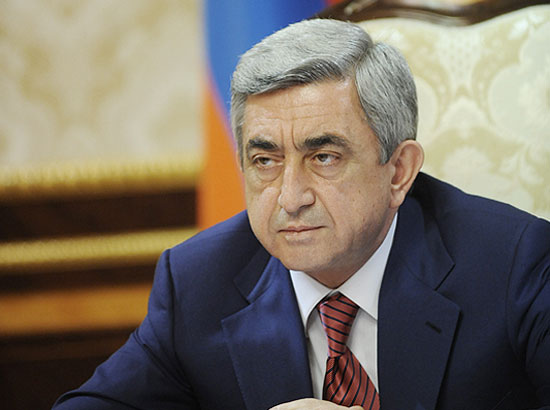
President Serzh Sargsyan held meeting with leadership of diplomatic service

big_1359955418_5816729Today, at Karen Demirchyan Sports and Concerts Complex President Serzh Sargsyan held a meeting with the senior staff of the Armenian Foreign Affairs Ministry’s central apparatus and the heads of the Armenian diplomatic missions abroad, talked about the vital issues of our country’s foreign policy agenda.

“Enough time has passed since my last meeting with the leadership of the diplomatic service of the Republic Of Armenia despite the fact that you have regularly held regional meetings and I visited the MFA central apparatus 2 months ago. Besides, in recent times I have had numerous opportunities to hold meetings and talk with many of you. This gathering offers us a great chance to touch upon our foreign policy agenda, the traditional, as well as newly emerging international and regional challenges and the ways to respond them.

Unfortunately, I have to state that serious tendencies of instability can be noticed in the international arena. Tensions and uncertainties keep on increasing. It necessitates further improving the activities of our diplomatic missions, the Ministry of Foreign Affairs and other relevant bodies, as well as reinforcing inter-ministerial collaboration. A diplomat should be able to thoroughly examine, analyze and assess the situation, forecast future developments and offer solutions stemming from national interests. We often mention that human capital is the most valuable resource. Thus, an expectant and reactive diplomat who dodges his responsibilities is an inadmissible luxury for a state like ours. We expect you to be actively engaged in all the areas in which Armenia and Armenians have direct or indirect interests,” said the President of Armenia at the meeting with the leadership of the RA diplomatic service.

In his address, Serzh Sargsyan touched upon the urgent issues of the Armenian foreign policy agenda, the works carried out by the Foreign Affairs Ministry in a number of directions and the coming activities, the implementation process of the programs having strategic importance for our country, the existing challenges and the Ministry’s steps to respond to those challenges. Serzh Sargsyan also presented the current level of Armenia’s relations with partner countries and talked about their prospects. He touched upon the resolution process of the Nagorno-Karabakh conflict in the format of the OSCE Minsk Group Co-Chairs and the present situation 20 years after the ceasefire was concluded. The president stressed the importance of diplomacy in the negotiation process and the everyday persistent work of each diplomat present at the meeting.

Serzh Sargsyan talked about the joint efforts and concerted works all Armenians should implement ahead of the Armenian Genocide Centenary, taking a comprehensive and thorough approach to that issue and the need of organizing the multifarious events dedicated to the Armenian Genocide Centenary at a high level.

In his address, the president touched upon regional issues, the Armenian-Turkish relations, the process of Armenia’s membership in the Customs Union and the economic relations.

Serzh Sargsyan stressed the importance of Armenia’s assistance to the large Armenian community of Syria who are running all the dangers of the Syrian crises and suffering the worst outcomes. The president highly praised the activities of the Armenian Embassy to Syria and the consulate-general which have rendered great assistance to the Armenians in Syria throughout this time and thanked the Armenian diplomats working in that country for their brave and devoted service.

The president spoke about the active measures being taken by our country to ensure regional and international security and underscored that Armenia performs its duties in a full-fledged manner prioritizing allied relations.

Serzh Sargsyan stressed the importance of activities aimed at consolidating the collaboration between Armenia and the European Union, as well as at further reinforcing and advancing the bilateral relations with European countries.

The President of Armenia drew the attention of the RA diplomatic service leadership to the need of reinvigorating the economic component of diplomacy. The president underscored that in order to attract foreign investments in our country, it is necessary to make the Armenian economy more popular and offer a chance to take the full advantage of making an investment in Armenia. In that context, Armenia’s decision to join the Eurasian Economic Union is of great importance.

Serzh Sargsyan also touched upon the quality of consular services and stressed that despite important reforms have been made in the consular sphere in recent years targeted at facilitating the procedures of rendering consular services to citizens, there are still a lot of works to do. The president assured that Armenian citizens are the first to assess each reform and innovation, and the primary indicator of consular services is measured only by their positive grades and satisfaction. According to the president, rendering quality services requires high quality human resources and there are works being implemented in that direction as well. Serzh Sargsyan highly emphasized the role of the Diplomatic School of Armenia in recruiting high quality personnel to our diplomatic service. Concluding his speech, the president wished the leadership of the diplomatic service successes and answered their questions.

Comment by the Minister of Foreign Affairs of Armenia Edward Nalbandian on the address of American Co-Chairman of the OSCE Minsk Group at the Carnegie Endowment in Washington D.C.

Minister-Nalbandian-meets-Azerbaijani-FM-and-cochairs

In the speech of the American Co-Chairman of the OSCE Minsk Group at the Carnegie Endowment in Washington D.C. it is underlined, that, “together with France, the United States and Russia share a common commitment to peace and security in Nagorno-Karabakh” and they would continue working through the Minsk Group for peacefully resolving this conflict.

Unlike Azerbaijan, Armenia on numerous occasions has commended and stressed the importance of the consistent efforts of the heads of the OSCE Minsk Group Co-Chair countries – USA, Russia and France, in supporting the sides to the conflict to reach exclusively peaceful settlement of the Nagorno-Karabakh issue.

The American diplomat is correct, that the parties have almost reached agreements on a number of occasions, and brings  2011 Kazan Summit as the latest example.

It is well-known that because of Baku’s backtrackings, its attempts to snatch one-sided advantages made it impossible to achieve progress in Kazan in June 2011, at the summits  in Sochi in March 2011, in Astrakhan in October 2010, in Saint-Petersburg in June 2010, even though the sides were close to reaching agreements. I would like to recall that Baku backtracked several times in the past as well, for instance – 10 years before Kazan, in 2001.

The American Ambassador rightly finds sniper shootings  along the Line of Contact, the human losses as unacceptable, highlighting that the OSCE monitors were not able to have neither the mandate nor the resources to identify those responsible, to reduce the reported thousands of ceasefire violations every year.

As the Co-Chair states, we have many times urged to respect ceasefire agreement reached in May 1994. Unlike Armenia, Azerbaijan has rejected and continues rejecting numerous proposals made by Co-Chair countries to consolidate ceasefire, withdraw snipers from the Line of Contact, and create a mechanism of investigation of incidents and ceasefire violations.

Azerbaijan not only rejects those proposals, it continuously commits gross violations of ceasefire, masterminds provocations, does not respect even its own commitments on maintaining and strengthening the ceasefire – not only according to the provisions of the cease-fire agreement, reached between Azerbaijan, Karabakh and           Armenia on May 12, 1994, but also the ceasefire consolidation agreement, reached in the same three-party format on February 4, 1995, according to which Azerbaijan was obliged to refrain from statements that could escalate the situation and to immediately notify to the Armenian sides and Co-Chairs about violations, instead of increasing anti-Armenian propaganda by false accusations. For decades Baku has been violating those commitments.

In two days the 20th anniversary of the establishment of cease-fire is marked, and I hope that the Co-Chairs would use this important occasion to deliver a special statement containing a strong  message. It is vital to exclude the use of force, thereby creating utmost favorable conditions for the success of the negotiation process.

We resolutely agree that peoples should be prepared for peace, not war. Unfortunately until now the Azerbaijani leadership has been doing just the reverse. In spite of the several appeals of the international community to refrain from provocative rhetoric and actions, Azerbaijan continues its bellicose statements, the glorification of murderers and persecution of peace advocates, the propaganda of xenophobia, intolerance and hatred, which leads to raising tension and escalation of the situation in the region.

The elements of the conflict settlement presented by James Warlick in general reflect the proposals of Co-Chair states.

As the Co-Chairs, we continue to believe that the elements outlined in the statements of the heads of the Co-Chair countries in L’Aquila, Muskoka, Deauville, Los Cabos and Enniskillen over the last years can be the foundation of reaching a lasting peaceful settlement of the conflict.

The American diplomat stresses that any enduring peace must reflect the views of all affected parties if it is to succeed. We have several times emphasized that without the full fledged involvement of Nagorno-Karabakh in the negotiation process, it will be impossible to achieve the resolution of the conflict.

The OSCE Minsk Group American Co-Chairman justly observed that any attempt to select some elements over others will make it impossible to achieve a balanced solution.

We share the Co-Chairs’ opinion, expressed many times, that those elements must be seen as an integrated whole and the attempts to give priority to some elements will make it impossible to reach the settlement.

Unlike Azerbaijan, which on the occasion and without makes references to only one principle of international law, in response to the appeals by the heads of Co-chair countries, Armenia has on several occasions reiterated and once again re-affirms its commitment to the principles of international law, particularly the non-use of force or the threat of force, equal rights and self-determination of peoples, and territorial integrity.

Тogether with the OSCE Minsk Group Co-Chairs Armenia will consistently continue to exert joint efforts towards exclusively peaceful settlement of the conflict between Azerbaijan and Karabakh.


President Serzh Sargsyan received the Co-Chairs of the OSCE Minsk Group

Սերժ Սարգսյան, ԵԱՀԿ Մինսկի խմբի համանախագահներ

 President Serzh Sargsyan received today the Co-Chairs of the OSCE Minsk Group Igor Popov (Russia), James Warlick (US), Jacques Fore (France) and the Personal Representative of the OSCE Chairman-in-Office Andrzej Kaprzyk.

The Co-Chairs presented the results of their negotiations in Baku and discussed with the President of Armenia issues related to possible future meetings at the presidential and ministerial levels to be held in the framework of the NK peace process.
Անկախ