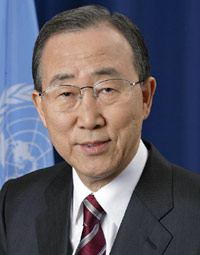
Message for International Youth Day. UN The Secretary-General

ban_ki-moon_portrait

A new publication from the United Nations shows that 20 per cent of the world’s young people experience a mental health condition each year.  The risks are especially great as they transition from childhood to adulthood.  Stigma and shame often compound the problem, preventing them from seeking the support they need.  For this year’s observance of International Youth Day, the United Nations wants to help lift the veil that keeps young people locked in a chamber of isolation and silence.

The barriers can be overwhelming, particularly in countries where the issue of mental health is ignored and there is a lack of investment in mental health services.  Too often, owing to neglect and irrational fear, persons with mental health conditions are marginalized not only from having a role in the design and implementation of development policies and programmes but even from basic care.  This leaves them more vulnerable to poverty, violence and social exclusion, and has a negative impact on society as a whole.

Young people who are already considered vulnerable, such as homeless youth, those involved in the juvenile justice system, orphaned youth and those having experienced conflict situations, are often more susceptible to stigma and other barriers, leaving them even more adrift when they are most in need of support.  Let us remember that with understanding and assistance, these young people can flourish, making valuable contributions to our collective future.

We have just about 500 days to reach the Millennium Development Goals.  We must support all young people, especially those who are vulnerable, to succeed in this historic campaign.

Wide-ranging efforts at all levels are needed to raise awareness about the importance of investing in and supporting young people with mental health conditions.  Increased education is crucial in reducing stigma and in changing how we talk about and perceive mental health.


Mental health is how we feel; it is our emotions and well-being.  We all need to take care of our mental health so that we lead satisfying lives.  Let us begin to talk about our mental-health in the same way we talk about our overall health.

As we mark International Youth Day 2014, let us enable youth with mental health conditions to realize their full potential, and let us show that mental health matters to us all.


THE SECRETARY-GENERAL — MESSAGE ON WORLD DAY TO COMBAT DESERTIFICATION

պանգի մուն

“Land belongs to the future, let us climate-proof it”


Land degradation, caused or exacerbated by climate change, is not only a danger to livelihoods, but also a threat to peace and stability.  The warning signs lie in conflict between pastoralists and subsistence farmers competing for more productive land and communities fighting over increasingly scarce water resources.  We see the symptoms of insecurity in global food market volatility, internal displacement and mass migration.

While land degradation is acutely felt in the world’s arid lands, some 80 per cent is actually occurring outside these areas.  More than 1.5 billion people subsist on land that is degrading – the majority of whom are small farmers.  Climate change directly threatens their productivity.  In many regions, freshwater resources are declining, food-growing areas are shifting and crop yields are faltering.

Globally, unpredictable and extreme weather is predicted to have an even greater impact on food production.  With world population rising, it is urgent that we work to build the resilience of all productive land resources and the communities that depend on them.  We need to manage the land sustainably, avoid further degradation, and reclaim and repair that which has been damaged.  More than 2 billion hectares of land have potential for restoration and rehabilitation.  We need to inspire action that will prompt the recovery of these areas.

Recovering land that is degrading will have multiple benefits.  We can avert the worst effects of climate change, produce more food and ease competition over resources.  We can preserve vital ecosystem services, such as water retention, which protects us from floods or droughts.  And a comprehensive and large-scale approach to land recovery can create new jobs, business opportunities and livelihoods, allowing populations to not only survive but thrive.

The theme of this year’s World Day to Combat Desertification is “Land belongs to the future, let’s climate-proof it”.  It can be done, as communities in Burkina Faso, Niger and Mali have shown by recovering more than 5 million hectares of degraded land.  Let us take inspiration from these and other examples and protect and nurture the land for this and future generations.


“A Visit To Auschwitz” Op-Ed Article of UN the Secretary-General

պանգի մուն

This year’s observance of the International Remembrance Day on January 27th — the anniversary of the liberation of the Auschwitz concentration camp — falls at a time when there are reminders all around us of the dangers of forgetting.  This year marks two decades since the genocide in Rwanda.  Conflicts in Syria, South Sudan and the Central African Republic have taken on dangerous communal dimensions.  Bigotry still courses through our societies and our politics.  The world can and must do more to eliminate the poison that led to the camps.


I visited Auschwitz-Birkenau last November.  A chill wind was blowing that day; the ground was rocky underfoot.  But I had an overcoat and sturdy shoes; my thoughts went to those who had had neither: the Jews and other prisoners who once populated the camp.  I thought of those captives standing naked for hours in icy weather, torn from their families and shorn of their hair as they were readied for the gas chambers.  I thought of those who were kept alive only to be worked to death.  Above all, I reflected on how unfathomable the Holocaust remains even today.  The cruelty was so profound; the scale so large; the Nazi worldview so warped and extreme; the killing so organized and calculated nature.


The barracks at Birkenau seemed to stretch to the horizon in every direction – a vast factory of death.  The “Book of Names” identifying millions of Jewish victims filled a room yet contained just a fraction of the toll, which also encompassed Poles, Roma, Sinti, Soviet prisoners of war, dissidents, homosexuals, people with disabilities and others.  I was especially moved by a video showing European Jewish life in the 1930s – scenes of family meals and visits to the beach, musical and theatre performances, weddings and other rituals, all savagely extinguished through systematic murder unique in human history.


Marian Turski, a Polish Jew who survived Auschwitz and is today the Vice-President of the International Auschwitz Committee, walked me through the infamous “Arbeit Macht Frei” gate — this time in freedom.  Rabbi Yisrael Meir Lau, a survivor of Buchenwald and now the Chief Rabbi of Tel Aviv, stood with me on the ramp where the transport trains unloaded their human cargo, and recounted the traumatic moment when the swift flick of an SS commander’s index finger meant the difference between life and death.  I grieve for those who died in the camps, and I am awed by those who lived — who bear sorrowful memories yet have shown the strength of the human spirit.


I was also accompanied by students from the International Youth Meeting Centre in Oswiecim, who work to build bridges among people and nations.  L’dor v’dor, Marian Turski said to me – Hebrew for “from generation to generation”, the passing on of wisdom.  It is for this reason that Auschwitz-Birkenau is on UNESCO’s World Heritage List.  We cannot build the future without remembering the past; what happened once can recur.


Combatting hatred is among the cardinal missions of The United Nations.  Our human rights mechanisms work to protect people.  Our special courts and tribunals strive to combat impunity, deliver justice and deter violations.  UN special advisers on Genocide Prevention and the Responsibility to Protect scan the world for the precursors of atrocity crimes.  The Alliance of Civilizations initiative seeks to counter manifestations of hatred, from anti-Semitism and Islamophobia to ultra-nationalism and bias against minorities.  Our new “Rights Up Front” effort seeks to strengthen early action to prevent grave abuses of human rights.


For almost a decade, the “United Nations and the Holocaust Outreach Programme” has been working with teachers and students on all continents to to promote tolerance and universal values.  The programme’s newest educational package, produced in partnership with the United States Holocaust Memorial Museum, will help to introduce Holocaust studies into classrooms in countries ranging from Brazil and Nigeria to Russia and Japan.  At this year’s remembrance ceremony at UN Headquarters, the featured speaker will be Steven Spielberg, whose Shoah Institute for Visual History and Education was a landmark in preserving survivor testimony.


A few steps from the crematorium at Auschwitz, I took a moment to myself for reflection.  I touched a barbed wire fence — no longer electrified but still sharp and intimidating.  I felt overwhelmed by the enormity of what had happened within, and humbled by the courage and sacrifice of the soldiers and leaders of many nations who defeated the Nazi menace.  My hope is that our generation, and those to come, will summon that same sense of collective purpose to prevent such horror from happening again anywhere, to anyone or any group, and build a world of equality for all.


 Անկախ