Information on defendants on criminal case initiated against judicial bailiffs for abuse

դատախազությունThe preliminary investigation on the criminal case initiated against a number of employees of the Service of Judicial Bailiffs of RA Judicial Department pursuant to the Articles 178, 308 and 314 of RA Criminal Code for abuse of official authority, swindling money in particularly large amount by official forgery and cheating in Yerevan city investigation department of General Investigation Department of RA Police is in process. Until 25 September 19 persons were involved as defendants, 2 persons are as suspects.

Taking the public interest into consideration the data and charges of the involved persons are presented below:

1. The deputy head of RA Judicial Department, the head of Service of Judicial Bailiffs Armen Movsisyan was accused according to the Point 1 of the Part 3 of the Article 178 of RA Criminal Code. Imprisonment was used as pretrial measures.

2. The head of subdivision of Judicial Bailiffs of Central Body of the Service of Judicial Bailiffs of RA Judicial Department Armen Avagyan was charged pursuant to the Article 314, the Point 1 of the Part 3 of the Article 178 of RA Criminal Code. Imprisonment was used as pretrial measures.

3. The head of Service of Judicial Bailiffs of the Court of First Instance of Ajapnyak and Davitashen administrative districts of the Service of Judicial Bailiffs of RA Judicial Department Armen Mirzoyan was accused according to the Article 314 and the Part 1 of the Article 308 of RA Criminal Code. Imprisonment was used as pretrial measure which was replaced by bail.

4. The head of subdivision of Judicial Bailiffs of the staff of the Court of First Instance of Avan and Nor Norq administrative districts of the Service of Judicial Bailiffs of RA Judicial Department Bagrat Arikyants was accused pursuant to the Article 314 and the Point 1 of the Part 3 of the Article 178 of RA Criminal Code. Imprisonment was used as pretrial measures.

5. The head of subdivision of the Service of Judicial Bailiffs of the Court of First Instance of Arabkir and Qanaqer-Zeytun administrative districts of the Service of Judicial Bailiffs of RA Judicial Department Samvel Aleqsanyan was charged according to the Article 314 of RA Criminal Code. Signature for not leaving was used as pretrial measures.

6. The storekeeper of the Service of Judicial Bailiffs of RA Judicial Department Yura Mushkidyanov was accused according to the Point 1 of the Part 3 of the Article 178 of RA Criminal Code. Imprisonment was used as pretrial measures.

7. The head of subdivision of the Service of Judicial Bailiffs of RA Court of Criminal Appeals Arman Palikyan was charged pursuant to the Part 1 of the Article 308 and the Article 314 of RA Criminal Code. Signature for not leaving was used as pretrial measures.

8. The deputy head of the Service of Judicial Bailiffs of RA Judicial Department Gagik Khachatryan was accused according to the Point 1 of the Part 3 of the Article 178 of RA Criminal Code. Imprisonment was used as pretrial measure which was replaced by personal guarantee.

9. The head of subdivision of the Service of Judicial Bailiffs of RA Civil Court of Appeals of the Service of Judicial Bailiffs of RA Judicial Department Arman Malkhasyan was charged according to the Part 1 of the Article 308 and the Article 314 of RA Criminal Code. Signature for not leaving was used as pretrial measures.

10. The head of division of staff management in the Service of Judicial Bailiffs of RA Judicial Department Narek Gasparyan was charged pursuant to the Point 1 of the Part 3 of the Article 178 and the Article 314 of RA Criminal Code. Imprisonment was used as pretrial measures.

11. The head of Finance Division of the Service of Judicial Bailiffs of RA Judicial Department, chief accountant Satenik Hovhannisyan was accused according to the Point 1 of the Part 3 of the Article 178 of RA Criminal Code. Signature for not leaving was used as pretrial measures.

12. The head of Supervision Division of the Service of Judicial Bailiffs of RA Judicial Department Yeghiazar Sargsyan was accused pursuant to the Point 1 of the Part 3 of the Article 178 of RA Criminal Code. Signature for not leaving was used as pretrial measures.

13. The head of subdivision of the Service of Judicial Bailiffs of the Court of First Instance of Arararat and Vayots Dzor regions of the Service of Judicial Bailiffs of RA Judicial Department, then from November, 2012 the head of the subdivision of the Service of Judicial Bailiffs of RA Administrative Court Eduard Hovhannisyan was accused according to the Article 314 of RA Criminal Code. Signature for not leaving was used as pretrial measures.

14. The head of subdivision of the Service of Judicial Bailiffs of the Court of First Instance of Arararat and Vayots Dzor regions of the Service of Judicial Bailiffs of RA Judicial Department Armen Petrosyan was charged according to the Article 314 of RA Criminal Code. Signature for not leaving was used as pretrial measures.

15. The ex-head of subdivision of the Service of Judicial Bailiffs of the Court of First Instance of Kotayq region of the Service of Judicial Bailiffs of RA Judicial Department Mher Gevorgyan was accused pursuant to the Part 1 of the Article 308 and the Article 314. Signature for not leaving was used as pretrial measures.

16. The ex-head of subdivision of the Service of Judicial Bailiffs of the Court of First Instance of Kotayq region of the Service of Judicial Bailiffs of RA Judicial Department Hayk Margaryan was accused according to the Part 1 of the Article 308 and the Article 314. Signature for not leaving was used as pretrial measures.

17. The head of subdivision of the Service of Judicial Bailiffs of the Court of First Instance of Shirak region of the Service of Judicial Bailiffs of RA Judicial Department Artak Gevorgyan was charged according to the Part 1 of the Article 308 and the Article 314. Signature for not leaving was used as pretrial measures.

18. The head of subdivision of the Service of Judicial Bailiffs of the Court of First Instance of Kotayq region of the Service of Judicial Bailiffs of RA Judicial Department Norayr Melqonyan was charged pursuant to the Article 314 of RA Criminal Code. Signature for not leaving was used as pretrial measures.

19. On 15.08.2013 a decision was made on involving the deputy head of the Service of Judicial Bailiffs Gegham Grigoryan as a defendant pursuant to the Point 1 of the Part 3 of the Article 178 of RA Criminal Code. Search was declared to find out his location. Imprisonment was chosen as pretrial measures.

Signature for not leaving was used as pretrial measures against the suspects Artyom Mamyan and Meruzhan Kyureghyan.

Sandra Bullock hails law limiting paparazzi: ‘Children should not be sold’

130913084709-nicole-kidman-paparazzi-bike-2013-horizontal-gallery(CNN) — Sandra Bullock is one of the highest-profile actresses in Hollywood and also one of the world’s most photographed moms. It’s hard to pick up a tabloid that doesn’t feature a photo of the Oscar-winner with her adopted 3-year-old son, Louis Bardot. And now Bullock is speaking out in support of a new law that increases penalties for paparazzi harassing the children of celebrities.

“We are fair game, I get it,” Bullock told CNN at her handprint and footprint ceremony outside the TCL Chinese Theatre in Hollywood on Wednesday. “Children should be allowed to be children and not be sold. You’re taking a picture of a child and selling it!”

California Gov. Jerry Brown on Tuesday signed the bill, which increases the penalties for intentional harassment of a child because of their parents’ employment.

The effort gained momentum after actresses Halle Berry and Jennifer Garner testified before the California Assembly Judiciary Committee in August to support the bill. The pair opened up about the hellish conditions faced by their children as a result of aggressive paparazzi.

Nicole Kidman knocked down by photog

Sandra Bullock on “Paparazzi Bill”

Bullock commends the two on their fight.

“I think it’s brilliant,” she explains.”The girls worked so hard, the attorney worked so hard, and I think it’s a good sign.”

According to a release from the governor’s office, the new law “increases the maximum jail time for harassment of a child or ward because of the person’s employment from six months in the county jail to a year in the county jail.”

It also imposes increasingly stiff fines: For a first violation, a fine not to exceed $10,000. For a second violation, it’s $20,000. For a third violation, it’s $30,000.

The “Gravity” star made a rare choice to bring young Louis with her to a media event, a decision Bullock is quick to defend.

“Today, I brought him out because this was a family day. It was the one exception that I make.”

“And this way,” she continued, “when he’s 16 and he hates me, I can take him to this moment and say, ‘Look, people said really nice things about your mother…’ ”

The current Vogue magazine cover star reveals her son becomes fearful for his own safety and that of his mom when going out.

“When you go to school, or you’re at an airport, the reason he doesn’t like this is because he’s used to people running at him, and he thinks they’re going to hurt mom or hurt him.”

Bullock is thankful for the law and what it will mean as a mother and one of the Hollywood’s biggest stars.

“This’ll be great. This will allow children to be children. … I’m so grateful.”

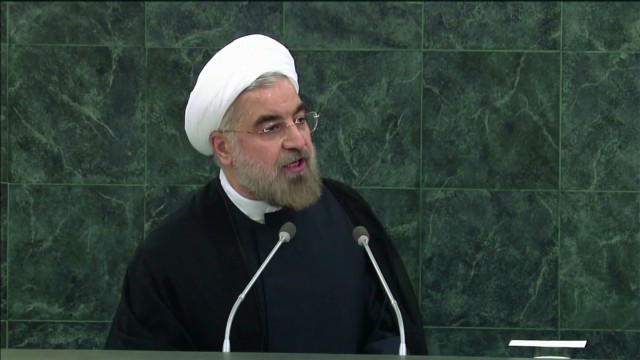
Rouhani: Nuclear weapons have no place in Iran’s security

130924174554-rouhani-nuclear-weapons-00001801-story-top(CNN) — Iran is prepared to engage in nuclear talks and nuclear weapons have no place in his country’s security, Iranian President Hassan Rouhani said Tuesday.

In a speech at the U.N. General Assembly, he said that Iran would be willing to “engage immediately in time-bound and result-oriented talks to build mutual confidence and removal of mutual uncertainties.”

“Nuclear weapons and other weapons of mass destruction have no place in Iran’s security and defense doctrine, and contradict our fundamental religious and ethical convictions,” Rouhani said.

He decried international sanctions against Iran.

“Sanctions, beyond any and all rhetoric, cause belligerence, war-mongering and human suffering,” he said.

Iran president: Holocaust ‘condemnable’

Rouhani: Age of ‘zero-sum game’ over

Israel: Iran goes by ‘N. Korea playbook’

Iran ready to make a nuclear deal?
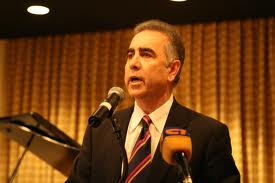
“Iran seeks to resolve problems, not to create them,” Rouhani said, pushing for the “rejection of violence and extremism.”

Alongside fears facing the world, there are “new hopes,” he said. “The hope of universal acceptance and the elite all across the globe of yes to peace and no to war. And the hope of preference of dialogue over conflict, and moderation over extremism.”

Striking a conciliatory tone, Rouhani said that Iran “does not seek to increase tensions with the United States.”

Rouhani said he listened carefully to U.S. President Barack Obama’s speech and hoped that the United States “will refrain from following the short-sighted interests of warmongering pressure groups” so that the two nations “can arrive at a framework to manage our differences.”

Earlier Tuesday, two senior administration officials said that Obama and Rouhani wouldn’t be shaking hands or meet on the sidelines of the U.N. General Assembly.

Such an encounter proved too complicated for Iran back home, the officials told reporters.

Both presidents spoke on the first day of the annual gathering of world leaders in New York. Obama made clear in his morning remarks that the United States was committed to preventing Iran from developing a nuclear weapon.

“We will not tolerate the development or use of weapons of mass destruction,” he said.

At the same time, Obama welcomed what he called positive signals from Iran that it was ready to negotiate with the international community on how it can develop a peaceful use of nuclear power without creating any weapons.

“We are not seeking regime change, and we respect the right of the Iranian people to access peaceful nuclear energy,” Obama said. “Instead, we insist that the Iranian government meet its responsibilities under the Nuclear Non-Proliferation Treaty and U.N. Security Council resolutions.”

He noted that Iranian Supreme Leader Ayatollah Ali Khamenei issued a fatwa against the development of nuclear weapons, and Rouhani “just recently reiterated that the Islamic Republic will never develop a nuclear weapon.”

“These statements made by our respective governments should offer the basis for a meaningful agreement,” Obama said, adding that “to succeed, conciliatory words will have to be matched by actions that are transparent and verifiable.”

Israeli Prime Minister Benjamin Netanyahu welcomed those comments, but said that his country “will not be fooled by half-measures that merely provide a smokescreen for Iran’s continual pursuit of nuclear weapons.”

“Iran thinks that soothing words and token actions will enable it to continue on its path to the bomb. Like North Korea before it, Iran will try to remove sanctions by offering cosmetic concessions, while preserving its ability to rapidly build a nuclear weapon at a time of its choosing,” Netanyahu said.

Secretary of State John Kerry will join his Iranian counterpart, Foreign Minister Mohammad Javad Zarif, at a Thursday meeting of the five permanent members of the U.N. Security Council, plus Germany. Discussions will surround restarting talks on Iran’s nuclear program.

One European Union official expressed optimism over the chance for concrete progress.

“In terms of whether we’re on the verge of a breakthrough, I would put it like this: I was struck as I said by the energy and determination the foreign minister demonstrated to me,” said Catherine Ashton, high representative for foreign affairs and security policy of the European Union.

But no one is expecting an overnight solution to Iran’s alleged effort to build a nuclear weapon, an effort Tehran has so far denied, insisting its nuclear program is for peaceful purposes.

“The roadblocks may prove to be too great, but I firmly believe the diplomatic path must be tested,” Obama said.

Iran president brings ‘charm offensive’ to U.N.

Syria a point of contention

Iran’s recent overtures signaling cooperation, though, likely stop short at the topics of Palestine and Syria. Iran is Syria’s closest ally in the region.

In his speech Tuesday, Rouhani blasted what he described as the “structural violence” against Palestinians. While he never mentioned U.S. ally Israel by name, the intention of his comments was clear.

“Palestine is under occupation; the basic rights of the Palestinians are tragically violated, and they are deprived of the right of return and access to their homes, birthplace and homeland,” he said. “Apartheid as a concept can hardly describe the crimes and the institutionalized aggression against the innocent Palestinian people.”

On Syria, he said that the common objective of the international community regarding that country “should be a quick end of the killing of the innocent.”

“We defend peace based on democracy and the ballot box everywhere, including in Syria, Bahrain and other countries in the region, and believe that there are no violent solutions to world crises,” Rouhani said.

“While condemning any use of chemical weapons, we welcome Syria’s acceptance of the Chemical Weapons Convention,” he said, stressing that extremists’ access to chemical weapons was the “greatest danger to the region.”

Syria is under U.S.-led pressure to give up its chemical weapons arsenal in the aftermath of the August 21 attack on suburban Damascus that Washington and its allies blame on the al-Assad regime.

Obama said Tuesday that Syria’s use of chemical weapons tested the relevance of the United Nations in the modern world, and he rejected contentions by the al-Assad regime and its main ally, Russia, that rebel forces were responsible for the attack.

“It is an insult to human reason — and to the legitimacy of this institution — to suggest that anyone other than the regime carried out this attack,” Obama said.

Russia has blocked U.S. efforts to secure a strong Security Council resolution authorizing possible military force if Syria fails to comply with international regulations on turning over its chemical stockpiles. Obama argued Tuesday that such a resolution was vital.

“There must be a strong Security Council resolution to verify that the Assad regime is keeping its commitments, and there must be consequences if they fail to do so,” he said. “If we cannot agree even on this, then it will show that the U.N. is incapable of enforcing the most basic of international laws. On the other hand, if we succeed, it will send a powerful message that the use of chemical weapons has no place in the 21st century, and that this body means what it says.”

At the same time, Obama announced an additional $340 million in U.S. aid “to meet humanitarian needs in Syria and surrounding countries,” referring to war refugees and other victims. The additional money increases the total U.S. commitment in humanitarian aid to $1.3 billion.

But Farah Atassi, activist with the opposition Syrian National Coalition, said Obama did not go far enough.

“The president did not address the core issue behind the Syrian crisis, which is holding the Assad regime accountable” — including for its use of conventional weapons, she said in a CNN interview. More than 100,000 people have died in the conflict, the vast majority from conventional weapons, according to U.N. figures.

Obama is letting Syria’s ally Russia lead, she said. “We don’t trust the Russians.”

“We want the U.S. to step forward and take the leadership right now to push for Assad to step down and allow for a transitional government from the opposition.”

Emphasizing that the opposition has not asked for “boots on the ground,” Atassi said U.S. military action should remain “on the table.” And, she said, the rebels are looking to Washington for help empowering moderate elements of the opposition.

“We are not terrorists,” she said.

Militant groups make up part of the Syrian opposition.

In his remarks to open the General Assembly on Tuesday, U.N. Secretary-General Ban Ki-moon called for the Syrian government to “fully and quickly” honor its obligations under the Chemical Weapons Convention, which calls for turning over control of its stockpiles.

Ban also appealed to all sides to stop supplying any weapons to all parties in the Syrian civil war while urging both the Syrian government and the opposition to respect international humanitarian law.

Russia and Iran, as well as Hezbollah in Lebanon, are providing military backing to the al-Assad regime while the United States and some European allies have started supplying light arms to rebel fighters.

Meanwhile, U.N. weapons inspectors will be back in Syria on Wednesday to assess at least six claims of chemical weapons use in Syria by the regime or rebels, a spokesman for Ban said Tuesday.

Al-Assad hinted at potential trouble for inspectors coming into Syria, saying other countries may order terrorists to attack them.

“Those militants might want to stop (the) experts’ arrival. We know that those terrorists are under the control of some countries,” he said in an interview Sunday with Chinese television. “And those countries may encourage the terrorists to stop experts from arrival, so that they could accuse the Syrian government for violating the agreement.”

Despite al-Assad’s veiled threat, positive progress has been made on the Syrian chemical weapons deal brokered by the United States and Russia in Geneva. Over the weekend, the United States said it was pleasantly surprised by the extent of Syria’s initial declaration of its chemical weapons stockpile reported to the Organisation for the Prohibition of Chemical Weapons.

The United States is pushing for a U.N. Security Council resolution this week in New York to enforce the Geneva deal.

Opinion: Can Iran’s President Rouhani deliver change in relations with U.S.?

Brazil outrage over U.S. surveillance

Obama faced criticism Tuesday from Brazilian President Dilma Rousseff, who used her U.N. speech to call allegations of U.S. surveillance of her country “totally unacceptable.”

Rousseff referred to classified leaks by former National Security Agency contractor Edward Snowden that made public how the U.S. government had access to phone and Internet records, including foreign information.

She said the U.S. surveillance intercepted private details of Brazilian citizens and businesses, along with “communications by Brazilian diplomatic representation offices, including the permanent mission of Brazil with the United Nations and even the very presidency of the republic of Brazil.”

“Meddling in such a manner in the life and affairs of other countries is a breach of international law and such is an affrontment to the principles that should otherwise govern relations among countries, especially among friendly nations,” she said, adding Brazil would propose U.N. action intended to prevent the manipulation of cyberspace as “a weapon of war.”

Because of the surveillance controversy, Rousseff postponed a state visit to Washington that had been planned for next month. The White House said the postponement was a joint decision.

Winter Olympics host city Sochi hit by flooding

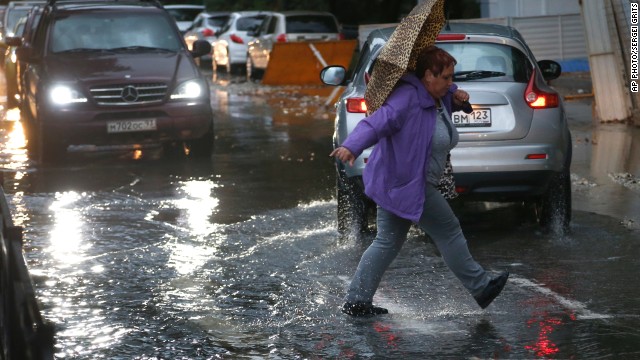
sochiCNN) — Rain, floods, evacuations and power cuts may have hit Sochi — but an Olympic size effort is underway to ensure the city is ready to host the 2014 Winter Games.

Streets and homes were flooded Tuesday with Irina Rossius, the press secretary for Russia’s Emergencies Ministry, forced to admit that a state of emergency was still in effect, according to Russian state agency, RIA Novosti.

While the local Emergency Ministries branch had denied that a state of emergency had been imposed, “the negative outlook” for Tuesday night has led to a change in circumstances.

Read: A brief history of the Winter Olympics

Will Sochi be most connected Games?

How social will Sochi 2014 be?How social will Sochi 2014 be?

Sochi gets ready to put on a showSochi gets ready to put on a show
It is estimated that 1800 workers are currently undertaking work to clean the city following the evacuations of residents.

While 10 homes in the village of Mirny and some train stations in the Adler district are still flooded, the ministry stated on its website that rescue teams had made progress by pumping out water and allowing some trains to run.

The ministry also confirmed that all 30 residents who were moved from the village of Kepsha have since returned home after the water level drop from 45 centimeters to 5cm.

Flights at Sochi’s regional airports were canceled amidst severe weather, while traffic jams left the roads in turmoil.

Kubanenergo, the local power company, confirmed Tuesday that it had cut off the power in five regions to avoid risking power outages.

Read: Will social media foil Putin’s grand Winter Olympics plan?

The floods come at the worst possible time for Sochi with the International Olympic Committee coordination committee making its final visit to the city before the Games, which start on February 7.

The commission’s chairman, Jean-Claude Killy, will finish his visit on Thursday after holding meetings with organizers and visiting venues.

“The exceptional weather conditions in Sochi have not impacted the visit of the IOC coordination commission that is in Sochi from Sept 24 to Sept 26,” read a statement sent to CNN by the IOC.

“The Commission’s work is ongoing and they have just completed a successful visit to the mountain venues.”

When contacted by CNN Wednesday, the Olympstroy press office insisted none of the venues had been damaged by the adverse weather.

“None of the sports venues in Imeretinskaya lowland and in Krasnaya Polyana have been affected by heavy rainfall,” read a statement.

“All the new Olympic facilities have been built in accordance with strict seismic safety, weather protection and geological protection guidelines.

” All venues have proper mudslide and landslide protection. Service personnel in both mountain and coastal clusters are in place to ensure proper functioning of the facilities.”


Customs Union Accession Action Plan Out

10706_am_3A Cabinet sitting was held today, chaired by Prime Minister Tigran Sargsyan.

The government approved a program of priority actions to join the Customs Union: making an inventory of instruments applicable within the Customs Union and international treaties signed by the Republic of Armenia, considering the problems arising from Armenia’s adherence to the Customs Union and its membership of the World Trade Organization, separating the regulations into the following groups: regulations immediately acceptable to Armenia, regulations taking time to accept and regulations calling for further negotiations, translating those international instruments and legal acts necessary for ratification before joining the Customs Union etc.

The meeting approved the proposal on amendment N4 regarding the agreements signed by the governments of Armenia and the United States to improve efficiency in healthcare and welfare services, build up a more competitive and diversified private sector. The Government next approved the loan agreement signed on July 19, 2013 between the Republic of Armenia and the European Bank for Reconstruction and Development to the sum of U.S. $ 7 million that will be used to improve water supply in Yerevan.

The Prime Minister said he met with the U.S. Ambassador yesterday to discuss all the problems related to the signing of a new agreement with the USAID. “Those two decisions pave the way to a new agreement with the USAID, conducive to nearly USD 43 million in additional assistance,” the Premier pointed out.

The meeting went on to approve a program and a timetable for the development of e-commerce, networking and hardware procurement in Armenia.

Marz administrations were allocated AMD 50mn each from the government’s reserve fund to tackle priority issues. A total of AMD40bn has already been earmarked to that end since 2012.

Yerevan Town Hall was allocated AMD9bn to repair the pavement of streets and purchase new housing for the dwellers of damaged residential buildings in the capital city.

Leading Expert’s Final Words on Turkey’s Legal Responsibility for the Genocide

հարութBy Harut Sassounian,

Publisher, The California Courier

 With the approaching Centennial of the Armenian Genocide, there has been growing public interest in taking legal action against Turkey in international courts.

One of the leading experts in this field was Dr. Yuri Barseghov, Professor of International Law, who wrote scores of pioneering books and articles on Armenian claims. Shortly before his death in 2008, Prof. Barseghov of Moscow outlined the basis for legal action against Turkey in an article titled: “Ways and Means of Assigning Responsibility for the Armenian Genocide.”

Dr. Barseghov maintained that in 1920, “the Ottoman Empire admitted its responsibility for committing this crime” by signing the Treaty of Sevres, which unfortunately was not ratified due to the reluctance of the Allied Powers to pressure Turkey. Since then, despite the recognition of the Armenian Genocide by dozens of countries and international organizations, Prof. Barseghov believed that such acknowledgments “will not solve the problem of [Turkish] responsibility.”

Prof. Barseghov contended that “since Turkey stubbornly continues to refuse recognizing that it committed this crime, it is still necessary to solve the question of responsibility for the Armenian Genocide through competent international bodies by making such decisions mandatory for both parties [Armenia and Turkey].”

Dr. Barseghov did not believe that the United Nations is a practical vehicle for the resolution of the Armenian Genocide issue, since it is a highly politicized body. “Decisions of the General Assembly are not mandatory,” while the major powers, such as the United States and Great Britain, enjoy the privilege of veto power in the Security Council blocking any action against Turkey.

The problem of initiating litigation under the statute of the International Court of Justice (ICJ) is that both Armenia and Turkey have to agree in advance to abide by the decisions of the Court. Neither country has so far “recognized the obligatory jurisdiction of the International Court of Justice.” Since Turkey most probably would not agree to submit itself to such jurisdiction, Dr. Barseghov suggested that the Republic of Armenia as a sovereign state take advantage of “the unique opportunity” of filing a unilateral case against Turkey on its responsibility for the Armenian Genocide, “under Article IX of the Convention on the Prevention and Punishment of the Crime of Genocide.”

Dr. Barseghov expressed regret that no response was received from the Armenian government after the Armenian Institute of International Law and Political Science of the Union of Armenians of Russia — which he directed — several years ago submitted a study on this subject to Pres. Robert Kocharian and Foreign Minister Vartan Oskanian.

Dr. Barseghov explained that “in order to start a case by this judicial procedure [Article IX], the Government of Armenia has to formulate its position on the questions of interpretation, application or implementation of the Convention on this basis on the question of responsibility of the Turkish state for the committed crime.”

Prof. Barseghov warned Armenian officials that “there exists a provision in International Law which is confirmed by the International Court of Justice in other cases: if a state has the opportunity to submit a dispute but does not take such action, it would mean that the state accepts the existing situation.”

Dr. Barseghov allayed possible Armenian concerns that the ICJ may object to filing such a case due to questions regarding the retroactivity of the Genocide Convention. He expressed his firm belief that the Convention applies to the Armenian Genocide even though it preceded the Convention. He noted that the ICJ in its Advisory Opinion of 1951 stated: “the principles inherited by the Convention on Genocide, unlike the treaty obligations established in it, were already part of common international law by the time these awful crimes were committed.”

Prof. Barseghov pointed out that arguments supporting the Convention’s retroactivity were put forward by the ICJ which has “twice given competent, exhaustive explanations on the fundamental basic questions of the applicability of the Convention including also its retroactivity.” Based on these rulings, Prof. Barseghov concluded: “the Convention applies also to crimes committed in the past whose consequences have not been eliminated.”

As announced during a recent conference in Yerevan, the Armenian government has formed a task force to prepare the legal file for a case to be brought against Turkey in international courts. The expert advice of Prof. Barseghov and other specialists should ensure that the lawsuit is properly prepared and presented to obtain long overdue justice for Armenian Genocide victims.

Millions Watch Popular Egyptian Talk Show on the Armenian Genocide

By Harut Sassounian

Publisher, The California Courier

Ever since Egypt’s President Mohamed Morsi was removed from office, Turkey’s Prime Minister Recep Tayyip Erdogan has been harshly critical of the new government, strongly advocating his fellow Islamist Morsi’s return to power.

Given Erdogan’s unwelcome meddling in Egypt’s internal affairs, millions of Egyptians have expressed anger and resentment against Turkey and its prime minister. Egyptian newspapers have been replete with anti-Turkish reports and commentaries. Dozens of articles have been published condemning Turkish denials of the Armenian Genocide and urging Egypt’s new leaders to recognize it. There have also been calls for erecting a monument for the Armenian Genocide in Cairo and demands that Turkey pay restitution for the Armenian victims. In an unprecedented move, attorney Muhammad Saad Khairallah, head of the Institute of the Popular Front in Egypt, filed a lawsuit accusing Turkey of committing genocide against Armenians.

On Sept. 4, Khairallah and Dr. Ayman Salama, Professor of International Law at Cairo University, appeared on Lilian Daoud’s highly popular talk show, Al-Soura al-Kamila (The Complete Picture) on ONtv, watched by millions in Egypt and throughout the Arab world. Participating in the show by phone were Resul Tosun, former Turkish Parliament member from Erdogan’s Islamist AK Party, and Harut Sassounian, Publisher of The California Courier. The 36-minute TV program was conducted in Arabic, a language I have rarely used since childhood.

Prof. Salama informed the audience that the Turkish Military Tribunal in 1919 indicted the criminals responsible for the Armenian Genocide. Seventeen Turkish officials were found guilty, and three were hanged. Dr. Salama indicated that France, Great Britain and Russia had issued a joint Declaration in 1915, warning that they would hold Turkish leaders responsible for massacring Armenians and committing “crimes against humanity and civilization.”

Attorney Khairallah insisted that raising the Armenian Genocide issue in Egypt is long overdue and does not have any political undertones. He hoped that his lawsuit will force Egypt, “the largest Sunni country in the Middle East,” to serve as an example for other Arab countries to acknowledge the Armenian Genocide. Khairallah announced that his lawsuit will be considered by the Egyptian Court on November 5. He hoped that the Court would make a historic decision regarding this critical “human rights issue.”

When the hostess of the TV show asked for my opinion on the Egyptian lawsuit, I expressed my great satisfaction, hoping for a positive verdict on the eve of the Centennial of the Armenian Genocide, and looking forward to its recognition by the Egyptian government.

I also commented that Erdogan had anointed himself as the new Sultan of the Middle East, and sole defender of all Muslims, Arabs and Palestinians. However, Erdogan’s misrepresentation was finally exposed when the Arab world realized that he was simply trying to dominate the region, pursuing Turkey’s self-interest rather than that of Arabs and Muslims.

Former Turkish parliament member Resul Tosun, joining the show by phone, quickly antagonized the viewers by claiming that “the current Egyptian government that came to power after the military coup is not legitimate, therefore, the filed lawsuit cannot be considered legitimate.” Tosun then went on to parrot his Turkish bosses’ baseless denials of the Armenian Genocide.

Prof. Salama, incensed by Tosun’s remarks, called Erdogan “the successor of the Ottoman butchers who committed the Armenian Genocide.”

The TV hostess then asked for my reaction to Tosun’s perverted views on the Armenian Genocide. I reminded the viewers that Kemal Ataturk, in an interview published in the ‘Los Angeles Examiner’ on August 1, 1926, had demanded that the Young Turks be “made to account for the lives of millions of our Christian subjects who were ruthlessly driven en masse and massacred.” I also recalled that the Sheikh of Al-Azhar, leader of the globally preeminent center of Islamic studies in Cairo, had issued a Fatwa (religious decree) in 1909 chastising Turkish officials for massacring 30,000 Armenians in Adana, Cilicia.

At the end of the show, attorney Khairallah announced that public rallies will be held shortly to demonstrate that his group’s lawsuit emanates from a popular demand — Egyptians asking their government “to recognize that Armenians were massacred at the hands of Turkish criminals.”

So far, Lebanon is the only Arab country to have recognized the Armenian Genocide. If Egypt follows suit, can Syria and the rest of the Arab world be far behind?


Here is the link to the talk show: http://www.youtube.com/watch?v=teAKr6Psyl0&sns=em

Japan and Turkey: On ‘Comfort Women’ and Genocide

By Harut Sassounian

Publisher, The California Courier

The sleepy town of Glendale became the center of a major international controversy on July 9, when the City Council approved a memorial to ‘comfort women’ — a euphemism to describe up to 200,000 young females who were forced into sexual slavery by the Japanese army during its occupation of Korea and neighboring countries before and during World War II.

The City Council, after hearing conflicting testimonies from members of the local Japanese and Korean communities, approved with a 4 to 1 vote the installation of a monument in Glendale in honor of ‘comfort women.’ At the unveiling ceremony of the monument, council members Ara Najarian and Zareh Sinanyan expressed sympathy for the plight of “comfort women,’ as their own Armenian ancestors had suffered from mass atrocities in Turkey.

Concerned by the parallels drawn between the genocide of Armenians by Turkey during World War I and the Japanese military’s sexual enslavement of ‘comfort women’ during World War II, the Consulate of Japan in Los Angeles sought a meeting with the Armenian National Committee of America to present its government’s position on this issue.

During Deputy Consul General Masahiro Suga’s meeting with ANCA, it became evident that the Japanese government had been far more forthcoming regarding the crimes committed by the imperial Japanese army than the Turkish government was on the Armenian Genocide. Mr. Suga explained that Japan had recognized its responsibility for violating the rights of ‘comfort women’ by issuing an apology, and offering compensation to the victims.

Nevertheless, the ‘comfort women’ remain dissatisfied with Japan’s acts of “atonement,” accusing Japanese officials of making conflicting announcements on this issue. Most ‘comfort women’ have also rejected the offered financial compensation, claiming that it was partially provided by private sources and not the government of Japan. In 2007, the U.S. House of Representatives adopted a resolution in support of ‘comfort women,’ urging the Japanese government to “formally acknowledge, apologize, and accept historical responsibility in a clear and unequivocal manner for its Imperial Armed Forces’ coercion of young women into sexual slavery.”

To find out how Japan’s reaction to the issue of ‘comfort women’ differed from the Turkish government’s denialist stand on the Armenian Genocide, I interviewed Jun Niimi, the Consul General of Japan in Los Angeles. He fondly spoke about his “affinity” toward Armenians developed during his 1995-98 service at the Japanese Embassy in Tehran, and his subsequent visits to Armenia, while stationed at the Embassy of Japan in Moscow.

Regarding the Japanese government’s position on ‘comfort women,’ Mr. Niimi explained that Prime Minister Tomiichi Murayama issued a statement in 1995, expressing “deep remorse” and “heartfelt apology.” Japan also “provided atonement through the Asian Women’s Fund.”

Turning to the differences in the reaction of Turkey to the Armenian Genocide and Japan’s to the abuse of ‘comfort women,’ Consul General Niimi made three points:

“The government of Japan is well aware of the tragedy of the Armenian people at the beginning of last century. We would like to express our deepest condolences and sympathy to the victims. It is our strong belief that this kind of tragedy should never be repeated. The second point is regarding the position of the Turkish government. This is about another country’s position. Even though we are aware of that atrocity, yet, we are not in a position to grasp the details of precisely what happened a century ago in that area. So we cannot make a comment on the Turkish government’s position. But, I would like to repeat that we are aware of the tragedy and would like to express our sympathy and condolences. And the third point is that, regardless of the position of the Turkish government, the Japanese government’s position on the issue of ‘comfort women’ is that it expressed apology and remorse and made efforts to extend support to former ‘comfort women.’”

I informed the Consul General that Japan’s position on the Armenian Genocide is not much different from that of Turkey. I asked Mr. Niimi to relay to his country’s Foreign Ministry that Japan’s lack of acknowledgment of the Armenian Genocide reinforces the skepticism of those who question the Japanese government’s sincerity in dealing fairly with the issue of ‘comfort women.’

In response, the Consul General of Japan expressed his understanding that “the word tragedy doesn’t sound good to you, because it’s genocide.” He promised to convey to his government “the sentiments of the Armenian community” on this issue.

Egypt Floats Genocide Recognition As Trial Balloon to Warn Turkey

Հարութ ՍասունյանBy Harut Sassounian

Publisher, The California Courier


The Arab Spring in Egypt has turned into a hellish summer with countless casualties.

Ever since the Egyptian military deposed President Mohamed Morsi, one particular foreign leader has been screaming the loudest, demanding his immediate reinstatement. That bellicose leader is Recep Tayyip Erdogan, the Prime Minister of Turkey, a staunch supporter of his fellow Islamist Morsi and the Muslim Brotherhood.

Egypt’s new leaders, backed by large segments of the population, were infuriated especially after Erdogan severely criticized the overthrow of Pres. Morsi and the killing of hundreds of Muslim Brotherhood protesters. Using extremely harsh language, the Turkish Prime Minister condemned the Egyptian military for “carrying out a massacre with its soldiers, police officers, [and] heavy artillery.” Ironically, Erdogan called anyone who keeps silent in the face of injustice, “a voiceless devil.”

There is no question that a human tragedy is unfolding in Egypt and becoming more critical with each passing day. While no one can remain indifferent to the killing and maiming of civilians, the Prime Minister of Turkey is the last person on earth who should be taking such a self-righteous attitude. Anyone who has blood on his hands has no right to demonize others! One does not have to go back into history and recall the genocides committed by Erdogan’s forefathers against Armenians, Assyrians, and Greeks. Just a couple of months ago, the Turkish Prime Minister’s own hands were soaked in blood when he proudly acknowledged that he ordered the police to open fire on unarmed demonstrators in Istanbul, killing five people, blinding 11, and injuring 8,000 others. Thus, Erdogan has been stripped of all moral authority to lecture anyone else on democracy and civil rights.

Erdogan’s repeated meddling in Egypt’s internal affairs and his staunch support for Pres. Morsi and the Muslim Brotherhood escalated the hostilities between the two countries to such a degree that Egypt and Turkey ended up recalling their respective Ambassadors, further disrupting their diplomatic relations. The worsening tension has jeopardized the $2 billion Turkish investment in Egypt and frozen the activities of 300 Turkish businesses in that country.

What a difference a year makes! In May of 2012, when I was visiting Egypt on a lecture tour, a local newspaper refused to publish that part of my interview dealing with the Armenian Genocide. I was informed that given the close relationship between the two Islamist nations, it would be impossible to print anything against Turkey.

Curiously, after Pres. Morsi’s unceremonious departure from power, a series of articles appeared in scores of Egyptian newspapers, detailing the history of the Armenian Genocide, demanding that Turkey pay restitution to the survivors, and calling on Erdogan to acknowledge his country’s criminal past.

To top it all, a surprising twitter message was posted on August 17 by Adly Mansour, Egypt’s Interim President, announcing that his country’s “UN representative tomorrow will sign the international document recognizing the Armenian massacres which were committed by the Turkish army, causing the deaths of one million people.”

Even though Egyptian and Turkish newspapers widely reported the twitter message attributed to the Egyptian President, we were unable to independently confirm its authenticity. However, it is clear that the current Egyptian government and media are intent on using the Armenian Genocide as a way of getting back at Erdogan’s heavy-handed interference in their domestic affairs.

Understandably, most Armenians would be displeased that the victimization of their ancestors is being exploited in a political tug of war between the two countries. Yet, unfortunately, this is politics as usual. If Egypt’s new leaders find it expedient to recognize the Armenian Genocide, this would be a welcome change. It is better to recognize the Genocide, regardless of political motives, than not to recognize it for all the wrong reasons! After all, no one can expect the Egyptian government to take a position on an issue, if it is contrary to its own national interests. In this regard, Egypt is no different from other countries, including the United States and Israel, which periodically dangle acknowledgment of the Armenian Genocide as a Damoclean Sword over the heads of Turkish leaders.

The final decision on the recognition of the Armenian Genocide depends on whatever concessions Cairo is expecting from Ankara. If Egypt, the most populous Arab state, recognizes the Armenian Genocide, that would deal a devastating blow to the Turkish government’s frantic efforts to counter the worldwide commemorations of the Genocide Centennial in 2015.

Goldenrod

ЗолотарникSolidago, commonly called goldenrods, is a genus of about 100 species of flowering plants in the family Asteraceae. Most are herbaceous perennial species found in the meadows and pastures, along roads, ditches and waste areas in North America. There are also a few species native to Mexico, South America, and Eurasia. Some American species have also been introduced into Europe and other parts of the world.

Description

Solidago species are perennials growing from woody caudices or rhizomes. They have stems that can be decumbent to ascending or erect, ranging in height from 5 to 100 or more centimeters. Some species have stems that branch near the top. Some Solidago species are hairless others have strigose, strigillose, hispid, or short-villous hairs. The basal leaves in some species remain persistent through flowering, while in others the basal leaves are shed before flowering. The leaf margins are often serrate, and leaf faces may be hairless or densely hairy; the distal leaves are sometimes 3-nerved, and hairless or sparsely to densely hairy with scabrous, strigillose, or villous hairs. In some species the upper leaves are stipitate-glandular or sometimes resinous. The flowering heads usually radiate, sometimes discoid, with (1–)2 to 1500+ florets in racemiform (club-shaped or pyramidal), paniculiform or corymbo-paniculiform, or sometimes secund arrays. The involucres are campanulate to cylindric or attenuate. The ray florets are pistillate and fertile. The corollas are yellow or rarely white and are usually hairless. The disc florets are bisexual and fertile and number 2 to 35 typically, but in some species there may be up to 60 florets. The corollas of the disc florets are yellow and the tubes are shorter than the throats. The fruits are cypselae, which are narrowly obconic to cylindric in shape, they are sometimes somewhat compressed. The cypselae have 8 to 10 ribs usually and are hairless or moderately covered with stiff slender bristles. The pappi are very big with barbellate bristles.

The many goldenrod species can be difficult to distinguish, due to their similar bright, golden yellow flower heads that bloom in late summer. Goldenrod is often unfairly blamed for causing hay fever in humans. The pollen causing these allergy problems is mainly produced by ragweed (Ambrosia sp.), blooming at the same time as the goldenrod, but is wind-pollinated. Goldenrod pollen is too heavy and sticky to be blown far from the flowers, and is thus mainly pollinated by insects.Frequent handling of goldenrod and other flowers, however, can cause allergic reactions, leading some florists to change occupation.

Solidago species are easily recognized by their golden inflorescence with hundreds of small capitula, some species have their flowers in spike-like inflorescences and others have axillary racemes. They have slender stems, usually hairless but S. canadensis shows hairs on the upper stem. They can grow to a length between 60 cm and 1.5 m. Their alternate leaves are linear to lanceolate. Their margins are usually finely to sharply serrated.

Propagation is by wind-disseminated seeds or by spreading underground rhizomes which can form colonies of vegetative clones of a single plant.

Goldenrod and visiting Cerceris wasp

They are mostly short-day plants and bloom in late summer and early fall. Some species produce abundant nectar when moisture is plentiful, or when it is warm and sunny.

Not in Turkey’s interest to Provoke Border Clash with Armenia

Harut SassounianBy Harut Sassounian

Publisher, The California Courier


A deadly incident with potentially serious consequences took place on the Armenian-Turkish border in the night of July 31.


Armenian and Turkish sources have provided conflicting versions of this event. They agree, however, that a Turkish shepherd was shot dead after crossing into Armenian territory.


Kars Governor Eyup Tepe claimed that without warning “Armenian soldiers” opened fire on 35-year-old Mustafa Ulker, as he was trying to retrieve his “sheep” from the Armenian side. The Turkish Governor accused Armenians of using “excessive force,” alleging that “the shepherd did not have a gun in his hand.” Another local Turkish official, Osman Ugurlu, identified the intruder as a Turkish citizen of Azeri origin who was armed only with a knife and was shot in the back.


In a diplomatic note of protest delivered to Armenia, the Turkish Foreign Ministry stated: “We strongly condemn the shooting of an innocent citizen for a simple border infringement apparently made very innocently. There is no valid explanation for the disproportionate use of Armenian force in such an ordinary event.” In a separate public statement, Ankara called on Armenia to show “good sense” in its relations with Turkey and Azerbaijan, warning Yerevan of the dire consequences of wrong moves that could endanger regional stability and peace.


Armenia disputed the Turkish version of events, stating that two Turkish young men had crossed the border at 3 a.m., to steal sheep. When Russian soldiers guarding the Armenian frontier ordered the intruders to go back, the Turks mocked them and refused to retreat. The border guards then fired two warning shots in the air at which point one of the Turks opened fire on them. The Russian troops responded, killing one Turkish intruder, according to the Armenian Border Department of the Federal Security Service of the Russian Federation.


Turkish sources have repeatedly stressed that the shepherd was shot by Armenians, despite Ankara’s awareness that Russian troops are the ones guarding Armenia’s borders with Turkey and Iran, in line with the Moscow-Yerevan agreement of 1992. Instead of blaming the Russians, the Turkish government insists on holding Armenia responsible for the shepherd’s killing, turning it into an Armenian-Turkish incident rather than a Russian-Turkish quarrel.


The Armenian Foreign Ministry issued a restrained statement, expressing regret for the loss of life and hoping that such incidents will not recur in the future. It is clear that Yerevan does not wish to inflame tempers and trigger a more serious incident with unintended consequences.


It is understandable that Turkish leaders would want to exaggerate the significance of this relatively minor border incident in order to distract attention away from Turkey’s multitude of domestic and foreign troubles, in particular:


·  On-going mass protests in Turkey, challenging Prime Minister Erdogan’s despotic rule.


·  Arresting 3,000 demonstrators, injuring 8,000, and killing five others as a result of the “disproportionate use of force” by Turkish police.


·  Announcements placed in major American, British, and German newspapers, denouncing Erdogan’s “Nazi-like” actions. The Turkish Prime Minister’s threatened lawsuit against The (London) Times for publishing a full-page paid letter, signed by dozens of prominent Western intellectuals and artists, would more widely expose his intimidating tactics.


·  Letter addressed to Turkey’s President Abdullah Gul by 46 Members of the US House of Representatives, asking him to condemn the recent anti-Semitic statements of Turkish leaders, including Erdogan, who had referred to Zionism as a “crime against humanity” and blamed the recent Gezi Park protests on Jewish instigators.


·  Serious internal feuds with Kurdish groups, opposition political parties, and high-ranking imprisoned military leaders.


·  Repeated military intrusions into Iraqi Kurdistan.


·  Strained relations with Egypt’s new rulers after the overthrow of Pres. Mohamed Morsi, Erdogan’s fellow Islamist.


·  Frictions with Cyprus, Greece, Iran, Iraq, and Israel, and hostilities with Syria.


·  The bombing of the Turkish Embassy in Somalia last month by an al-Qaeda-linked group.


With all these problems swirling in and around Turkey, Foreign Minister Ahmet Davutoglu’s announced policy of “zero problems with neighbors” has turned into “zero neighbors without problems.”


At a time when Armenians are planning worldwide commemorations of the Genocide Centennial, Turkey can ill afford to add to its host of troubles a border clash with Armenia, which would only serve to publicize Turkey’s long list of past and present crimes!

US Intelligence Report: All Armenians Demand Return of Lands from Turkey

Harut SassounianBy Harut Sassounian

Publisher, The California Courier


The recently announced demand for lands from Turkey by the Prosecutor General of Armenia attracted much attention from Armenians worldwide and harsh criticism from the Turkish government. While this was the first time that an Armenian official had raised this issue since the country’s independence in 1991, the demand itself is not new. Armenians have been seeking the return of their historic territories from Turkey for decades.

A confidential 1943 document, declassified by the Central Intelligence Agency, reveals that the US government was well aware of the Armenian demands for recognition of the “atrocities” and return of Turkish occupied “provinces.”

The document dated December 13, 1943, authored by the Office of Strategic Services (OSS), the predecessor of the CIA, stated: “All the Armenian press in the United States is active in keeping the Turkish Armenian massacres fresh in the minds of its readers. Fearful that the Axis atrocities of the present war [World War II] will eclipse the atrocities of the last when the final reckoning comes, they are anxious to keep alive the Armenian case against Turkey. Armenians have present as well as past grievances against Turkey, whose capital levy tax ‘Varlik’ falls harder on Armenians than on any other minority group in Turkey. Even more unforgivable in the eyes of Armenians is the fact that Turkey holds provinces which, they are firmly convinced, belong rightfully to Armenia. Restitution of these provinces to Armenia is the goal of all Armenians.” Elsewhere in the document, OSS accurately reported that “Armenians, almost without exception, entertain feelings of deepest suspicion, hostility, and fear” toward Turkey.

A second declassified confidential document dated July 31, 1944, carries a surprising title: “Tashnags Turn to Soviet Russia.” The OSS indicated that “the once uncompromisingly anti-Soviet Armenian Revolutionary Federation (Tashnags) officially changed its spots, and the swing toward support of the Soviet Union, which has been growing gradually more perceptible during the last few months, has culminated in the adoption of a pro-Soviet policy at the Federation’s annual convention held in Boston the first week of July.” This OSS report was prepared as the Soviet Union had announced its intention to claim the Eastern provinces of Turkey (Kars, Ardahan, and Surmalou) in a post-World War II settlement. The Soviet claim was backed by the Armenian Church, the Soviet Armenian government and the Diaspora, including the anti-Soviet Armenian Revolutionary Federation (ARF).

The OSS astutely reported: “The Tashnags have never actually renounced their dream of a free and independent Armenia, including the Turkish irredenta, which has kept them at loggerheads with the USSR, ever since Armenia was established as a Soviet [illegible] in 1920. … With the vision of independence fading, the now Soviet-friendly Tashnags are turning their attention to the acquisition of the Turkish provinces of Armenia by the SovietArmenianRepublic.”

In explaining ARF’s post-war expectations, OSS stated: “If, as the Tashnags believe and hope, Turkey remains neutral [in World War II], she will be in a highly vulnerable position, and one item of payment for her neutrality, according to Mr. [James] Mandalian [editor of the Boston-based ARF newspaper Hairenik], would be the cession of Turkish Armenia to Soviet Armenia.”

The 1943 OSS document also contained a lengthy report on the Armenian-American press, focusing its attention on six of the 17 Armenian newspapers in the United States: “Hairenik and Asbarez (Tashnag)” classified as “rightist-nationalist;” “Baikar, Nor Or (Ramgavar)” and “Eritassard Hayastan (Hunchag)” classified as “liberal;” and Lraper (Armenian Progressive League of America)” classified as “leftist-Communist.” The last two newspapers are no longer in publication.

According to OSS, Hairenik and Asbarez are “strongly nationalist, anti-Soviet, and anti-Communist,” while Baikar is “resolutely opposed to the Tashnags and their principles. The Ramgavars have accepted the incorporation of Armenia into the Soviet Union as the most satisfactory way out of Armenian problems, and many articles are printed in Baikar extolling the Soviet regime in Armenia, particularly in its relations to the ArmenianApostolicChurch.”

OSS estimated that the 95,000 Armenians in the United States in 1943, mostly settled in Massachusetts, New York, and California, “retain a keen interest in the affairs of their homeland [Soviet Armenia], though few, if any, would go back there.”

Erdogan Succeeds in Antagonizing Both Arabs and Jews

SasunyanBy Harut Sassounian

Publisher, The California Courier


After brutally quelling massive domestic protests against his increasingly despotic rule, Prime Minister Recep Tayyip Erdogan is now facing another serious problem: His unexpected ‘success’ in uniting Arabs and Jews against him!


The Turkish Prime Minister had already antagonized Israel and Syria with his hostile actions and statements. In recent days, he also managed to offend millions of Egyptians by rejecting their new government after Pres. Morsy was deposed by the military. Despite Erdogan’s professed objection to the overthrow of Egypt’s ‘democratically elected President,’ it is evident that he is far more concerned about saving his own neck, fearing a similar takeover by the historically coup-prone Turkish military.


Last week, AleppoUniversity stripped Erdogan of his honorary doctorate in international relations, awarded to him in 2009, when Syria and Turkey were enjoying a short-lived love fest. Khodr Orfaly, President of the University, accused Erdogan of instigating “plots against the Syrian people” and using “arbitrary” violence against protesters in Turkey.


After losing an Arab award, the Turkish Prime Minister may next be deprived of the “Profiles in Courage” prize given to him by the American Jewish Congress (AJC) in 2004 for “promoting peace between cultures.” In an article published last month in the Jewish “Commentary” magazine, Michael Rubin urged the AJC to revoke its award, describing Erdogan as “Hamas’s leading cheerleader, a promoter of terrorism, and a force for instability in the region. Rubin further asserted that “Erdogan already had a history of embracing rabid anti-Semitism and harboring conspiracy theories during his tenure as Istanbul’s mayor.”


Rubin also criticized Pres. Obama for “toasting Erdogan” and the 135 members of the Congressional Turkey Caucus for running “interference for Turkey’s worst excesses,” including “arbitrary arrests, police violence, launching tear gas into hotels and consulates, attacking the free press, launching anti-Semitic diatribes, and ordering the arrest of medical personnel.” Rubin questioned the motives of these House members and wondered whether they “enjoy the wining and dining Turkish authorities arrange on trips to Istanbul or Ankara as a reward for membership” in the Turkey Caucus. He urged the members of Congress to “suspend if not resign their membership.”


Rubin strongly advised the American Jewish Congress and other Jewish organizations to “base awards on lifetime achievement, not only wishful thinking. The risk of bestowing legitimacy on platforms that run contrary to the AJCongress’ mission is otherwise too great. The AJCongress’ award to Erdogan not only did not stop Erdogan’s anti-Semitism, but rather it for too long provided cover for it. Perhaps the organization can now mitigate the damage it has caused — and also deflate Erdogan’s buffoonery — by publicly revoking its award.”


Regrettably, Rubin is nine years too late in criticizing AJC’s honoring of Erdogan. Back in 2004, within days of the award ceremony, I wrote a column critical of AJC and its President Jack Rosen who had absurdly announced that his organization was honoring Erdogan as leader of “a model Moslem country.”


Now that the whole world has seen Erdogan’s true colors under the façade of leading “a model Moslem country,” many others need to reconsider the awards they had lavishly heaped on this undeserving leader.


For example, the Anti-Defamation League (ADL) should revoke its prestigious “Courage to Care Award” presented to Erdogan in 2005. On that ‘happy’ occasion, the Prime Minister pointed out to Abraham Foxman, ADL’s National Director, Turkey’s “close relationship with Israel,” and pledged “zero tolerance” for “anti-Semitic diatribes.”


Here are some other honors given to Erdogan that should be rescinded:


State Medals:

— Russian state medal from Pres. Vladimir Putin (June 1, 2006)

— Crystal Hermes Award from German Chancellor Angela Merkel (April 15, 2007)

— Nishan-e-Pakistan, the highest civilian award of Pakistan (Oct. 26, 2009)

— King Faisal International Prize for “Service to Islam” (Jan. 12, 2010)

— Georgia’s Order of Golden Fleece (May 17, 2010)

— Libyan President Muammar Qaddafi’s International Prize for Human Rights (Nov. 29, 2010)

— Kuwait’s “Outstanding Personality in the Islamic World Award” (Jan. 11, 2011)


Honorary Doctorates:

— St. John’s University, New York (Jan. 26, 2004)

— EuropeanUniversity of Madrid (May 18, 2010)

— MoscowStateUniversity (March 16, 2011)

— ShanghaiInternationalStudiesUniversity (Apr. 11, 2012)

— University of Algiers (July 5, 2013)


Honorary Citizenship:

— South Korea (February 2004)

— Iran (February 2009)

— Kosovo (November 2010)


All those who have honored Erdogan have simply dishonored themselves. The sooner they revoke their accolades, the sooner they will redeem themselves from their disgraceful acts.

In Major Policy Shift, Armenia Demands Lands from Turkey

Harut SassounianBy Harut Sassounian

Publisher, The California Courier


Ever since independence in 1991, Armenia’s leaders have been reluctant to make any concrete demands from Turkey beyond recognition of the Armenian Genocide.


Only in recent years, Armenian officials have begun to speak about “the elimination of the consequences of the genocide,” without specifying the ‘consequences’ and the means for their ‘elimination.’


Earlier this month, however, a major shift was announced in Armenia’s foreign policy vis-à-vis Turkey, when Aghvan Hovsepyan, the Prosecutor General of Armenia, called for the return of historic Armenian territories at an international conference of Armenian lawyers in Yerevan. This is the first time that a high-ranking Armenian government official has made such a public demand from Turkey.


In a lengthy and comprehensive speech, Hovsepyan stated that the recognition of the Armenian Genocide by various countries is simply a moral and emotional issue. Calling for a switch to “the legal field,” the Prosecutor General indicated that “to eliminate the consequences of the Armenian Genocide” Turkey must “pay compensation to heirs of the Armenian Genocide, return to the Armenian Church the miraculously still standing Armenian churches and properties in Turkey, and give back the ‘lost territories’ to the Republic of Armenia.”


Prosecutor General Hovsepyan insisted that unless Armenians adopt this bold approach, they will not accomplish any concrete results in the next one hundred years, just as they did not in the last one hundred years. He proposed a thorough legal review of all international agreements regulating Armenia-Turkey relations, from the Berlin Treaty of 1878 to the signed but not ratified protocols of 2009. He also declared that the region of Nakhichevan is “an inseparable part of Armenia, albeit occupied by Azerbaijan.” Hovsepyan urged the assembled lawyers from around the world to prepare the legal case for territorial demands from Azerbaijan and Turkey and present it to the Armenian government for eventual submission to the International Court of Justice (World Court).


Statements made by a prosecutor general usually do not carry much weight in international affairs, if it were not for the fact that several other high-ranking officials, including Pres. Serzh Sargsyan, President of the Constitutional Court Gagik Haroutyunyan, Minister of Diaspora Hranush Hakobyan, Armenia’s Minister of Justice Hrair Tovmasyan, and Minister of Justice of Artsakh (Karabagh) Ararat Tanielyan, also made remarks on restitutive justice at the lawyers’ conference. It was clear that the Prosecutor General was the designated spokesman of the Armenian government to articulate its new tougher line toward Turkey in advance of the Genocide Centennial.


Pres. Sargsyan, using more circumspect language than the Prosecutor General, told the lawyers’ conclave: “The international recognition and condemnation of the Armenian Genocide, and elimination of its consequences will always remain a salient issue. As long as the Armenian State is in existence, all efforts to deny and send into oblivion this historical reality will be doomed. This greatest crime against humanity must be recognized and condemned once and for all, and first of all, by Turkey itself.”


In keeping with the government’s new policy orientation, Constitutional Court President Gagik Haroutyunyan announced that a special committee will be formed to prepare the legal documentation necessary for the pursuit of Armenian Genocide claims.


At the conclusion of the conference, the participants issued a joint statement asserting that the priority for Armenian lawyers is not proving the self-evident facts of the Genocide, but preparing a comprehensive legal document “to remedy the consequences of the Armenian Genocide.”


This is a welcome development in terms of arriving at a consensus between the Armenian government and the Diaspora on the objectives to be pursued for the 100th anniversary of the Armenian Genocide.


However, in order to move beyond mere emotionally inspiring statements, the Armenian leaders must take two immediate steps:


1) Withdraw the Armenian government’s signature from the counter-productive Armenia-Turkey Protocols. On the eve of the Genocide Centennial, it would be inconceivable to move forward with fruitless efforts to improve relations with Turkey, while preparing to file a lawsuit for restitution.


2) Form a team of international law experts to begin structuring the legal case against Turkey in the World Court and/or the European Court of Human Rights.


While skeptics may not take seriously the recent policy pronouncements of the Armenian authorities, the Turkish Foreign Ministry has no such doubts. Last week, Ankara denounced the Armenian territorial demands, announcing angrily that “nobody can dare to claim territory from Turkey!”


PETER KOUTOUJIAN DISCUSSES KEY COMMUNITY CONCERNS WITH ARMENIAN ORGANIZATIONS AT THE HAIRENIK BUILDING IN WATERTOWN

PKoutoujian_HairenikWATERTOWN, MA — Middlesex County Sheriff Peter Koutoujian sat down with the editorial team of The Armenian Weekly and representatives of Armenian American organizations in Watertown yesterday to share the views and values that motivated this veteran public servant to run for the 5th District Congressional seat recently vacated by Rep. Edward Markey following his successful Senate bid, reported Armenian National Committee of America-Eastern Region (ANCA-ER).

“I am proud of my Armenian heritage and of my record of accomplishments on behalf of the Armenian community and all the communities I represent. I look forward to continuing that promise of hard work and commitment if elected to Congress, and I thank the Armenian National Committee of America’s tremendously warm endorsement,” Koutoujian said.

The ANCA has been an early and vocal supporter of Koutoujian’s congressional bid, citing his years of service to the Commonwealth from prosecutor, to State Assemblyman and, now, Middlesex County Sheriff. “His leadership in Massachusetts and in the Armenian American community has been steadfast and inspiring, and he has the ANCA’s full backing in this election process and beyond,” explained ANCA National Board member Stephen Mesrobian in the ANCA’s July 3rd endorsement statement.

Following his in-depth interview with the Armenian Weekly, Koutoujian joined representatives of the ANCA, Armenian Relief Society (ARS), Armenian Revolutionary Federation (ARF), Homenetmen, Hamazkayin, and others for lunch at the Armenian-American Social Club in Watertown.

Koutoujian’s leadership on community concerns extends throughout the Massachusetts’ 5th district, which includes the towns of Belmont, Lexington, Waltham and Watertown – each with large and vibrant Armenian-American presence.

He emphasized the fact that this election will have low voter turnout and the importance of registering new voters, especially Armenian Americans, who can help him claim victory in a few months.

“We’re pleased to see Mr. Koutoujian actively seeking communication with our core Armenian organizations, including the ANCA-ER,” said ANCA-ER Executive Director Michelle Hagopian. “He has a longstanding track record of public service and loves his community, and we’re going to work hard to make sure he is elected to Congress come fall.”

#####

Photo Captions:

Koutoujian_Hagopian.jpeg: Middlesex County Sheriff Peter Koutoujian seen here with ANCA Eastern Region Executive Director Michelle Hagopian.

PKoutoujian_Hairenik.jpeg: Peter Koutoujian joined members of Armenian organizations for lunch at the Armenian-American Social Club in Watertown on Monday, July 8, 2013.

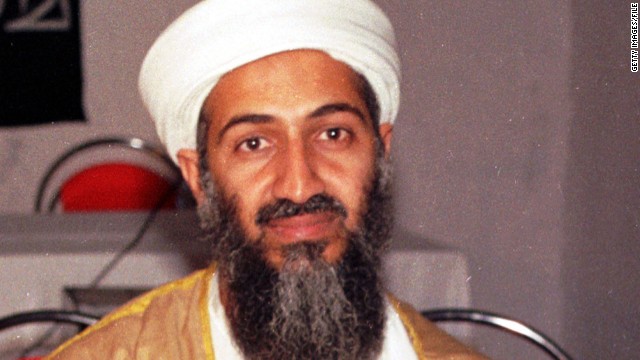
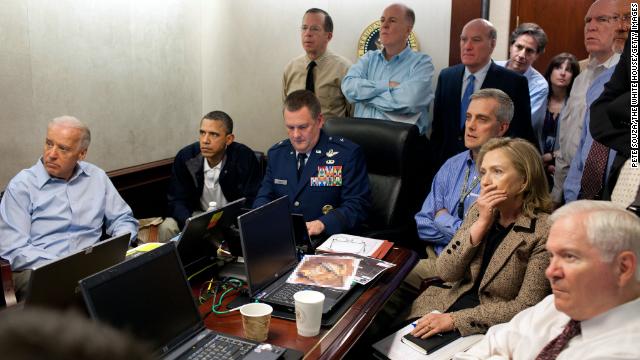
Report: Osama bin Laden — doting grandpa, paranoid terrorist

120523040531-osama-bin-laden-horizontal-galleryIslamabad (CNN) — Osama bin Laden typically wore a cowboy hat while tending his garden.

Its broad brim obscured his features from the view of pesky eyes or satellite cameras that might blow his cover while he was hiding out in Pakistan, according to a report published widely in Pakistani media.

The 337-page leaked report details the domestic life of one of the world’s most wanted men as a grandfather in his final days of life.

It also scathes Pakistani authorities for failing to keep him out of the country, and for failing to prevent the U.S. raid by Navy SEALs that killed bin Laden in May 2011.

CNN is working to confirm the authenticity of the report, which bears the names of a former top diplomat, a supreme court justice and former officers of the military and police.

Photos: The death of Osama bin LadenPhotos: The death of Osama bin Laden

2011: Obama announces bin Laden’s death
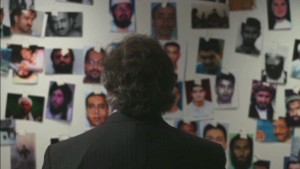
Documentary examines hunt for bin Laden

Bin Laden Raid – SEALs’ Accounts

Veggie growing contest

The famous terrorist’s life was speckled with quirky measures designed to keep him under the radar, the report said.

Al Qaeda’s No. 1 spent lots of time doting on his some dozen children and grandchildren in the six years he spent in his walled compound in the city of Abbottabad, said terror expert Peter Bergen, commenting on the report.

They could not pass time watching TV or surfing online, because bin Laden had no Internet connection and no satellite television hook-up. He also didn’t have a phone line, all measures to avoid detection.

For the same reason, the children were not allowed to play with other kids in the neighborhood. They spent the bulk of their lives within the compound’s walls.

When bin Laden was not personally giving them religious instruction, he took them out into the yard.

He would award them prizes if they grew particularly good vegetables in the garden.

Faking deafness

Bin Laden fled to Pakistan a month after the September 11, 2001, attacks on the United States, moving from the south to the north then hopping from town to town before landing in Abbottabad in 2005.

While he was on the run, one of his wives gave birth four times and had to be taken to local hospitals, but it was obvious that she was not from the region. She spoke Arabic instead of Urdu, Pakistan’s official language.

Bin Laden’s family feared this might raise suspicions. So, they told doctors she was deaf and mute.

While on the run in the restive tribal region of the Swat Valley, bin Laden shaved off his recognizable beard, according to the report. Men helping him told others not to ask any questions about the tall stranger, who spoke Arabic.

Who really killed bin Laden?

How man came face-to-face with bin Laden

Pervez Musharraf on Osama bin Laden


While in Swat, police once pulled bin Laden’s driver over, but he quickly settled the matter, before the officer had a chance to get a closer look at the clean-shaven man riding with him.

After arriving in Abottabad, a woman living in the same building with bin Laden recognized him from his image shown on cable TV. Her husband, who was helping bin Laden, went into a panic, the report said.

He told her to mind her own business and forbade her and all other women in the house from watching TV anymore.

The assassination raid

The measures kept bin Laden from being recognized for years in a city known for being the home to one of Pakistan’s largest military complexes.

The CIA eventually suspected he was there and recruited a Pakistani doctor to run a vaccination program in Abbottabad in an attempt to find bin Laden by locating his children through their DNA.

Eventually the United States did find bin Laden and assassinated him during a special forces raid on his compound. He was later buried at sea, the U.S. military said.

Although the SEALs were within Pakistan’s borders for three hours, its military did not detect them.

“The radar systems were not looking for that kind of intrusion from the Afghan side of the border,” terror expert Peter Bergen said. He feels sure that will change now.

The report also dedicated 22 pages to fighting terrorism and keeping people like bin Laden from taking refuge in the country again.

The report’s authors blast Pakistani authorities at every level of government, intelligence and the military for not stopping the U.S. mission, calling it “a story of complacency, ignorance, negligence, incompetence, irresponsibility, and possibly worse at various levels inside and outside the government.”

Pakistan’s government considers the assassination operation a violation of its sovereignty, basically an act of war.

Agapanthus

agapanthusAgapanthus is a landscape staple in warm-winter regions, and it’s no wonder why. This easy-to-grow perennial produces colorful globes of blue or white trumpet-shape flowers in summer and fall. Its evergreen strappy leaves add texture to beds, borders, and containers.

Agapanthus blooms best in a spot where it gets full sun and has moist, well-drained soil. Divide it every three to four years to keep clumps healthy and vigorous.

If you live in a cool-winter area, you can overwinter agapanthus in containers by bringing the pots to a cool (around 40 degrees F) spot and watering them only once a month or so. In spring, move the containers back outdoors after all danger of frost has passed. Potted agapanthus is said to bloom best when slightly root-bound.

Light:
Sun,Part Sun
Zones:
7-11
Plant Type:
Perennial
Plant Height:
To 4 feet tall
Plant Width:
To 3 feet wide
Flower Color:
Blue/Violet/Lavender, White
Bloom Time:
Summer, Fall
Landscape Uses:
Containers,Beds & Borders
Special Features:
Flowers,Cut Flowers,Deer Resistant,Easy to Grow

Despite Lavish Public Praise, U.S. is Deeply Troubled by Erdogan

Harut SassounianBy Harut Sassounian

Publisher, The California Courier


Some months ago I wrote a column titled “Obama is Exploiting Turkish Leaders’ Craving for Flattery,” explaining that the U.S. President is able to persuade Prime Minister Recep Tayyip Erdogan to do his bidding by taking advantage of his weakness for lavish praise!


Those aware of Erdogan’s authoritarian streak — on full display during the recent brutal attacks on protesters in Istanbul and other Turkish cities — have been deeply troubled by U.S. officials’ repeated mischaracterization of the Prime Minister’s dictatorial regime as ‘a role model for the Islamic world.’


The insincerity of such assessments was exposed when WikiLeaks made public thousands of confidential diplomatic cables from the U.S. Embassy in Ankara, indicating that American officials’ real opinion about Erdogan is the exact opposite of what they have been stating in public.


The Embassy dispatches, published by the German magazine Der Spiegel, described the Turkish Prime Minister “as a power-hungry Islamist surrounded by corrupt and incompetent ministers.” In a May 2005 cable, the U.S. Embassy surmised that Erdogan never had a realistic view of the world and believes he was chosen by God to lead Turkey. A knowledgeable source told American officials that “Tayyip believes in God … but does not trust him.”


U.S. diplomats report that the Prime Minister gets almost all his information from Islamist-leaning newspapers, ignoring the input of his own ministers. The Turkish military and intelligence services no longer share with him some of their reports. He trusts no one completely, surrounding himself with “an iron ring of sycophantic (but contemptuous) advisors.” Despite Erdogan’s macho behavior, he is reportedly terrified of losing his grip on power.


Although the Turkish leader declared war on corruption when he first assumed office, informants told U.S. Embassy officials that corruption exists at all levels, even within the Erdogan family. A senior government advisor confidentially told a journalist that the Prime Minister enriched himself from the privatization of a state oil refinery. An Energy Ministry official alleged that Erdogan asked Iranians to sign a gas pipeline deal with a Turkish company owned by an old schoolmate. Furthermore, two American sources claimed that the Prime Minister had eight Swiss bank accounts. Erdogan has denied all such allegations, insisting that his wealth is mostly derived from gifts received at his son’s wedding, and acknowledging that an anonymous Turkish businessman has been paying the expenses of his four children to study in the United States. Such explanations are viewed by the American Embassy as “lame.”


The Embassy’s cables contain many other startling accusations against Erdogan. Informants have told U.S. officials that when his political party’s candidate lost the Trabzon mayoral race, the Prime Minister allegedly funneled millions of dollars from a secret government account to his close friend Faruk Nafiz Ozak whom he had named as head of the local Trabzonspor football club. The money was for hiring top players so that the soccer team’s victories would overshadow the accomplishments of the elected mayor.


According to a cable sent by former U.S. Ambassador Eric Edelman, Erdogan’s appointees lacked “technocratic depth.” While some “appear to be capable of learning on the job, others are incompetent or seem to be pursuing private … interests.” High-ranking Turkish officials have informed the American Embassy in Ankara that they are appalled by the Prime Minister’s staff. Erdogan reportedly appointed as his undersecretary a man exhibiting “incompetence, prejudices and ignorance.” The Women’s Minister Nimet Cubukcu, an advocate of criminalizing adultery, obtained her position because she happened to be a friend of the Prime Minister’s wife. Another minister is accused of “nepotism, links to heroin smuggling, and a predilection for underage girls.”


Foreign Minister Ahmet Davutoglu, highly-praised by U.S. officials in public, also comes under private scrutiny and criticism. According to confidential American Embassy cables, Davutoglu “understands little about politics outside of Ankara.” In fact, U.S. diplomats are alarmed “by his imperialistic tone … and his neo-Ottoman vision.” In a January 2010 dispatch, the American Ambassador reported that Turkey has “Rolls Royce ambitions but Rover resources.” Former Defense Minister Mehmet Gonul was also critical of the Foreign Minister, warning American officials about his “Islamist influence on Erdogan,” and calling him “exceptionally dangerous.”


Having spoiled Erdogan through lavish public praise, despite privately acknowledging his character flaws, U.S. officials must now assume full responsibility for the Prime Minister’s reckless behavior at home and abroad!


Museum mystery: Spinning statue turns heads

130625083346-newday-pkg-cursed-egyptian-statue-00012219-story-topThe museum officials were stumped. A statue is supposed to stand still, not rotate all by itself.

But this one at the Manchester Museum seemed to have done just that. Turned around 180 degrees — revealing an inscription on its back asking for beer.

No other figure in the display had moved — nor had any other in the museum.

For the staff, it was a bona fide mystery. One that called for some serious sleuthing.

A simple statue

Spinning statue stumps museum officials

Statuette no. 9325 doesn’t appear to go by any proper name. It’s a prefabricated figure — an off-the-shelf product — that was placed into a small tomb around 1800 B.C.

A private collector in Britain donated it to the museum in 1933. The inscription on the back, requesting a sacrifice of beer, bread and animals, was a standard prayer for the deceased.

For decades, the figurine stood perfectly still — until museum workers moved its case a few feet from its original position.

Turn, turn, turn

In February, curator Campbell Price noticed something curious was afoot.

The statue seemed to have slightly turned.

When he looked next, it was facing another direction. A day later, another.

The turns were subtle. But at the end of each day, you could tell the statue was angled differently.

Caught in the act

In April, museum officials installed a time-lapse camera that snapped an image of the statue every minute of every day for a week.

When they ran the images in fast motion, they came across a surprising revelation: the statue only moved during the day, when visitors were walking past.

It seemed, Price wrote, that vibrations caused by foot traffic in room was the culprit.

Mysterious structure found at bottom of ancient lake

Mystery solved?

Though officials now have a logical explanation, it still seems a bit mysterious.

“What is very strange is that the statue has spun in a perfect circle,” Price said. “It hasn’t wobbled off in any particular direction.”

Some are in awe of the spirit nature of the figurine, and don’t quite accept Price’s explanation.

One of the blog’s readers left his own theory for no. 9325’s movements in the comments section: “The statue is cursed,” wrote benabrahamse.

A museum guide has suggested saying a prayer for the statue.

But Price is unmoved.

“Most Egyptologists are not superstitious people,” he said.

No one has bought the statue a beer.

After all, they don’t want it wobbling.


World’s top places of refuge: where could Snowden go?

Edward SnowdenFleeing US law enforcement, the NSA whistleblower Edward Snowden seems stuck for where to go next. CNN Travel’s own top secret document reveals which countries should be on his list …

Snowden has sown a global trail of confusion in his flight from the United States. Journalists and diplomats have been scrambling to anticipate where he might pop up next.

What should Snowden be looking for in a decent place of refuge?

A willingness to grant “quickie” citizenships and the lack of an extradition treaty are obvious attractions, says Professor Ruth Wedgwood, an expert in international law and diplomacy at Washington’s Johns Hopkins University.

Decent plumbing and good weather probably wouldn’t go amiss, either.

Snowden will have to be quick, though. Fugitives should be careful in choosing their destinations as diplomatic allegiances shift fast, says Michael Abbell, a former director of the US Department of Justice’s Office of International Affairs and a key extradition negotiator under Ronald Reagan.

“Especially when you’re dealing with such things as are arguably political in nature,” Abbell told CNN. “From time to time there have been countries that people could more or less get lost in [but] it depends on the nature of the case.”

What Snowden and other fugitives clearly need is a guide to the world’s political safe havens. This constitutes something of a niche travel guide, and it’s unlikely Lonely Planet or Frommer’s have one in the pipeline.

Fortunately, CNN Travel has compiled just such a list. Until now, it has been encrypted in secure computer servers located deep in the basement behind several locked doors. And then someone went and leaked it…

1. Iceland

Iceland makes for an excellent fugitive destination, particularly for someone with a wintry name such as Snowden. It professes a love for internet freedoms and once checkmated extradition efforts by offering citizenship to tax-evading US chessman Bobby Fischer.

For Snowden it might feel chilly after Hawaii, Hong Kong and midsummer Moscow, but he could easily warm up with a dip in the geothermal waters of the Grindavik Blue Lagoon.

Why stay: Ash-spewing volcanoes could help to shroud your location.

Why leave: New laws to aid whistleblowers are not yet in place. Also, they eat puffins.

2. Ecuador

It’s a two-way deal: exiles get a sub-tropical shelter while the Ecuadorean President, Rafael Correa, gets to burnish anti-American credentials and a distraction from his clampdowns on press freedom.

Why stay: Plenty of Inca ruins and colonial Spanish buildings to admire.

Why leave: Ecuador still has an extradition deal with the United States.

3. The UK

It might be heavily in diplomatic hock to Washington, but the UK remains a popular place of refuge — particularly among Russian exiles drawn by its liberal outlook, robust legal system and miserable weather. OK, maybe not the weather.

Despite security cameras on every corner, plenty of people have managed to lose themselves in London. And if all else fails, it has an Ecuadorian embassy, although since Assange has already snagged the spare room, you’ll be on the sofa.

Why stay: Strong tradition of political radicalism

Why leave: Did we mention the awful weather?

4. The Philippines

The Filipino police have a strong track record of helping foreign agents hunt down their quarry, but with more than 7,000 islands to choose from, it could take them some time.

Why stay: Boracay’s beaches, Banaue’s scenic rice terraces and — as it happens — more colonial Spanish architecture!

Why go: Rampant corruption. Even if you’re not on the lam, you’ll still be bilked for backhanders.

5. Spain

Southern Spain’s enduring popularity among expat UK villains has earned its coastline the unfortunate soubriquet of “Costa del Crime.” A spate of arrests has tarnished its appeal, though.

Why stay: The sunshine, the paella, the sangria.

Why leave: British pubs selling greasy breakfasts to greasier Brits. Abject lack of Spanish colonial architecture.

6. France

The French have a rep for being rude to foreigners — unless they are fleeing justice. The country has ignored extradition deals in the past, refusing to give up US-wanted hijackers in the 1960s and 70s. If you’ve done something political — or you are Roman Polanski — you’re probably safe.

Why stay: France has it all: Culture, countryside and cheese.

Why leave: France also has the French.

7. United States

Why not hide in plain sight? It’s a big, frequently beautiful country and there are parts of America where folks don’t even know who their president is, let alone who’s on his most wanted list.

Why stay: Land of the free.

Why go: Pressure to have plastic surgery. Even if you’re not changing your identity.

8. North Korea

Clearly this would be madness. But as extradition expert Abbell notes, North Korea and Iran are two countries where fugitives are almost guaranteed to be beyond the reach of international justice.

US soldier Charles Jenkins demonstrated this principle between 1965 and 2004 after deserting to the north during the Korean War, and living — albeit rather wretchedly — to tell the tale.

Why stay: Don’t stay.

Why leave: It won’t be your emails that are monitored, just your every waking thought.

9. Cuba

Embargoes didn’t stop Jay Z from heading to Havana, but you probably won’t have to worry about facing the other kind of rap as Cuba seems happy to ignore its extradition treaties.

Why stay: Salsa, cigars and those great old cars held together with washing machine spares.

Why go: Worrying proximity to Guantanamo

10. Transit

Snowden appears to have spent several days airside at Moscow’s Sheremetyevo airport, a location that Kremlin authorities insist does not fall within Russian borders.

Perhaps he could stay there, following the footsteps of Iranian exile Mehran Karimi Nasseri, whose eight years stranded at Charles de Gaulle airport inspired the movie “The Terminal”.

Why stay: Limitless supplies of Dan Brown books and giant Toblerones.

Why go: Audacious flight from justice will be rendered into a lame Tom Hanks comedy.