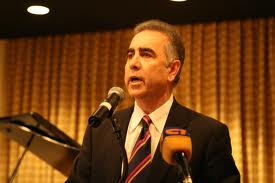
Australia Must Dismiss Foreign Minister For Denying the Armenian Genocide

Հարութ Սասունյան

By Harut Sassounian

www.TheCaliforniaCourier.com


The Turkish Sabah newspaper published last week the following disturbing news: “Australian FM: Armenian Case not Genocide.”


Sabah described the events that led to its nefarious headline. Gunay Evinch, board member and past president of the Assembly of Turkish American Associations (ATAA), had recently visited Australia to brief local Turkish groups on the Movsesian lawsuit. He told them that “the United States Supreme Court let stand a 9th Circuit Court of Appeals’ decision invalidating a California law that had defined the Armenian case as genocide, because it was US federal policy not to define the Armenian case as genocide.”


Sabah also reported that Evinch’s visit was “a part of a broader Anglo-Turkish Diaspora Cooperation Program in which Turks in the United States, Canada, United Kingdom, Australia and New Jersey (sic) share best practices based on a common jurisprudential and political heritage.”


Following Evinch’s advice, Ertunc Ozen, President of Australian Turkish Advocacy Alliance, wrote to Australia’s Foreign Minister Julie Bishop on May 5, “expressing concern at motions passed by the parliament of New South Wales in May 2013 regarding Turkey and the fate of various communities of the Ottoman Empire during and after World War I.”


Foreign Minister Bishop wrote to Ozen on June 4: “The Australian Government acknowledges the devastating effects which the tragic events at the end of the Ottoman Empire have had on later generations, and on their identity, heritage and culture.” Astonishingly, she added: “We do not, however, recognize these events as ‘genocide.’ Australian states and territories have no constitutional role in the formulation of Australian foreign policy. While respecting the rights of individuals and groups to have strong views on the matter, the long-standing and clear approach of the Australian Government has been not to become involved in this sensitive debate.”


The Foreign Minister is wrong on three counts: 1) She erred in stating that Australia does not recognize the Armenian Genocide. While the Australian government prefers not to use the term genocide in order not to antagonize Turkey, no other official has ever stated that it was not genocide; 2) She incorrectly wrote that the Australian states that recognized the Armenian Genocide were formulating foreign policy. These states had simply acknowledged a historical fact; and 3) She contradicted herself by stating that the Australian Government does not get involved “in this sensitive debate,” yet she did permit herself to get involved by stating that it was not genocide!


Vache Kahramanian, Executive Director of the Armenian National Committee of Australia, immediately dispatched a strongly-worded letter to the Foreign Minister, calling her ‘misguided statement’ ‘deeply insulting and hurtful to the Armenian-Australian community.’ He also characterized Bishop’s views as ‘intolerable,’ ‘inexcusable,’ ‘a grave offense,’ and ‘a disservice to all Australians.’ Kahramanian justifiably wondered, “How can Australia’s moral conscience become so corrupted?”


ANC-Australia’s Executive Director reminded the Foreign Minister that her statement was in stark contrast to “the views held by many senior ministers in the current government. As recently as April 2014, Australia’s Treasurer, the Hon. Joe Hockey MP, issued an official statement on the 99th anniversary commemoration of the Armenian Genocide marking April 24 as the day ‘we gather to remember the 1.5 million people who perished in the genocide.’ Ministers Turnbull, Morrison, along with ranking members from Labor, the Greens, minor parties and Independents have called on the Australian Parliament to officially recognise the events of 1915 as genocide. Australia’s Prime Minister, Tony Abbott, during his years as Opposition Leader, issued an annual statement referring to the Armenian Genocide with no qualifiers or euphemisms.”


Kahramanian also told the Foreign Minister: “By denying the Armenian Genocide you are also denying Australia’s very own history. Located within Australia’s National Archives are countless numbers of testimonies by ANZAC prisoners of war who were held captive in the Ottoman Empire…. These testimonies vividly recall the suffering and annihilation of the Armenian people.”


ANC-Australia Chairman Greg Soghomonian urged the Foreign Minister to “immediately reverse this critical error of judgment,” and requested a meeting with her.


I suggest that Australian-Armenians ask Prime Minister Tony Abbott whether the Foreign Minister had cleared her deeply offensive letter with him beforehand. If she had not, the ANC-Australia should demand her immediate dismissal. ANC should ask all three Australian state parliaments that have recognized the Armenian Genocide to adopt a new resolution condemning Foreign Minister Bishop’s denialist stand and urging the Prime Minister to fire her!


Turkish Counter-Efforts Help Publicize Genocide Centennial

Հարութ Սասունյան


By Harut Sassounian

www.TheCaliforniaCourier.com


Armenians in the US and around the world were needlessly alarmed by a recent article in the Turkish Hurriyet newspaper, titled: “Turkish Americans prepare ‘master plan’ for 2015.”


No one should be surprised that the Turkish government and affiliated organizations worldwide have been earnestly planning to counter commemorative activities being organized by the Armenian government and the Diaspora for the Centennial of the Armenian Genocide on April 24, 2015.


Tolga Tanis reported in Hurriyet’s July 5 issue that the Assembly of Turkish American Associations (ATAA) will invite Turkish-American groups to Washington in September to plan “proactive and active responses” to Armenian Centennial events.


ATAA reportedly will form Turkish “activist committees” to visit “lawmakers in each state, conduct social media campaigns, keep in touch with traditional media outlets, prepare online courses, and organize countrywide networking meetings for Americans.” Hurriyet also reported that ATAA will organize “at least 20 day-long conferences in partnership with local universities and with the participation of famous Turkish-Americans like Dr. Mehmet Oz and Coca Cola CEO Muhtar Kent.”


As part of its “reactive responses,” ATAA allegedly plans to counter:


— Articles, books and films on the Armenian Genocide;

— Panels, conferences and exhibitions organized by Armenians;

— “Anti-Turkish bills” in Congress.


Before Armenians get too excited about these purported Turkish schemes, the following questions must be asked:


— Is Hurriyet accurately reporting ATAA’s plans? The Turkish media is notorious for distorting facts and making up stories. Interestingly, no such announcement is found on ATAA’s website;

— If Hurriyet’s article is fully or even partly true, is it certain that ATAA will actually carry out any of its announced plans or is this simply a propaganda ploy or fundraising effort?


As a starter, it has come to our attention that at least one critical part of Hurriyet’s story is a falsehood! Ara Khachatourian, English Editor of Asbarez newspaper, reported that a spokesman for the prominent TV personality has denied that Dr. Oz is involved in any way in Turkish denialist activities. Likewise, I am trying to confirm if the alleged report about Coca Cola CEO Muhtar Kent’s involvement in genocide denial is accurate. It is noteworthy that Hurriyet has already amended its initial report, adding a disclaimer, possibly after complaints from Dr. Oz and Mr. Kent about the unauthorized and inaccurate use of their names: “The two individuals whose names are mentioned in the article above (Dr. Mehmet Oz and Coca-Cola CEO Muhtar Kent) are two prominent figures on a long list of accomplished Turkish Americans who will be invited to speak at community events. They have no knowledge of or involvement in ATAA’s plans.”


I wish Dr. Oz and Mr. Kent were actually involved in Turkish denialist efforts, which would have triggered a worldwide boycott of Dr. Oz’s TV show and Coca Cola products. This would have provided Armenians a golden opportunity for publicity on the Armenian Genocide Centennial that no amount of money could buy!


Moreover, my fervent hope is that Hurriyet’s article would turn out to be totally accurate and that ATAA would carry out fully all of the promised activities. The more often Turkish denialists raise the Armenian Genocide issue trying to counteract the established historical facts, the more they would be inadvertently publicizing the Genocide Centennial, and thereby disgrace themselves in the eyes of the world!


While Armenians are unable to make their voices heard loudly in the international arena, in an ironic twist, Turkey’s influential public relations firms in Washington would be of tremendous assistance! Equally helpful are the public pronouncements of Turkish leaders, such as the one by Prime Minister Erdogan on April 23, 2014, despite their denialist content. As an unintended consequence, ATAA’s anti-Centennial efforts would prompt the international media to pay ever greater attention to the continuing injustice suffered by Armenians, by providing more coverage to the planned Armenian commemorations.


Although Turkish counter-strategies should receive adequate scrutiny, Armenians should pay more critical attention as to whether they are preparing themselves appropriately to observe the Centennial in the global arena, given the immense loss of the 1.5 million martyrs of the Armenian Genocide. By being overly obsessed with the sinister actions of Turkish denialists, Armenians may not be focusing sufficiently on their own obligation to honor the sacred memory of the victims and demand justice!


Turkey’s Declining Support in Congress After Blunders at Home and Abroad

Էրդողան, Ֆեթուլլահ Գյուլեն,Թուրքիա

By Harut Sassounian

www.TheCaliforniaCourier.com


Due to Prime Minister Erdogan’s widespread human rights abuses of his own citizens and foreign policy blunders vis-a-vis Armenia, Cyprus, Egypt, Greece, Iran, Iraq, Israel, and Syria, Turkey has lost much of the support it once enjoyed in the United States, and indeed, around the world.


The most recent evidence of this downturn is the adoption of House Resolution 4347 (Turkey Christian Churches Accountability Act) on June 26 by the Foreign Affairs Committee. Because of souring relations between Ankara and Washington, the U.S. Government refrained from spending its political capital on the Hill to prevent the bill’s passage.


In addition, intra-Turkish feuds such as the one between Erdogan and Fethullah Gulen, a Turkish cleric with extensive influence in Turkey and abroad, have deprived Ankara of important grassroots support in the United States. Gulen-affiliated groups did not lift a finger to bail out Erdogan’s government from a humiliating defeat in the Foreign Affairs Committee.


Due to another internal political dispute, the Turkish Coalition of America refused to sign the joint letter sent by three other Turkish-American groups to House Committee members opposing the Churches bill. In a desperate search for supporters, the Turkish groups recruited to their lobbying efforts the Azerbaijan American Council, which has no business sticking its nose in a matter involving the status of Christian churches in Turkey. By signing such a hostile joint letter, the Azeri group further antagonized Armenians worldwide, making it more difficult to reach a fair settlement in the Karabagh (Artsakh) conflict.


Finally, the Turkish government’s clash with Israel after the Mavi Marmara attack and Turkey’s new Ambassador Serdar Kilic’s recent angry letter to the American Jewish Committee for recognizing the Armenian Genocide deprived Ankara of any lobbying support it used to receive in Congress from the Israeli government and some Jewish-American organizations.


In the absence of all support from its traditional allies, the Turkish government could only rely on its hired guns — highly-paid US lobbying firms — to implement the standard Turkish tactics used in opposing any initiative that Ankara deems to be against its interests:


1) Object firmly to any anti-Turkish initiative to prevent its consideration;

2) If step 1 does not work, propose amendments to dilute the initiative;

3) Even after diluting the initiative, pressure the committee members to vote against it.


In the case of the churches bill, the Turkish government failed to block its consideration by the House Foreign Affairs Committee and was unable to collect enough votes to defeat the measure. The only thing left for Ankara to do was having some members of the Congressional Turkish Caucus to propose amendments to dilute the bill. This tactic had a modest success because Cong. Ed Royce (Rep.-CA), Chairman of the House Foreign Affairs Committee, tried to reach a consensus on the bill and went out of his way to accommodate the handful of dissenting members of Congress. After all, who in their right mind would oppose a bill that called for the return of religious properties to their proper owners which happen to be the Christian churches!


This is the second major defeat that Turkey suffered in Congress in the last three months. The Senate Foreign Relations Committee had adopted an Armenian Genocide resolution with a vote of 12-5 on April 10 — a further indication of the declining Turkish political clout in Washington. One simply needs to read two recent articles in the New York Times (“After Opening Way to Rebels, Turkey is Paying Heavy Price”) and the Wall Street Journal (“An Unhelpful Ally”) to see the degree of damage Erdogan has caused to his country’s reputation.


In addition to the loss of clout, the Turkish government is wasting the millions of dollars it pays each year to high-powered, but apparently useless American lobbying firms that make big promises, pocket large amounts of money, and deliver practically nothing. When will the people of Turkey demand an account from their corrupt and irresponsible leaders who are throwing away Turkish citizens’ hard earned tax dollars in a vain attempt to whitewash their genocidal history?


Pundits are predicting that despite Prime Minister Erdogan’s dismal record both at home and abroad, he is expected to be elected president next August. Armenians, Greeks, Kurds and other oppressed ethnic and religious minorities are only too happy to see Turkey ruled by an incompetent leader who will bring the country to its knees!


Turkish Denialists Fail to Block Genocide Speech at Australian Parliament

Հարութ-Սասունյան1


By Harut Sassounian
www.TheCaliforniaCourier.com

The Armenian Genocide Centennial Committee of Australia had invited this writer to speak at commemorative events in Sydney and Melbourne, and deliver a formal address at the New South Wales Parliament during the week of April 24.

On April 27, the Australian Turkish Advocacy Alliance sent a three-page letter to all Parliament members urging them to boycott my presentation. A Parliament member forwarded a copy of the letter to the Armenian National Committee of Australia in advance of my talk on April 29. The cleverly-worded letter, most likely written by the Turkish Embassy’s professional lobbyists, made several false claims and defamatory accusations.
The Turkish denialist group sought to import Ankara’s human rights restrictions to a democratic country like Australia by trying to muzzle not only this speaker’s right to free speech, but also the Parliament’s right to invite whomever it chose. Calling me a ‘propagandist’ who ‘benefits from conflict and hatred,’ the Turkish letter ‘strongly’ advised Parliament members not to attend my talk.

Gunes Gungor, Executive Director of the Australian Turkish Alliance, falsely reported that I am ‘related’ to Hampig Sassounian, simply because I shared his last name. Hampig was convicted of assassinating the Consul General of Turkey in Los Angeles in 1982. While the life of any human being is precious, Gungor sheds crocodile tears over the death of a single Turkish diplomat, ignoring the wholesale killings of 1.5 million innocent Armenians! How would Gunes Gungor like it if I were to accuse him of being related to several criminals I found on the internet, just because they shared the same last name?

Gungor in his letter also badmouthed the distinguished jurist Raphael Lemkin who coined the term ‘genocide’ based on his detailed studies of the extermination of Armenians by the Ottoman Turkish government. In a desperate search for any reason to tarnish Lemkin’s impeccable reputation, Gungor claimed that “towards the end of the meetings because of his aggressive comments he [Lemkin] was asked to leave the room.” Gungor did not even know how to spell Lemkin’s first name.

The Turkish propagandist finally attempted to draw a distinction between the Armenian Genocide and the Jewish Holocaust. After pretending to be an expert on the Armenian Genocide, Gungor confessed his ignorance by stating that “much about the late Ottoman Empire has yet to be learned and many conclusions have yet to be drawn.”

Despite Gungor’s attempts to undermine my address, Parliament members and guests, including scholars, elected officials, and Jewish community leaders gave me a standing ovation. Surprisingly, Gungor showed up at the Parliament to hear me speak, not trusting his own ability to have the event cancelled. While members of the audience were given ample time to ask any question they wished, Gungor and his two Turkish colleagues did not ask a single question. More surprisingly, as the three Turks were leaving the Parliament hall, one of Gungor’s colleagues was overheard saying, “on nights like these, I wonder what we are doing here!”


My other talks took place with packed audiences without disruption. According to the ANC of Australia over 1,100 people attended my first talk on April 24 in Sydney. I gave a second talk the next night in the same city. I then spoke at a similar event on April 27 in Melbourne at the presence of around 500 guests.


The only sour note during my journey was Prime Minister Tony Abbott’s message sent to the Sydney commemoration. Taking a page from Pres. Obama’s playbook, Abbott used every other word (horror, tragedy, terrible events, lost lives) except for genocide in his brief message. Vache Kahramanian, Executive Director of the ANC of Australia, wrote to the Prime Minister, telling him that his message will not be read to the audience because it is “of great insult to the Armenian-Australian community with its blatant omission of the Genocide word.” Kahramanian reminded the Prime Minister of his previous year’s message while he was opposition leader in which he had properly characterized the Armenian Genocide. In contrast to the Prime Minister, Australia’s Treasurer, Joe Hockey, the country’s most senior government minister, issued a formal statement clearly acknowledging the Armenian Genocide.


I left Australia greatly impressed with the political activism of the Armenian community of 50,000 which runs circles around the much larger Turkish community of over 200,000.


Armenia Helps Coordinate Worldwide Genocide Centennial Activities

 Ցեղասպանության 100-ամյակ


By Harut Sassounian

www.TheCaliforniaCourier.com


Two important conferences took place in Yerevan last week in preparation for next year’s Armenian Genocide Centennial.


Participating in the first meeting, held on May 26, were representatives of Centennial Committees from 40 countries who reported on their plans for April 24, 2015. On this occasion, the emblem and motto for the Centennial were unveiled — “I remember and demand….”  The conference was a unique opportunity for the attendees to exchange contact information and discuss collaborative joint efforts.


The second meeting, held on May 27, brought together State Centennial Committee members, with representatives of the regional committees, and dozens of Armenian diplomats and high-ranking clergy from around the world. The State Committee consists of the leadership of Armenia and Artsakh (Karabagh), and heads of major Armenian organizations worldwide.


In a daring move, Pres. Sargsyan announced that he had invited the President of Turkey to visit Yerevan on April 24, 2015, in order to face the truth of the Armenian Genocide. Caught by surprise, Turkish officials have yet to respond to this challenging invitation. The Armenian President also informed the conference participants that he had invited several other heads of state to Yerevan on that date. French President Francois Hollande has already confirmed that he plans to be in Yerevan on the Genocide’s Centennial.


After presentations by State Committee members, representatives from Argentina, France, Lebanon, Russia, and the United States were given the opportunity to address the conference. I was also asked to speak in my capacity as Co-Chair of the Armenian Genocide Centennial Committee of the Western United States.


I began by explaining that Armenians around the world should not be obsessed with the expectation that Pres. Obama would include the word genocide in his ‘memorial’ statement of April 24, 2015. Contrary to popular misconception, the United States government has repeatedly recognized the Armenian Genocide, starting in 1951 with an official document submitted to the World Court; House of Representatives resolutions in 1975 and 1984; and Pres. Ronald Reagan’s Presidential Proclamation of April 22, 1981. Consequently, there is no crucial need to insist that Pres. Obama also acknowledge the Armenian Genocide, save for the purpose of fulfilling his promise and sustaining his integrity.


In my talk I also suggested that since the Armenian Genocide lasted from 1915 to 1923, the planned Centennial activities should extend from 2015 to 2023. This would be a true nightmare for the Turkish government, having to confront not one, but eight years of Centennial events.


Since the Centennial is a historic milestone, I urged Armenian communities around the world to organize unique events which have a mass appeal and the potential of generating nationwide or worldwide publicity for Armenians’ just demands from Turkey. The same old annual events should not be repeated on the occasion of the Centennial. However, before initiating any project, it is incumbent on all Armenian communities to first agree on the objectives to be accomplished and decide whether the planned activities meet those goals.


I proceeded to read to the conference participants the mission statement of the Armenian Genocide Centennial Committee of Western United States:


“The 100th anniversary of the Armenian Genocide signifies a global demand for justice by Armenians worldwide and all people of good will.

The Centennial marks one of the 20th century’s greatest crimes against humanity. In 1915, the Turkish Government began a premeditated and systematic campaign to uproot the Armenian population from its ancestral homeland and slaughter 1.5 million defenseless men, women and children.

Turkey must finally acknowledge its responsibility for the Genocide and make appropriate moral, financial, and territorial restitution, as mandated by the fundamental norms of international law and civilized society.”


I concluded my remarks by suggesting that Armenians worldwide coordinate their Centennial activities so that the same message is delivered to friend and foe alike. I also proposed that the motto chosen by the State Committee be modified from “I remember and demand” to “We remember and demand justice!”


While this gathering should have been held much earlier, it was most useful in terms of coordinating the planned Centennial activities. Not surprisingly, Turkish Foreign Minister Ahmet Davutoglu announced last week that his government was closely monitoring the Centennial Committee’s Yerevan meetings. Fortunately, the organizers in Armenia were cautious not to make public the Centennial plans to keep Turkish officials in the dark, giving them as little time as possible to counter the Armenian initiatives!


Why Turks were Able to Exterminate Armenians, but not Jews

Հարութ-Սասունյան1


By Harut Sassounian

www.TheCaliforniaCourier.com


(Part II)


This is the second and final part of a column I wrote last month, analyzing why the Young Turks were able to exterminate the Armenians, but could not carry out their simultaneous plan to eliminate the Jewish settlers of Palestine.


On May 9, 1917, Reuters disseminated the following news report by settler Aaron Aaronsohn: “an order was given to deport all Jews from Tel Aviv, including citizens of the Central Powers [Germany and Austria-Hungary], within 48 hours. A week before, 300 Jews were expelled from Jerusalem. Jamal Pasha declared that their fate would be that of the Armenians. The 8,000 deportees from Tel Aviv were not allowed to take any provisions with them, and after the expulsion their houses were looted by Bedouin mobs.”


Shortly thereafter, Oskar Cohen, a Jewish socialist member of the German Parliament, asked the Chancellor to press the Turkish government “to vigorously prevent the recurrence in Palestine of atrocities” against Jews similar to the ones committed against the Armenians.


On June 8, Aaronsohn wrote in his diary: “The cry we raised was effective. The Turks and the Germans were quick to realize that one cannot get away with slaughtering the Jews like the Armenians. German financing of the war might have suffered because of the Jews. Therefore they ceased the new deportations.”


Palestine, the official journal of the British Zionist movement, described the significant difference between the lobbying capabilities of Jews and Armenians: “The German government knows that the Jews do not compare to the Armenians in terms of their world power, and that the weight of the Jews in Germany is therefore different from that of the Armenians.”

Mordecai Ben-Hillel Hacohen, a prominent chronicler of Jewish history in Palestine, wrote in his diary of March 30, 1917: “the Turkish government has been stained in the eyes of the whole country because of its crime against the Armenians, and perhaps the government will reconsider its thoughts of doing thus to the Jews as well….”

Moshe Smilansky, a leader of the Jewish agricultural settlements in Palestine, after relating reports of the terrible massacres of Armenians, concluded: “The testimony of the eye witnesses aroused fear and panic in the Jewish audience. Who knows what would have been our fate were it not for Morgenthau, the American representative in Constantinople, and the fear of the world press which is ‘controlled’ by the Jews.”


Yair Auron reported in his book that Meir Dizengoff, a leader of the Jewish refugees in Palestine throughout World War I, “worked in close cooperation with the Zionist delegation in Constantinople, which was pro-German and pro-Turkish. According to Dizengoff, there were also excellent relations with the German consul in Palestine…. The consul served as a conduit for transferring funds to the Yishuv [Jewish community], on orders from the German Ambassador in Constantinople.” Dizengoff also stated that the Germans were the ones who assisted and saved the Yishuv. “The fact that Jamal Pasha became more sympathetic to the Jews was due to Germany.” Dizengoff recalled Jamal and Enver Pashas’ threats to the Jews: “Zionists beware! If you oppose us, we will do to you what we have done to the Armenians.”


In October 1917, when the Turkish authorities uncovered the Jewish Nili spy ring, a new threat loomed over the Jewish settlers in Palestine, giving yet another excuse for the Turks to oppress them. They feared that such anti-Turkish efforts would result in harsh counter-measures as practiced against Armenians. The Turkish Governor of Haifa met with Jewish leaders of the village of Zichron Yaakov on October 4, 1917, and threatened that unless they cooperated with his demands, he would do to them what he did to Armenians. He told them that he “barehandedly killed several Armenians, and his soldiers killed thousands of them.” Chaim Margalit-Kalvarisky, the representative of the Jewish Colonization Association in Galilee, wrote the following note in his diary: “I received word from a fairly dependable source that the [Turkish] high command was very angry at the Jewish settlement, and they were consulting about the possibility of a general deportation of all the Jews of Palestine to the furthest provinces of the Empire [Eastern Anatolia].” Kalvarisky recorded Jamal Pasha’s ominous words after a heated exchange with him: “Heaven help the people whose sons are those cursed spies. We taught the Armenian people a lesson about such deeds, and we will not hesitate to take the same steps in this case.”


Having witnessed the brutality of the Turks against Armenians who were accused of insubordination and rebellion, the Jewish settlers decided to be completely submissive and not challenge the Turkish authorities. Prof. Auron observed that “there was not a single attack by a Jewish settler on a Turkish soldier.” What ultimately saved the Jews was the occupation of Palestine by the British forces, precluding further brutalities and massacres by the Turkish authorities.


At the end, 1.5 million Armenians were wiped out, whereas the Jewish settlers of Palestine suffered relatively minor losses. During the war years, the Jewish population of Palestine was reduced from 86,000 to 55,000. Despite the fact that Armenians had also their advocates in Europe and the United States, the Jewish settlers enjoyed the double protection of powerful countries on both sides of the war: the Western countries, including the United States, and Germany, Turkey’s military ally. Vahakn Dadrian, in his book, “The History of the Armenian Genocide,” relates that Hans Wangenheim, the German Ambassador to Turkey, told US Ambassador Henry Morgenthau: “I will help the Zionists… but I shall do nothing for the Armenians.”


While Germany saved the Jewish settlers of Palestine, it assisted the Young Turk regime to exterminate the Armenians.


Turkey Becomes a Rogue State By Rejecting European Court’s Verdict

Հարութ Սասունյան


By Harut Sassounian

www.TheCaliforniaCourier.com


The European Court on Human Rights (ECHR) issued on May 12 its largest judgment ever against any country, ruling that Turkey had to pay $123 million as compensation to relatives of missing Greek Cypriots and residents of a Greek enclave in Northern Cyprus.


The Cyprus vs. Turkey lawsuit was filed in 1999, twenty five years after the Turkish occupation of Northern Cyprus. In 2001, after ruling that the Turkish government had violated numerous articles of the European Convention on Human Rights, ECHR postponed making a determination of the penalty to be assessed to Turkey.


That decision came earlier this month, when the 17 judges of ECHR’s Grand Chamber issued their final judgment. By a vote of 16 to 1 (the Armenian and Cypriot judges voted with the majority, while the Turkish judge was the lone dissenter), ECHR ruled that the intervening 13 years had not invalidated the court’s 2001 judgment, as claimed by Turkey. By a vote of 15 to 2, ECHR held that the Turkish government had to pay $41 million, plus any tax and interest (if not paid within three months) for 1,456 Greek Cypriots missing as a result of Turkey’s invasion of Cyprus in 1974. By another 15 to 2 votes, ECHR judges decided that Turkey had to pay an additional $82 million plus any tax and interest (if not paid within three months) for damages suffered by residents of the Greek Cypriot enclave of Karpas peninsula in Turkish-occupied Northern Cyprus.


Right before the court’s judgment, Turkish Foreign Minister Ahmet Davutoglu made a vain attempt to derail ECHR’s anticipated negative decision by warning that a ruling against Turkey would undermine the ongoing negotiations to reach a settlement on the Cyprus conflict. The court rightfully ignored Davutoglu’s threat and went on to issue its firm judgment in favor of Cyprus.


Having failed to bully the judges, Davutoglu disdainfully declared that Turkey rejects the verdict of Europe’s top human rights court and boasted that his country will refuse to pay the $123 million in damages.


Davutoglu should be reminded that ECHR’s “Grand Chamber judgments are final” — not subject to appeal — and “all final judgments are transmitted to the Committee of Ministers of the Council of Europe for supervision of their execution,” according to the court’s records.


Turkish Foreign Minister’s arrogant declaration will certainly come back to haunt his government in the not too distant future. All members of the Council of Europe, without exception, are obligated to comply with ECHR’s rulings. The court’s judgments are binding on all member states. During the past several decades, Turkey has lost hundreds of judgments in the European Court and has paid, whether it liked it or not, countless millions of dollars in penalties. Turkey has no other choice, if it wants to remain a member of the Council of Europe. There have been some ECHR cases where Turkish officials had initially vowed that they would not pay the assessed penalties, but eventually fully paid the required compensation plus interest.


If the Turkish government sticks with Davutoglu’s boastful rejection, not only Turkey could be stripped of its membership in the Council of Europe, but also forfeit its slim chance of joining the European Union!


Member states of the Council of Europe do not have the right to decide whether they are willing to abide by ECHR’s judgments. Otherwise, why would 47 European countries collectively spend almost $100 million a year to maintain a court if its judgments are meaningless or subject to voluntary compliance?


Recently, Turkish leaders have gone on a rampage flaunting domestic and international laws, by jailing a record number of journalists, firing on peaceful demonstrators in Gezi Park, beating family members of a mine explosion victims, making anti-Semitic statements, threatening to expel the US Ambassador, and waving a finger at Pres. Obama in the White House!


The Council of Europe’s Committee of Ministers should not tolerate a rogue member state which is a major violator of human rights. The Council should put Turkey on notice that unless it makes immediate arrangements to pay the $123 million penalty, it would be expelled from the Council of Europe and have its assets in third countries seized to enforce the court’s judgment.


Europe should take a firm stand on this judgment, as there will be many more such verdicts against Turkey on Cyprus and possibly someday on Armenian restitutional and territorial demands….


Անկախ


Obama Listens to Repeated References To Armenian Genocide at Shoah Gala

Հարութ Սասունյան
By Harut Sassounian


On May 7, I attended a very impressive benefit gala at the Hyatt Regency Century Plaza hotel in Los Angeles, celebrating the 20th anniversary of the USC Shoah Foundation which archives the testimonies of survivors and witnesses of the Jewish Holocaust, the Armenian, Cambodian and Rwandan genocides, and the 1937 Nanjing Massacre.


Internationally acclaimed Oscar-winning director Steven Spielberg, after filming Schindler’s List, established the Shoah Foundation to collect and preserve the personal accounts of survivors and other witnesses of the Holocaust. In 2006, the Shoah Foundation became part of the University of Southern California and currently holds 52,000 video testimonies in 34 languages, representing 58 countries. It is the largest archive of its kind in the world.


The gala was attended by Pres. Obama who received the “Ambassador for Humanity” award. Also in attendance were Samuel Jackson, Octavia Spencer, Barbra Streisand, Liam Neeson, and Bruce Springsteen who performed two of his poignant songs, “Promised Land,” and “Dancing in the Dark.”


In 2010, the Armenian Film Foundation and J. Michael Hagopian signed a historic agreement with the Shoah Foundation to digitize, preserve, and disseminate filmed interviews with survivors and witnesses of the Armenian Genocide. Last month, 400 digitized copies of the Armenian testimonies were delivered to USC Shoah Foundation’s Institute for Visual History and Education. By the Centennial of the Armenian Genocide on April 24, 2015, the Armenian testimonies, after they are translated, subtitled, and indexed, will be made available along with eyewitness accounts of the Holocaust and other genocides to 50 institutions (including the US Holocaust Museum) in 30 countries.


Nearly 100 Armenian-Americans attended the May 7 gala, raising over $100,000 for the Armenian collection at Shoah. During the evening’s program, several speakers made references to the Armenian Genocide. Spielberg was the first to announce that the Armenian Genocide testimonies were to be included in the Shoah archives. A video shown to the attendees featured several photographs of J. Michael Hagopian, genocide survivor Paul Andonian, and Armenian deportees on a death march. Shoah Foundation Executive Director Stephen Smith also spoke about the Armenian Genocide, acknowledging the presence of Yevnige Salibian, a 104-year-old genocide survivor from Aintab. Banquet host comedian Conan O’Brien, after acknowledging Mrs. Salibian’s presence from the podium, walked over to her table when the gala ended and had a picture taken with her.


As an honored guest, Salibian was seated next to TV celebrity Kim Kardashian. The following day, Kardashian posted on social media her photograph with Salibian, adding the following message: “Honored to be at the USC Shoah Foundation event to support Armenian Genocide testimonies. I’m sitting next to the most inspiring 100-year-old Armenian Genocide survivor.” Within few days, her posting received close to 400,000 ‘likes’ and almost 5,000 comments on Instagram, and 110,000 ‘likes’ on her facebook page.


Despite repeated references to the Armenian Genocide from the podium, Pres. Obama did not make any direct references to Armenians or the Armenian Genocide in his 18-minute speech — nor was he expected to do so! However, the President made indirect references to genocides other than the Holocaust, without specifying them:


— “I want to say a special word to the survivors who are with us this evening, not just of the Holocaust, but as Steven [Spielberg] noted, survivors of other unimaginable crimes.”

— “If the memories of the Shoah survivors teach us anything, it is that silence is evil’s greatest co-conspirator. And it’s up to us — each of us, every one of us — to forcefully condemn any denial of the Holocaust.”

— “You [Spielberg] …documented the experience not only of the Holocaust, but of atrocities before and since…. To you and everybody at the Shoah Foundation, and for all that you’ve done, for setting a light, an eternal flame of testimony, that can’t be extinguished and cannot be denied, we express our deepest gratitude.”


Armenians do not need to press Pres. Obama to explicitly refer to the Armenian Genocide. Another US President, Ronald Reagan, has already acknowledged it in his Presidential Proclamation of April 22, 1981. It is unnecessary to insist that every US President make the same acknowledgment year after year. Pres. Obama may consider using the term Armenian Genocide not for the sake of Armenians, but to uphold his own integrity by keeping the solemn pledge he made as a presidential candidate. Only then could he fully qualify as an “Ambassador for Humanity.”


Why Turks Were Capable of Exterminating Armenians, but not Jews

Հարութ Սասունյան

By Harut Sassounian

Publisher, The California Courier


Endless comparisons are made between the Armenian Genocide and the Jewish Holocaust. However, there is yet another comparison that is rarely made: the Turkish ability to carry out the Armenian Genocide and inability to eliminate the Jewish settlers from Palestine during the same period. Such a comparison has not been made because hardly anyone has studied the Turkish deportation plans of Jews during World War I in relationship to the Armenian Genocide.


My preliminary analysis is based on information gleamed from Prof. Yair Auron’s book, “Zionism and the Armenian Genocide: The Banality of Indifference,” Vartkes Yeghiayan’s “Pro Armenia,” and other archival materials. I would like to detail the circumstances of deportations of the Jews and how they were mostly spared, while Armenians were not! More importantly, what steps did the Jewish Diaspora and settlers in Palestine take to avoid suffering Armenians’ tragic fate?


Armenians and Jews, as minorities in the Ottoman Empire, were convenient scapegoats for the whims of ruthless Turkish leaders. Interestingly, the Young Turks used the same arguments for deporting both Armenians and Jews. The Turks had accused Armenians for cooperating with the advancing Russian Army, while similarly blaming Jews for cooperating with British forces invading Ottoman Palestine. Furthermore, Jews were accused of planning to establish their own homeland in Palestine, just as Armenians were allegedly establishing theirs in Eastern Turkey. In yet another parallel, Jamal Pasha, one of the members of the Young Turk triumvirate, had cynically commented that he was “expelling the Jews for their own good,” just as Armenians were forcefully removed “away from the war zone” for their own safety!


In 1914, when Turkey entered World War I on the German side and against the Allied Powers (England, Russia, and France), Palestine became a theater of war. Turkish authorities imposed a war tax on the population, which fell more heavily on the Jewish settlers. Their properties and other possessions were confiscated by the Turkish military. Some Jewish settlers were used as slave labor to build roads and railways. Alex Aaronsohn, a Jewish settler in Zichron Yaacov, wrote in his diary: “an order had recently come from the Turkish authorities, bidding them surrender whatever firearms or weapons they had in their possession. A sinister command, this: we knew that similar measures had been taken before the terrible Armenian massacres, and we felt that some such fate might be in preparation for our people,” as quoted in Yeghiayan’s Pro Armenia.


In Fall 1914, the Turkish regime issued an expulsion order for all ‘enemy nationals,’ including 50,000 Russian Jews who had escaped from Czarist persecutions and settled in Palestine. After repeated intercessions by German Ambassador Hans Wangenheim and American Ambassador Henry Morgenthau, these ‘enemy nationals’ were allowed to stay in Palestine, if they agreed to acquire Ottoman citizenship.


Nevertheless, on December 17, 1914, Jamal Pasha’s subordinate, Bahaeddin, governor of Jaffa, implemented the expulsion order, deporting 500 Jews who were grabbed from the streets and dragged to police headquarters, and from there forced to board ships docked in the harbor. Homes of Jewish settlers were searched for weapons. Hebrew-language signs were removed from shops and the Jewish school of Jaffa was closed down. Zionist organizations were dissolved, and on January 25, 1915, the Turkish authorities issued a declaration against “the dangerous element known as Zionism, which is struggling to create a Jewish government in the Palestinian area of the Ottoman Kingdom….”


In response to protests from Amb. Morgenthau and the German government, Constantinople reversed the deportation order and Bahaeddin was removed from his post. According to Prof. Auron, the condition of the Jewish settlers could have been much worse had it not been for “the influence of world Jewry on Turkish policy…. The American, German, and Austrian Jewish communities succeeded in restraining some of its harsher aspects. Decrees were softened; overly zealous Turkish commanders were replaced and periods of calm followed the times of distress.”


Back in 1913, Pres. Wilson had instructed Amb. Morgenthau upon his appointment: “’Remember that anything you can do to improve the lot of your co-religionists is an act that will reflect credit upon America, and you may count on the full power of the Administration to back you up.’ Morgenthau followed this advice faithfully,” according to Isaiah Friedman’s book, “Germany, Turkey and Zionism: 1897-1918.” After arranging for the delivery of much needed funds from American Jews to Jaffa, Morgenthau wrote to Arthur Ruppen, director of the Palestine Development Association: “I have been the chosen weapon to take up the defense of my co-religionists….”

In Spring 1917, the Turkish authorities issued a second order to deport 5,000 Jews from Tel Aviv. Aaron Aaronsohn, leader of the Nili group – a small Jewish underground organization in Palestine working for British intelligence – immediately disseminated the news of the deportation to the international media. Aaronsohn secretly met with British diplomat Mark Sykes in Egypt and through him sent an urgent message to London on April 28, 1917: “Tel Aviv has been sacked. 10,000 Jews in Palestine are now without home or food. Whole of Yishuv [Jewish settlements in Palestine] is threatened with destruction. Jamal [Pasha] has publicly stated Armenian policy will now be applied to Jews.”


Upon receiving Aaronsohn’s reports from Palestine, Chaim Weizmann, a key pro-British Zionist in London, transmitted the following message to Zionist leaders in various European capitals: “Jamal Pasha openly declared that the joy of Jews at the approach of British troops would be short lived as he would them share the fate of the Armenians…. Jamal Pasha is too cunning to order cold-blooded massacres. His method is to drive the population to starvation and death by thirst, epidemics, etc….”


American Jews were outraged hearing of the deportations in Palestine. News reports were issued throughout Western countries on “Turkish intentions to exterminate the Jews in Palestine,” according to Prof. Auron. Moreover, influential Jewish businessmen in Germany and the Austro-Hungarian Empire demanded that their governments pressure Turkish leaders to abandon their plans to deport Jews. Jamal Pasha was finally forced to rescind the expulsion order and provided food and medical assistance to Jewish refugees in Tel Aviv.


(to be continued)


 Անկախ

What Should Armenians Learn From Prime Minister Erdogan?

Հարութ-Սասունյան1


By Harut Sassounian


Publisher, The California Courier


The purpose of this column is to draw lessons from the recent attacks on the Armenian town of Kessab in Syria.


Last week, Turkish Prime Minister Recep Tayyip Erdogan took two bold actions: 1) he blocked Twitter, a social media site with 12 million users in Turkey, to cover up revelations of corruption about himself and his inner circle; and 2) he aided and abetted the Jihadist fighters’ invasion of Kessab, located in the Northwest corner of Syria, bordering Turkey!


What do these two seemingly unrelated events have in common?


Erdogan himself indirectly answered this question, during a campaign rally on March 20: “we will wipe out Twitter. I don’t care at all what the international community says. Everyone will see the power of the Turkish Republic.”


Clearly, the Prime Minister does not care that he would be criticized for violating the democratic principle of freedom of expression and acting as an autocratic thug. He says and does whatever he thinks is in Turkey’s or his own best interest!


US officials reacted by paying mere lip service to Erdogan’s internet crackdown. Samantha Power, US Ambassador to the United Nations, tweeted the following message: “Deeply troubling that Turkey blocked Twitter. Shutting down free access to info inconsistent with democracy; support citizens’ call to unblock.” Douglas Frantz, Assistant Secretary of State for Public Affairs and former managing editor of the Los Angeles Times, who was forced to resign after blocking publication of an article on the Armenian Genocide, described Erdogan’s anti-Twitter action as: “21st century book burning.” Similar benign criticisms were voiced by State Department spokeswoman Jen Psaki, White House Press Secretary Jay Carney, and European Union Digital Agenda Commissioner Neelie Kroes.


Did Erdogan care about these verbal lashings? Absolutely not! He didn’t give a damn! He had already blocked YouTube for two years, because the website carried videos deemed insulting to Kemal Ataturk. The Turkish Prime Minister now threatens to ban both facebook and YouTube after the March 30 elections.


Why don’t Armenian leaders — in Armenia and Diaspora — act more boldly, similar to Erdogan, especially when the survival of Armenians is at stake? It is most appropriate to raise such a question after the invasion of Kessab byJihadists, taking Armenian hostages, pillaging their homes, and desecrating their churches.


Regrettably, repeated pleas by Armenian-American organizations to US officials, to help protect Armenians and other Syrian Christians, have fallen on deaf ears. On March 24, the ANCA sent another strongly-worded letter to Pres. Obama, demanding immediate White House and congressional intervention to stop the attacks on Kessab. The US government does not seem interested in the tragic fate of Syrian-Armenians and other minorities, since Washington is hell-bent on toppling Bashar al-Assad’s regime, ignoring the loss of innocent lives.


Armenians should not be content by merely shaking their heads and complaining to each other about the tragic news emanating from Syria. They must wake up from their collective coma and take bold action. Daily demonstrations must be held in major U.S. cities and in front of American, British, French, Saudi, and Turkish embassies and consulates around the world to protest their arming of so-called rebels who are kidnapping and murdering Syrian Armenians, among many others.


Urgent meetings should be held with top US, British and French officials, demanding that they immediately halt deliveries of all weapons and financial assistance to ‘rebels’ in Syria, until they cease attacks on civilians!


I wrote a column back in 2002 with the following headline: “The Armenian ‘Mouse’ Needs to Roar More Often.” Basically, it was a call for bolder action. I had referred to the short story written by William Saroyan, titled: “The Armenian Mouse,” in which a brave mouse, by its aggressive behavior, manages to defend itself from more ferocious beasts.


Remaining silent and inactive are no longer viable options, while our compatriots are getting slaughtered in Syria. Sheepish behavior only serves to embolden the enemies of the Armenian nation.


Armenians need to be proactive rather than reactive. On the eve of the Genocide Centennial, they cannot be silent bystanders while the Turkish government and its allies are directly or indirectly embarking on a new campaign of exterminating Armenians in Syria.


Armenians must speak up, protest, and take effective action to defend their countrymen in all corners of the world. They need to become the ‘mouse’ that ROARS!


Անկախ

Senator McCain Offends Visiting Syrian Church Leaders

Հարութ Սասունյան


By Harut Sassounian

Publisher, The California Courier


Sen. John McCain is a prime example of how U.S. officials so often have misjudged overseas crises, believing that the best way to bring democracy to a country is through massive US bombing and invasion.


The Arizona Senator has been highly critical of Pres. Obama’s ‘arm the rebels strategy,’ urging a more direct US military intervention in Syria. Sen. McCain does not seem to understand that toppling Pres. Bashar Al-Assad would result in more deaths and destruction, and turn Syria into a major hub of international terrorism. Over 30,000 Islamic Jihadists from dozens of countries currently are fighting the Syrian government and each another — surely, not to bring democracy to Syria!


In fact, the former Republican presidential candidate is so obsessed with beating the drums of war that reportedly he behaved in an ill-tempered and discourteous manner with a group of high-ranking Christian Syrian leaders, just because they were not advocating violent regime change. The church delegation had come to Washington last month seeking a peaceful resolution to the Syrian conflict and protection for Christians numbering around two million — 10% of the country’s population.


The visiting Church leaders included Bishop Armash Nalbandian, Primate of the Armenian Apostolic Church of Damascus, and representatives of the Presbyterian, Evangelical, Syrian Orthodox, and Greek Orthodox churches of Syria. The delegation met with members of Congress, State Department officials, U.S. NGO’s, academics, religious leaders, and members of the media.


The Syrian clergymen were gratified with their Washington visit, except for their unpleasant encounter with Sen. McCain, as described by Judicial Watch:


“Hell-bent on arming opposition forces in Syria — despite strong evidence that they’re run by Islamic terrorists — John McCain displayed behavior unbecoming of a United States Senator during a recent meeting with Syrian Christian leaders touring Capitol Hill.… Senator McCain, an Arizona Republican, evidently doesn’t want to hear negative stories about the rebels he’s working to arm. So he stormed out of a closed-door meeting with the Syrian clergy officials last week…. McCain marched into the committee room yelling, according to a high-level source that attended the meeting, and quickly stormed out. ‘He was incredibly rude,’ the source told Judicial Watch…. Following the shameful tantrum, McCain reentered the room and sat briefly, but refused to make eye contact with the participants, instead ignoring them by looking down at what appeared to be random papers.”


During their meetings in Washington, the Syrian Christian leaders informed U.S. officials about the unfolding massive human tragedy in their country and the precarious situation of Christian communities; kidnapping of Christian Bishops, priests, nuns, and parishioners; attacks on Christian villages; desecration of churches and holy sites; and violations of religious freedom by armed Islamists.


Given the escalating bloodshed in Syria, the Church leaders asked the United States to:

— End all military and financial aid to armed rebels;

— Demand from U.S allies — Saudi Arabia, Qatar, and Turkey — not to support the terrorists;

— Ask that all sides of the conflict stop the violence, including bombings and terrorism;

— Resolve the conflict through dialogue, not military action;

— Ensure the Syrian people’s security;

— Protect the Christian minorities;

— Protect the churches and mosques;

— Protect religious, historical, and cultural monuments;

— Assist in the distribution of humanitarian aid in Syria.


The website of the Syrian Armenian Committee for Urgent Relief and Rehabilitation (SACURR) — www.syriashdab.com — reported that as of Sept. 30, 2013, the war caused serious harm to the Armenian community: 64 civilians murdered, 172 injured, 110 kidnapped, and 15 soldiers killed in action. Moreover, various Armenian institutions were damaged: seven Apostolic and three Catholic churches; 13 schools; and 10 community centers.  Close to half of 65,000 Syrian-Armenians has fled to Armenia, Lebanon and elsewhere.


SACURR, composed of nine major Armenian social, religious and political organizations in Syria, reported that by the end of September it had received $1.7 million from overseas Armenian entities. Even though this is a small fraction of the amount needed, SACURR has been able to provide food, shelter, security, and medical and educational assistance to Syrian Armenians, including $500,000 in tuition aid to 6,436 students in 38 schools.


Sen. McCain and other foolhardy U.S. officials would do well to heed the wise counsel of the visiting Syrian Christian leaders. Dispatching more weapons to Syria would only exacerbate the fighting, resulting in endless bloodshed.


 Անկախ

Canadian Turks Should Condemn, Not Condone, Genocide Denial

Հարութ Սասունյան

By Harut Sassounian

Publisher, The California Courier


Canadian Turks launched a petition last month seeking the removal of all references to the Armenian Genocide from the 11th grade curriculum of Toronto high schools.


This petition is a part of Turkish denialists’ long-standing efforts to reverse the Toronto District School Board’s (TDSB) 2008 decision to educate students about the Armenian, Jewish, and Rwandan genocides. TDSB’s action follows the recognition of the Armenian Genocide by the Canadian Senate in 2002 and the House of Commons in 2004. In addition, since 2006, successive Canadian Prime Ministers have issued official annual statements acknowledging the Armenian Genocide, despite intensive political pressure and economic blackmail by the Turkish government.


Back in 2008, a similar Turkish petition failed to sway TDSB to amend the genocide curriculum, after gathering over 11,000 signatures, mostly from Turkey. Indeed, the Ankara government and its Turkish proxies in Toronto have done everything possible during the past seven years to undermine this curriculum.


Below are the baseless claims made by the Turkish petition against TDSB’s genocide curriculum, followed by my rebuttal:


— Turkish Petition: “As the Turkish/Turkic speaking parents of students attending the Toronto District School Board, we are deeply concerned about the negative impact of the current curriculum module on ‘Armenian Genocide’ and the learning resources adopted by the Board since 2008.”


My response: There has been NO violence or intimidation against a single Turkish student in Toronto schools even though the genocide curriculum has been taught there for several years. The reason is that Armenians do not hold today’s Turks responsible for the crimes committed by the Government of Ottoman Turkey almost 100 years ago, except those who associate themselves with these crimes by their denial. The Republic of Turkey, on the other hand, as successor to the Ottoman Empire, is responsible for the continuing consequences of the Armenian Genocide. Denying the facts of the Genocide has a far more serious negative psychological impact on Armenians than its inclusion in the curriculum on Turks. Furthermore, the truth cannot be concealed in order not to offend the sensibilities of those who wish to cover up historical facts. Would anyone advocate erasing all references to the Jewish Holocaust from history books not to offend present-day Germans?


— Turkish Petition: “The textbook on the Genocide of the Armenians and other readers, such as Barbara Coloroso’s Extraordinary Evil, unremittingly discredits one community’s narrative over the other; and, adversely affects the students of TDSB with Turkish and Turkic heritages.”


My response: There cannot be two narratives or two versions of the proven facts of the Armenian Genocide. There can only be one version — the truth!


— Turkish Petition: “We firmly believe that the values of mutual respect, understanding and peaceful coexistence can be achieved through an honest and open dialogue on history. Moreover, fair and unprejudiced learning should be based on historical facts and not solely on the narratives of select communities while ignoring others. It should also be noted that there are no court decisions on any of these historical claims and the opinions of historians differ regarding the details and the definitions of these events.”


My response: ‘Mutual respect, understanding and peaceful coexistence’ cannot be achieved through distortions and lies. Only after acknowledging the truth and making appropriate amends, Canadian Turks can talk about such lofty ideals. Furthermore, contrary to the Turkish claims, there are several court verdicts on the Armenian Genocide, starting with the Turkish Military Tribunals of 1919, and judgments by Argentinean, Swiss, and U.S. courts. Significantly, the UN Sub-Commission on Prevention of Discrimination and Protection of Minorities adopted in 1985 a report acknowledging the Armenian Genocide. The ultimate arbiter of any genocide is the United Nations, since the Genocide Convention is a UN document.


To sum up, this latest Turkish petition is a total failure since its initiator, the Federation of Canadian Turkish Associations, has so far collected less than 2,000 signatures out of a claimed membership of 200,000 in Canada. Interestingly, most of the signatories are not from Canada, but Turkey where the petition has been widely circulated.


A more worthwhile initiative for Canadian Turks would be to start a petition urging the Turkish government to acknowledge the Armenian Genocide and make proper restitution to the descendants of this heinous crime on the occasion of the Genocide’s Centennial.

Անկախ

Switzerland Must Appeal European Court’s Verdict on the Armenian Genocide

Հարութ Սասունյան

By Harut Sassounian
Publisher, The California Courier

The European Court of Human Rights issued last week a critical Armenian Genocide-related ruling in the case of Dogu Perincek vs. Switzerland.

Perincek, the leader of a minor Turkish political party, had traveled to Switzerland in 2005 with the intention of daring the Swiss authorities to punish him for denying the Armenian Genocide. He brazenly called the Armenian Genocide an “international lie.”

In response to a criminal complaint filed by the Switzerland-Armenia Association, Perincek was tried and fined for racial discrimination by the Lausanne Police Court in March 2007. A Swiss Appeals Court confirmed his sentence, ruling that he had violated Article 261bis of the Criminal Code. The National Council (parliament) of Switzerland had already recognized the Armenian Genocide in 2003. Perincek then appealed his case to the Federal Tribunal, the highest court in Switzerland, which reconfirmed his sentence.

On June 10, 2008, Perincek appealed his sentence to the European Court of Human Rights in Strasbourg, claiming that many of his rights, including freedom of expression, were violated by the Swiss courts. He demanded a compensation of 140,000 euros for moral and financial damages, and court expenses.

On Dec. 17, 2013, the European Court dismissed most of Perincek’s claims (Articles 6, 7, 14, 17, 18 of the European Convention) and rejected his demand for compensation. However, five out of the seven Judges ruled that Switzerland had violated Perincek’s right to free expression (Article 10).

This was a highly unusual ruling since freedom of expression is not an absolute right in European jurisprudence. Many European states impose restrictions on free speech, including imprisonment for denying the Holocaust. Punishing Holocaust denial, while condoning rejection of the Armenian Genocide, is an unacceptable double standard. Either denial of both genocides should be outlawed or neither.

The European Court’s 80-page ruling was not easy to read, not only because it was in French, but more importantly, the five Judges who ruled in Perincek’s favor misinterpreted almost all issues. A whole book could be written to rebut their countless factual mistakes. The Judges misrepresented Perincek’s allegations, Swiss laws and court rulings, facts of the Armenian Genocide and its international recognition, while repeatedly contradicting themselves. To make matters worse, the four-page press release issued by the Registrar of the Court last week further distorted the Court’s verdict, thereby completely confusing the international media about the details of case.

The five Judges who endorsed Perincek’s false accusations were: Guido Raimondi (Italy), Peer Lorenzen (Denmark), Dragoljub Popovic (Serbia), Andras Sajo (Hungary), and Helen Keller (Switzerland). The opposing Judges were: Nebojsa Vucinic (Montenegro) and Paulo Pinto de Albuquerque (Portugal). In a seven-page addendum to the verdict, Judges Raimondi and Sajo contradicted themselves again, while making excuses for ruling in Perincek’s favor. Having raised questions about the veracity of “the Armenian massacres,” after claiming that their task is not to assess the facts of the genocide, the two concurring Judges assert that the destruction of the Armenian people was government-sponsored, thereby acknowledging its genocidal nature. Yet they insisted on referring to the Armenian Genocide as “Mets Yegherrn” (sic) which they translate as “the Grand Crime.” Dissenting Judges Vucinic and Pinto de Albuquerque, on the other hand, attached to the verdict their 19-page well-researched comprehensive report on the Armenian Genocide. This valuable study should be translated into several major languages and disseminated worldwide.

More urgently, Armenian government officials and major diaspora organizations have asked the Swiss government to appeal the European Court’s fallacious verdict to its 17-judge Grand Chamber before the 90-day deadline. Armenia’s Diaspora Minister Hranush Hakobyan has called on Armenians worldwide to protest the Court’s verdict by contacting their governments and sending letters of complaint to the Court. The Armenian National Committee in Europe pledged to take all necessary measures to object to the Court’s ruling, urging Switzerland to file an appeal.

If left unchallenged, the European Court’s ruling would have a chilling effect not only on efforts to criminalize denial of the Armenian Genocide in other European countries, particularly France, but more importantly, on the forthcoming Centennial of the Genocide. The Court’s verdict, as it stands, is an endorsement of the denialist stance of both Turkey and Perincek, who is currently serving a life sentence in a Turkish jail for engaging in criminal activity! Turkey had directly intervened in this case by submitting extensive testimony to the European Court. The Turkish Foreign Ministry issued a bold statement shamelessly applauding the Court’s verdict and boasting about its support for freedom of expression! Under Article 301 of Turkish Penal Code, telling the truth about the Armenian Genocide is a crime, while in Switzerland lying about the Genocide is an offense!

For the sake of truth and justice, it is imperative that the Swiss government appeal the Court’s verdict and not succumb to Turkish political and economic pressures.

Անկախ

Land of the Rising Sun: Fertile Ground for Armenians

Հարութ Սասունյան

By Harut Sassounian

Publisher, The California Courier


I visited the amazing land of Japan for the first time last month.


The minute I set foot on Tokyo’s Narita Airport, it felt like entering a surreal country — almost too good to be true!


The first thing that one notices is the extreme politeness of the Japanese people. Their repeated bowing to greet guests is incomparably more respectful than our customary casual handshake. I was amazed to find out that everyone gets the same excellent service, at no extra charge! No one gets tips, including waiters and parking attendants.


Japan is impeccably clean. No litter can be found anywhere. Piles of dirt or garbage are nowhere to be seen. You cannot find a single car in the streets with a dent or speck of dust. Even trucks hauling construction materials are covered with a net and hosed down before leaving the loading site, not to scatter dirt on city streets. Amazingly, after a typhoon directly hit Tokyo, there was no debris in the streets.


To top it all, there is very little crime in Japan due to the calm demeanor of the population and absence of guns. Despite Tokyo’s crowded sidewalks, everyone goes about their business, without pushing or shoving, arguing or raising their voices. Drivers respect traffic laws and conduct their cars in an orderly manner, without cutting in front of others or honking horns.


Many people are seen in the streets wearing medical masks. One would think that they were protecting themselves from catching the flu or some other disease from passersby. It turns out that the mask wearers were the ones who had the flu. They were being exceedingly considerate, not wishing to pass their germs onto others!


Besides visiting Japanese shrines and ancient palaces, I had the opportunity to engage in Armenian-related activities in this far away land. I was pleased to learn that the Republic of Armenia had an Embassy in Tokyo. Amb. Hrant Pogosyan and Attache Monica Simonyan received me graciously and briefed me about their relentless efforts to foster friendly relations between the two countries. We discussed opportunities for collaboration between the Armenian community in the United States and the Embassy of Armenia in Japan, particularly during the upcoming Centennial of the Armenian Genocide.


A totally unexpected treat was the concert organized by the Armenian Embassy, celebrating the 110th anniversary of Aram Khachaturian’s birth. Three top musicians, pianists Armen Babakhanian and Julietta Vardanyan, and cellist Aram Talalyan, had flown from Armenia especially for this one night performance. The Japanese audience, foreign diplomats, and a handful of Armenian students and businessmen were highly impressed with Khachaturian’s music and the virtuosity of the performers. I even met a Japanese scholar who spoke Armenian fluently. I had never heard Armenian spoken with a Japanese accent!


Japanese friends had kindly arranged that I meet CEO’s of several major corporations in Tokyo and Kyoto and discuss investment possibilities in Armenia. I was highly impressed by state of the art stem-cell research laboratory at Kyoto University.


Later that day I had the unique opportunity to give a lecture to a group of bright university students and their professors. They spoke English quite well and asked numerous questions, even though I was told that Japanese students normally do not ask questions. My talk covered the Armenian Genocide, the Artsakh (Karabagh) conflict, Syria’s civil war, the Arab Spring, the controversial issue of Comfort Women, and the necessity of peaceful resolution of conflicts.


After returning to Tokyo, my hosts surprised me by presenting me from the archives of The Japan Times newspaper, a copy of the issue dated Oct. 4, 1998, which had a half-page article about my humanitarian efforts for Armenia on behalf of the United Armenian Fund.


My final meeting was with three high-ranking Japanese government officials with whom I discussed at length Japan’s relations with Armenia, Azerbaijan, Turkey, China, Russia, and South Korea.


My conversations with Japanese university students and government leaders made me realize that Armenians have made a habit of concentrating all of their political efforts on the Middle East, Europe, North and South America, and totally ignoring the large number of strategically important countries in Asia.


It may be politically and economically more productive to extend the span of our attention to countries whose citizens know hardly anything about Armenia and Armenians.


Justice Dept. Records Reveal: Azerbaijan Pays Millions to U.S. Firms

Հարութ Սասունյան


By Harut Sassounian

Publisher, The California Courier


Awash in billions of petrodollars, but lacking a moral compass, Azerbaijan has been busy handing out loads of money to anyone who is willing to heed its propaganda.

Baku’s bribery scheme, known worldwide as “caviar diplomacy,” has now ensnared Washington’s movers and shakers. Apparently, there is no shortage of Americans who are eager to sell their souls for a fistful of dollars. As a novice in the field of lobbying, Azerbaijan has quickly learned the tricks of the trade from its ‘elder brother’ Turkey, a well-versed master of political deception.

The website of the U.S. Dept. of Justice lists the names and amounts paid by various Azeri entities to 11 American firms:

— Azerbaijan’s Embassy in Washington pays $35,000 per month to Patton Boggs “for advice and assistance on U.S.-Azerbaijan bilateral relations”; $18,250 per month to Melwood Communications to assist in “media relations and communications strategy”; $20,000 per month to the DCI Group for “public relations and media outreach, and building relationships with think tanks”; and $45,000 per month to The Podesta Group to carry out public relations.

— The Livingston Group, named after former House Speaker Bob Livingston, who left public office in disgrace, has so far received close to $2 million for lobbying on behalf of Azerbaijan’s Foreign Ministry.

— The International Bank of Azerbaijan pays Jefferson Waterman International (JWI) $25,000 per month “to develop relations with American institutions” and “media relations strategy.” JWI receives another $25,000 per month from “The Presidency of Azerbaijan” for counseling on media strategy. Azerbaijan’s Ministry of Finance owns 51% of the shares of the International Bank of Azerbaijan.

— The Azerbaijan America Alliance has so far paid Fabiani & Company $2.4 million “for planning and executing strategies to encourage research and advocacy about the Azeri people, country, culture and international relations.” A recent gala dinner in Washington, hosted by the Azerbaijan America Alliance, was attended by 700 guests, including Obama administration officials, members of congress, and foreign diplomats. Notorious congressional opponents of Armenian issues attended the banquet, including Senators Saxby Chambliss and Richard Burr, House Speaker John Boehner and former Cong. Dan Burton.


— Roberti White LLC is paid $20,834 per month by SOCAR USA, the American subsidiary of the State Oil Company of Azerbaijan, to explore business opportunities in the United States.

— Since money is no object, even the Consulate General of Azerbaijan in Los Angeles can afford to hire its own public relations firm. Over the years, it has engaged the services of Sitrick and Company ($50,000 per year); The Toolshed Group LLC ($35,000), founded by Jason Katz, former Director of Public Affairs for the American Jewish Committee; and The Potomac Square Group (amount undisclosed) “to provide media outreach…and interaction with editors.”

Now comes yet another ex-congressman who is chasing Azerbaijan’s Almighty Dollar! Former New York Cong. Michael McMahon is handling public affairs/government relations for the so-called “Turkish Republic of Northern Cyprus,” a territory recognized only by its occupying power — Turkey! McMahon, who served on the House Foreign Affairs Committee until his defeat in 2010, is leading the lobbying effort on behalf of Herrick, Feinstein LLP of New York which won a $200,000 per year contract to arrange congressional visits to occupied Northern Cyprus and improve its public image in the media. McMahon also handled the development and construction of Turkey’s expanded Consulate in New York City.

It is, therefore, not surprising that McMahon’s name surfaced last week, trying to legitimize Pres. Ilham Aliyev’s falsified re-election in which he gained 85% of the vote, while his nine opponents collectively received the remaining 15%!

While international observers criticized Aliyev’s re-election as “unfair and rife with fraud,” The New York Times quoted McMahon as stating that the vote was “honest, fair and really efficient. There were much shorter lines than in America, and no hanging chads,” a reference to the disputed ballots in Florida during the 2000 U.S. presidential race.

Shockingly, The N.Y. Times fell victim to McMahon’s ploy, deciding to title its article on the fraudulent vote as “Observers Differ on Fairness of Election in Azerbaijan.” The Times thus equated one man’s pro-Azeri propaganda with the overwhelming evidence of widespread fraud confirmed by respectable international observers, such as the Organization for Security and Cooperation in Europe (OSCE). Fortunately, The Times pointed out that “the split in assessments seemed to reflect an aggressive lobbying effort by the Aliyev government to portray the election as fair.”


Armenian-Americans cannot compete with Azerbaijan’s lavish handouts. They don’t have to. Since the truth is on their side, they do not need to spend millions on lobbying to present the facts as they are!


Not in Turkey’s interest to Provoke Border Clash with Armenia

Harut SassounianBy Harut Sassounian

Publisher, The California Courier


A deadly incident with potentially serious consequences took place on the Armenian-Turkish border in the night of July 31.


Armenian and Turkish sources have provided conflicting versions of this event. They agree, however, that a Turkish shepherd was shot dead after crossing into Armenian territory.


Kars Governor Eyup Tepe claimed that without warning “Armenian soldiers” opened fire on 35-year-old Mustafa Ulker, as he was trying to retrieve his “sheep” from the Armenian side. The Turkish Governor accused Armenians of using “excessive force,” alleging that “the shepherd did not have a gun in his hand.” Another local Turkish official, Osman Ugurlu, identified the intruder as a Turkish citizen of Azeri origin who was armed only with a knife and was shot in the back.


In a diplomatic note of protest delivered to Armenia, the Turkish Foreign Ministry stated: “We strongly condemn the shooting of an innocent citizen for a simple border infringement apparently made very innocently. There is no valid explanation for the disproportionate use of Armenian force in such an ordinary event.” In a separate public statement, Ankara called on Armenia to show “good sense” in its relations with Turkey and Azerbaijan, warning Yerevan of the dire consequences of wrong moves that could endanger regional stability and peace.


Armenia disputed the Turkish version of events, stating that two Turkish young men had crossed the border at 3 a.m., to steal sheep. When Russian soldiers guarding the Armenian frontier ordered the intruders to go back, the Turks mocked them and refused to retreat. The border guards then fired two warning shots in the air at which point one of the Turks opened fire on them. The Russian troops responded, killing one Turkish intruder, according to the Armenian Border Department of the Federal Security Service of the Russian Federation.


Turkish sources have repeatedly stressed that the shepherd was shot by Armenians, despite Ankara’s awareness that Russian troops are the ones guarding Armenia’s borders with Turkey and Iran, in line with the Moscow-Yerevan agreement of 1992. Instead of blaming the Russians, the Turkish government insists on holding Armenia responsible for the shepherd’s killing, turning it into an Armenian-Turkish incident rather than a Russian-Turkish quarrel.


The Armenian Foreign Ministry issued a restrained statement, expressing regret for the loss of life and hoping that such incidents will not recur in the future. It is clear that Yerevan does not wish to inflame tempers and trigger a more serious incident with unintended consequences.


It is understandable that Turkish leaders would want to exaggerate the significance of this relatively minor border incident in order to distract attention away from Turkey’s multitude of domestic and foreign troubles, in particular:


·  On-going mass protests in Turkey, challenging Prime Minister Erdogan’s despotic rule.


·  Arresting 3,000 demonstrators, injuring 8,000, and killing five others as a result of the “disproportionate use of force” by Turkish police.


·  Announcements placed in major American, British, and German newspapers, denouncing Erdogan’s “Nazi-like” actions. The Turkish Prime Minister’s threatened lawsuit against The (London) Times for publishing a full-page paid letter, signed by dozens of prominent Western intellectuals and artists, would more widely expose his intimidating tactics.


·  Letter addressed to Turkey’s President Abdullah Gul by 46 Members of the US House of Representatives, asking him to condemn the recent anti-Semitic statements of Turkish leaders, including Erdogan, who had referred to Zionism as a “crime against humanity” and blamed the recent Gezi Park protests on Jewish instigators.


·  Serious internal feuds with Kurdish groups, opposition political parties, and high-ranking imprisoned military leaders.


·  Repeated military intrusions into Iraqi Kurdistan.


·  Strained relations with Egypt’s new rulers after the overthrow of Pres. Mohamed Morsi, Erdogan’s fellow Islamist.


·  Frictions with Cyprus, Greece, Iran, Iraq, and Israel, and hostilities with Syria.


·  The bombing of the Turkish Embassy in Somalia last month by an al-Qaeda-linked group.


With all these problems swirling in and around Turkey, Foreign Minister Ahmet Davutoglu’s announced policy of “zero problems with neighbors” has turned into “zero neighbors without problems.”


At a time when Armenians are planning worldwide commemorations of the Genocide Centennial, Turkey can ill afford to add to its host of troubles a border clash with Armenia, which would only serve to publicize Turkey’s long list of past and present crimes!

US Intelligence Report: All Armenians Demand Return of Lands from Turkey

Harut SassounianBy Harut Sassounian

Publisher, The California Courier


The recently announced demand for lands from Turkey by the Prosecutor General of Armenia attracted much attention from Armenians worldwide and harsh criticism from the Turkish government. While this was the first time that an Armenian official had raised this issue since the country’s independence in 1991, the demand itself is not new. Armenians have been seeking the return of their historic territories from Turkey for decades.

A confidential 1943 document, declassified by the Central Intelligence Agency, reveals that the US government was well aware of the Armenian demands for recognition of the “atrocities” and return of Turkish occupied “provinces.”

The document dated December 13, 1943, authored by the Office of Strategic Services (OSS), the predecessor of the CIA, stated: “All the Armenian press in the United States is active in keeping the Turkish Armenian massacres fresh in the minds of its readers. Fearful that the Axis atrocities of the present war [World War II] will eclipse the atrocities of the last when the final reckoning comes, they are anxious to keep alive the Armenian case against Turkey. Armenians have present as well as past grievances against Turkey, whose capital levy tax ‘Varlik’ falls harder on Armenians than on any other minority group in Turkey. Even more unforgivable in the eyes of Armenians is the fact that Turkey holds provinces which, they are firmly convinced, belong rightfully to Armenia. Restitution of these provinces to Armenia is the goal of all Armenians.” Elsewhere in the document, OSS accurately reported that “Armenians, almost without exception, entertain feelings of deepest suspicion, hostility, and fear” toward Turkey.

A second declassified confidential document dated July 31, 1944, carries a surprising title: “Tashnags Turn to Soviet Russia.” The OSS indicated that “the once uncompromisingly anti-Soviet Armenian Revolutionary Federation (Tashnags) officially changed its spots, and the swing toward support of the Soviet Union, which has been growing gradually more perceptible during the last few months, has culminated in the adoption of a pro-Soviet policy at the Federation’s annual convention held in Boston the first week of July.” This OSS report was prepared as the Soviet Union had announced its intention to claim the Eastern provinces of Turkey (Kars, Ardahan, and Surmalou) in a post-World War II settlement. The Soviet claim was backed by the Armenian Church, the Soviet Armenian government and the Diaspora, including the anti-Soviet Armenian Revolutionary Federation (ARF).

The OSS astutely reported: “The Tashnags have never actually renounced their dream of a free and independent Armenia, including the Turkish irredenta, which has kept them at loggerheads with the USSR, ever since Armenia was established as a Soviet [illegible] in 1920. … With the vision of independence fading, the now Soviet-friendly Tashnags are turning their attention to the acquisition of the Turkish provinces of Armenia by the SovietArmenianRepublic.”

In explaining ARF’s post-war expectations, OSS stated: “If, as the Tashnags believe and hope, Turkey remains neutral [in World War II], she will be in a highly vulnerable position, and one item of payment for her neutrality, according to Mr. [James] Mandalian [editor of the Boston-based ARF newspaper Hairenik], would be the cession of Turkish Armenia to Soviet Armenia.”

The 1943 OSS document also contained a lengthy report on the Armenian-American press, focusing its attention on six of the 17 Armenian newspapers in the United States: “Hairenik and Asbarez (Tashnag)” classified as “rightist-nationalist;” “Baikar, Nor Or (Ramgavar)” and “Eritassard Hayastan (Hunchag)” classified as “liberal;” and Lraper (Armenian Progressive League of America)” classified as “leftist-Communist.” The last two newspapers are no longer in publication.

According to OSS, Hairenik and Asbarez are “strongly nationalist, anti-Soviet, and anti-Communist,” while Baikar is “resolutely opposed to the Tashnags and their principles. The Ramgavars have accepted the incorporation of Armenia into the Soviet Union as the most satisfactory way out of Armenian problems, and many articles are printed in Baikar extolling the Soviet regime in Armenia, particularly in its relations to the ArmenianApostolicChurch.”

OSS estimated that the 95,000 Armenians in the United States in 1943, mostly settled in Massachusetts, New York, and California, “retain a keen interest in the affairs of their homeland [Soviet Armenia], though few, if any, would go back there.”

Erdogan Succeeds in Antagonizing Both Arabs and Jews

SasunyanBy Harut Sassounian

Publisher, The California Courier


After brutally quelling massive domestic protests against his increasingly despotic rule, Prime Minister Recep Tayyip Erdogan is now facing another serious problem: His unexpected ‘success’ in uniting Arabs and Jews against him!


The Turkish Prime Minister had already antagonized Israel and Syria with his hostile actions and statements. In recent days, he also managed to offend millions of Egyptians by rejecting their new government after Pres. Morsy was deposed by the military. Despite Erdogan’s professed objection to the overthrow of Egypt’s ‘democratically elected President,’ it is evident that he is far more concerned about saving his own neck, fearing a similar takeover by the historically coup-prone Turkish military.


Last week, AleppoUniversity stripped Erdogan of his honorary doctorate in international relations, awarded to him in 2009, when Syria and Turkey were enjoying a short-lived love fest. Khodr Orfaly, President of the University, accused Erdogan of instigating “plots against the Syrian people” and using “arbitrary” violence against protesters in Turkey.


After losing an Arab award, the Turkish Prime Minister may next be deprived of the “Profiles in Courage” prize given to him by the American Jewish Congress (AJC) in 2004 for “promoting peace between cultures.” In an article published last month in the Jewish “Commentary” magazine, Michael Rubin urged the AJC to revoke its award, describing Erdogan as “Hamas’s leading cheerleader, a promoter of terrorism, and a force for instability in the region. Rubin further asserted that “Erdogan already had a history of embracing rabid anti-Semitism and harboring conspiracy theories during his tenure as Istanbul’s mayor.”


Rubin also criticized Pres. Obama for “toasting Erdogan” and the 135 members of the Congressional Turkey Caucus for running “interference for Turkey’s worst excesses,” including “arbitrary arrests, police violence, launching tear gas into hotels and consulates, attacking the free press, launching anti-Semitic diatribes, and ordering the arrest of medical personnel.” Rubin questioned the motives of these House members and wondered whether they “enjoy the wining and dining Turkish authorities arrange on trips to Istanbul or Ankara as a reward for membership” in the Turkey Caucus. He urged the members of Congress to “suspend if not resign their membership.”


Rubin strongly advised the American Jewish Congress and other Jewish organizations to “base awards on lifetime achievement, not only wishful thinking. The risk of bestowing legitimacy on platforms that run contrary to the AJCongress’ mission is otherwise too great. The AJCongress’ award to Erdogan not only did not stop Erdogan’s anti-Semitism, but rather it for too long provided cover for it. Perhaps the organization can now mitigate the damage it has caused — and also deflate Erdogan’s buffoonery — by publicly revoking its award.”


Regrettably, Rubin is nine years too late in criticizing AJC’s honoring of Erdogan. Back in 2004, within days of the award ceremony, I wrote a column critical of AJC and its President Jack Rosen who had absurdly announced that his organization was honoring Erdogan as leader of “a model Moslem country.”


Now that the whole world has seen Erdogan’s true colors under the façade of leading “a model Moslem country,” many others need to reconsider the awards they had lavishly heaped on this undeserving leader.


For example, the Anti-Defamation League (ADL) should revoke its prestigious “Courage to Care Award” presented to Erdogan in 2005. On that ‘happy’ occasion, the Prime Minister pointed out to Abraham Foxman, ADL’s National Director, Turkey’s “close relationship with Israel,” and pledged “zero tolerance” for “anti-Semitic diatribes.”


Here are some other honors given to Erdogan that should be rescinded:


State Medals:

— Russian state medal from Pres. Vladimir Putin (June 1, 2006)

— Crystal Hermes Award from German Chancellor Angela Merkel (April 15, 2007)

— Nishan-e-Pakistan, the highest civilian award of Pakistan (Oct. 26, 2009)

— King Faisal International Prize for “Service to Islam” (Jan. 12, 2010)

— Georgia’s Order of Golden Fleece (May 17, 2010)

— Libyan President Muammar Qaddafi’s International Prize for Human Rights (Nov. 29, 2010)

— Kuwait’s “Outstanding Personality in the Islamic World Award” (Jan. 11, 2011)


Honorary Doctorates:

— St. John’s University, New York (Jan. 26, 2004)

— EuropeanUniversity of Madrid (May 18, 2010)

— MoscowStateUniversity (March 16, 2011)

— ShanghaiInternationalStudiesUniversity (Apr. 11, 2012)

— University of Algiers (July 5, 2013)


Honorary Citizenship:

— South Korea (February 2004)

— Iran (February 2009)

— Kosovo (November 2010)


All those who have honored Erdogan have simply dishonored themselves. The sooner they revoke their accolades, the sooner they will redeem themselves from their disgraceful acts.

In Major Policy Shift, Armenia Demands Lands from Turkey

Harut SassounianBy Harut Sassounian

Publisher, The California Courier


Ever since independence in 1991, Armenia’s leaders have been reluctant to make any concrete demands from Turkey beyond recognition of the Armenian Genocide.


Only in recent years, Armenian officials have begun to speak about “the elimination of the consequences of the genocide,” without specifying the ‘consequences’ and the means for their ‘elimination.’


Earlier this month, however, a major shift was announced in Armenia’s foreign policy vis-à-vis Turkey, when Aghvan Hovsepyan, the Prosecutor General of Armenia, called for the return of historic Armenian territories at an international conference of Armenian lawyers in Yerevan. This is the first time that a high-ranking Armenian government official has made such a public demand from Turkey.


In a lengthy and comprehensive speech, Hovsepyan stated that the recognition of the Armenian Genocide by various countries is simply a moral and emotional issue. Calling for a switch to “the legal field,” the Prosecutor General indicated that “to eliminate the consequences of the Armenian Genocide” Turkey must “pay compensation to heirs of the Armenian Genocide, return to the Armenian Church the miraculously still standing Armenian churches and properties in Turkey, and give back the ‘lost territories’ to the Republic of Armenia.”


Prosecutor General Hovsepyan insisted that unless Armenians adopt this bold approach, they will not accomplish any concrete results in the next one hundred years, just as they did not in the last one hundred years. He proposed a thorough legal review of all international agreements regulating Armenia-Turkey relations, from the Berlin Treaty of 1878 to the signed but not ratified protocols of 2009. He also declared that the region of Nakhichevan is “an inseparable part of Armenia, albeit occupied by Azerbaijan.” Hovsepyan urged the assembled lawyers from around the world to prepare the legal case for territorial demands from Azerbaijan and Turkey and present it to the Armenian government for eventual submission to the International Court of Justice (World Court).


Statements made by a prosecutor general usually do not carry much weight in international affairs, if it were not for the fact that several other high-ranking officials, including Pres. Serzh Sargsyan, President of the Constitutional Court Gagik Haroutyunyan, Minister of Diaspora Hranush Hakobyan, Armenia’s Minister of Justice Hrair Tovmasyan, and Minister of Justice of Artsakh (Karabagh) Ararat Tanielyan, also made remarks on restitutive justice at the lawyers’ conference. It was clear that the Prosecutor General was the designated spokesman of the Armenian government to articulate its new tougher line toward Turkey in advance of the Genocide Centennial.


Pres. Sargsyan, using more circumspect language than the Prosecutor General, told the lawyers’ conclave: “The international recognition and condemnation of the Armenian Genocide, and elimination of its consequences will always remain a salient issue. As long as the Armenian State is in existence, all efforts to deny and send into oblivion this historical reality will be doomed. This greatest crime against humanity must be recognized and condemned once and for all, and first of all, by Turkey itself.”


In keeping with the government’s new policy orientation, Constitutional Court President Gagik Haroutyunyan announced that a special committee will be formed to prepare the legal documentation necessary for the pursuit of Armenian Genocide claims.


At the conclusion of the conference, the participants issued a joint statement asserting that the priority for Armenian lawyers is not proving the self-evident facts of the Genocide, but preparing a comprehensive legal document “to remedy the consequences of the Armenian Genocide.”


This is a welcome development in terms of arriving at a consensus between the Armenian government and the Diaspora on the objectives to be pursued for the 100th anniversary of the Armenian Genocide.


However, in order to move beyond mere emotionally inspiring statements, the Armenian leaders must take two immediate steps:


1) Withdraw the Armenian government’s signature from the counter-productive Armenia-Turkey Protocols. On the eve of the Genocide Centennial, it would be inconceivable to move forward with fruitless efforts to improve relations with Turkey, while preparing to file a lawsuit for restitution.


2) Form a team of international law experts to begin structuring the legal case against Turkey in the World Court and/or the European Court of Human Rights.


While skeptics may not take seriously the recent policy pronouncements of the Armenian authorities, the Turkish Foreign Ministry has no such doubts. Last week, Ankara denounced the Armenian territorial demands, announcing angrily that “nobody can dare to claim territory from Turkey!”


Despite Internal Turmoil, Turkey Keeps up Genocide Denial Campaign

Հարութ-Սասունյան1By Harut Sassounian

Publisher, The California Courier


Some may have expected that the recent mass protests and unrest in Turkey would preoccupy its leaders with internal problems, distracting them from other important developments, such as Armenian Genocide issues. Regrettably, this has not happened.


As tens of thousands of demonstrators angrily protested throughout Turkey, expressing their dissatisfaction with Erdogan’s dictatorial rule, foreign ministry officials continued to pursue their routine denialist tasks, countering any and all efforts by other states to reaffirm the reality of the Armenian Genocide.


There were three such instances of Turkish reaction in recent weeks:


1) The Turkish government reacted harshly when Pope Francis acknowledged the Armenian Genocide, calling it “the first genocide of the 20th century.” The Pontiff was speaking during the June 3 visit to the Vatican of a delegation of Armenian Catholics. Although Pope Francis had made similar remarks in the past while serving as a Cardinal in Argentina, this is the first time he referred to the Armenian Genocide since his recent papal election.


The Turkish foreign ministry was quick to lodge a formal protest to the Vatican, expressing its “disappointment” at the Pope’s statement. Vatican’s Ambassador in Ankara was promptly summoned to the foreign ministry and told that the Pontiff’s remarks were “absolutely unacceptable” and could harm bilateral relations. An unnamed Turkish official even suggested that the Pope’s upcoming visit to Turkey might be in jeopardy after his remarks on the Armenian Genocide!


Rather than backing down, the Vatican made matters worse for Turkey by announcing that Pope Francis planned to visit Armenia on April 24, 2015, to perform a requiem service at the Centennial commemoration of the Armenian Genocide.


In view of the denialist mindset of Turkish officials, it is understandable that they would be displeased with the Pope’s factually candid and morally uplifting statement. After all, the Pontiff is not only the spiritual leader of the Catholic Church, but also a head of state. Yet, there was no need for the Turkish foreign ministry to get so agitated, since the Vatican had recognized the Armenian Genocide twice in 2000 and 2001.


Turkish officials don’t seem to realize that by overreacting to acknowledgments of the Armenian Genocide, they are inadvertently promoting the very cause they are trying to undermine! Indeed, the Turkish condemnation of Pope Francis’ statement on the Armenian Genocide was reported by the media worldwide, helping to further publicize the facts of the Armenian Genocide. Ankara’s real intent in slamming anyone around the world who dares to speak out on the Armenian Genocide is to discourage all others from issuing similar statements, particularly in view of the upcoming Centennial in 2015.


2) The Greek Parliament also angered the Turkish authorities earlier this month when the ruling New Democracy Party, lifting a page from the French legislature, introduced a bill to punish xenophobia and denial or distortion of genocides recognized by Greece, such as the Armenian Genocide and the Holocaust. Violators of the proposed law would face up to three years of imprisonment and a fine of 5,000 to 20,000 euros. The Greek Parliament recognized the Armenian Genocide in 1996. Even though there has not been any public statements by Turkish officials against the newly introduced resolution, it is almost certain that pressure is being applied through Turkey’s ambassador in Athens and other diplomatic channels.


3) Ukrainian Parliament members Arsen Avakov of the opposition Batkivshchina ‘Fatherland’ Party, and Vilen Shatvoryan and Nver Mkhitaryan of the ruling Party of Regions introduced a resolution on June 6 for the recognition of the Armenian Genocide. Azernews reported that Azerbaijanis living in Ukraine protested outside the Parliament against this resolution. Also, a letter signed by several Azerbaijani organizations in Ukraine was sent to President Victor Yanukovych, claiming that the resolution is “of serious concern to the Turkic-speaking people of Ukraine, especially Azerbaijanis… and a serious blow to Azerbaijan and Turkey.” According to well-informed sources in Ukraine, the Turkish government is behind the Azeri protests, including the strong reaction from Mustafa Dzhemilev, Chairman of the Mejlis of the Crimean Tatars and a member of the Ukrainian Parliament.


Despite the persistence of domestic instability, Turkish officials have continued to project their denialist policies around the globe, interfering with the internal affairs of other states. One would hope that the international community would reject the Erdogan regime’s pompous and arrogant attitude, as it is being rejected at home by large segments of the Turkish population.