Turkey’s Declining Support in Congress After Blunders at Home and Abroad

Էրդողան, Ֆեթուլլահ Գյուլեն,Թուրքիա

By Harut Sassounian

www.TheCaliforniaCourier.com


Due to Prime Minister Erdogan’s widespread human rights abuses of his own citizens and foreign policy blunders vis-a-vis Armenia, Cyprus, Egypt, Greece, Iran, Iraq, Israel, and Syria, Turkey has lost much of the support it once enjoyed in the United States, and indeed, around the world.


The most recent evidence of this downturn is the adoption of House Resolution 4347 (Turkey Christian Churches Accountability Act) on June 26 by the Foreign Affairs Committee. Because of souring relations between Ankara and Washington, the U.S. Government refrained from spending its political capital on the Hill to prevent the bill’s passage.


In addition, intra-Turkish feuds such as the one between Erdogan and Fethullah Gulen, a Turkish cleric with extensive influence in Turkey and abroad, have deprived Ankara of important grassroots support in the United States. Gulen-affiliated groups did not lift a finger to bail out Erdogan’s government from a humiliating defeat in the Foreign Affairs Committee.


Due to another internal political dispute, the Turkish Coalition of America refused to sign the joint letter sent by three other Turkish-American groups to House Committee members opposing the Churches bill. In a desperate search for supporters, the Turkish groups recruited to their lobbying efforts the Azerbaijan American Council, which has no business sticking its nose in a matter involving the status of Christian churches in Turkey. By signing such a hostile joint letter, the Azeri group further antagonized Armenians worldwide, making it more difficult to reach a fair settlement in the Karabagh (Artsakh) conflict.


Finally, the Turkish government’s clash with Israel after the Mavi Marmara attack and Turkey’s new Ambassador Serdar Kilic’s recent angry letter to the American Jewish Committee for recognizing the Armenian Genocide deprived Ankara of any lobbying support it used to receive in Congress from the Israeli government and some Jewish-American organizations.


In the absence of all support from its traditional allies, the Turkish government could only rely on its hired guns — highly-paid US lobbying firms — to implement the standard Turkish tactics used in opposing any initiative that Ankara deems to be against its interests:


1) Object firmly to any anti-Turkish initiative to prevent its consideration;

2) If step 1 does not work, propose amendments to dilute the initiative;

3) Even after diluting the initiative, pressure the committee members to vote against it.


In the case of the churches bill, the Turkish government failed to block its consideration by the House Foreign Affairs Committee and was unable to collect enough votes to defeat the measure. The only thing left for Ankara to do was having some members of the Congressional Turkish Caucus to propose amendments to dilute the bill. This tactic had a modest success because Cong. Ed Royce (Rep.-CA), Chairman of the House Foreign Affairs Committee, tried to reach a consensus on the bill and went out of his way to accommodate the handful of dissenting members of Congress. After all, who in their right mind would oppose a bill that called for the return of religious properties to their proper owners which happen to be the Christian churches!


This is the second major defeat that Turkey suffered in Congress in the last three months. The Senate Foreign Relations Committee had adopted an Armenian Genocide resolution with a vote of 12-5 on April 10 — a further indication of the declining Turkish political clout in Washington. One simply needs to read two recent articles in the New York Times (“After Opening Way to Rebels, Turkey is Paying Heavy Price”) and the Wall Street Journal (“An Unhelpful Ally”) to see the degree of damage Erdogan has caused to his country’s reputation.


In addition to the loss of clout, the Turkish government is wasting the millions of dollars it pays each year to high-powered, but apparently useless American lobbying firms that make big promises, pocket large amounts of money, and deliver practically nothing. When will the people of Turkey demand an account from their corrupt and irresponsible leaders who are throwing away Turkish citizens’ hard earned tax dollars in a vain attempt to whitewash their genocidal history?


Pundits are predicting that despite Prime Minister Erdogan’s dismal record both at home and abroad, he is expected to be elected president next August. Armenians, Greeks, Kurds and other oppressed ethnic and religious minorities are only too happy to see Turkey ruled by an incompetent leader who will bring the country to its knees!


Turkey and United States Conspire to Issue April 24 Statements

Հարութ Սասունյան


By Harut Sassounian

www.TheCaliforniaCourier.com


While it is not surprising to learn that Turkey and the United States have coordinated their official declarations on the Armenian Genocide, recent revelations have confirmed their shameful behind-the-scenes schemes.


In a speech delivered in Australia late last year, former US Ambassador to Armenia John Evans revealed for the first time that the State Department regularly conferred with the Turkish Embassy in Washington on the content of the US President’s annual April 24 statement on the Armenian Genocide.


This clearly reflects the degree of collaboration between Turkey and the United States on the genocide issue, and even more appalling, American officials’ succumbing to the gag rule imposed by a denialist regime!


The American-Turkish collusion on the Armenian Genocide issue was recently corroborated by Deniz Kahraman in the Aydinlik Turkish newspaper, revealing that the two governments jointly drafted the statement that Prime Minister Erdogan issued on April 23, 2014. He offered condolences to Armenians, Turks, and others who died from various causes during World War I, thus equating the deaths of Turkish soldiers with Armenian Genocide victims.


Basing his information on unnamed diplomatic sources, Kahraman wrote that the White House had been fully aware of the content of Erdogan’s statement in advance of its release. In fact, the Turkish Prime Minister’s text was prepared with U.S. input and finalized by officials in both countries. It appears that the initial text was prepared by the Turkish Foreign Ministry, after which the White House made some modifications, “based on U.S. sensitivities” on this issue. On April 21, the Turkish Foreign Ministry forwarded the final text to Prime Minister Erdogan’s office which released it to the public on April 23.


Kahraman also revealed that in return for accepting U.S. modifications of Erdogan’s statement, Washington offered to block the pending Armenian Genocide resolution in the Senate, after its adoption by the Foreign Relations Committee in early April.


Aydinlik reported that Foreign Minister Ahmet Davutoglu has personally followed since last year the Armenian Diaspora’s preparations for the 100th anniversary of the Armenian Genocide. Turkey is reportedly evaluating its countermoves, which include convincing the Armenian government to revive the comatose Armenian-Turkish protocols, while simultaneously energizing the mediating efforts of the OSCE Minsk Group to resolve the Karabagh (Artsakh) conflict through public diplomacy.


According to Aydinlik, Ankara is evaluating its plans on how best to counter Armenians who are pursuing their demands from Turkey through three separate channels: “legal, political, and public opinion.” Kahraman reported that a serious political rift emerged last June between Turkey and the US, after which Washington started pressuring Turkey to take more resolute steps on the Armenian Genocide issue and normalize relations with Israel. To appease the United States, the Turkish Prime Minister issued a statement on April 23, on the eve of the 99th anniversary of the Armenian Genocide.


Aydinlik also reported that the decision of the European Court of Human Rights in favor of Turkish denialist Dogu Perincek had strengthened Ankara’s hand in international circles. However, Washington wanted Turkey to be more accommodating on the Armenian Genocide issue. That is why Turkish and US officials orchestrated the release of a public statement by Erdogan on April 23, right before Pres. Obama’s own statement on April 24.


It is therefore not surprising that State Department spokeswoman Jen Psaki had high praise for Erdogan’s April 23 statement, describing it as a positive step that would pave the way for improved relations between Armenia and Turkey. Unbeknownst to the public, the State Department was in fact praising a statement that it had helped draft.


While Turkey and the United States are playing a dishonest game of publicly supporting each other’s privately orchestrated statements on the Armenian Genocide, Foreign Minister Davutoglu let the cat out of the bag by announcing in Parliament that Erdogan’s April 23 message of condolences was part of the Turkish campaign to undermine Armenian efforts to commemorate the Centennial of the Genocide.


Finally, I wish to remind all those who have wrongly claimed that Erdogan’s April 23 message was an unprecedented pronouncement by a Turkish leader, almost 90 years ago, on June 22, 1926, Pres. Kemal Ataturk made a truly bold statement in an interview with the Los Angeles Examiner: “These leftovers of the Young Turk Party who should have been made to account for the lives of millions of our Christian subjects who were ruthlessly driven en masse from their homes and massacred….”


Turkey Becomes a Rogue State By Rejecting European Court’s Verdict

Հարութ Սասունյան


By Harut Sassounian

www.TheCaliforniaCourier.com


The European Court on Human Rights (ECHR) issued on May 12 its largest judgment ever against any country, ruling that Turkey had to pay $123 million as compensation to relatives of missing Greek Cypriots and residents of a Greek enclave in Northern Cyprus.


The Cyprus vs. Turkey lawsuit was filed in 1999, twenty five years after the Turkish occupation of Northern Cyprus. In 2001, after ruling that the Turkish government had violated numerous articles of the European Convention on Human Rights, ECHR postponed making a determination of the penalty to be assessed to Turkey.


That decision came earlier this month, when the 17 judges of ECHR’s Grand Chamber issued their final judgment. By a vote of 16 to 1 (the Armenian and Cypriot judges voted with the majority, while the Turkish judge was the lone dissenter), ECHR ruled that the intervening 13 years had not invalidated the court’s 2001 judgment, as claimed by Turkey. By a vote of 15 to 2, ECHR held that the Turkish government had to pay $41 million, plus any tax and interest (if not paid within three months) for 1,456 Greek Cypriots missing as a result of Turkey’s invasion of Cyprus in 1974. By another 15 to 2 votes, ECHR judges decided that Turkey had to pay an additional $82 million plus any tax and interest (if not paid within three months) for damages suffered by residents of the Greek Cypriot enclave of Karpas peninsula in Turkish-occupied Northern Cyprus.


Right before the court’s judgment, Turkish Foreign Minister Ahmet Davutoglu made a vain attempt to derail ECHR’s anticipated negative decision by warning that a ruling against Turkey would undermine the ongoing negotiations to reach a settlement on the Cyprus conflict. The court rightfully ignored Davutoglu’s threat and went on to issue its firm judgment in favor of Cyprus.


Having failed to bully the judges, Davutoglu disdainfully declared that Turkey rejects the verdict of Europe’s top human rights court and boasted that his country will refuse to pay the $123 million in damages.


Davutoglu should be reminded that ECHR’s “Grand Chamber judgments are final” — not subject to appeal — and “all final judgments are transmitted to the Committee of Ministers of the Council of Europe for supervision of their execution,” according to the court’s records.


Turkish Foreign Minister’s arrogant declaration will certainly come back to haunt his government in the not too distant future. All members of the Council of Europe, without exception, are obligated to comply with ECHR’s rulings. The court’s judgments are binding on all member states. During the past several decades, Turkey has lost hundreds of judgments in the European Court and has paid, whether it liked it or not, countless millions of dollars in penalties. Turkey has no other choice, if it wants to remain a member of the Council of Europe. There have been some ECHR cases where Turkish officials had initially vowed that they would not pay the assessed penalties, but eventually fully paid the required compensation plus interest.


If the Turkish government sticks with Davutoglu’s boastful rejection, not only Turkey could be stripped of its membership in the Council of Europe, but also forfeit its slim chance of joining the European Union!


Member states of the Council of Europe do not have the right to decide whether they are willing to abide by ECHR’s judgments. Otherwise, why would 47 European countries collectively spend almost $100 million a year to maintain a court if its judgments are meaningless or subject to voluntary compliance?


Recently, Turkish leaders have gone on a rampage flaunting domestic and international laws, by jailing a record number of journalists, firing on peaceful demonstrators in Gezi Park, beating family members of a mine explosion victims, making anti-Semitic statements, threatening to expel the US Ambassador, and waving a finger at Pres. Obama in the White House!


The Council of Europe’s Committee of Ministers should not tolerate a rogue member state which is a major violator of human rights. The Council should put Turkey on notice that unless it makes immediate arrangements to pay the $123 million penalty, it would be expelled from the Council of Europe and have its assets in third countries seized to enforce the court’s judgment.


Europe should take a firm stand on this judgment, as there will be many more such verdicts against Turkey on Cyprus and possibly someday on Armenian restitutional and territorial demands….


Անկախ


Police Clash With Kurdish Protesters in Turkey

Թուրքիա,ոստիկանություն, քուրդ ցուցարարներ


Turkish media reports say Kurdish demonstrators have clashed with police in several towns in southeastern Turkey during protests marking the 15th anniversary of the capture of Kurdish rebel leader Abdullah Ocalan.


The Dogan news agency said riot police fired tear gas and water cannons on Saturday to disperse the protesters, some of whom responded by hurling stones, fireworks or fire bombs.


A police vehicle caught fire in the town of Silopi, while a demonstrator was hurt by a fire bomb in Sirnak.


The demonstrators were protesting Ocalan’s continued imprisonment. Ocalan was captured in Kenya in 1999 and returned to Turkey where he is serving a life term in prison.


 Անկախ

Turkey Joins UN Cultural Committee: Wolf in Charge of Guarding Sheep

ՄԱԿ-ի մշակութային հանձնաժողով

By Harut Sassounian

Publisher, The California Courier


Earlier this year, I wrote a column describing the Turkish government’s bullying tactics to reclaim antique objects from European and American museums. It is ironic that Turkey, one of the greatest looters and pilferers of other nations’ cultural heritage, would so aggressively demand the return of these antiquities.


Just in case its threats fail to work, Turkey embarked on a new course of action last month — bribery! Turkish Education Minister Nabi Avci announced on November 10: “Turkey has doubled its contribution to the United Nations Educational, Scientific and Cultural Organization (UNESCO) amid the financial crisis it faces with the United States and Israel not paying their membership fees.”


Minister Avci did not even attempt to hide the real reason for Turkey’s generosity. He disclosed that “significant progress has been made in Turkey’s candidacy for the UNESCO World Heritage Committee elections to be held on November 19.” Indeed, the Turkish Minister’s prediction came true when his country was elected to the 21-member World Heritage Committee for the next four years.


The Turkish Foreign Ministry immediately announced that as a member of that Committee, “Turkey intends to share, at the international scale, the experience and knowledge it has accumulated in managing and protecting its own 11 world heritage areas representing different layers of Anatolian civilization, including Neolithic, Hellenistic, Roman, Byzantine, Seljuk and Ottoman periods.”


Electing Turkey to a body that is supposed to preserve cultural assets is akin to putting a wolf in charge of guarding sheep. Turkey should not be eligible to serve on the UNESCO committee or on any other UN agency because of its long record as a major violator of human rights and the hegemonic threat it presents to the peace and security of neighboring states.


Not surprisingly, the Foreign Ministry’s announcement made no mention of the numerous Armenian religious and cultural monuments in present-day Turkey. Only in recent years, with the intent of easing the way for its European Union candidacy as well as generating income from foreign tourists, the Turkish government has renovated a handful of Armenian and Greek churches, after decades of neglect and systematic desecration and destruction.


Now that Turkey has undeservedly become a member of the World Heritage Committee, Armenia’s UNESCO representative has the opportunity during each meeting for the next four years to point out the irony Turkey faces — tasked with preserving cultural monuments, while remaining one of the biggest confiscators of other nations’ cultural heritage.


Murat Suslu, Turkey’s director-general of cultural heritage and museums, told the New York Times with a straight face: “We only want back what is rightfully ours…. If you come to my house and you steal precious objects from me, do I not have the right to get them back?” Mr. Suslu, who insisted that thievery and looting are wrong no matter when they occurred, must be reminded that Turkey can make such claims only after returning to Alevis, Arabs, Armenians, Assyrians, Cypriots, Greeks, and Kurds, what is rightfully theirs!


Just as ironic was the statement made by Ertugrul Gunay, Turkey’s Culture Minister, to the Economist magazine: “I wholeheartedly believe that each and every antiquity in any part of the world should eventually go back to its homeland. Even if these objects are made of stone, just as people have souls, so do animals, plants and monuments. Taking a monument away destabilizes the world and is disrespectful to history.”


Instead of falsely presenting their country as a looting victim, Turkish officials should acknowledge that they are in possession of numerous antiquities confiscated by their Ottoman predecessors while occupying over a dozen neighboring countries. For example, the sarcophagus of Alexander the Great, discovered near Sidon, Lebanon in 1887, was shipped to Istanbul’s ArchaeologyMuseum under orders from Sultan Abdul Hamid II, where it is still kept as one of its most prized possessions. It’s now up to Lebanon to demand the return of this precious cultural treasure from Turkey! Also, Saudi Arabia has the right to reclaim a plethora of sacred Islamic relics removed from Mecca by the Ottoman authorities in the 19th century.


Turkey’s membership in UNESCO’s World Heritage Committee provides a unique opportunity for Armenians and other dispossessed nations to draw the world’s attention to the Turkish government’s illegal confiscation of their cultural heritage and demand their immediate return.

Անկախ

Bulgaria Builds Fence on Border With Turkey

Բուլղարիա,Թուրքիա, սահման, արգելապատնեշ


Bulgarian authorities say they are constructing a fence on a 30-kilometer (19-mile) stretch of the country’s 274-kilometer (171-mile) border with Turkey in an effort to stop illegal immigration.

Defense Minister Angel Naydenov said Thursday that the 3-meter-high (10-foot-) fence is expected to be ready by February. It will run mainly through forested, hilly areas where visibility for border patrols is limited.

Bulgarian authorities have rejected accusations the fence was aimed at keeping out refugees from Syria and other war-ravaged countries seeking to get into the EU. The country has faced an influx of migrants that far outnumbers its capacity.

During the Cold War, Bulgaria’s barbed-wire borders prevented its citizens from fleeing to the West, but after the country joined NATO in 2004 all fences were removed.


Turkey Seizes 1,200 Rocket Heads Near Syria

Թուրքիա,Սիրիա, Թայիփ Էրդողան


Turkish authorities have seized 1,200 rocket heads after searching a truck in a region close to the Syrian border.

The weapons were discovered in Adana, 200 kilometers (125 miles) from the Turkish-Syrian border, by officials looking to cut down on drug smuggling, provincial Gov. Huseyin Avni Cos told reporters Thursday.

Cos said an investigation into the weapons has been launched. The weapons are believed to be going to neighboring Syria, which has a three-year-old civil war that the U.N. says has left at least 100,000 people dead and forced millions of Syrians from their homes.

Turkey, which shares a 910-kilometer (566-mile) border with Syria, is a major hub for rebels fighting against Syrian President Bashar Assad’s regime. Turkey has also been accused of harboring rebels associated with al-Qaida who operate across the border in Syria, including the Nusra Front.

At a news conference in Stockholm on Thursday, Turkish Prime Minister Recep Tayyip Erdogan insisted his country had no tolerance for extremists.

“Organizations like Nusra, al-Qaida cannot find shelter in Turkey,” Erdogan said. “We would fight


Advocacy Group Cites Turkey Press Freedom Crisis

turkey press freedomA prominent press freedom advocacy group is asking Turkish Prime Minister Recep Tayyip Erdogan to take steps to end what it calls a crisis for journalists in Turkey.

In a letter to Erdogan dated Sept. 16, the New York-based Committee to Protect Journalists outlines a rash of new concerns. It cites particularly the government’s attempts to control the coverage of recent events, including anti-government protests in June.

In a report last year, the group raised concerns about the prosecution and imprisonment of journalists in Turkey. The new letter, signed by CPJ Executive Director Joel Simon, says that since then the Turkish government has engaged in heated anti-press rhetoric.


5 Killed in Landslide in Turkey

Trucks wait at the Cilvegozu border crossing between Turkey and Syria near HatayAn official says a landslide triggered by heavy rains has killed at least five people near Turkey’s border with Syria.

Gov. Celalettin Lekesiz said the landslide, which struck early Friday, demolished six hillside houses near the town of Dortyol in the border province of Hatay. At least 12 people were hurt.

The private Dogan news agency said the victims included an elderly man and woman and their two grandchildren who were buried beneath their collapsed home.

The government’s disaster management agency said at least nine people were rescued by helicopters dispatched to the area.

Turkey is frequently hit by deadly landslides that are triggered by torrential rains.


Scorned Turkish housewife takes EVERYTHING from marital home including roof and windows (and yes, she took the kitchen sink!)

Sahin Idem in his distroyed houseThey say hell hath no fury like a woman scorned and it appears Fatma Idem has taken the age-old maxim to heart.

The 34-year-old decided to get even with her spouse – by taking everything from their house when she left, including the roof and windows.

Fatma took crockery, cutlery, carpets and curtains when she left husband Sahin, 40, before returning to remove parts of the actual building.

Fatma waited until her husband was at work and then, aided by her brothers, she removed the roof and windows from the former marital home.
Neighbours in Adana, Turkey, called Sahin at work last week, to say his wife was dismantling their home.

Park warden Sahin raced home but was powerless to prevent the house being destroyed as Fatma proved she’d paid for the new roof and windows.

Sahin has now been forced to put his two young sons into temporary care until he can find and furnish a new home where they can be re-united.


Woman labeled ‘icon’ of Turkey protests: It’s not about me

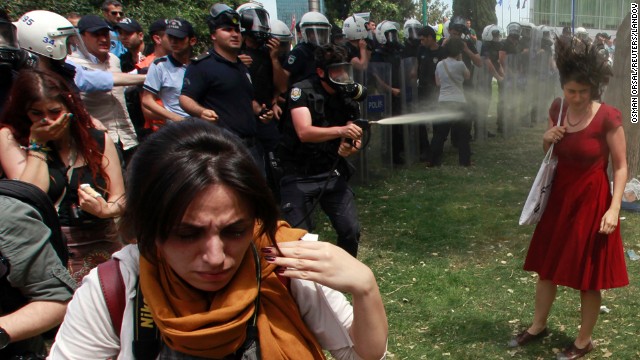
130604063059-turkey-protest-0528-story-top(CNN) — She has become a symbol of the violent protests in Turkey. Across social media, she’s known as “The Woman in Red.”

Wearing a red summer dress and a delicate necklace, the woman walked among demonstrators in Istanbul’s Taksim Square when a security officer lurched at her and pepper-sprayed her so powerfully her hair was blown upward.

She could do nothing but turn away from the toxic spray. The officer, wearing a gas mask, lunged closer to her, unleashing more spray on the back of her neck. She covered her mouth as officers spray others.

The photos of the incident have been shared widely on social media in recent days. International headlines have proclaimed her an“icon” of the movement against the government of Prime Minister Tayyip Erdogan.

Apology for ‘police aggression’

Online campaign puts spotlight on Turkey

Police, protesters clash in Ankara

“That photo encapsulates the essence of this protest,” a math student named Esra told Reuters. “The violence of the police against peaceful protesters, people just trying to protect themselves and what they value.”

The images have also inspired cartoons and graffiti in Turkey and around the world. And just seeing a woman in a red dress walking in public has apparently touched a chord with other women in the region, too.

Zeinobia tweeted, “The woman in red in Turkey, I wish to wear such dress in downtown Cairo without fear, without protests, without sexual harassment.”

But the truth is that woman in red told CNN Wednesday that she wants no part of this.

What’s happening in Turkey is the “people’s revolt,” she said.

Ceyda Sungur told Turkey’s TV 24 that she is uncomfortable about her new fame. She doesn’t want to be an icon of a movement.

“There are a lot of people who were at the park and they were also tear-gassed,” she said. “There is not (a) difference between them and I.”

But, she added, “I am not surprised” about the violence that evolved from what began days ago as a peaceful sit-in to protest plans to demolish a park in central Istanbul — the last green space in the city center.

Some in the crowd chanted “Tayyip resign!”

“Shoulder to shoulder against fascism!” they shouted.

Riot police moved in, lobbing tear gas and using pepper spray. Protesters responded by hurling bottles, blocking bulldozers and setting up barricades. Eventually, protesters and police were locked in full-on clashes.

Read: What’s driving protests and unrest

Erdogan conceded Saturday that Turkish security forces had used tear gas excessively against demonstrators.

Read: Erdogan: Successful leader or ‘dictator’?

On Tuesday, a top Turkish official apologized for the “police aggression” and trade unions threw their weight behind the demonstrations.

The 240,000-member KESK confederation of public-sector workers called for a two-day strike to protest what it calls the “fascism” of Erdogan’s ruling Justice and Development Party.

Riot police around Ankara’s central Kizilay Square brought in armored vehicles topped with water cannon in a show of force Tuesday evening, but the demonstrations throughout Wednesday were mostly calm.

Read: Despite economic boom, protesters target Erdogan

CNN’s Talia Kayali contributed to this report.