Text of Swiss Appeal to European Court On Armenian Genocide Disclosed

 Փերինչեքն ընդդեմ Շվեյցարիայի


By Harut Sassounian

Publisher, The California Courier


Two weeks ago — on the last day of the three-month deadline — the Swiss government decided to file an appeal with the European Court of Human Rights (ECHR) on the Perincek vs. Switzerland lawsuit.


Even though the text of the Swiss appeal has been kept under seal pending ECHR’s consideration, I was able to obtain a copy in French. This is the first time that the content of the Swiss appeal appears in the media.


The ECHR ruled on Dec. 17, 2013, that Swiss courts had violated the rights of Dogu Perincek, a minor Turkish party leader, who had traveled to Switzerland in 2005 with the explicit purpose of denying the Armenian Genocide. He had dared the Swiss authorities to arrest him for calling the Genocide “an international lie.”


Following his conviction for violating a Swiss law on racial discrimination, denial of genocide, and other crimes against humanity, Perincek appealed his sentence all the way to the Federal Tribunal, the highest court in Switzerland, which confirmed his guilt. He then applied to the European Court of Human Rights, accusing Switzerland of violating many of his rights, including that of free speech. Surprisingly, five of the seven ECHR judges exonerated Perincek, finding that Switzerland violated certain provisions of the European Convention.


If left unchallenged, ECHR’s ruling would have been a major setback for recognition of the Armenian Genocide, particularly before the worldwide commemoration of the Centennial of the Genocide to be held on April 24, 2015. Even more importantly, by exceeding their mandate on the alleged infringements of Perincek’s rights, the majority of the ECHR judges raised questions about the validity of the Armenian Genocide. They also drew unwarranted and superfluous distinctions between the Armenian Genocide and the Jewish Holocaust, ruling that punishing the deniers of the former is illegal, while convicting those denying the latter is proper.


Given the detrimental consequences of this unjustified ruling on the Armenian Cause, the government of Armenia, Armenian communities worldwide, and Swiss-Armenians in particular, lobbied Switzerland to make sure that it appeals ECHR’s decision in the Perincek case. In reality, the Swiss authorities should not have needed any prodding from Armenians, since they had an obligation to defend the judgments of their own courts, including the Federal Tribunal, and the integrity of their country’s legal system!

The six-page Swiss appeal, filed on March 17, 2014, asserted that ECHR’s ruling raised “serious questions regarding the interpretation and application” of the European Convention on Human Rights for the following three reasons:


— The ruling involves an issue — the Armenian Genocide — that has never been considered by ECHR. This case raises two fundamental juridical questions that the Court has not dealt with: The juridical qualification of the Genocide and the scope of freedom of expression, when a state party to the Convention, in the framework of fighting racism, criminalizes the denial of genocide.


— The ruling reduces in an undue manner “the margin of appreciation” available to Switzerland under the jurisprudence of ECHR. Perincek had repeatedly stated that he would never change his mind on the Armenian Genocide. His denialist position is “particularly offensive.” The Court’s contention that such a person would bring any value to “the debate and historical research” on this issue “is a departure from ECHR’s established and balanced jurisprudence.”


— The ruling creates “artificial distinctions.” Perincek does not simply contest the use of the term genocide, but qualifies the Armenian mass killings as an “international lie.” Furthermore, even though there has not been an international verdict in the case of the Armenian Genocide, the Turkish Court’s 1919 verdict against the masterminds of the Armenian Genocide “constituted an element of reliable evidence, acknowledging the facts or unfavorable conduct” relative to the World Court’s jurisprudence. Furthermore, even “the Nuremberg Tribunal did not mention the term genocide and did not convict the Nazi perpetrators for committing genocide, but crimes against peace, war crimes, and crimes against humanity.”


The Swiss appeal has provided compelling arguments and convincing evidence that five of the seven ECHR judges made serious judgmental and factual errors in delivering a ruling in favor of Perincek and against Switzerland.


A panel of five new ECHR judges will now decide whether to refer Switzerland’s appeal to the 17-judge Grand Chamber for a final determination.


 Անկախ

What Should Armenians Learn From Prime Minister Erdogan?

Հարութ-Սասունյան1


By Harut Sassounian


Publisher, The California Courier


The purpose of this column is to draw lessons from the recent attacks on the Armenian town of Kessab in Syria.


Last week, Turkish Prime Minister Recep Tayyip Erdogan took two bold actions: 1) he blocked Twitter, a social media site with 12 million users in Turkey, to cover up revelations of corruption about himself and his inner circle; and 2) he aided and abetted the Jihadist fighters’ invasion of Kessab, located in the Northwest corner of Syria, bordering Turkey!


What do these two seemingly unrelated events have in common?


Erdogan himself indirectly answered this question, during a campaign rally on March 20: “we will wipe out Twitter. I don’t care at all what the international community says. Everyone will see the power of the Turkish Republic.”


Clearly, the Prime Minister does not care that he would be criticized for violating the democratic principle of freedom of expression and acting as an autocratic thug. He says and does whatever he thinks is in Turkey’s or his own best interest!


US officials reacted by paying mere lip service to Erdogan’s internet crackdown. Samantha Power, US Ambassador to the United Nations, tweeted the following message: “Deeply troubling that Turkey blocked Twitter. Shutting down free access to info inconsistent with democracy; support citizens’ call to unblock.” Douglas Frantz, Assistant Secretary of State for Public Affairs and former managing editor of the Los Angeles Times, who was forced to resign after blocking publication of an article on the Armenian Genocide, described Erdogan’s anti-Twitter action as: “21st century book burning.” Similar benign criticisms were voiced by State Department spokeswoman Jen Psaki, White House Press Secretary Jay Carney, and European Union Digital Agenda Commissioner Neelie Kroes.


Did Erdogan care about these verbal lashings? Absolutely not! He didn’t give a damn! He had already blocked YouTube for two years, because the website carried videos deemed insulting to Kemal Ataturk. The Turkish Prime Minister now threatens to ban both facebook and YouTube after the March 30 elections.


Why don’t Armenian leaders — in Armenia and Diaspora — act more boldly, similar to Erdogan, especially when the survival of Armenians is at stake? It is most appropriate to raise such a question after the invasion of Kessab byJihadists, taking Armenian hostages, pillaging their homes, and desecrating their churches.


Regrettably, repeated pleas by Armenian-American organizations to US officials, to help protect Armenians and other Syrian Christians, have fallen on deaf ears. On March 24, the ANCA sent another strongly-worded letter to Pres. Obama, demanding immediate White House and congressional intervention to stop the attacks on Kessab. The US government does not seem interested in the tragic fate of Syrian-Armenians and other minorities, since Washington is hell-bent on toppling Bashar al-Assad’s regime, ignoring the loss of innocent lives.


Armenians should not be content by merely shaking their heads and complaining to each other about the tragic news emanating from Syria. They must wake up from their collective coma and take bold action. Daily demonstrations must be held in major U.S. cities and in front of American, British, French, Saudi, and Turkish embassies and consulates around the world to protest their arming of so-called rebels who are kidnapping and murdering Syrian Armenians, among many others.


Urgent meetings should be held with top US, British and French officials, demanding that they immediately halt deliveries of all weapons and financial assistance to ‘rebels’ in Syria, until they cease attacks on civilians!


I wrote a column back in 2002 with the following headline: “The Armenian ‘Mouse’ Needs to Roar More Often.” Basically, it was a call for bolder action. I had referred to the short story written by William Saroyan, titled: “The Armenian Mouse,” in which a brave mouse, by its aggressive behavior, manages to defend itself from more ferocious beasts.


Remaining silent and inactive are no longer viable options, while our compatriots are getting slaughtered in Syria. Sheepish behavior only serves to embolden the enemies of the Armenian nation.


Armenians need to be proactive rather than reactive. On the eve of the Genocide Centennial, they cannot be silent bystanders while the Turkish government and its allies are directly or indirectly embarking on a new campaign of exterminating Armenians in Syria.


Armenians must speak up, protest, and take effective action to defend their countrymen in all corners of the world. They need to become the ‘mouse’ that ROARS!


Անկախ

The Deputy Foreign Minister received Ukraine’s Ambassador

Շավարշ Քոչարյան


On March 21 Deputy Foreign Minister Shavarsh Kocharyan received Ivan Kukhta, Ambassador of Ukraine to Armenia, by the latter’s request.

 During the meeting the Deputy Foreign Minister reaffirmed that Armenia’s principled stance on the right to self-determination is unaltered and during years has been expressed on numerous occasions.

The Deputy Foreign Minister stated that the centuries-old relations between the friendly peoples of Armenia and Ukraine form the solid basis on which the interaction between the two countries are being built.

Անկախ

Shifting Inter-Relationships Between Armenia and Diaspora

Հարութ Սասունյան


By Harut Sassounian

Publisher, The California Courier


The Diaspora Ministry of the Republic of Armenia invited a small group of scholars and analysts to Yerevan last December to discuss the Diaspora’s changing role in relation to the homeland. The participants in the “Changing Diaspora in an Ever-changing World” roundtable had come from Argentina, Armenia, Germany, Lebanon, Russia, Ukraine, and the United States.


The discussion centered on the formation of the Diaspora, current challenges, Armenia-Diaspora collaboration, improved links for closer cooperation between Armenia and Diaspora, and the quest for new working mechanisms and perspectives.


Here are excerpts from my presentation at the meeting:


The Diaspora encountered a completely new set of circumstances after Armenia’s independence. The sudden realization of the long-cherished dream of free Armenia caught many Diasporans by surprise. New words appeared in their vocabulary: Artsakh (Karabagh), earthquake, blockade, protocol, opposition, coalition government, regime change.


Most Diasporans had a hard time distinguishing between the actions of an individual, group or organization and the rights and obligations of a state. At the same time, Armenia’s new leaders could not fully comprehend the patriotic sentiments, wishes and desires of Diasporan Armenians, causing a disconcerting rift between the two sides.


Complicating matters, the Diaspora is not a monolithic group, but is composed of distinct subsets, having taken shape at different times in foreign lands under various cultural and linguistic influences.


When asked by journalists in Armenia about Diaspora’s views on a particular issue, I have difficulty answering such a question. How can anyone encapsulate the diverse views of seven million Diasporans? To reflect the opinion of the majority of the Diaspora, one would need to form a pan-Armenian body, either by expanding the Hayastan All-Armenian Fund’s functions beyond fundraising or creating a brand new structure that would represent Armenians worldwide, except those in Armenia and Artsakh, based on the principle of ‘one man, one vote.’ The elected representatives would have the right to speak in the name of all Diaspora Armenians and meet periodically with the leadership of Armenia and Artsakh to consult and coordinate their priorities on pan-Armenian issues.


Leaders of all three wings of the Armenian nation (Armenia, Artsakh and the Diaspora) can then discuss their respective positions, and agree on the role each would play. Such a division of labor is preferable over unending internal feuds and conflicts that sometimes take place, as was the case during the signing of the Armenia-Turkey Protocols.


It is incumbent upon Armenia’s leadership to be more sensitive on issues that are important for Diaspora Armenians and consult with them before taking final decisions.


Understandably, Armenia’s leaders are not obliged to take orders from anyone outside the country’s borders. While having the final say over all matters, they nevertheless have the moral duty and obligation to consider the views of key Diasporan organizations, in the absence of a Diaspora-wide elected body. In any case, Armenia’s authorities are responsible before the nation for their actions. They are praised when taking the right decisions and criticized when they do not.


It must be stated that an elective Diaspora-wide structure, no matter how difficult to establish, would be far more inclusive and representative than appointed leaders — despite their devoted efforts — who merely represent their respective members. It is imperative to include large segments of our people in all activities, so that we become more effective in our endeavors, particularly at a time when Azerbaijan and Turkey are organizing their Diasporas and spending tens of millions of dollars to undermine our just demands on the eve of the Genocide Centennial.


As we often state: “Azerbaijan has oil, Georgia has a sea, and Armenia has a Diaspora!” However, a disorganized and dwindling Diaspora would be of little value for our national cause. It can neither preserve itself nor be of any assistance to the homeland.


We must do everything possible to have a powerful homeland and a strong Diaspora. The survival of each is dependent on the vitality of the other. Despite the valiant efforts of the Diaspora Ministry, we must realize that the magnitude of what needs to be done is so enormous that it exceeds the capabilities of any one ministry. There is a clear need for the concerted efforts of Armenia’s entire leadership to make Diaspora Armenians feel welcome and at home!


President received the Minster of Foreign Affairs of Serbia Ivan Mrkić

սարգսյան-մրկիչ

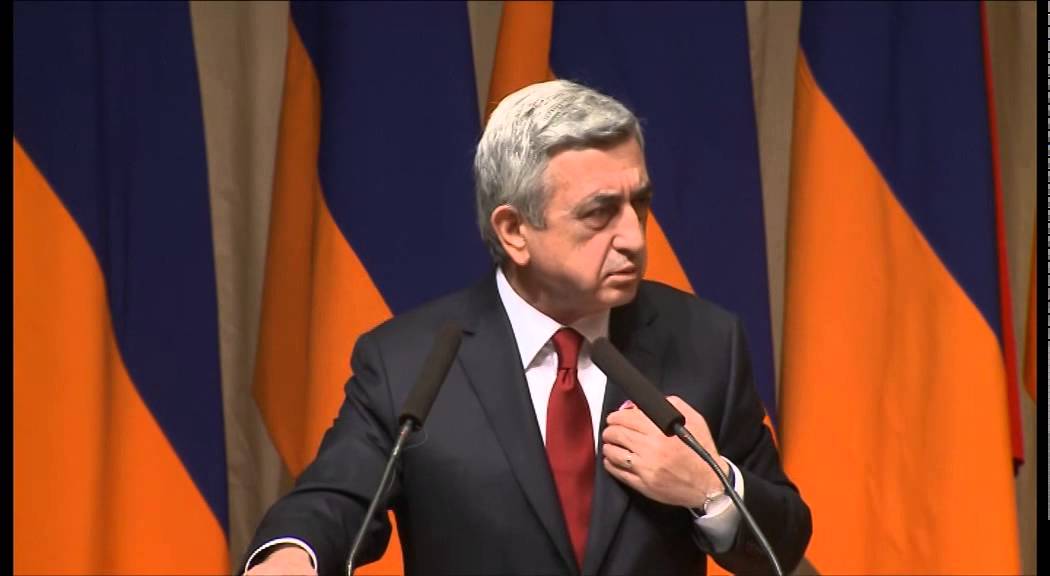
 Today, President Serzh Sargsyan received the Minister of Foreign Affairs of the Republic of Serbia Ivan Mrkić.

The President welcomed the high-ranking guest and stressed the importance of his visit in terms of continuing the Armenian-Serbian high-level political dialogue and promoting the cooperation agenda. Serzh Sargsyan underscored that the age-old relations between Armenia and Serbia have had numerous illustrations. According to the President, the Armenian people gratefully remember the seven Serbian pilots who fell victim to the air crash on the approaches of Yerevan while they were coming to the aid of Armenia during the days after the 1988 devastating earthquake. Moreover, every year, at the anniversary of the earthquake, in the same place, a tribute is paid at the memorial dedicated to their memory.

Serzh Sargsyan and the Minister of Foreign Affairs of Serbia Ivan Mrkić stressed the importance of the high-level reciprocal visits, as a result of which, in recent years, the bilateral relations and the collaboration in a number of fields have intensified.

The interlocutors expressed their willingness to continue to make efforts at maintaining and developing the existing positive dynamics agreeing that there is a great unrealized potential in the advancement of political, economic, cultural, as well as of the other spheres of reciprocal interest in the framework of international organizations.

At the meeting, the importance of mutually beneficial and close cooperation between Armenia and Serbia during the period of Serbia’s chairmanship of the OSCE was also stressed.
Անկախ

Corruption Scandal May End Erdogan’s Political Career

Հարութ Սասունյան

By Harut Sassounian

Publisher, The California Courier


In a series of secretly recorded phone conversations revealed last week, Turkey’s Prime Minister Recep Tayyip Erdogan was heard instructing his son to hide from police tens of millions of dollars of cash stashed in his Istanbul house.


This shocking revelation generated widespread calls for Erdogan’s resignation who claimed that the phone recordings are fake or edited. It appears, however, that the wiretapped conversations between the Prime Minister and his son are authentic, according to Guarded Risk, an American cyber company that conducted a comprehensive forensic analysis of the phone calls.


It is ironic that Erdogan who came to power as an Islamist with the declared aim of eliminating corruption from Turkish politics, has fallen victim to the dictum: “power corrupts; absolute power corrupts absolutely!”


The phone calls were secretly recorded on the day police raided the homes of several cabinet members, prominent businessmen, and the head of the state bank. They were all accused of involvement in bribery and other corrupt practices.


Here is the English translation of excerpts from Erdogan’s five wiretapped conversations with his son, Bilal:


First phone call at 8:02 am on Dec. 17, 2013:


Erdogan: …Take everything you have out of your house, OK?

Bilal: What would I have, dad? Your money is in the safe.

Erdogan: That’s what I am talking about….

Bilal: What shall we do with it, daddy? Where shall we put it?

Erdogan: In specific places, in some specific places… . Do it!


Second call at 11:17 am:


Bilal: …My brother [in-law] Berat has another idea. He says we should give some of it to Faruk [Kalyoncu, president of a construction company] for the other job, so he can process them like the previous ones. Shall we do that? We can sort out a big amount of money that way.
Erdogan: Possibly.
Bilal: OK. For the other part, because we started a business partnership with Mehmet Gur [managing director of a construction group], we thought of giving it to him saying, ‘keep it, you can use it as projects come up.’ This way, we can reduce it and move the rest to somewhere else.
Erdogan: OK, fine, as long as you do it…. It would be good if you do… If you can liquidate them all.
Bilal: Yes, we will liquidate them all today, God willing!


Third call at 3:39 pm:


Erdogan: Did you complete the tasks I gave you?

Bilal: We will finish them by this evening. We sorted some out; We sorted the Berat part, now we will first handle the part with Mehmet Gur, and the rest, we will do after dark….
Erdogan: What did Sumeyye [daughter] do?
Bilal: She took them out, brought them over, we spoke, etc.
Erdogan: Do not speak on the phone with each other.


Fourth call at 11:15 pm:


Bilal: Hi daddy, I am calling to… we did [it] mostly. Did you call me just now, daddy?

Erdogan: No I did not, you called me.
Bilal: I was called from a secret number.
Erdogan: When you say ‘mostly,’ did you fully liquidate it?
Bilal: It’s not zero yet, daddy. Let me explain. We still have 30 million euros that we could not yet liquidate. Berat has an idea. There was an additional 25 million dollars Ahmet Calik [businessman] should receive. They say let’s give this [to him]. When the money comes, we do [something], they say. And with the remaining money we can buy an apartment from Sehrizar, he says. What do you say, father?
Erdogan: Whatever, we will sort it out.
Bilal: Should we do it like this?
Erdogan: OK, do it.
Bilal: Do you want them all liquidated, father, or do you want some money for yourself?
Erdogan: No, it can’t be left over, son. You could transfer it to the other, with Mehmet you could transfer it there.
Bilal: Yes, we gave it to them. We gave $20 [million] to them.
Erdogan: For God’s sake, first you should have transferred it. Then you could have done it…
Bilal: We were able to give this much for now. It is hard already; it takes too much space. We are putting part of it somewhere else, we gave part of it to Tunc, and then…
Erdogan: Did you transfer all to Tunc?
Bilal: They asked, I guess he said that he could only take 10 million euros.
Erdogan: Whatever! Don’t talk on this [phone].
Bilal: OK, then, we will sort it.
Erdogan: OK, do it. I am not able to come tonight. I’m staying in Ankara.


Fifth call at 10:58 am on Dec. 18, 2013:


Erdogan: I decided to call to see if there is anything new.

Bilal: No, nothing. We finished the tasks you gave us, with God’s help.
Erdogan: Has it been all liquidated?
Bilal: Completely! How should I put it? I had Samandira and Maltepe’s money, 730,000 US Dollars and 300,000 Turkish Liras. I will handle these too. We owe 1 million Turkish Liras to Faruk İsik [parliament member]; I will give it to him and tell him to transfer the rest to the academy.
Erdogan: Do not speak so openly!
Bilal: Shouldn’t I?
Erdogan: Don’t. OK?
Bilal: OK, daddy
Erdogan: I mean, do not keep anything on your person, whatever it is Samandira or whatever… Send it to where it needs to be, why do you keep it on you?
Bilal: OK, daddy, but I think currently we are under surveillance.
Erdogan: What have I been telling you since the very beginning!
Bilal: But is the security staff following us, father?
Erdogan: Son, you are being wiretapped.
Bilal: But they are also visually monitoring us.
Erdogan: That may be true. Now, we’ve just done some things at the Istanbul police headquarters.


Additional recordings have since surfaced in which Erdogan and his son talk about rejecting a $10 million bribe offer from a Turkish businessman for being insufficient.


Erdogan could end up losing not only his current position and the chance of becoming President later this year, but may also face prosecution and a lengthy jail term for his alleged crimes.


 Անկախ


PRESIDENT SERZH SARGSYAN ANSWERED THE QUESTIONS OF THE PARTICIPANTS OF THE 10TH CONVENTION OF THE VOLUNTARY HOMELAND DEFENDERS UNION

Հո ախմախ չե՞նք, որ այդ վատ բանի վրա ռեսուրս ծախսենք. Սերժ Սարգսյանը կուտակային կենսաթոշակային համակարգի մասինBefore the question and answer session, the President congratulated all the members of the newly elected Board of the Voluntary Homeland Defenders Union (VHDU), including the President of the Union and Deputy Presidents, on the occasion of taking the responsibility once more and stressed that that it was indeed a big responsibility for them. Serzh Sargsyan wished the VHDU Board good luck and expressed his willingness to answer all the questions of the participants of the convention.

Question – Sona Rechelyan – a student of the Economic Department of YSU, a member of the “Young Homeland Defender” structure
-Mr. President, in what condition is the Armenian economy today?

Serzh Sargsyan – It is already a long time that the relevant structural unit of the Government sums up the results of 2013, and all of us will have an opportunity to discuss those results, but I should say immediately, that in 2013 the economic growth of our country is going to yield to the economic growth in 2012. If you remember, in 2012 we had a 7 percent economic growth, while this year we expect 3.5 percent. In general, this tendency is typical to the world economy and it is no accidence that after the first semester of 2013 the international structures and experts began to give more modest assessments and forecasts about the growth of the world economy and the economies of different countries. If you are familiar you should remember, if not, be aware that the International Monetary Fund forecasted 3,8 percent economic growth for the CIS. Today the real one is assessed 2,1 percent. For the Russian Federation the forecast was 3,7 percent, while the real and preliminary ones were 1,5 percent. The forecast for the European Area was -0.2 percent, the preliminary one was -0.4 percent. As you see, in every place depending on both the world processes and on the internal problems of a concrete country, the growth has stopped. Now, is this good or bad? If we compare it with others it is good, but if we compare it with our needs, it is bad. Thus, of course we should work much harder this year in order to have good results. Surely, there are troubling tendencies in our economy. For example, I am concerned with the decrease of investments. Certainly, there are specialists who explain this from the perspective of world tendencies when the investments are transferred from developing countries to developed countries, and secondly, they consider 2013 year as a year full of uncertainties in our country, and wherever there are uncertainties there are little investments. But in any case, the uncertainties are overcome, the decisions are made, and in this regard, certainly, I expect a higher economic growth in 2014. You know most people, even our comrades in arms present here, may think that if it is already so many years that we have an economic growth, then why the society is in such a mood that the situation is becoming worse. You know in many circumstances it is a matter of perceptions. Indeed, we have had an economic growth, a stable economic growth during the last six years, except for one year. The average salary in Armenia has increased vigorously, more vigorously than inflation. When I suggested that you give questions, I naturally have materials, I have all the analyses of years, and I can say immediately that if we look through the prism of six years we have had average year inflation. You are an economist and you should understand what the average year inflation means and not the twelve months one. I can tell the twelve months one as well. Throughout six years the inflation in our country has comprised 140 percent. Accordingly, during these six years the inflation has comprised 40 percent. The average salary comprised 160 percent, as a result, the average salary increases in higher rates, and, of course, in many cases it is a matter of perceptions. The people who criticize us think that they have such an invulnerable argument and always bring that argument. When we speak about favorable numbers, good numbers, they say that those numbers are pictured and those numbers are fabricated. But it is very surprising that when the RA National Statistical Service speaks about bad indicators, they say it is right. Thus, in case of bad and negative numbers they are right, while in case of good numbers they are pictured. But I do not say for this reason, I say this for another reason. I want to bring a concrete example which will have a serious importance for any economist. As you know, last year in the second half of September, we issued currency securities, that is, securities not in the Armenian Dram. Of course, we issued not alone, but together with the three world-famous companies, and during that time those ill-willing critics said that nobody would lend Armenia. As you know, issuing securities means borrowing. They said that the Armenian debt was so big that nobody would lend, and even if they lent, the percentages would ne very high. And on September 3, when we made a decision to join the Customs Union, everybody started to say that in this case nobody would lend Armenia at all. As a result, our country was offered a debt of three billion US dollars. We took only 700 million because more debt could deteriorate our economic situation and our indicators. In addition, during this period from September to February, those 6 percent securities became 5.8 percent one. Hence, they became more expensive. As you know, the more the percent decreases the more expensive the securities become. If our situation is bad, if our debts are a lot, if our economy precipitates, how it happens that the world’s largest 60 investors offer us such a huge amount – three billion US dollars. Is there anybody in the hall who can say that he is ready to lend somebody knowing that he is not going to give it back. It is impossible. Who do you lend? The one who you know will give back or the one who you just want to give a hand, and if he won’t return you will not feel any regret. Could it be that the world’s largest 60 investors feel sorry for us and give money for no particular reason in order for us to spend. Our economy is healthy, our economy is firm, our economy has experienced substantial changes, and these are very good foundations to make a good economic growth in the future as well.


Question  – Karen Grigoryan – a member of the VHDU Board, the Mayor of Echmiatsin
-Good evening, Mr. President. My question is the following – in recent days it is often touched upon the issue pertaining to the pensions and the 5 percent. What is the problem?

Serzh Sargsyan – Certainly, it is spoken a lot about the pension reforms and it is obvious that it should have happened like that. There has not been a state in the world, where pension reforms have made in peace and without protests for simple, very simple reasons. The reason is that the outcomes of those reforms will appear within a long time, while people right now want that their situation improves, and secondly, it is clear again that we put people in a difficult situation for some period of time and say that, yes, you must save 5 percent in order to receive back that 5 percent multiplied. It is evident that we have discussed a lot and have knowingly taken that step since that step is directed to the future of Armenia, that step is taken for our children and for our grandsons. Nobody can say that we do not need these reforms. Even our severest critics say that we need reforms but this one thesis is wrong, that one thesis is not right or you have chosen wrong time, you should do it in six months, in one year, in five years…

You know that I have worked in the Government of the Republic of Armenia (RA) for a long time since 1993, and all the Governments of the RA, without exception, have dealt with this issue, and this issue has made them worried. Today’s Government has decided to deal with this issue right today, and I express my whole support to that solution, because this is, indeed, a necessary solution. I do not exclude that there may be complicated legal formulations in that law or some words should be changed. I do not exclude. But if somebody says he is ready to write an ideal document and to immediately take and put it to public discussion and nobody will discover any complication there, I will say that I do not believe in that. It is a large document, and I repeat, there may be failed formulations, but we are ready to correct those failed formulations. The meaning, I am sure, is not going to change, and that decision is a necessity for all of us.

I repeat once more, yes, today we put people in a difficult situation to the extent of the 5 percent of their salary. But let us notice that this year a lot of people’s salaries have increased – at the law enforcement bodies by 10 percent, at certain companies by 10 percent, 15 percent, and in some companies by 25 percent. You are aware that from July 1 the salaries of all the state employees will increase by 40-80 percent. What is the problem? Think as if they have increased by 35 or 75 percent. Do not expect that 5 percent. That 5 percent will be of use by all of us, all of us.

There is the other side of the issue. Those funds will foster our economic development. Long-term and low percent money will appear in our country which is vital for our business entities. Ask any businessman, talk to the Business Union and to any non-governmental organization – what is the problem of the Armenian economy today? It is the cheap and long-term money. We must have that money in order for our economy to develop and to direct the fruits of the development to raise pensions. We will do it by all means, dear Karen, and I do not see any big problem here, yet I know that today the 80 percent of the country’s population complains about that decision. We, sorry for my word, to say in a homeland defender’s language, are not idiots to spend resources on that bad thing. We spend political resources. People are dissatisfied with us, we do not have any political interest in that and do not obtain any resource. We erode resources for the time that will come in 20 years, for our children.

Question  – Anan Voskanyan – a member of the VHDU Board, the President of VHDU Artik Regional Division, the Head of Pemzashen community.
-Mr. President, I think all of us are worried about the fate of the gas treaty with Russia. Would you please introduce in a few word?

Serzh Sargsyan – Sure – at first, dear Anan, I think that that conviction should have already passed because we signed that treaty on December 3 last year and the National Assembly ratified it and that treaty has come into effect. But I totally share your opinion that there are various conversations among the public, because a lot of people, depending on many reasons, do not want to tell the truth and try to blacken that great achievement. Some people, driven by the anger that we succeeded in having such a good treaty, try to turn everything on its head and present this as unsuccessful. To be able to prove my words, let us on by one touch upon the issues which according to them are very logical. But before touching upon the issues on by one, I want all of us to see what the substance of this gas treaty is. In my opinion, the substance of the gas treaty is first of all the gas price. Have you heard during this time that those debaters speak about the price. At first, let them speak about the price and say that if it is expensive we negotiated very badly, they gave us a bad price, let them criticize us here, let them say that, in addition, this one is also bad, the other one is also bad and the other one also. If we have been able to obtain a good price, let them say that-yes, the price is good, but here, here and here they have failed. Nobody speaks about that price, because that price is the lowest which Russia gives to any state. Hence, we have gas for the lowest price inside the borders of the RA. Secondly, in that treaty the gas price is related the Russian internal price system for five years, and if there are not rises in price, and you have seen the decision of the Russian Government according to which prices will not go up, we will have a stable price for 5 years. Is this good or bad? Surely, it is good for us, but bad for our ill-willing persons. Next issue is about debts. And they give different assessments. There are people whose memory already betrays them to some extent. There are people who can’t read well and try to say that to the violation of our laws, some debts have been augmented, that those debts should be reflected in the budget etc., that as if we have run secret negotiations. I think that most of our citizens should remember that I have made at least about one dozen statements on that topic since 2011 and have always said the following that the gas price will not go up for the consumers of the RA. What does it mean? It is clear that if you say such thing, the Armenian should understand that it is possible that the imported gas gets expensive for the state and for an entity, but the gas is not going to get expensive for the consumers of the RA, and it has been like that for two years. This is in the first place. In the second place, everybody is aware that we have been negotiating with the Russian side since 2011 and have made a conclusion that the payment price of gas does not change, instead the calculation price changes, but when the negotiations are over we will made a final conclusion about the price. The negotiations lasted for three years. Taking into consideration all the aspects, the Russian side suggested that we pay the 50 percent of that calculation price. Has it treated badly? Hence, where from do those about 300 million US dollars generate? If we had not run such long and hard negotiations we would have had to raise the price since 2011 and that 300 million would have been taken out of people’s pocket, the private sector’s pocket, the economy’s pocket etc.. We are yielded to the 50 percent of that amount. Thirdly, as for the 20 percent – why did they sell, they sold for cheap price etc.. I wonder what that 20 percent gave us. If we as a state have sold the 80 percent throughout these years, we might sell the 80 percent, while the 20 percent might not be sold? Is not it strange? Let anybody tell me what that 20 percent gave us and how many pennies of dividends it delivered. Or did that 20 percent give us an opportunity to appoint a director there or to do what, to influence upon decisions? Moreover, we do not need to be able to influence upon decisions because we have a very good legal field in that sphere and it is sufficient that a company be it Russian, American, Indonesian, will act in the framework of our laws and for our interest. As for the price of the 20 percent, I can now announce that if there is anybody who will pay 100 million US dollars, I am ready to negotiate with the Russian side, take back and give it to the man for that 100 million who will want that 20 percent. They say why you have not conducted a contest, why you have not asked others. I do not have the right to say publicly but my desire to say is so big that I must say that imagine we conducted a contest, that 20 percent valued 30 million, how we would realize that 20 percent for 150 million. Then who would be responsible for that? Is not it clear that the 20 percent which has not given a penny of dividend throughout these years, can’t cost that much. Anybody who talks on different platforms from the National Assembly to the Opera Square, if he can go and negotiate with the Russian side and bring cheaper gas and with better conditions, sure, let him do, let him bring. I will nullify the treaty in one day, I will ask my party members in the National Assembly and friends to immediately invalidate all that. But is there anybody? Or they just talk? Talking is easy, so easy. Do you remember how many talkers there were during years of the war? How many fairy tales they told, how many myths they told? But when there was a need to occupy a concrete village, one of them got a headache, one of them went to his nephew’s forty days after death, the other’s car wheel leaked. Talking is so easy.

Is there anything else there? Why did you sign for 30 years? The people are so blinded by the evil that do not understand what they say. Instead of criticizing us that why you signed for 30 years and not for 60, they tell us why you have signed for such a long time. Is not it clear for any economist that the return of investments in a longer time has a much milder effect on the economy. We have signed for 30 years in order for the Russians to return their investments in 30 years. If we signed for 5 years, they would return them in 5 years. Which one is better for us?

Question  – Edik Minasyan –the Department of History of YSU
-Mr. President, I want to ask about the emigration. What is the solution?

Serzh Sargsyan – Indeed, the emigration is one our most painful and most acute problems, and nobody should not think that he is more concerned with the emigration problem then I. Indeed, it is one of the big problems which makes me worried. On the other hand, I do not accept the manipulation of this issue for political purposes and I do not accept the solution to this problem by beating the knees and crying. It is clear to all of us that this process is temporary and it displays different development trends in different periods. Although in 1992, 200 thousand people left our country that process has paced down. Assume, in 2001, 60 thousand left, but, thank god, that process slowed down during subsequent years and not only slowed down, but also transformed into immigration. According to 2013 data, the passenger transportation has decreased in comparison with 2012, the negative difference is almost 25 percent and that negative difference comprises 31 thousand people. Surely, the 31 thousand is not the right number of emigrants, it may differ by 5, 10 or 15 thousand, but is a reliable number, and that number is certainly big, it is big because there are only 3 million people living in our country. If we were at least 10 million, 12 or 15 million, that fact could not be the subject of any concern. On the other hand, the 31 thousand is no the number against which it will be impossible to struggle, decrease and nevertheless come to immigration. We will definitely reach that. But I am saying again, and all the more it should be clear for this audience that the problem does not stop to be a problem if you stop to speak about it. On the other hand, never a problem is solved by crying, by manipulation, a problem is solved by work. We should work all together, all together. Once more, I want to bring the example of the times when we or each of the present here lost one village, he did not beat the knees, did not blame others, did not manipulate, and contemplated what to do in order to occupy both this village and the one beside it. This was the thought of all of us, am I right? How much did we retreat in 1992? What has changed? Nothing has changed. Neither the performers have changed, nor the situation. You will see that we will come to a positive balance.

Question  – Mesrop Manukyan – a lecturer of the Economic Department of YSU
-Esteemed Mr. President, during the answers of one of the questions you spoke about the present condition of our economy. My question is the following. What will you predict, how will our economy develop? Thank you.

Serzh Sargsyan – I think it will be good, dear Mesrop, surely, it will be good. Why because I think that we have already entered the field of certainty. Even if we say that the membership to the Customs Union has been smooth, without any problems, nevertheless, there was uncertainty for the society and investors about what direction we would choose, to what it will lead etc. We already have certainty, have concrete programs, and this certainty and concrete programs tell us that we will be able to make much more progress. If we had a 7.2 percent export growth in 2013 on the scene of the decrease of the economic development in our partner countries, then by joining the Customs Union we will be able to make a much bigger growth because the lion’s share of that 7.2 percent goes to the Customs Union countries, the Russian Federation. More precisely, in 2013 we have increased the export to the Russian Federation by 20 percent, that opportunity has now become inexhaustible – a huge market. A 200 million market with almost same opportunities has opened for 3 million people and for our economy. We will definitely make use of it. Besides, we have programs in the sphere of technologies for this period which traditionally increases by 15-20 percent every year in Armenia. In 2014 we will finish a program, a big program on the sphere of mining on which we have worked for years which will give an opportunity to produce 80-100 thousand tones of concentrate in Armenia. And that is the critical quantity which gives an opportunity to have a copper foundry, a big copper foundry which in, its turn, is possible only by having a sulphuric acid recycling factory. If we will not have, we can’t do. Accordingly, we will have a substantial growth in the sphere of mining. If some provocateurs do not mislead the “Nairit” employees, then regardless of any circumstance, most probably this year we will start to build a new “Nairit”. At least we have the calculation works and the preliminary treaties and at the first opportunity we will set the old “Nairit” in motion. This will give us a very big opportunity as well. Next is the creation of a big fish industry complex in Gegharquniq Marz – a program which started in 2013 and will materialize in 2014. It pursues a goal to produce and recycle 50 thousand tones of fish in 2019. And this is a big economic turnover and a creation of lots of jobs. We have serious programs in the development of greenhouse construction. We had certain progress in 2013. This also helped to increase the export to the Russian Federation. In 2014, we will have sufficient growth here. We have programs in the sphere of light industry. The light industry growth has sufficient share in our economic growth and I can enumerate very long in this manner. I see good economic successes in 2014 and in the future years.
Question  – Pargev Manukyan – the retired Director of Vardenik School, the founder and leader of Vardenik’s “Gaylavaz” detachment.
-Mr. President, at this time the administrative and household employees of schools are being massively cut down with a justification that student number decreases. However, during last years the student number increased from 25 to 35 and the salary rate increased from 18 to 22. While they justify that it goes down. If those employees who are women without family and who do not have husbands, work at school as cleaners and if there are no cleaners, house-keepers, electricians and organizers, what will the school’s fate be like? I ask you to answer.

Serzh Sargsyan – I hear for the first time that there should not be cleaners, house-keepers or electricians in our schools as you say. Such thing can’t be. As you know, we always include that in the school financing and yes, what can we do, it is right, it is financed by the student number. And I should say that all of us should come to terms with the idea that we should retire on a merited pension when time comes. If we are pensioners we should go and bring up our grandsons, receive a pension, in order for young men to substitute us, in order for them not to be left without job. This is the reality and we should look on that reality with a sober glance. We can’t say, you know this woman who is a very good teacher, has a big family, let us keep her. But we keep her by hurting others. We have drastically raised the salaries of teachers throughout the recent years, but which teacher you ask says that there is not a substantial change in terms of the salary. Why is not there any? Because instead of one teacher, work two of them, three of them. Why? I do not consider it to be a right thing. The working teacher should be duly paid, should be paid as much as the state envisages and as much that he can take care of his elementary needs. We envisage new reforms in this sphere as well. We will raise the salaries of the best teachers drastically, drastically. They will receive three or four times as much as the average salary of the country. As you know, today our average salary is 158 thousand drams. I repeat that the best teachers will receive three or four times as much, but they should be the best in their school. Hence, if in this case, indeed, a position of a cleaner or an electrician has been cut down, I think that Mr. Ashotyan will inform me about the reason right on Monday.

Անկախ

Raffi Hovannisian Receives UK Parliamentarians

Րաֆֆի Հովհաննիսյան, բրիտանացի պատգամավորներ

Yerevan—Raffi K. Hovannisian today received a visiting delegation of British legislators headed by John Whittingdale, leader of the British group of the Inter-Parliamentary Union. The delegation included Baroness Gloria Hooper and Lord Richard Faulkner of the House of Lords and Harriett Baldwin and Stephen Pound of the House of Commons.


They conferred on current developments in the region and Armenia’s domestic and foreign policy priorities, focusing on the Armenian nation’s quest for democracy and the rule of law, the upcoming 100th anniversary of the Armenian Genocide, as well as Mountainous Karabagh’s (Artsakh’s) quest for international recognition of its sovereignty and integrity.


The officials conveyed their hope that the UK Parliament would ultimately reflect upon these issues in the nearest future.


 Անկախ

MEMBERS OF CONGRESS JOIN GLOBAL PROTEST ON 10TH ANNIVERSARY OF SAFAROV MURDER OF GURGEN MARGARYAN

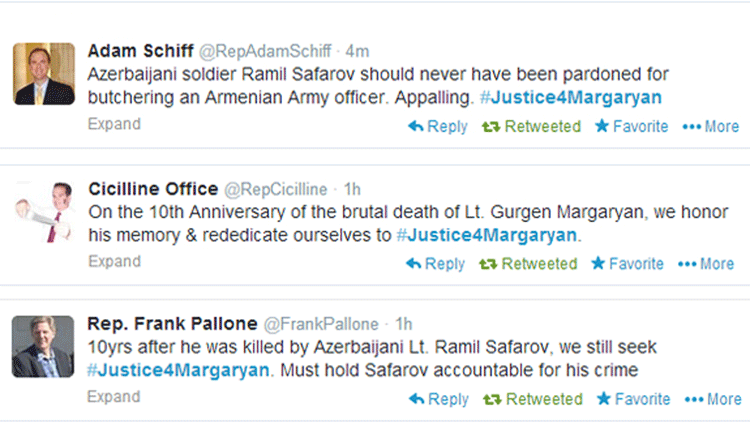
schiff_cicilline_pallone_tweets— Reps. Schiff, Cicilline and Pallone Participate in Social Media Campaign Condemning Azerbaijan’s Pardon, Praise and Promotion of Unrepentant Axe Murderer Ramil Safarov
WASHINGTON, DC – Ten years after the brutal murder of Armenian Lt. Gurgen Margaryan, Representatives Adam Schiff (D-CA), David Cicilline (D-RI) and Congressional Armenian Caucus Co-Chair Frank Pallone (D-NJ) joined with Armenians worldwide in condemning the Azerbaijani government’s pardon, praise and promotion of his confessed but still unrepentant murderer, Lt. Ramil Safarov, reported the Armenian National Committee of America (ANCA).
“Thanks to the AYF for launching this global initiative, to a worldwide legion of online activists for sending our message of peace and justice across the internet, and, of course, to our friends, Representatives Adam Schiff, Frank Pallone, and David Cicilline, for adding their vital voices to this far-reaching awareness-raising campaign,” stated ANCA Executive Director Aram Hamparian.
The U.S. Representatives joined a targeted Twitter, Facebook, and Instagram campaign, spearheaded by the Armenian Youth Federation (AYF) in the United States and Canada, to raise awareness about Safarov’s brutal axe murder of Margaryan, in his sleep, during a NATO sponsored English language peace training program.  In August, 2012, Safarov, who had been tried, convicted and imprisoned for his actions in Hungary, was inexplicably extradited back to Azerbaijan, where he was given a hero’s welcome by President Ilham Aliyev, in addition to financial compensation and a promotion in military rank.  A chilling video featuring Azerbaijani Government officials openly and proudly praising the axe-murderer can be viewed at:http://youtu.be/ualn6CqJltU
In a tweet timed with the AYF international effort, Rep. Schiff stated “Azerbaijani soldier Ramil Safarov should never have been pardoned for butchering an Armenian Army officer. Appalling. #Justice4Margaryan”  In an expanded statement shared with the ANCA, Rep. Schiff explained, “Ten years later, we remember Armenian Lt. Gurgen Margaryan, who was hacked to death by Azerbaijani soldier Ramil Safarov while participating in a NATO training exercise in Hungary.  Safarov should be in prison, but inexplicably, he was extradited back to Azerbaijan from Hungary in 2012.  Instead of serving out his sentence in an Azeri jail, he was pardoned, promoted to Major, given back pay and paraded through the streets of Baku in a disgusting and bloodthirsty welcome home.”
Rep. Cicilline echoed these thoughts in his tweet, noting “On the 10th Anniversary of the brutal death of Lt. Gurgen Margaryan, we honor his memory & rededicate ourselves to #Justice4Margaryan.”  Upon Aliyev’s release of Safarov in 2012, Rep. Cicilline commented that, “Over the years, serious questions have been raised about whether the Azerbaijani government is truly committed to developing a peaceful, nonviolent relationship with the people of Armenia. Its reckless actions this week do nothing to address these concerns.”

Rep. Pallone was equally adamant about the need for justice for Margaryan’s murder, in this tweet:  “10yrs after he was killed by Azerbaijani Lt. Ramil Safarov, we still seek #Justice4Margaryan. Must hold Safarov accountable for his crime.”  Following Safarov’s release, Rep. Pallone had stated that Azerbaijan’s actions “only further confirm their desire to facilitate and condone violence against Armenia and its people.”
All tweets honoring Margaryan’s memory can be viewed by searching #Justice4Margaryan in the Twitter feed.
Azerbaijan’s glorification of Safarov in 2012 sparked international outrage, but did not result in his return to prison.  A statement issued by the White House on August 31, 2012, stated, “President Obama is deeply concerned by today’s announcement that the President of Azerbaijan has pardoned Ramil Safarov following his return from Hungary. Safarov confessed to the murder of Armenian Army officer Gurgen Margaryan in Budapest in 2004, and was serving a life sentence in Hungary for this brutal crime. We are communicating to Azerbaijani authorities our disappointment about the decision to pardon Safarov. This action is contrary to ongoing efforts to reduce regional tensions and promote reconciliation.”  The OSCE Minsk Group Co-Chairs expressed “their deep concern and regret for the damage the pardon and any attempts to glorify the crime have done to the peace process and trust between the sides.” Over dozen U.S. Senate and House members condemned the Azerbaijani action.

European Court of Human Rights Intervenes in Artsakh Conflict

Հարութ Սասունյան


By Harut Sassounian

Publisher, The California Courier


It is noteworthy that the European Court of Human Rights (ECHR) is holding simultaneous hearings on two rival lawsuits filed by Armenians and Azerbaijanis. Is this a mere coincidence or an attempt by the Court to intervene in a thorny dispute that political leaders have failed to resolve for over 25 years?


This week, ECHR is hearing the case of “Sargsyan vs. Azerbaijan,” dealing with Minas Sargsyan’s complaint against the Republic of Azerbaijan, claiming that he was forced to flee his Gulistan home in the Shahumyan region, after his property was destroyed by Azeri armed forces in June 1992. The Sargsyan case was first filed with ECHR on August 11, 2006. Interestingly, the Court held hearings on both the Armenian and Azerbaijani complaints on the same day: it heard the “Chiragov and Others vs. Armenia” case in the morning of September 15, 2010, and later that afternoon, the “Sargsyan vs. Azerbaijan” case.


In a preliminary decision on December 14, 2011, ECHR found Sargsyan’s complaint to be partly admissible. The Court rejected Azerbaijan’s contention that the case should be dismissed because it covered events prior to Azerbaijan’s ratification of the European Convention on Human Rights in 2002. Unfortunately, applicant Minas Sargsyan passed away in 2009, but his two children are continuing the complaint. ECHR will further probe the merits of the Sargsyan case during its February 5, 2014 hearing.


Two weeks earlier, ECHR heard the rival case of “Chiragov and Others vs. Armenia,” in which six Azerbaijani Kurds had filed a complaint against the Republic of Armenia. They claimed to be unable to return to their homes and properties in the Lachin district since May 17, 1992, having been forced to flee because of the Karabagh (Artsakh) war.


The Azeri complaint against Armenia was first filed with ECHR on April 6, 2005. In a preliminary decision on December 14, 2011, ECHR agreed to take up the case, finding that the ongoing negotiations between Armenia and Azerbaijan did not preclude the Court from dealing with this contentious situation. ECHR held a subsequent hearing on January 22, 2014, to consider the following questions:


1) does Armenia exercise effective control over the territory of Artsakh?

2) do the six Azeri citizens possess sufficient documentation proving their identity and ownership of the claimed properties?

3) should the Azeri applicants have exhausted all domestic remedies (ECHR requirement) by applying first to Artsakh courts prior to filing a complaint with ECHR, considering the further complication that Artsakh is not a recognized state?


Here are some thoughts about ECHR’s crucial role in these two conflicting cases:


1) Both complaints were filed with ECHR almost 10 years ago and cover alleged human rights violations that had occurred over two decades earlier. Since the Armenian applicant and one of the six Azeris had died in the intervening years, neither one will ever see the justice that they had sought from the European Court. As the popular saying goes, “justice delayed is justice denied!”


2) ECHR’s obvious effort to take simultaneous action on these two separate yet opposing cases indicates that the Court might be trying to resolve not only these two complaints, but also lay the groundwork for the resolution of the Artsakh conflict, at least the refugees’ right to return to their homes.


ECHR’s even-handed treatment of Armenian and Azerbaijani applicants thus far would lead one to believe that the Court would eventually rule in favor of both cases opening the door to thousands of additional complaints from refugees on both sides who suffered a similar fate during the Artsakh war. Since all member countries of the European Council are obliged to comply with ECHR’s decisions, the Court may order that these refugees be allowed to return to their native homes, thereby imposing a partial humanitarian solution on an intractable conflict that the leaders of both countries and international mediators have been unable to resolve for over 25 years!


Անկախ

Former Grit Cabinet ministers could run in next election

Sarkis AssadourianBy ABBAS RANA |

Published: Monday, 01/27/2014 12:00 am EST
(Page 2 of 2)

“As you know, there is an open nominations process. We are surely noticing a lot of interest from people to run for the Liberal Party and are looking forward to the beginning of the nomination process,” wrote Ms. Lyne-Hallé.
“This also shows that the interest of Canadians for the Liberal Party and its leader Justin Trudeau across the country is strong and increasing and that Canadians are looking for a change in politics.”
Meanwhile, three-term former Liberal MP Sarkis Assadourian, who did not seek re-election in the 2004 federal election and has since been out of federal politics, is already running a nomination campaign in the Ontario riding of Richmond Hill against Elizabeth Wilfert, wife of former Liberal MP Bryon Wilfert.
Mr. Assadourian, 66, is seeking the Liberal nomination in the Ontario riding of Richmond Hill. Currently represented by Conservative MP Costas Menegakis, the riding was previously represented by five-term former Liberal MP Bryon Wilfert. He lost the last federal election and is now working for Tactix, a government relations and public affairs firm in Ottawa as a strategic adviser.
Mr. Wilfert told The Hill Times last week that he decided not to seek re-election because he’s in the process of receiving an honorary diplomatic appointment from a foreign country in Canada, which restricts him from seeking any political office in the country.
Mr. Assadourian served as an MP from 1993 until 2004. He was first elected in the riding of Don Valley North and then twice in Brampton Centre. Prior to the 2004 federal election, then-party leader Paul Martin appointed Ruby Dhalla as a “star” Liberal candidate who served until the last election when she was defeated by Conservative MP Parm Gill.
The Martin government appointed Mr. Assadourian as a citizenship judge in 2005. Currently, he’s a member of the Ontario Deputy Judges Council.
Mr. Assadourian ran unsuccessfully in the 2010 Richmond Hill municipal election, finishing fifth out of seven candidates for a council seat.
Ms. Wilfert is currently the president of the College of Dieticians of Ontario.
As of last week, no nomination date had been fixed but already potential candidates have been campaigning.
arana@hilltimes.com
The Hill Times

President Serzh Sargsyan sent a letter of condolences on demise of Aram Gharabekyan

սերժ սարգսյանToday President Serzh Sargsyan sent a letter of condolences on the passing of a famous conductor, RA Honored Worker of Arts, Aram Gharabekyan.

“I was deeply saddened to learn about the untimely passing of a famous conductor, RA Honored Worker of Arts Aram Gharabekyan.

Aram Gharabekyan, who studied in the world’s best conservatories, stood out as a high-quality and unique conductor, was rewarded with many international awards while developing native music art.

I express my deepest condolences to Aram Gharabekyan’s relatives, colleagues and friends” the condolences letter of President of the Republic of Armenia reads.

Անկախ

A prosperous and stable Eastern Partnership is in the interests of all

The EU’s eastern neighbours are an integral part of Europe. They share our European history and culture, and seek to build an independent and prosperous future as sovereign nations free from outside pressure and influence. Their importance to the EU is unmistakable.

Eastern Europe has seen many fundamental shifts since 1991. The spread of democracy, open market economies, and respect for the rule of law have transformed the political landscape.  Further efforts are needed to entrench and develop the reforms that have been undertaken so far. And in support of such change, the EU has offered Association Agreements, including Deep and Comprehensive Free Trade Areas, that will allow companies in the region the opportunity to grow by developing their trade with the world’s largest marketplace.

In Vilnius the leaders of the European Union are meeting with representatives of our nearest neighbours to the East.  At the summit Georgia and Moldova are initialling Association Agreements, marking a new stage in the EU’s relationship with these important partners, and recognising the significant commitments they have made, and action they have undertaken, to equip themselves to meet the challenges of the 21st century.

Armenia has taken the decision not to join Moldova and Georgia in initialling an Association Agreement at Vilnius.  This is a disappointment. The UK remains keen to see Armenia and the EU work together to continue Armenia’s reform process, free from external pressures.

We look forward to further EU engagement with Azerbaijan, and I hope that momentum can be built in negotiations towards an Association Agreement.

In time, we hope that the EU-Belarus relationship will improve; this is in Belarus’ hands and I continue to urge Belarus to make the necessary reforms to make this a reality.

The EU door remains open, and this is our message for Ukraine too.

It was deeply disappointing that the government of Ukraine announced last week that it had decided to put signature of an Association Agreement on hold. I sincerely hope that the Ukrainian government will resume its preparations to sign the Association Agreement soon; and I urge them not to lose a moment in effecting the reforms that the country needs. Ukraine’s leaders have a historic choice before them, to embrace the long-term vision of a European future and the prosperity and stability which that brings, or to turn the clock back and turn away from the world’s largest and most successful trading bloc.

No-one is arguing that transformation or modernisation is easy or quick.  But the experience of countries such as Poland, the Baltic States, Slovakia and Slovenia shows that it can be done successfully where the political will exists.  And what the serious studies on the impact of Association Agreements have shown is that these accords offer a real opportunity for living standards in this region to catch up with those of their neighbours.

It is in everyone’s interests that Eastern Partnership countries become more prosperous and stable. Opening the door to the West doesn’t close the door to the East. The Eastern Partnership is good for the region and for its neighbours.

In Vilnius the EU is demonstrating its commitment to the Eastern Partnership.  The Eastern Partnership is not just a concept or slogan for the UK or EU.  It is an expression of EU commitment to its eastern partners, to their economic prosperity and their future.  The Association Agreements offer hope to the region that the economic prosperity and standards of living of the EU can be theirs too. This will take time, and no one is blind to the challenges, but what these Agreements show is that in a time of change, the EU stands by your side.


By David Lidington, Minister for Europe, the UK Foreign and Commonwealth Office

NATO Week in Armenia

The U.S. Embassy is pleased to congratulate Armenia on its successful hosting of the November 18 – 22 “NATO Week.” The United States values and supports Armenia’s partnership with NATO.  NATO Week highlighted Armenia’s contributions to international peace operations and launched a joint Armenia-NATO effort designed to foster integrity and reduce corruption in the military.

Armenia is working to become a greater contributor to international peace and security.  Armenia is actively seeking to expand its peacekeeping commitments, both with NATO and the UN, and is negotiating to support missions in Lebanon and Mali. We welcome Armenia’s willingness to contribute to peace operations around the world and are eager to support Armenian contributions to peace operations.

Armenia’s cooperation with NATO has opened up opportunities for joint training and exercises, and for gaining valuable experience serving together with NATO partners in peace operations.  The U.S. government has provided robust support toward the development of Armenia’s peacekeeping brigade and continues to seek opportunities to expand our support.  U.S. and Armenian soldiers are also working side-by-side in Kosovo in support of wider international efforts to build peace and stability in the area.  Armenian peacekeepers tackle a broad range of assignments withdistinction and honor.

Armenia is well on its way to developing peacekeeping brigade that is interoperable with its partners and capable to be deployed in support to various peace operations.  Armenia is making great strides towards developing this highly-trained and capable brigade and the Embassy would like to congratulate Armenia on its excellent progress.

RAFFI HOVANNISIAN’S DIPLOMATIC MEETINGS

Րաֆֆի Հովհաննիսյան


Yerevan—Today Raffi K. Hovannisian received an official delegation from the Ministry for Foreign Affairs of Finland. The delegation included Terhi Hakala, Director General for Russia, Eastern Europe and Central Asia, Christer Michelsson, Ambassador of Finland to Armenia, and other officials.


They discussed regional developments, as well as relevant Armenian domestic and foreign policies.


On the same day Hovannisian met with the newly appointed Ambassador of Lithuania Erikas Petrikas.


Heritage Party Press Service

The newly appointed Ambassador of Guatemala presented his credential to President Serzh Sargsyan

 4002

Today, the newly appointed Ambassador Extraordinary and Plenipotentiary of the Republic of Guatemala Herbert Estuardo Meneses Coronado (residence in Moscow) presented his credential to President Serzh Sargsyan.

The President of Armenia congratulated the Ambassador on his appointment.

The interlocutors concurred that since the establishment of diplomatic relations, the two countries have not been able to use properly the existing potential for the development of interstate relations.

The President of Armenia expressed hope that the newly appointed Ambassador of Guatemala during his tenure in office will do his best to fully utilized the existing potential for the development of bilateral relations and wished him all the best in that mission.


President Serzh Sargsyan sent a letter of condolences on demise of Sos Sarkissian

Серж Саргсян

 Today, President Serzh Sargsyan sent a letter of condolences on demise of the RA People’s Artist Sos Sarkissian. The Presidential letter addressed to the family, colleagues and art lovers reads, “We are grieving deeply. We have lost a great actor, a great intellectual, and a great Armenian.

Sos Sarkissian’s presence in our art and public life was significant. His conduct and posture were making us all kinder, more honest, and better. The roles he played constitute an entire epoch in the history of our theater and cinema art.

I express my deep condolences to the family, colleagues and lovers of Sos Sarkissian’s art which eventually means our entire nation. This is an irreversible and all-national loss.”


Rouhani: Nuclear weapons have no place in Iran’s security

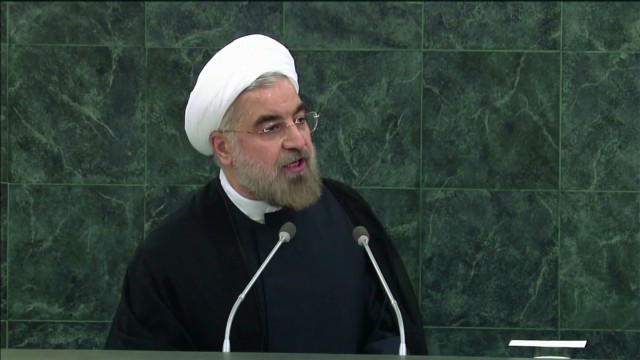
130924174554-rouhani-nuclear-weapons-00001801-story-top(CNN) — Iran is prepared to engage in nuclear talks and nuclear weapons have no place in his country’s security, Iranian President Hassan Rouhani said Tuesday.

In a speech at the U.N. General Assembly, he said that Iran would be willing to “engage immediately in time-bound and result-oriented talks to build mutual confidence and removal of mutual uncertainties.”

“Nuclear weapons and other weapons of mass destruction have no place in Iran’s security and defense doctrine, and contradict our fundamental religious and ethical convictions,” Rouhani said.

He decried international sanctions against Iran.

“Sanctions, beyond any and all rhetoric, cause belligerence, war-mongering and human suffering,” he said.

Iran president: Holocaust ‘condemnable’

Rouhani: Age of ‘zero-sum game’ over

Israel: Iran goes by ‘N. Korea playbook’

Iran ready to make a nuclear deal?

“Iran seeks to resolve problems, not to create them,” Rouhani said, pushing for the “rejection of violence and extremism.”

Alongside fears facing the world, there are “new hopes,” he said. “The hope of universal acceptance and the elite all across the globe of yes to peace and no to war. And the hope of preference of dialogue over conflict, and moderation over extremism.”

Striking a conciliatory tone, Rouhani said that Iran “does not seek to increase tensions with the United States.”

Rouhani said he listened carefully to U.S. President Barack Obama’s speech and hoped that the United States “will refrain from following the short-sighted interests of warmongering pressure groups” so that the two nations “can arrive at a framework to manage our differences.”

Earlier Tuesday, two senior administration officials said that Obama and Rouhani wouldn’t be shaking hands or meet on the sidelines of the U.N. General Assembly.

Such an encounter proved too complicated for Iran back home, the officials told reporters.

Both presidents spoke on the first day of the annual gathering of world leaders in New York. Obama made clear in his morning remarks that the United States was committed to preventing Iran from developing a nuclear weapon.

“We will not tolerate the development or use of weapons of mass destruction,” he said.

At the same time, Obama welcomed what he called positive signals from Iran that it was ready to negotiate with the international community on how it can develop a peaceful use of nuclear power without creating any weapons.

“We are not seeking regime change, and we respect the right of the Iranian people to access peaceful nuclear energy,” Obama said. “Instead, we insist that the Iranian government meet its responsibilities under the Nuclear Non-Proliferation Treaty and U.N. Security Council resolutions.”

He noted that Iranian Supreme Leader Ayatollah Ali Khamenei issued a fatwa against the development of nuclear weapons, and Rouhani “just recently reiterated that the Islamic Republic will never develop a nuclear weapon.”

“These statements made by our respective governments should offer the basis for a meaningful agreement,” Obama said, adding that “to succeed, conciliatory words will have to be matched by actions that are transparent and verifiable.”

Israeli Prime Minister Benjamin Netanyahu welcomed those comments, but said that his country “will not be fooled by half-measures that merely provide a smokescreen for Iran’s continual pursuit of nuclear weapons.”

“Iran thinks that soothing words and token actions will enable it to continue on its path to the bomb. Like North Korea before it, Iran will try to remove sanctions by offering cosmetic concessions, while preserving its ability to rapidly build a nuclear weapon at a time of its choosing,” Netanyahu said.

Secretary of State John Kerry will join his Iranian counterpart, Foreign Minister Mohammad Javad Zarif, at a Thursday meeting of the five permanent members of the U.N. Security Council, plus Germany. Discussions will surround restarting talks on Iran’s nuclear program.

One European Union official expressed optimism over the chance for concrete progress.

“In terms of whether we’re on the verge of a breakthrough, I would put it like this: I was struck as I said by the energy and determination the foreign minister demonstrated to me,” said Catherine Ashton, high representative for foreign affairs and security policy of the European Union.

But no one is expecting an overnight solution to Iran’s alleged effort to build a nuclear weapon, an effort Tehran has so far denied, insisting its nuclear program is for peaceful purposes.

“The roadblocks may prove to be too great, but I firmly believe the diplomatic path must be tested,” Obama said.

Iran president brings ‘charm offensive’ to U.N.

Syria a point of contention

Iran’s recent overtures signaling cooperation, though, likely stop short at the topics of Palestine and Syria. Iran is Syria’s closest ally in the region.

In his speech Tuesday, Rouhani blasted what he described as the “structural violence” against Palestinians. While he never mentioned U.S. ally Israel by name, the intention of his comments was clear.

“Palestine is under occupation; the basic rights of the Palestinians are tragically violated, and they are deprived of the right of return and access to their homes, birthplace and homeland,” he said. “Apartheid as a concept can hardly describe the crimes and the institutionalized aggression against the innocent Palestinian people.”

On Syria, he said that the common objective of the international community regarding that country “should be a quick end of the killing of the innocent.”

“We defend peace based on democracy and the ballot box everywhere, including in Syria, Bahrain and other countries in the region, and believe that there are no violent solutions to world crises,” Rouhani said.

“While condemning any use of chemical weapons, we welcome Syria’s acceptance of the Chemical Weapons Convention,” he said, stressing that extremists’ access to chemical weapons was the “greatest danger to the region.”

Syria is under U.S.-led pressure to give up its chemical weapons arsenal in the aftermath of the August 21 attack on suburban Damascus that Washington and its allies blame on the al-Assad regime.

Obama said Tuesday that Syria’s use of chemical weapons tested the relevance of the United Nations in the modern world, and he rejected contentions by the al-Assad regime and its main ally, Russia, that rebel forces were responsible for the attack.

“It is an insult to human reason — and to the legitimacy of this institution — to suggest that anyone other than the regime carried out this attack,” Obama said.

Russia has blocked U.S. efforts to secure a strong Security Council resolution authorizing possible military force if Syria fails to comply with international regulations on turning over its chemical stockpiles. Obama argued Tuesday that such a resolution was vital.

“There must be a strong Security Council resolution to verify that the Assad regime is keeping its commitments, and there must be consequences if they fail to do so,” he said. “If we cannot agree even on this, then it will show that the U.N. is incapable of enforcing the most basic of international laws. On the other hand, if we succeed, it will send a powerful message that the use of chemical weapons has no place in the 21st century, and that this body means what it says.”

At the same time, Obama announced an additional $340 million in U.S. aid “to meet humanitarian needs in Syria and surrounding countries,” referring to war refugees and other victims. The additional money increases the total U.S. commitment in humanitarian aid to $1.3 billion.

But Farah Atassi, activist with the opposition Syrian National Coalition, said Obama did not go far enough.

“The president did not address the core issue behind the Syrian crisis, which is holding the Assad regime accountable” — including for its use of conventional weapons, she said in a CNN interview. More than 100,000 people have died in the conflict, the vast majority from conventional weapons, according to U.N. figures.

Obama is letting Syria’s ally Russia lead, she said. “We don’t trust the Russians.”

“We want the U.S. to step forward and take the leadership right now to push for Assad to step down and allow for a transitional government from the opposition.”

Emphasizing that the opposition has not asked for “boots on the ground,” Atassi said U.S. military action should remain “on the table.” And, she said, the rebels are looking to Washington for help empowering moderate elements of the opposition.

“We are not terrorists,” she said.

Militant groups make up part of the Syrian opposition.

In his remarks to open the General Assembly on Tuesday, U.N. Secretary-General Ban Ki-moon called for the Syrian government to “fully and quickly” honor its obligations under the Chemical Weapons Convention, which calls for turning over control of its stockpiles.

Ban also appealed to all sides to stop supplying any weapons to all parties in the Syrian civil war while urging both the Syrian government and the opposition to respect international humanitarian law.

Russia and Iran, as well as Hezbollah in Lebanon, are providing military backing to the al-Assad regime while the United States and some European allies have started supplying light arms to rebel fighters.

Meanwhile, U.N. weapons inspectors will be back in Syria on Wednesday to assess at least six claims of chemical weapons use in Syria by the regime or rebels, a spokesman for Ban said Tuesday.

Al-Assad hinted at potential trouble for inspectors coming into Syria, saying other countries may order terrorists to attack them.

“Those militants might want to stop (the) experts’ arrival. We know that those terrorists are under the control of some countries,” he said in an interview Sunday with Chinese television. “And those countries may encourage the terrorists to stop experts from arrival, so that they could accuse the Syrian government for violating the agreement.”

Despite al-Assad’s veiled threat, positive progress has been made on the Syrian chemical weapons deal brokered by the United States and Russia in Geneva. Over the weekend, the United States said it was pleasantly surprised by the extent of Syria’s initial declaration of its chemical weapons stockpile reported to the Organisation for the Prohibition of Chemical Weapons.

The United States is pushing for a U.N. Security Council resolution this week in New York to enforce the Geneva deal.

Opinion: Can Iran’s President Rouhani deliver change in relations with U.S.?

Brazil outrage over U.S. surveillance

Obama faced criticism Tuesday from Brazilian President Dilma Rousseff, who used her U.N. speech to call allegations of U.S. surveillance of her country “totally unacceptable.”

Rousseff referred to classified leaks by former National Security Agency contractor Edward Snowden that made public how the U.S. government had access to phone and Internet records, including foreign information.

She said the U.S. surveillance intercepted private details of Brazilian citizens and businesses, along with “communications by Brazilian diplomatic representation offices, including the permanent mission of Brazil with the United Nations and even the very presidency of the republic of Brazil.”

“Meddling in such a manner in the life and affairs of other countries is a breach of international law and such is an affrontment to the principles that should otherwise govern relations among countries, especially among friendly nations,” she said, adding Brazil would propose U.N. action intended to prevent the manipulation of cyberspace as “a weapon of war.”

Because of the surveillance controversy, Rousseff postponed a state visit to Washington that had been planned for next month. The White House said the postponement was a joint decision.

President Serzh Sargsyan continues to receive congratulations on the occasion of the Republic of Armenia’s Independence Day


անկախության  տարեդարձ The Secretary General of the United Nations Ban Ki-moon sent a congratulatory letter to President Serzh Sargsyan on the occasion of Armenia’s Independence Day. “Your country’s active engagement in the work of the Organization is crucial in advancing our common goals of peace, development and human rights for all”, reads the letter of the Secretary General of the United Nations.

On the occasion of the holiday, President Serzh Sargsyan received congratulations and best wishes from the President of the Federal Republic of Germany Joachim Gauck, President of the Swiss Confederation Eveline Widmer-Schlumpf, President of Lebanon Michel Suleiman, Emperor of Japan Akihito, King of Saudi Arabia Abdullah bin Abdulaziz Al Saud, King of the Hashemite Kingdom of Jordan Abdullah II ibn Al-Hussein, US State Secretary John Kerry, President of India Pranab Kumar Mukherjee, President of the Turkish Republic Abdullah Gül, President of Belarus Alexander Lukashenko, President of Turkmenistan Gurganguli Berdimuhamedov, President of Ireland Michael Daniel Higgins, President of the Republic of Korea Park Geun-hye, President of Mexico Enrique Peña Nieto, President of Algeria Abdelaziz Bouteflika, President of Benin Yayi Boni, President of Indonesia Susilo Bambang Yudhoyono.


President of the Russian Federation Vladimir Putin sent a congratulatory message to President Serzh Sargsyan on the occasion of the RA Independence Day

 On the occasion of the Republic of Armenia’s 22nd Independence Anniversary, President Serzh Sargsyan receives congratulations from the leaders of foreign states, international organizations, state and non-governmental sector, representatives of the clergy, and individuals.

On the occasion of the holiday, the President of the Russian Federation Vladimir Putin sent a congratulatory message to President Serzh Sargsyan.

The message of the President of the Russian Federation reads:

“Distinguished Serzh Azatovich,

I cordially congratulate You on the occasion of the national holiday – Independence Day of the Republic of Armenia.

Your country has registered considerable success in the resolutions of the contemporary issues related to the social and economic, scientific and technical and cultural development. Armenia’s repute on the international arena is growing.
The Russian-Armenian relations, which have deep historical roots, today have reached the level of allied partnership and continue to develop actively. It was proved particularly by the results of Your recent visit to Moscow.

I am confident that through the joint efforts we will be able to insure further consolidation of the entire complex of the bilateral relations, constructive cooperation in different multilateral formats, including in the context of Armenia’s membership to the Customs’ Union. It is, undoubtedly, in the basic interests of our brotherly nations.

I wish You excellent health, well-being and recurrent success, and I wish happiness and prosperity to Your compatriots.

 President of France François Hollande sent a congratulatory message to President Serzh Sargsyan on the occasion of the RA Independence Day


“Mr. President,

On the occasion of the national holiday of the Republic of Armenia, I send my best wishes for happiness and success to You and the entire Armenian nation.

Since independence, Armenia has been successful advancing on the road towards prosperity and democracy due, in particular, to bold reforms conducted in the framework of Armenia’s dialogue with the European Union. I would like to reiterate France’s unequivocal support to the continuation of that undertaking.

As You know, I attach great importance to the friendly relations and cooperation between Armenia and France. I would like together with You to continue our work for strengthening these relations in the most decisive way, particularly in the economic area.

Allow me to stress the importance which France, as a Co-Chair of the Minsk Group, attaches to the progress in the negotiations for the peaceful resolution of the Nagorno Karabakh conflict.

I will be glad to host You in Paris soon to discuss these topics together.

Please accept, Mr. President, the assurances of my highest consideration,” President of France stated in his congratulatory letter.

Address by President Serzh Sargsyan on the occasion of Independence Day

Սերժ Սարգսյան


Today, at the Karen Demirchian Sports and Culture Centre, a reception was organized on behalf of the President Serzh Sargsyan on the occasion of the 21st anniversary of the independence of the Republic of Armenia. The Head of State delivered congratulatory address on the occasion of the Independence Day.

***

Address by President Serzh Sargsyan on the occasion of Independence Day


Your Holiness,
Distinguished President of the Republic of Nagorno Karabakh,
My Fellow Compatriots,
Distinguished Guests,
Ladies and Gentlemen,

I cordially congratulate you on the occasion of Independence Day.

For the last twenty-two years, we have been traveling a new road, which has often appeared narrow and rocky just as our mountain pathways. We have been moving forward cautiously and prudently because we carry great responsibility on our shoulders. The is the Armenia of Orontids and Artaxiads, this is the Armenia of Arsacids and Bagratids, this is the Republic of Armenia of the beginning of the previous century, this is the Armenia which has already entered the third millennium After Christ.

Our path is full of ups and downs but it is our way. We are besieged from right and left; sometimes defiant, sometimes vexed, we nevertheless are moving forward towards the light. We will bring back all those whom at times we have not been able to keep by our side. We will reinstate all our losses and will leave all privations behind. We will look back and register with pride that together we have passed gingerly the only possible narrow pathway. We should have no doubts about that.

My Fellow Compatriots,

For a long time our nation was compelled to solve not development but primarily existential problems. Today, the task has changed: now we are calling to life projects which are dealing with the strengthening and development of the Armenian Statehood. Certainly, security is the number one priority for everyone in this world, and we are no exception. Security-related issues will always be in the focus of our attention, just as they are today. We are constantly searching for ways to boost our economy, and we have achieved certain results. We are setting goals to expand the borders of possible, so that each year with a precise regularity we are able to increase salaries and pensions. Along the way, we are carrying out our reforms, which provide steady development for stronger democracy, good governance, the rule of law, and progress in all other areas. Our policies are directed towards these objectives.

The stance of the Armenian authorities and our society is clear-cut. We have had enough of wars, perturbations, abrupt U-turns and adventurism. We need unfailing defense, peaceful work and sustainable development, and we are doing just that. Perhaps a little slowly, perhaps with some slip-ups along the way but definitely not when it comes to the most important issues and definitely not when it comes to fateful decisions.

Armenian State means realization of the Armenian dream – this is the greatest symbolism of today’s holiday. The re-establishment of our independence in 1991 made our nation’s centuries-long dream come true. Our brothers and sisters in Diaspora and, first and foremost, the citizens of Armenia nourish and make part of their own dream, which came true. Are we able to raise our dream fulfilled to new heights in the contemporary world? Yes, we are, if we neither underestimate, nor overestimate our capabilities. For one who is traveling down a rocky pathway it is absolutely crucial to evaluate painstakingly each step along the way.

The Orontids’ Armenia and the Artaxiads’ Armenia were manifestations of Armenian dream. Today, the situation is quite different, and we have quite another country. This is a new reality which our people started to create fighting and defending ourselves while relying on a substantial legacy inherited from the Soviet Armenia. A glance back reveals the huge distance we have already covered and enormous risks we have avoided. It also inspires us with hope that we can accelerate our advancement. Every offspring of the Armenia nation has a mission to be accomplished in this process. If anyone has not learned it yet, it is high time to do so.

My Fellow Compatriots,

Independence is an objective and daily routine at the same time. It has to be conquered every day through living, adopting decisions and implementing them as free citizens of independent Armenia. We are living in a free country, and can discuss anything we want to. One thing, however, is unalterable under any circumstance: the sovereignty of the Republic of Armenia. It is a dream and duty fulfilled, which is always with us. This is a feast that we inherited paying the price with our heroes’ blood and this is a duty which we shall pass on to our grandchildren.

I once again congratulate all citizens of the Republic of Armenia and the entire Armenian nation. I wish us all peaceful work for the benefit of our families and our country. I wish we allot our capabilities wisely on different turns of the path and crown with success our dreams and programs. Joint together they make what we call the Republic of Armenia.

Long live the Republic of Armenia!
Glory to the Armenian Nation!