ANCA-GREATER WASHINGTON WELCOMES BROAD BACKING FOR JAMGOCHIAN MARYLAND DELEGATE CAMPAIGN

jamgochian_pallone_lsiBETHESDA, MD – Congressional Armenian Caucus Co-Chair Frank Pallone (D-NJ) joined an enthusiastic crowd of more than a hundred Maryland community leaders and activists in a strong show of support for House of Delegates candidate Hrant Jamgochian’s June 17th campaign fundraising kick-off, reported the Armenian National Committee of America – Greater Washington (ANCA-GW).

The reception, graciously hosted by Mrs. Nancy Greenspan at her Bethesda home, was an opportunity for area voters and supporters, including a diverse cross-section of the local Armenian American community, to stand with Jamgochian’s campaign and support Hrant’s positions on a broad range of local and state-wide issues, ranging from health care and education to the environment and economy.

jamgochian_group“We’re pleased to see Hrant in the lead as the front-runner in this race, and proud to support his campaign every step to victory,” said ANCA Greater Washington Chairwoman Sevan Kolejian. “We look forward to helping Hrant spread his message to Maryland voters and to playing our part in electing Maryland’s first-ever Armenian American to state-level office.”

Photos from the event can be found at: https://www.facebook.com/media/set/?set=a.506150389453664.1073741826.181565881912118&type=1

In remarks voicing his support for Hrant’s campaign, Congressman Pallone cited his own long and productive working relationship with him on healthcare issues, saying: “He [Jamgochian] is an extraordinarily respected and strong voice on patients’ rights and works tirelessly in the non-profit sector to advance healthcare rights to the most vulnerable members of our society. As the Ranking Member in the House Energy and Commerce Health Subcommittee, I can tell you that Hrant has got it right when it comes to good democratic values and a true commitment when it comes to access affordability and quality of care for all Maryland residents.”

Jamgochian explained, “This election is about values, and communicating those values to our neighbors. We believe in protecting the most vulnerable members of society, in fostering an affordable and accessible educational system, and in an economy where people pay their fair share and we are able to find jobs in the fields we have spent years preparing for.”

On hand to lend their assistance to the Jamgochian campaign that evening were three of this year’s ANCA Leo Sarkisian summer interns: Manoug Alemian, Taleen Lachinian and Tamar Purut. “Hrant’s enthusiasm and commitment to community outreach and empowerment was inspirational,” said Lachinian, who had met Jamgochian and his wife, Lenna, the day before at the Soorp Khatch Armenian Church Father’s Day Picnic. “We need more Armenian Americans in elected office, and it’s encouraging to see dedicated professionals like Hrant devoting their lives to public service.”

To learn more about or to support the Hrant Jamgochian for Maryland State Delegate campaign, visit:http://www.gojamgo.com


Talaat Killed the Ottoman Crown Prince For Opposing the Armenian Genocide?

Harut Sassounian

By Harut Sassounian

Publisher, The California Courier


It is not often that I cover murder mysteries, but I am making an exception given the unusual circumstances of an Ottoman Crown Prince’s death in 1916 and its possible link to Talaat and the Armenian Genocide.


The first clue was an article I came across in the April 3, 1921 issue of The Pittsburgh Press, titled: “Patiently Tracked to His Hiding Place and Killed: How the Bloodthirsty Turkish Grand Vizier, Talaat Pasha, Who Planned the Murders of a Million Armenians Met His Fate.” This news report was occasioned by Soghomon Tehlirian’s assassination of Talaat on March 15, 1921, in Berlin.


One paragraph, in particular, buried in the middle of the lengthy article, contained a shocking revelation: “Perhaps the strangest fact of all in connection with Talaat’s career is that he paved his way to this supreme office by murdering the heir to the throne, Crown Prince Youssouf Eddine, a nephew of the reigning Sultan. The young prince had protested strongly against Talaat’s announced policy of exterminating the Armenians. Talaat, seeing a prospect of serious opposition, shot the prince like a dog.”


To ascertain the veracity of this surprising news item, I conducted a lengthy internet search and consulted publications in English, French, Turkish, Spanish, and Armenian, based on the different spellings of the Prince’s name: Youssouf Eddine, Yusuf Izzeddin, Yusuf Izzettin, etc.


While most of these sources agree that the Crown Prince died under suspicious circumstances, they present three distinct narratives on how he met his untimely death. There is even an entire Turkish book on this mystery, titled: ‘Shehzade Yusuf Izzedin olduruldu mu, intihar mi etti?’ [Crown Prince Yusuf Izzedin was killed or committed suicide?].


The first account is the one mentioned by The Pittsburgh Press claiming that the Crown Prince was killed by Talaat for opposing the extermination of the Armenian people.


The second explanation for the premature death of the Crown Prince is that he committed suicide by slashing his wrists. The Young Turk government issued the following official announcement on Feb. 3, 1916: “In consequence of the malady from which he suffered so long, His Highness the Heir to the throne committed suicide at half-past seven this morning in the bedroom of the harem pavilion of the summer-house at Zindjirly, by opening the veins of his left arm.”


This formal statement was met with widespread skepticism, giving rise to a third explanation for the Crown Prince’s demise. French Minister of State Yves Guyot, in the preface to his book’s English edition, ‘The Causes and Consequences of the War,’ published in 1916, wrote that those who had read the official communiqué were convinced that the Young Turks “made the heir to the throne ‘commit suicide.’ Information from many quarters confirms that suspicion.”


Guyot and other chroniclers asserted that War Minister Enver Pasha had Izzeddin killed for opposing the Ottoman alliance with Germany during WorldWarI. “After the bombardment of Odessa by the Turkish fleet he [Izzeddin] indicated his disapproval in no uncertain manner. From that moment he was doomed,” wrote the French Minister.


Guyot also described in detail a secret meeting in 1915 attended by Talaat, Enver and other Young Turk leaders, during which Enver advocated the elimination of the Crown Prince, who was “assassinated on the day before he was to start for Europe,” according to Guyot.


Bishop Grigoris Balakian, a prominent survivor of the Armenian Genocide, affirms in his memoirs, ‘Armenian Golgotha,’ that the Crown Prince was “killed by Enver and Talaat’s criminal clique…. Enver himself killed Yusuf Izzedin at the imperial farm of Balmomji.” Having witnessed the dead bodies of thousands of Turkish soldiers at the Battle of the Dardanelles, the Crown Prince protested to Enver that “the Dardanelles is the grave of the Turkish Army.” He was murdered after threatening Enver with a pistol.


Those who think that the assassination of a Crown Prince is too far-fetched to be credible should realize that such palace intrigues were a common practice during the long history of the Ottoman Empire. All too often, Sultans would orchestrate the murder of scheming heirs, and rival siblings would kill each other to pave the way for their own accession to the throne. In fact, 15 of the 36 reigning Sultans either abdicated (3), were overthrown (7) or were murdered (5).


Open letter to the president of the NKR, Mr. Bako Sahaki Sahakyan

        Բակո Սահակի Սահակյան      Honorable Mr. President, the deficient situation of a series of disturbing and discouraging problems, stretching deeper roots each day, oblige us to inform you about their disastrous consequences.

“Free life in the fatherland” – it is with this idea that all Armenians stood up to free the fatherland from the enemy, to live and freely build a home. However 21 years have passed since the victory, but the building of a home in their own liberated land has remained a vital problem for Shushi’s inhabitants.

I consider it necessary to remind you about the fact that, while people worried about this problem are seeking pieces of land, there are several pieces of deserted land that belong to different officials and individual oligarchs. With my application filed earlier this year (N1/104), on May the 20th, I demanded that their names and the sizes of the land pieces belonging to them be made public, but I received a refusal and a strongly groundless answer, which is in contradiction with the NKR law on freedom of information.

If state statistical information about these land pieces will be published, then the Armenian will wake up and realize for whom he has made war and liberated the land of Artsakh. Is it possible that’s how it should be in a democratic country, or maybe European structures will remain indifferent to such dictatorial phenomena?  I don’t think that Artsakh needs to be expressed as European emphasis.

The current situation, extremely disappointing and creating a strongly negative thought about the state and ruling classes, fully allows one to think that the Artsakhtsi, according to an unwritten law, doesn’t have the right to land in his liberated land.

“Since the first days of Shushi’s liberation, I have been living in Shushi for almost 20 years now. I patiently went through all the post-war trials, hoping that one day my turn ill come to have a piece of land in the homeland, where I can build a home and have a family. However, it recently became known that this is mostly a monopoly of oligarchs and officials.  A clear expression of this is the stop of land allocation by Shushi’s local administration and, as a continuation, decision regarding the sale of the remaining free and hardly reachable pieces of land in Shushi through auction, following the “you have money, you will have land” principle. Of course, this means that having land, building a home and live in Artsakh is the right of those who have great sums of money and can win lands in the auction sales.

Please tell me, what should I call ‘Homeland’? The lands of officials and oligarchs? When due to the arbitrariness of the Artsakh government I don’t even have a small piece of the large lands, so I can build a home with my own hands’ work and have a family. The only thing left to do is draw the Diaspora’s attention and ask for support in finding a solution to this and similar problems, why not, even apply to European structures. Otherwise, I have no intention of complying with this “I don’t give a damn” way of working of the authorities and to wait in vain for justice and I myself will be forced to join the  large groups of emigrants”, says Sipan Petrosyan, inhabitant of Shushi. Not having any property, he filed an application to the municipality of Shushi, received a refusal, motivated by the fact that in 2012, pieces of land were allocated to his two brothers at a cadastral price. However, all property rights belong to his brothers and the applicant is not authorized to carry out any construction works in the mentioned land pieces. As a matter of fact, the Shushi local administration’s response to the abovementioned application of Sipan Petrosyan is strongly groundless and illegitimate.

During the processing of such situations, as a natural consequence, a considerable part of cases discussed in European structures deal with similar situations, where all violations of human rights prescribed by the legislation of the NKR will be mentioned. More, in European structures such cases will simply end in favor of the applicant. As a result, the highest state authorities will have to face the obligation of finding a global solution to such problems.    

Certain official, not being under verification by the competent state bodies, allowed themselves to abuse the official position in allocating land pieces in Shushi and in auction sales and sign a series of groundless contract with different persons. In order for these land piece allocation problems not to finally become a cause of emigration, we consider it necessary to ask you the following:

a)      The government of the independent Republic of Artsakh should adopt a fair decision and carry out a very important project. That is recognizing all  land pieces and ruins fit for building housing as prevailing state interest and allocate them with priority right to private individuals for building a house and settling in the fatherland, with the objective to prevent emigration from Artsakh and de-Armenization.

b)     After the decision of the NKR government regarding the recognition as prevailing state interest takes effect, the basis of all the decision made by the prefecture and the city hall of Shushi regarding the whole process of allocation and auction sale of land pieces, from the past years as well as current ones, should be reinvestigated and supervised by a several competent state bodies.

c)      The state must start proceedings against employees of local administration on grounds of not carrying out their obligations as prescribed by the law or deficiently carrying them out, as well as abusing their official position.

d)     A permanent commission under the direct control of the NKR governmentshould be created; this commission should check in what measure the past land piece allocations are fair and legitimate, as the legal decisions of European structures have not yet been called to life. Competent state bodies and local administration must not discriminate between oligarchs, officials and simple NKR citizen, but must be guided by the principles of democracy․

Most honourable Mr. President, in order to find a solution to this and similar nation destructive problems, we are expecting a fair decision from you, in the name of our martyrs, our heroic freedom fighters and the protection of the rights of our victorious people, which as the right to live in its victorious land like a victorious person.

Thank you in advance.

NKR citizen Ruzanna Tsatryan



Worried tourism chiefs hand out leaflets on how to be nice in a bid to rid Paris of its image as one of the world’s rudest cities

paris2Desperate to shed its image as one of the world’s rudest cities, Paris has embarked on a campaign to improve its reputation and better cater to the needs of tourists.

Waiters, taxi drivers and sales staff in the French capital all too often come off as impolite, unhelpful and unable to speak foreign languages, say local tourism chiefs, who are handing out a manual with guidelines on better etiquette.

A six-page booklet entitled ‘Do you speak Touriste?’ contains greetings in eight languages including German, Chinese and Portuguese and advice on the spending habits and cultural codes of different nationalities.

‘The British like to be called by their first names,’ the guide explains, while Italians should be shaken by the hand and Americans reassured on prices.

Of the Chinese, the fastest-growing category of tourists visiting the city, the guide says they are ‘fervent shoppers’ and that ‘a simple smile and hello in their language will fully satisfy them’.

France is the world’s top destination for foreign tourists, with Paris visited by 29 million people last year.

The Paris chamber of commerce and the regional tourism committee have warned, however, that growing competition from friendlier cities such as London meant Paris needed to work harder to attract visitors, especially from emerging market countries.

Some 30,000 copies of the handbook on friendly service are being distributed to taxi drivers, waiters, hotel managers and sales people in tourist areas from the banks of the Seine river up to Montmartre and in nearby Versailles and Fontainebleau.


Bolshoi Ballet acid victim is now almost completely blind after 18 operations fail to save his sight

Sergei Filin2The artistic director of the Bolshoi Ballet is now almost completely blind after 18 operations failed to save his sight following an acid attack earlier this year.

Sergei Filin, 42,  was left with severe burns to his eyes and face when a masked attacker threw a jar of sulphuric acid in his face as he was returning home late on January 17.

He flew to Germany from Moscow for treatment in March, but despite initial optimistic reports, he has now lost 95 per cent of his vision and is totally blind in his right eye.

A spokeswoman for the Bolshoi told The Times yesterday: ‘He is now blind in his right eye. The problem is that it is acid and it continues to cause damage. He has had 18 operations and I understand that some of them were very difficult.’
She said that his facial burns had almost completely healed and his hair had grown back.

The spokeswoman also said that he continues to speak regularly on company business to Galina Stepanenko, who has been standing in for him.

The Bolshoi, one of Russia’s best-known cultural symbols, filed two reprimands against Tsiskaridze for giving unauthorised interviews after the attack on Mr Filin.

When he arrived at Aachen University Clinic, Mr Filin said he was ‘full of strength and faith’ that he will eventually see well enough to return to work at the famed Moscow theatre.

But it appears his progress has now stalled and the prognosis for his sight is now bleak.


Bollywood star sparks controversy in India after it is revealed surrogate mother is pregnant with his son… as gender testing is illegal in the country

Khan and his wifeA Bollywood superstar and his wife are under investigation by health officials in India following reports that the couple know the sex of a baby they are having through a surrogate mother.

A complaint to India’s health authorities has alleged that Shah Rukh Khan and his wife Gauri know they are expecting a boy.

Sex determination tests are banned in India to stop the practice of aborting female fetuses due to a preference for sons.

India’s Health Ministry has now launched an investigation. The Press Trust of India reported that Khan was not at home when authorities tried to question him about the reports that the surrogate mother had the test.

Khan – who has a 16-year-old son and a 13-year-old daughter – has so far not commentated.

Speaking to CNN, Dr Jignesh Thakkar of the Indian Radiological & Imaging Association, said that the health ministry investigated the case at its request.

‘We wanted to know how this apparently had been leaked out because it’s confidential information that only a doctor and not even a patient knows,’ he said

‘Action should be taken against doctors and patients who are not following this law.’

India’s 2011 census showed that the country had 914 girls for every 1,000 boys under age 6, a gender ratio mainly attributed to sex-selective abortions despite the ban on prenatal gender tests.

As well as being banned in India, sex determination tests are also banned throughout Asia because of a traditional preference for sons.

Doctors found to have provided information to parents about the sex of an unborn child could face three years in jail. They could also have their medical license suspended for five years.

Parents could also face five years in jail.


ANCA EASTERN REGION PARTNERS WITH INVESTORS AGAINST GENOCIDE TO ENCOURAGE GENOCIDE-FREE INVESTING AT FIDELITY

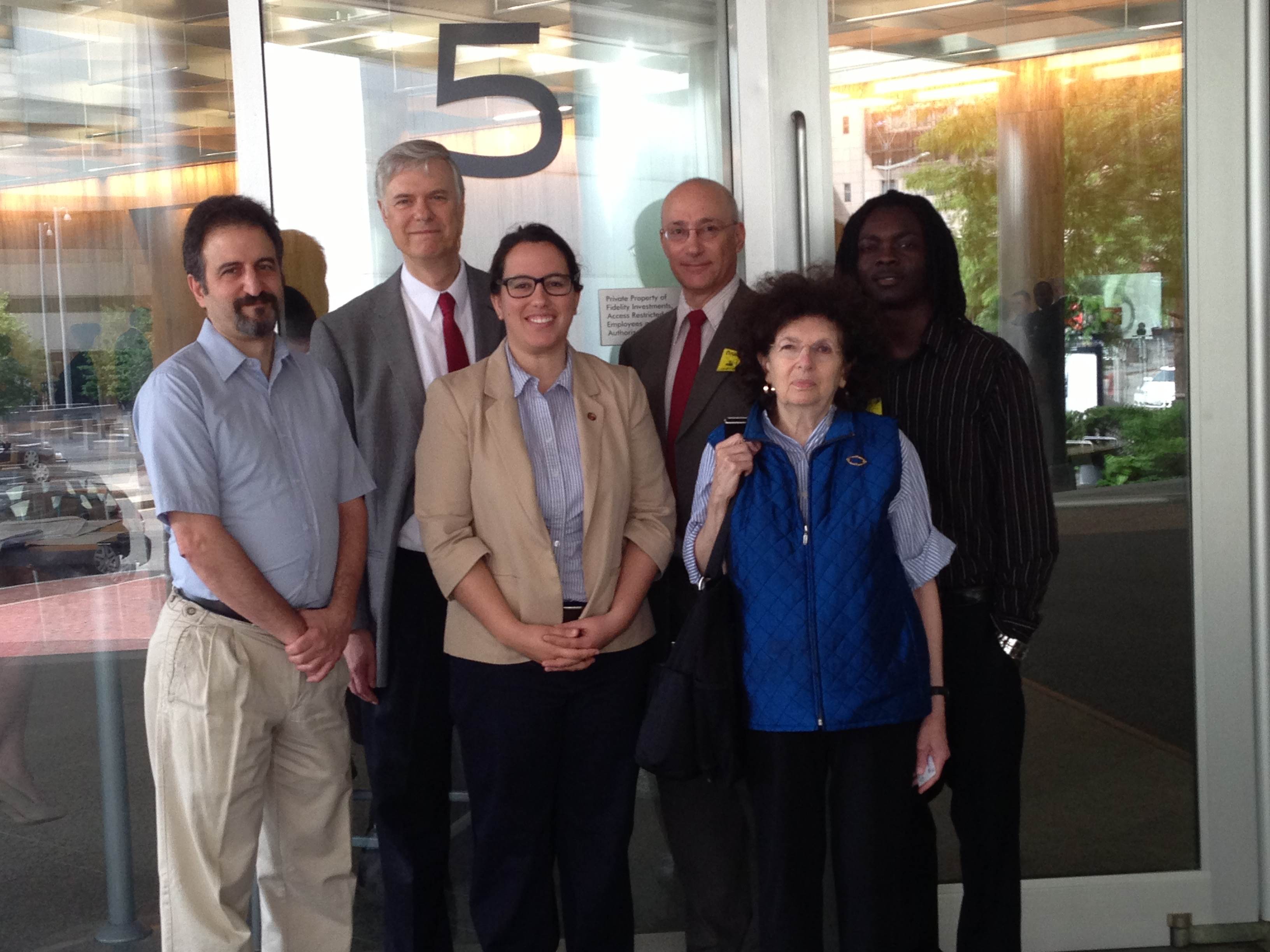
FidelityBoston, MA — The Armenian National Committee of America Eastern Region (ANCA-ER) joined with Investors Against Genocide (IAG) on Tuesday in urging mutual fund giant Fidelity Investments to avoid investments in companies with ties to genocidal regimes worldwide.

Michelle Hagopian, ANCA Eastern Region Executive Director, and ANC of Eastern Massachusetts activist Dikran Kaligian represented the ANCA at Fidelity’s June 18th shareholder meeting as part of an outspoken group of anti-genocide advocates.

Six mutual funds recorded votes at Fidelity’s shareholder meeting on the proposal presented by Investors Against Genocide, which states “Shareholders request that the Board institute transparent procedures to prevent holding investments in companies that, in management’s judgment, substantially contribute to genocide or crimes against humanity, the most egregious violations of human rights.” These funds bring to 40 the number of Fidelity funds that have had “genocide-free investing” on their proxy ballot.

Tuesday’s preliminary voting results in favor of the proposal ranged from a high of 29.19% to a low of 24.13%, which are comparable to results on similar proposals at Fidelity in 2008 and 2009.

“Fidelity continues to own large positions in PetroChina, a company widely recognized as the largest business partner of the government of Sudan which is currently bombing, starving and displacing massive numbers of its own civilians in several regions,” said Eric Cohen, chairperson of Investors Against Genocide.

“This year marks 10 years of the genocide in Darfur, and it is the fifth year that Fidelity has opposed genocide-free investing. As a result, people investing with Fidelity are still inadvertently linked to companies tied to the atrocities in Sudan,” he said.

Fidelity’s website claims, “We are sensitive to the ongoing tragedy occurring in Darfur and, like most others in the world, we are repulsed by genocide and all other crimes against humanity. … That said, we have concluded that when it is appropriate to remain actively invested in a company, we will do so, thus retaining the ability to oppose company practices that we do not condone.”

“Fidelity’s anti-genocide statements need to be backed up by concrete action,” said Hagopian. “Tuesday’s shareholder meeting showed that millions of Americans want their investments to be genocide-free. Mutual funds are the most common investment vehicle for family savings and retirement plans in America. The ANCA and IAG will continue to speak out at these shareholder meetings as part of an international campaign to end all financial support for genocidal regimes.”

Although federal law prevents U.S. oil companies (and most other U.S. companies) from operating in Sudan, Fidelity and other American financial institutions are major investors in the foreign oil companies involved in Sudan that are helping to fund that government’s continued genocide and crimes against humanity. As a result, ordinary investors, through their mutual funds, family savings, and pension plans entrusted to these financial institutions, are inadvertently investing in genocide.

IAG, a Boston-based nonprofit organization coordinating the anti-genocide shareholder action at Fidelity and other financial institutions, including Vanguard, JPMorgan Chase, and Franklin Resources, is engaged in an effort to encourage legislation and regulatory changes to address investments in companies that help to fund genocide. For more information, visit: www.investorsagainstgenocide.org

In March, the ANCA San Francisco-Bay Area teamed up with IAG to advance a similar anti-genocide proposal to shareholders at Franklin Resources, the parent company of Franklin Templeton mutual funds.


Despite Internal Turmoil, Turkey Keeps up Genocide Denial Campaign

Հարութ-Սասունյան1By Harut Sassounian

Publisher, The California Courier


Some may have expected that the recent mass protests and unrest in Turkey would preoccupy its leaders with internal problems, distracting them from other important developments, such as Armenian Genocide issues. Regrettably, this has not happened.


As tens of thousands of demonstrators angrily protested throughout Turkey, expressing their dissatisfaction with Erdogan’s dictatorial rule, foreign ministry officials continued to pursue their routine denialist tasks, countering any and all efforts by other states to reaffirm the reality of the Armenian Genocide.


There were three such instances of Turkish reaction in recent weeks:


1) The Turkish government reacted harshly when Pope Francis acknowledged the Armenian Genocide, calling it “the first genocide of the 20th century.” The Pontiff was speaking during the June 3 visit to the Vatican of a delegation of Armenian Catholics. Although Pope Francis had made similar remarks in the past while serving as a Cardinal in Argentina, this is the first time he referred to the Armenian Genocide since his recent papal election.


The Turkish foreign ministry was quick to lodge a formal protest to the Vatican, expressing its “disappointment” at the Pope’s statement. Vatican’s Ambassador in Ankara was promptly summoned to the foreign ministry and told that the Pontiff’s remarks were “absolutely unacceptable” and could harm bilateral relations. An unnamed Turkish official even suggested that the Pope’s upcoming visit to Turkey might be in jeopardy after his remarks on the Armenian Genocide!


Rather than backing down, the Vatican made matters worse for Turkey by announcing that Pope Francis planned to visit Armenia on April 24, 2015, to perform a requiem service at the Centennial commemoration of the Armenian Genocide.


In view of the denialist mindset of Turkish officials, it is understandable that they would be displeased with the Pope’s factually candid and morally uplifting statement. After all, the Pontiff is not only the spiritual leader of the Catholic Church, but also a head of state. Yet, there was no need for the Turkish foreign ministry to get so agitated, since the Vatican had recognized the Armenian Genocide twice in 2000 and 2001.


Turkish officials don’t seem to realize that by overreacting to acknowledgments of the Armenian Genocide, they are inadvertently promoting the very cause they are trying to undermine! Indeed, the Turkish condemnation of Pope Francis’ statement on the Armenian Genocide was reported by the media worldwide, helping to further publicize the facts of the Armenian Genocide. Ankara’s real intent in slamming anyone around the world who dares to speak out on the Armenian Genocide is to discourage all others from issuing similar statements, particularly in view of the upcoming Centennial in 2015.


2) The Greek Parliament also angered the Turkish authorities earlier this month when the ruling New Democracy Party, lifting a page from the French legislature, introduced a bill to punish xenophobia and denial or distortion of genocides recognized by Greece, such as the Armenian Genocide and the Holocaust. Violators of the proposed law would face up to three years of imprisonment and a fine of 5,000 to 20,000 euros. The Greek Parliament recognized the Armenian Genocide in 1996. Even though there has not been any public statements by Turkish officials against the newly introduced resolution, it is almost certain that pressure is being applied through Turkey’s ambassador in Athens and other diplomatic channels.


3) Ukrainian Parliament members Arsen Avakov of the opposition Batkivshchina ‘Fatherland’ Party, and Vilen Shatvoryan and Nver Mkhitaryan of the ruling Party of Regions introduced a resolution on June 6 for the recognition of the Armenian Genocide. Azernews reported that Azerbaijanis living in Ukraine protested outside the Parliament against this resolution. Also, a letter signed by several Azerbaijani organizations in Ukraine was sent to President Victor Yanukovych, claiming that the resolution is “of serious concern to the Turkic-speaking people of Ukraine, especially Azerbaijanis… and a serious blow to Azerbaijan and Turkey.” According to well-informed sources in Ukraine, the Turkish government is behind the Azeri protests, including the strong reaction from Mustafa Dzhemilev, Chairman of the Mejlis of the Crimean Tatars and a member of the Ukrainian Parliament.


Despite the persistence of domestic instability, Turkish officials have continued to project their denialist policies around the globe, interfering with the internal affairs of other states. One would hope that the international community would reject the Erdogan regime’s pompous and arrogant attitude, as it is being rejected at home by large segments of the Turkish population.


Comments by Edward Nalbandian, Minister of Foreign Affairs of Armenia, on the Enniskillen Joint Statement on Nagorno-Karabakh by the Heads of the OSCE Minsk Group Co-Chair Countries 18.06.2013

399. Comments by Edward Nalbandian, Minister of Foreign Affairs of Armenia, on the Enniskillen Joint Statement on Nagorno-Karabakh by the Heads of the OSCE Minsk Group Co-Chair Countries 18.06.2013The joint statement on the Nagorno-Karabakh Conflict made today in Enniskillen by the heads of the OSCE Minsk Group Co-Chair countries is the fifth one. We highly appreciate the continuous efforts of the heads of the OSCE Minsk Group Co-Chair countries – Russia, USA and France, aimed at the peaceful settlement of the Nagorno-Karabakh conflict.

Armenia is unanimous with the Co-Chair states and is determined to achieve an exclusively peaceful settlement of the conflict.

As the United States, Russia and France, we also regret that rather than finding a solution, because of Baku’s attempts to snatch one-sided advantage, progress was not achieved in the Summits of Kazan in June, 2011, Sochi in March, 2011, Astrakhan in October, 2010, Saint-Petersburg in June, 2010. Armenia shares the Co-Chairs’ approach that further delay in reaching a balanced framework agreement on the main principles for a comprehensive peace is unacceptable.

As the Co-Chairs, we continue to believe that the elements outlined in the statements of the heads of the Co-Chair countries over the last four years can be the foundation of reaching a fair and lasting settlement of the conflict, and that those elements should be seen as an integrated whole and that any attempt to select some elements over others would make it impossible to achieve a solution.

We absolutely agree that peoples should be prepared for peace, not war. Unfortunately until now the Azerbaijani leadership is doing just the reverse. We absolutely agree with the heads of the Co-Chair states-France, the United States and Russia, that the use of force will not resolve the conflict, and that only a negotiated settlement can lead to stability and peace, which will open new opportunities for regional cooperation and development.

Unlike Azerbaijan, which on the occasion and without makes references to only one principle of international law, Armenia has on several occasions reiterated and in response to the Enniskillen appeal of Presidents Vladimir Putin, Barack Obama and Francois Holland, once again re-affirms its commitment to the principles of international law, particularly the non-use of force or the threat of force, equal rights and self-determination of peoples, and territorial integrity.

In spite of the several appeals of the international community to refrain from provocative rhetoric and actions, Azerbaijan continues its bellicose rhetoric and provocations on the line of contact with Nagorno-Karabakh and on the border with Armenia, the glorification of murderers and persecution of peace advocates, the propaganda of xenophobia, intolerance and hatred, which leads to raising tension and escalation of the situation in the region.

The joint statement of Enniskillen on the Nagorno-Karabakh conflict by the heads of the OSCE Minsk Group Co-Chairs may become an impetus for achieving progress in the negotiation process would Azerbaijan correctly perceives the messages of the three Co-Chair countries.


Case of 4 employees of Gyumri territorial subdivision of SSSS sent to court

7846_bIn the framework of the criminal case initiated on the abuses recorded during the process of fixing and paying pensions the preliminary investigation on the part of the abuses found in Gyumri territorial subdivision was completed. The prosecutor implementing prosecutorial supervision confirmed the bill of indictment, at the same time he submitted a petition to the court on restoring the damage inflicted to the state.

According to the factual data obtained during the pre-trial proceeding 5 persons were involved as a defendant for squandering a particularly large amount of pension money, funeral benefits and heritable money from 2008 to 2010.

Thus,
According to the materials of criminal case the head of Gyumri territorial subdivision of Social Security State Service of RA Ministry of Labor and Social Affairs Eduard Varzhapetyan reaching a prior agreement on squandering a particularly large amount of money with the operator of the same subdivision Artur Abrahamyan, from 2007 to 2009 from pension depository had separated the data of pensioners who had not received pension for a long time and in the name of those pensioners had prepared false applications on restarting the detained payment of pension.

E. Varzhapetyan had given the mentioned documents to A. Abrahamyan who had involved the separated data in appropriate payment lists, had confirmed the payment fact with false signatures, received the pension money and passing the received money to E. Varzhapetyan had swindled a particularly large amount of money drawn out in the name of 9 pensioners, as well as had committed official forgery.

According to the materials of criminal case, later, A. Abrahamyan by E. Varzhapetyan’s instruction had removed the data of swindled money from pension depository. According to the agreement E. Varzhapetyan had given A. Abrahamyan 10 percent of the received money.

According to the preliminary investigation data, the responsible person for heritage payment subdivision R. Mnatsakanyan, out of personal interests, abusing official authorities, from 2008 to 2010 being aware of the fact that the inspector-payers of the same subdivision Kima Piloyan and Anya Khachatryan had made groundless payment of pension money in the name of pensioners to the operator Artur Abrahamyan,as well as being aware of swindling a particularly large amount of money by the group of the mentioned people, had not prevented the groundless drawing out and swindling of state budget resources.

On the contrary, he had received and confirmed the reports on paying pension money, funeral benefits and heritable money from his actual wife Kima Piloyan and Anya Khachatryan, had submitted reports on them to payment service, had signed acts of accounts. So, Kima Piloyan, Anya Khachatryan and Artur Abrahamyan had an opportunity to swindle a significant amount of pension money by a group inflicting the state a damage of particularly large amount.

On the base of the obtained evidence E. Varzhapetyan was accused according to the Point 1 of the Part 3 of the Article 179 and the Article 314 of RA Criminal Code,

Artur Abrahamyan was accused according to the Point 1 of the Part 3 of the Article 179, the Article 38-314 and the Part 1 of the Article 325 of RA Criminal Code,

Kima Piloyan was accused according to the Point 1 of the Part 3 of the Article 179 and the Part 1 of the Article 325 of RA Criminal Code,

Ruben Mnatsakanyan was accused according to the Part 2 of the Article 308 of RA Criminal Code.

Anya Khachatryan was involved as a defendant according to the Point 1 of the Part 3 of the Article 179 and the Part 1 of the Article 325. The part on her was separated as a separate proceeding and taking into consideration that it is not known where she is, was detained. Measures are taken to find Anya Khachatryan.

Totally, the damage inflicted to the state was estimated 91.560.299 AMD 3.000.000 AMD of which E. Varzhapetyan restored during the preliminary investigation. The Department of State Interest Protection of RA Prosecutor General’s Office submitted a petition to the court to confiscate the rest of the money – 88.560.299 AMD from the mentioned 4 defendants.

We remind that in May, 2011 a criminal case was initiated on the abuses recorded in the process of fixing and paying pensions in the Department of State Interest Protection of RA Prosecutor General’s Office. The implementation of the preliminary investigation of it was tasked to the Investigation Department of Especially Important Cases of General Investigation Department of RA Police adjunct to government.

Entire villages washed away: At least 23 dead and 50 missing in India as days of torrential rains wreak havoc and leave 10,000 pilgrims stranded on a mountainside

rains in IndiaAt least 23 people have died and 50 more remain missing after torrential downpours in northern India swept away roads, buildings and vehicles.

One building collapse today killed at least three people who were washed away when an entire apartment block toppled into a river, a government spokesman said.

Most of the destruction is concentrated in the state of Uttarakhand, where the Ganges river and its tributaries are flowing at dangerously high levels.

Another landslide triggered by the monsoon rains buried a bus, killing three people in Almora district.

Adding to the crisis, many more people have been left totally stranded in their homes by collapsing roads and bridges.
More than 10,000 pilgrims on a mountain pass leading to a Hindu religious site had to be evacuated by helicopter after roads to the pilgrimage spot were unusable.

In response, army and paramilitary troops are leading efforts to rescue scores of people from the rooftops of their flooded homes.

India’s capital, Delhi, has also been hit by the heavy rains as many roads were flooded after recent blistering summer heat.

Delhi airport was affected after more than four inches of rain fell in five hours on Sunday afternoon. Passengers were seen having to wade knee-deep in water to get to Terminal 3.

The height of annoyance! Millionaire homeowners in world’s tallest block of flats forced to walk 97 floors to top after lift breaks down

Princess Tower1Homeowners living in the world’s tallest residential skyscraper are having to climb up more than 1,300ft of steps – the equivalent of walking one-third of the way up Ben Nevis – after all the lifts broke down.

Princess Tower in Dubai, which stands at 1,355ft tall with 97 above-ground residential floors, has been named the tallest residential building in the world Guinness World Records.

But residents living in the luxurious tower block – many of whom are British – have been told they have ‘no choice’ but to walk up to their flats, some on the 97th floor, after all eight lifts in the building broke down last week.

The building, which has six levels in the basement and 101 above ground level, opened in September last year, with two-bed flats on the rental market for £140-a-day and penthouse flats selling for more than £2million.

Princess Tower boasts 763 luxury apartments as well as eight giant stores and overlooks the Palm Jumeirah, the manmade ‘palm island’ where David Beckham and Brad Pitt are said to have bought luxury pads.

Emergency repairs are ongoing after the problems began last week – leaving penthouse owners who paid £2millio plus for their flats forced to take the stairs.

Flat owners have today been told that a solitary ‘service elevator’ is available for ‘limited’ trips to the 50th floor – but anyone living above that level will still have to walk the rest of the way.

Bosses at the skyscraper – owned by Tameer estates – say the flooding was caused by water from the ‘fire protection system’ and that a ‘faulty fire hose’ was to blame.

Water from the hose got into the residents’ lift shafts, flooding them and causing them to be shut down.

One resident, who lives on the 78th floor, said: ‘I came home after a hard day of work and was told I’d have to walk to my apartment on the 78th floor.

‘I truly couldn’t believe it – there was no way I was walking all that distance so I just booked myself into a hotel.’

A spokesman for Kone Elevators said: ‘We have had engineers on site 24-hours a day since the water leak occurred.’


World’s oldest person dies: Former Japanese postman was the last living man to have been born in the 1800s

Կիմուրան աշխարհի ամենածեր մարդ տիտղոսը ստանալիսThe last living man to have been born in the 19th century has died at the age of 116.

Jiroemon Kimura, who was born on April, was not only the world’s oldest person but also the world’s oldest ever living man.

The former postman died in his hospital bed in Kyotango, Japan where he had been undergoing treatment for pneumonia.

Mr Kimura had been officially recognised by the Guinness World Records as the world’s oldest living person and the oldest man ever.

According to Guinness, Mr Kimura, a former postman, was the first man in history to have lived to 116 years old.

He is survived by seven children, 14 grandchildren, 25 great-grandchildren, and 15 great-great-grandchildren, Japanese media said.

The title of oldest living person is now held by another Japanese person, 115-year-old Misao Okawa, of Osaka.

Kyotango officials said Mr Kimura’s funeral would be held Friday.

The town’s mayor Mayor Yasushi Nakayamasaid: ‘Mr Kimura was and will always be a treasure to our town, to our country and to our world.’

According to local media, Kimura ate a three-meal-a-day diet of rice, pumpkins and sweet potatoes.

He reportedly did not smoke and said he only ate until he felt 80 per cent full.

According to one town official his motto in life  was ‘to eat light and live long’.

He celebrated his 116th birthday on April 19 by watching a video message of congratulations from Japan’s prime minister.


Australian woman, 29, tries to become first person to complete 103 mile Florida to Cuba swim WITHOUT a shark cage

Chloe McCardel2An Australian woman is attempting to become the first person to swim from Cuba to Florida without a shark cage.

Chloe McCardel, 29, is setting off on the 103-mile (166-km) swim today.

The treacherous body of water known as the Florida Straits is the Holy Grail for marathon swimmers and has been conquered only once, by Susie Maroney, also Australian, who used a protective cage at age 22 during her 1997 swim that glided on ocean currents and enabled her to make the journey in just 25 hours.

Since 2011, four unsuccessful, uncaged swims have been attempted, three by American Diana Nyad and one by Australian Penny Palfrey, and in all, 20 people have tried and failed, McCardel said in a press conference on Tuesday at the Hemingway Marina west of Havana.

‘It’s the hardest marathon swim in the entire world,’ the blond, well-tanned 28-year-old told reporters.

‘This is like winning a World Cup in soccer or getting a world record and a gold medal at the Olympic Games, but it’s possibly harder because no one has been able to do it,’ said McCardel, who works as a first aid trainer in Melbourne.

McCardel trains 50 weeks a year and has a record of accomplishment that includes two double crossings of the English Channel.
She and her husband, Paul, did a thorough study of past failed attempts to see what could be done differently.

Based on their findings, they turned to science to increase the chance of success.

Like past swimmers, McCardel will be surrounded by an underwater electromagnetic field to keep sharks away.

Her support crew of 50 people includes a team of U.S.-based scientists, all experts on the Gulf Stream, to monitor the current and its constant changes as it flows toward the Atlantic Ocean.

Armenia Should Send Peacekeeping Forces to Lebanon, but not Mali

հարութBy Harut Sassounian

Publisher, The California Courier


The Armenian Defense Ministry is considering sending two platoons of troops to southern Lebanon. Ministry officials are traveling to Rome this week to discuss the structure, deployment site, number of troops, and needed supplies with their Italian counterparts who are in charge of the United Nations Interim Force in Lebanon (UNIFIL).


This is a positive development since 2006 when Pres. Kocharian’s government refrained from joining dozens of countries that had agreed to take part in UN’s peacekeeping mission after Israel’s war with Lebanon. At that time, former Pres. Kocharian’s spokesman told Mediamax that the Armenian government refused to contribute troops because of UNIFIL’s unclear mandate and that any clashes involving Armenian soldiers could endanger the Armenian community in Lebanon. Pres. Kocharian staunchly defended his position on this matter during a private conversation I had with him in 2006.


The Turkish government, on the other hand, was quick to recognize the benefits of sending troops to Lebanon, as part of its effort to establish a military footprint, expand its political and economic influence in the Arab world, gather valuable intelligence, and counteract the Armenian influence in Lebanese affairs. Consequently, Turkish troops entered Lebanon for the first time since the collapse of the Ottoman Empire almost a century ago. Currently, UNIFIL consists of 11,000 troops from 37 countries, including 495 from Turkey. Armenia sent just one officer to southern Lebanon last year on an observer mission. Meanwhile over 130 Armenian soldiers have been serving in Afghanistan and 35 in Kosovo for several years, and until recently in Iraq.


The Armenian government did not fully explain last week as to why is it now interested in sending a peacekeeping force to Lebanon, after former Pres. Kocharian’s refusal to do so seven years ago. In my view, there are five good reasons why Armenia should contribute troops to UNIFIL:


1) The presence of Armenian soldiers on Lebanese soil would generate great pride among the large Armenian community in that country.


2) The Armenian contingent would serve to balance in a small way the pro-Turkish propaganda resulting from a much larger Turkish military deployment in southern Lebanon since 2006.


3) The Armenian troops would be the only ones from the South Caucasus, as neither Azerbaijan nor Georgia has contributed troops to Lebanon.


4) Even though there is an element of risk in sending troops to police southern Lebanon which borders Israel and Syria, this is a far less dangerous mission than Afghanistan where over 130 Armenian soldiers have been serving for a number of years.


5) As in Afghanistan, Iraq, and Kosovo, Armenian troops would gain valuable military experience by serving along with contingents from dozens of other countries.


The Armenian Defense Ministry also announced that it might send peacekeeping troops to Mali in Africa, where a series of bloody confrontations have been unfolding. In these clashes, Al-Qaeda-linked Islamist fighters have been battling Malian, French and African forces. A civil war is also raging between separatist Tuareg tribes and Malian troops. The situation is so precarious that U.N. Secretary-General Ban Ki-moon issued a report last week warning that peacekeeping troops may face grave risks in and around Mali.


Under such dangerous conditions, it would be unwise for Armenian troops to be dispatched to Mali. The responsibility for the security of Mali is primarily assumed by troops from African countries with logistical support from the French military. Armenia cannot afford to risk the lives of its soldiers unnecessarily, keeping in mind its own security priorities at home due to the Karabagh (Artsakh) conflict.


Having a limited number of Armenian troops serving in less dangerous locations may be a good idea in order to gain military training and diplomatic visibility, but dispatching large numbers of soldiers to multiple theaters of conflict and placing them in perilous situations would be most imprudent, given the small size of the Armenian military.


Although Armenia’s participation in UNIFIL is subject to parliamentary approval, little opposition is expected in view of the ruling party’s overwhelming majority. The Armenian government should seek the Parliament’s consent to dispatch peacekeeping troops to southern Lebanon only. There are many sensible reasons for stationing Armenian units in Lebanon, but not in Mali!


Turkish riot police move in on protesters at Taksim Square

130610110550-01-turkey-protest-0610-horizontal-gallerystanbul (CNN) — Turkish riot police in sizable numbers moved into Taksim Square on Tuesday morning, where they engaged in a game of cat-and-mouse with a small, hard-core group of protesters.

The protesters lobbed Molotov cocktails at armored vehicles, which responded by spraying water cannons.

The demonstrators, using wooden boards as shields, would pull back — only to return again, lobbing cocktails and firecrackers and flashing “victory” signs.

Smoke from tear gas and fireworks wafted through the air as the armored vehicles shoved away makeshift barriers set up by the demonstrators.

The small group reappeared, this time in larger numbers and surrounded an armored vehicle.

Police deployed multiple canisters of teargas and fired water cannons, sending them scattering again.

“If you stop throwing rocks, we will not use tear gas,” the police told the raucous group over loud speakers. “We don’t want you to get hurt, please obey.”

Police move in on Turkey’s Taksim Square

Turkey protesters dig in for long haul
At Gezi Park, the seat of the protest, however, the situation was relatively calm.

There, demonstrators milled about as officers in full riot gear huddled together.

“Look we are not coming into Gezi Park,” the loud speakers said.

“Most of the crowd is situated in the park,” said Efe Songun, who attended the protests. “They are shouting their slogans.”

A show of force

The police movement came one day before Prime Minister Recep Tayyip Erdogan planned to meet with protest organizers. The presence appeared more to be a show of force at the square than an effort to flush out protesters who have been camped there for days.

The demonstrations in Turkey started as a small sit-in over plans to bulldoze the park — the last green space in central Istanbul — and replace it with a shopping mall.

But they have grown into a protest across the political spectrum.

Demonstrators have demanded Erdogan’s resignation, accusing his government of creeping authoritarianism.

The result has been the biggest challenge to Erdogan and his governing Justice and Development Party during their decade in power.

Erdogan fights back

And the prime minister has fought back.

In speeches, Erdogan has said he has no tolerance for what he calls illegal demonstrations.

Sunday, he slammed protesters, warning that “even patience has an end.”

He criticized protesters’ tactics and challenged them to beat him at the ballot box.

“All they do is destroy. They attacked public buildings; they burned public buildings. They burned the cars of civilians,” he said.

“Let’s face off at the ballot box in seven months. If you are saying democracy and freedom, if you are saying rights and freedoms, you cannot achieve that with violence. Only within the laws, you can achieve it.”

Violence at past protests

Previous protests have met with a harsher police response, garnering broad criticism from inside and outside of Turkey’s borders.

Since the demonstrations started May 31, two protesters have been killed. One was hit by a car in Istanbul; the other was shot in the head by unknown assailants in Antakya, near the border with Syria.

A police captain died after falling from a bridge last week, the Adana governor’s office said.

The Turkish Medical Association claimed that more than 4,300 people were injured in clashes last week. Only a few dozen sustained serious injuries.

Woman labeled ‘icon’ of Turkey protests: It’s not about me

130604063059-turkey-protest-0528-story-top(CNN) — She has become a symbol of the violent protests in Turkey. Across social media, she’s known as “The Woman in Red.”

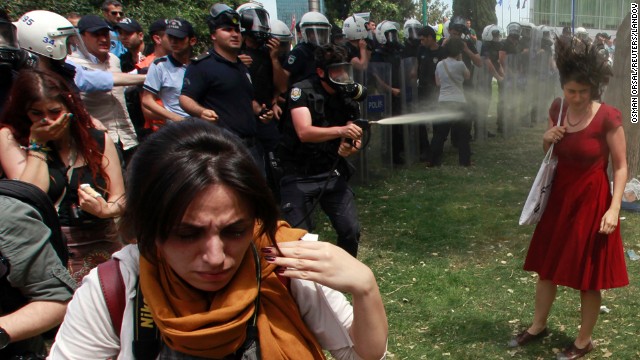
Wearing a red summer dress and a delicate necklace, the woman walked among demonstrators in Istanbul’s Taksim Square when a security officer lurched at her and pepper-sprayed her so powerfully her hair was blown upward.

She could do nothing but turn away from the toxic spray. The officer, wearing a gas mask, lunged closer to her, unleashing more spray on the back of her neck. She covered her mouth as officers spray others.

The photos of the incident have been shared widely on social media in recent days. International headlines have proclaimed her an“icon” of the movement against the government of Prime Minister Tayyip Erdogan.

Apology for ‘police aggression’

Online campaign puts spotlight on Turkey

Police, protesters clash in Ankara

“That photo encapsulates the essence of this protest,” a math student named Esra told Reuters. “The violence of the police against peaceful protesters, people just trying to protect themselves and what they value.”

The images have also inspired cartoons and graffiti in Turkey and around the world. And just seeing a woman in a red dress walking in public has apparently touched a chord with other women in the region, too.

Zeinobia tweeted, “The woman in red in Turkey, I wish to wear such dress in downtown Cairo without fear, without protests, without sexual harassment.”

But the truth is that woman in red told CNN Wednesday that she wants no part of this.

What’s happening in Turkey is the “people’s revolt,” she said.

Ceyda Sungur told Turkey’s TV 24 that she is uncomfortable about her new fame. She doesn’t want to be an icon of a movement.

“There are a lot of people who were at the park and they were also tear-gassed,” she said. “There is not (a) difference between them and I.”

But, she added, “I am not surprised” about the violence that evolved from what began days ago as a peaceful sit-in to protest plans to demolish a park in central Istanbul — the last green space in the city center.

Some in the crowd chanted “Tayyip resign!”

“Shoulder to shoulder against fascism!” they shouted.

Riot police moved in, lobbing tear gas and using pepper spray. Protesters responded by hurling bottles, blocking bulldozers and setting up barricades. Eventually, protesters and police were locked in full-on clashes.

Read: What’s driving protests and unrest

Erdogan conceded Saturday that Turkish security forces had used tear gas excessively against demonstrators.

Read: Erdogan: Successful leader or ‘dictator’?

On Tuesday, a top Turkish official apologized for the “police aggression” and trade unions threw their weight behind the demonstrations.

The 240,000-member KESK confederation of public-sector workers called for a two-day strike to protest what it calls the “fascism” of Erdogan’s ruling Justice and Development Party.

Riot police around Ankara’s central Kizilay Square brought in armored vehicles topped with water cannon in a show of force Tuesday evening, but the demonstrations throughout Wednesday were mostly calm.

Read: Despite economic boom, protesters target Erdogan

CNN’s Talia Kayali contributed to this report.

French Open final stopped by gay marriage demo: Protester brandishing lit flare broke on to court feet from champion Rafael Nadal

f5Rafael Nadal had to be protected by security guards at the French Open yesterday after a protester against gay marriages ran on to the court during the men’s final.

The man, who was stripped to the waist, wearing a mask and carrying a flare, was bundled to the ground by guards.

The incident followed a protest against same-sex marriage by accomplices in the stands.

After the intruder was led away, Nadal shook hands with his bodyguard before resuming play and beating fellow Spaniard David Ferrer to win his eighth French Open title.

On his back, the half-naked demonstrator displayed the name of the protest group Hommen, which has become increasingly vocal against same-sex marriages.

The issue has caused uproar in France after president Francois Hollande legalised gay marriages last month – the 13th country in the world to do so.

Hommen are demanding a referendum on the new law, claiming that it undermines the sanctity of  the family, and thousands have attended protest marches all over the country.

Nadal admitted he had initially been frightened, saying: ‘It was a very quick moment. I felt a little bit scared at the first moment because I didn’t see what was going on.

‘I just turned and I saw a guy with some fire, so I got a little bit scared at the first second. But then I saw that it’s one of those things that nobody can prevent.

‘I just can say thank you very much to all the security guys. They did amazing work. They were very quick and they were very courageous.’

A spokeswoman for the France Tennis Federation said: ‘The incident is over and is now in the hands of the police.’

Nadal’s PR representative Benito Perez Barbadillo tweeted: ‘When are they going to stop mixing politics and sport? Left, right, center, they are all the same. Leave us alone!’

President Serzh Sargsyan received the world famous opera singer Montserrat Caballé


3205

Today, President Serzh Sargsyan received the world famous opera singer Montserrat Caballé.

The President of Armenia welcomed the celebrated opera diva in Armenia, noted that he was aware of the difficulties related to her visit and expressed gratitude to the renowned singer that she nevertheless had overcome all that and visited Armenia as well as Artsakh which was a great and noble enterprise.

At the meeting, President of Armenia endowed Montserrat Caballé with a high state award – the Order of Honor, for her outstanding contribution to the world’s musical culture. The President underscored that he was greatly pleased and certain in awarding one of Armenia’s most distinguished awards to a singer who through her presence, inimitable voice and art has honored almost every best and famous stage in the world and has a huge army of admirers.

The world famous Spanish opera singer Montserrat Caballé accepted the award with gratitude, which in her words is a token of admiration and warm feelings. She spoke with reverence and love of Armenia and the Armenian people, our centuries-long heroic history and culture. “Armenia is an island of peace and love. You’ve got a wonderful country and the nation of immense spiritual power,” Montserrat Caballé said.

The celebrated singer noted that she was leaving Armenia with unforgettable impressions and was sure that even though this visit is coming to an end, it will have a continuation.

Anti-gay campaigners in Russia tell Elton John: ‘Wear flamboyant clothes at your concert and we’ll protest in the streets’

e4Elton John has been told to lose his flamboyant stage costumes for an upcoming concert in Russia – or face protests by anti-gay campaigners.

The singer, who will play in the southern city of Krasnodar next month, has been told by a communist group that his usual outfits are ‘homosexual propaganda’ that could breach local laws where promoting homosexuality is a criminal offence.

The country’s Communists of Russia party has instead suggested that the 66-year-old performer should wear ‘more respectable’ traditional Cossack clothes for his concert.

Local party leader Mikhail Abramyan recommended that Elton don a knee-length kaftan, knee-high leather boots, and a fur hat for the July 14th gig.

He said: ‘It would be more respectable.  We have suggested it to the promoters and we hope he’ll wear it.’, according to Russian news agency Ria Novosti.

A spokesman for Elton John did not wish to comment this afternoon.