 Istanbul (CNN) — Trade unions claiming 240,000 members are throwing their weight behind anti-government demonstrations across Turkey.
The KESK confederation of public sector workers was calling a two-day strike starting Tuesday to protest what it called the “fascism” of the governing party of Prime Minister Recep Tayyip Erdogan, who has become one of the focal points of demonstrators’ anger.
They have united demonstrators from across the political spectrum against a common foe: security forces who unleashed tear gas and water cannon on them in response to what had been largely peaceful protests against Erdogan’s government.
Read more: Turkish protesters decry ‘unprecedented violence’
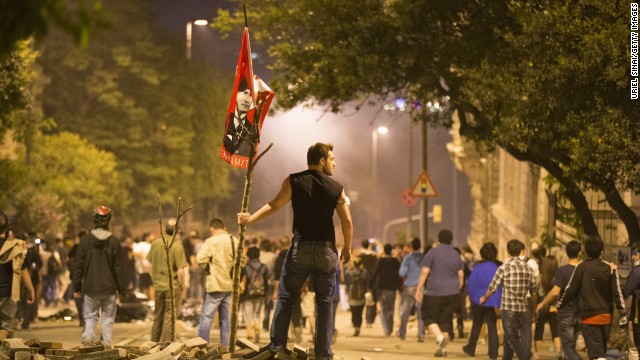 Anti-government riots erupt in Turkey
 Turkey’s political situation deteriorates
 Turkish protesters target prime minister
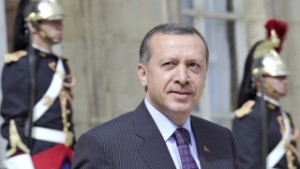 Erdogan: Powerful, popular, polarizing
Turkish Deputy Prime Minister Bulent Arinc on Tuesday apologized “for the police aggression against our citizens who were involved in the initial protests and acted with environmental concern,” Turkey’s semiofficial Anadolu news agency reported. But, Arinc said, “I don’t think we owe an apology to those who caused destruction on the streets and who interfered with people’s freedom.”
The Turkish Medical Association said that at least 3,195 people were injured in clashes Sunday and Monday. Of them, 26 were in serious or critical condition, it said.
One protester, Mehmet Ayvalitas, died of his injuries, the association said. And the governor of Hatay in southeastern Turkey said that a 22-year-old man, Abdulah Comert, was killed with a firearm by unknown people during demonstrations late Monday, Anadolu reported.
The medical association reported that the bulk of the injuries occurred in Istanbul, where the protests began before spreading to Ankara, Izmir, Adana and other places.
What’s driving unrest and protests in Turkey?
Relative calm
After chaotic scenes in the streets Monday that continued late into the night and sent tear gas wafting through the air, the situation was relatively calm Tuesday morning in Istanbul’s central Taksim Square, near the park where the protest movement began.
Barricades remain up around the square, and Erdogan’s opponents appear determined to continue the demonstrations despite the prime minister’s comment Monday that he expects the situation to return to normal “within a few days.”
The protests began after plans were made to raze Gezi Park, the last green space in central Istanbul, and replace it with a replica of 19th-century Ottoman barracks. The development would contain a shopping mall.
What began as a sit-in by a handful of angry residents quickly grew into a larger protest. Riot police moved in, using tear gas and pepper spray. Protesters responded by hurling bottles, setting up barricades, blocking bulldozers and burning trash in the middle of the street.
Then, outraged by the behavior of security forces, demonstrators began attacking police. The protests have since morphed into larger complaints against Erdogan, whom protesters call paternalistic and authoritarian.
Despite economic boom, Erdogan targeted by protests
Police criticized
 Park protest triggers national response
 Update on Turkey’s unrest
 Turkish citizens want PM to resign
International groups including Amnesty International have criticized the police response as excessive. In Ankara on Sunday night, a CNN crew witnessed authorities roughing up at least one protester. One police officer kicked a CNN videographer, CNN’s Nick Paton Walsh reported, and a CNN crew in Istanbul on Sunday also witnessed bloodied protesters.
Erdogan, who left the country Monday on a four-day trip to North Africa, has responded by dismissing the demonstrations as the work of “extreme elements” and marginal groups.
“My smart citizens will recognize this, then they will give them the right lesson,” he said.
But Turkey’s president, Abdullah Gul, took a somewhat more conciliatory tone Monday, saying “the messages sent in good faith have been received.”
In Istanbul, the crowds have been chanting “Tayyip resign” — referring to Erdogan — and “Shoulder to shoulder against fascism.”
The protests have spread to 67 of Turkey’s 81 provinces, according to Anadolu.
Opinion: Is Turkey on the verge of a meltdown?
Opposition pushing back
Hugh Pope, a senior Turkey analyst with the International Crisis Group, called the protests “completely unprecedented” and said Erdogan was caught off guard. Most demonstrators, Pope said, are “overwhelmingly ordinary people” who simply want their voices heard.
“However, there are other demonstrators who are somewhat more opportunistic in the left-wing factions who normally don’t get much in the way of airtime in Turkey and are camped on Taksim Square,” Pope said.
Erdogan has defiantly praised his government’s accomplishments in overseeing a decade of strong economic growth in Turkey.
His party has won the past three elections, most recently securing 49.95% of the vote in 2011.
“What you have is essentially a large group of Turks who feel alienated from this government, in power for 10 years,” said Richard Haass, a Middle East analyst at the Council on Foreign Relations in Washington.
“It’s increasingly a one-party country. All the politics happen within it. The opposition is weak, divided, feckless,” he said. “You have a lot of people in Turkey who feel both alienated and intimidated by the government, and this is the way they decided to push back.”
CNN’s Ivan Watson and Talia Kayali contributed to this report.
 A prominent press freedom advocacy group is asking Turkish Prime Minister Recep Tayyip Erdogan to take steps to end what it calls a crisis for journalists in Turkey.


 Police move in on Turkey’s Taksim Square
 Turkey protesters dig in for long haul
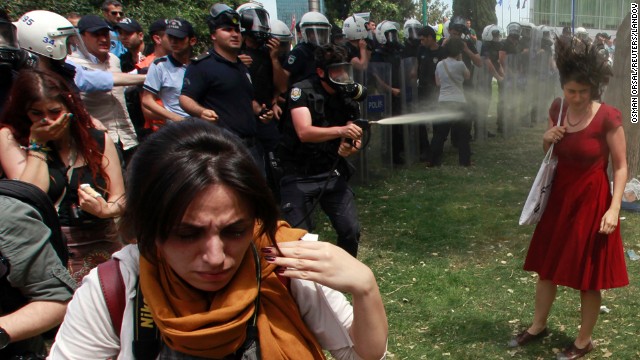
 Apology for ‘police aggression’
 Online campaign puts spotlight on Turkey
 Police, protesters clash in Ankara

