Why Turks Were Capable of Exterminating Armenians, but not Jews

Հարութ Սասունյան

By Harut Sassounian

Publisher, The California Courier


Endless comparisons are made between the Armenian Genocide and the Jewish Holocaust. However, there is yet another comparison that is rarely made: the Turkish ability to carry out the Armenian Genocide and inability to eliminate the Jewish settlers from Palestine during the same period. Such a comparison has not been made because hardly anyone has studied the Turkish deportation plans of Jews during World War I in relationship to the Armenian Genocide.


My preliminary analysis is based on information gleamed from Prof. Yair Auron’s book, “Zionism and the Armenian Genocide: The Banality of Indifference,” Vartkes Yeghiayan’s “Pro Armenia,” and other archival materials. I would like to detail the circumstances of deportations of the Jews and how they were mostly spared, while Armenians were not! More importantly, what steps did the Jewish Diaspora and settlers in Palestine take to avoid suffering Armenians’ tragic fate?


Armenians and Jews, as minorities in the Ottoman Empire, were convenient scapegoats for the whims of ruthless Turkish leaders. Interestingly, the Young Turks used the same arguments for deporting both Armenians and Jews. The Turks had accused Armenians for cooperating with the advancing Russian Army, while similarly blaming Jews for cooperating with British forces invading Ottoman Palestine. Furthermore, Jews were accused of planning to establish their own homeland in Palestine, just as Armenians were allegedly establishing theirs in Eastern Turkey. In yet another parallel, Jamal Pasha, one of the members of the Young Turk triumvirate, had cynically commented that he was “expelling the Jews for their own good,” just as Armenians were forcefully removed “away from the war zone” for their own safety!


In 1914, when Turkey entered World War I on the German side and against the Allied Powers (England, Russia, and France), Palestine became a theater of war. Turkish authorities imposed a war tax on the population, which fell more heavily on the Jewish settlers. Their properties and other possessions were confiscated by the Turkish military. Some Jewish settlers were used as slave labor to build roads and railways. Alex Aaronsohn, a Jewish settler in Zichron Yaacov, wrote in his diary: “an order had recently come from the Turkish authorities, bidding them surrender whatever firearms or weapons they had in their possession. A sinister command, this: we knew that similar measures had been taken before the terrible Armenian massacres, and we felt that some such fate might be in preparation for our people,” as quoted in Yeghiayan’s Pro Armenia.


In Fall 1914, the Turkish regime issued an expulsion order for all ‘enemy nationals,’ including 50,000 Russian Jews who had escaped from Czarist persecutions and settled in Palestine. After repeated intercessions by German Ambassador Hans Wangenheim and American Ambassador Henry Morgenthau, these ‘enemy nationals’ were allowed to stay in Palestine, if they agreed to acquire Ottoman citizenship.


Nevertheless, on December 17, 1914, Jamal Pasha’s subordinate, Bahaeddin, governor of Jaffa, implemented the expulsion order, deporting 500 Jews who were grabbed from the streets and dragged to police headquarters, and from there forced to board ships docked in the harbor. Homes of Jewish settlers were searched for weapons. Hebrew-language signs were removed from shops and the Jewish school of Jaffa was closed down. Zionist organizations were dissolved, and on January 25, 1915, the Turkish authorities issued a declaration against “the dangerous element known as Zionism, which is struggling to create a Jewish government in the Palestinian area of the Ottoman Kingdom….”


In response to protests from Amb. Morgenthau and the German government, Constantinople reversed the deportation order and Bahaeddin was removed from his post. According to Prof. Auron, the condition of the Jewish settlers could have been much worse had it not been for “the influence of world Jewry on Turkish policy…. The American, German, and Austrian Jewish communities succeeded in restraining some of its harsher aspects. Decrees were softened; overly zealous Turkish commanders were replaced and periods of calm followed the times of distress.”


Back in 1913, Pres. Wilson had instructed Amb. Morgenthau upon his appointment: “’Remember that anything you can do to improve the lot of your co-religionists is an act that will reflect credit upon America, and you may count on the full power of the Administration to back you up.’ Morgenthau followed this advice faithfully,” according to Isaiah Friedman’s book, “Germany, Turkey and Zionism: 1897-1918.” After arranging for the delivery of much needed funds from American Jews to Jaffa, Morgenthau wrote to Arthur Ruppen, director of the Palestine Development Association: “I have been the chosen weapon to take up the defense of my co-religionists….”

In Spring 1917, the Turkish authorities issued a second order to deport 5,000 Jews from Tel Aviv. Aaron Aaronsohn, leader of the Nili group – a small Jewish underground organization in Palestine working for British intelligence – immediately disseminated the news of the deportation to the international media. Aaronsohn secretly met with British diplomat Mark Sykes in Egypt and through him sent an urgent message to London on April 28, 1917: “Tel Aviv has been sacked. 10,000 Jews in Palestine are now without home or food. Whole of Yishuv [Jewish settlements in Palestine] is threatened with destruction. Jamal [Pasha] has publicly stated Armenian policy will now be applied to Jews.”


Upon receiving Aaronsohn’s reports from Palestine, Chaim Weizmann, a key pro-British Zionist in London, transmitted the following message to Zionist leaders in various European capitals: “Jamal Pasha openly declared that the joy of Jews at the approach of British troops would be short lived as he would them share the fate of the Armenians…. Jamal Pasha is too cunning to order cold-blooded massacres. His method is to drive the population to starvation and death by thirst, epidemics, etc….”


American Jews were outraged hearing of the deportations in Palestine. News reports were issued throughout Western countries on “Turkish intentions to exterminate the Jews in Palestine,” according to Prof. Auron. Moreover, influential Jewish businessmen in Germany and the Austro-Hungarian Empire demanded that their governments pressure Turkish leaders to abandon their plans to deport Jews. Jamal Pasha was finally forced to rescind the expulsion order and provided food and medical assistance to Jewish refugees in Tel Aviv.


(to be continued)


 Անկախ

Text of Swiss Appeal to European Court On Armenian Genocide Disclosed

 Փերինչեքն ընդդեմ Շվեյցարիայի


By Harut Sassounian

Publisher, The California Courier


Two weeks ago — on the last day of the three-month deadline — the Swiss government decided to file an appeal with the European Court of Human Rights (ECHR) on the Perincek vs. Switzerland lawsuit.


Even though the text of the Swiss appeal has been kept under seal pending ECHR’s consideration, I was able to obtain a copy in French. This is the first time that the content of the Swiss appeal appears in the media.


The ECHR ruled on Dec. 17, 2013, that Swiss courts had violated the rights of Dogu Perincek, a minor Turkish party leader, who had traveled to Switzerland in 2005 with the explicit purpose of denying the Armenian Genocide. He had dared the Swiss authorities to arrest him for calling the Genocide “an international lie.”


Following his conviction for violating a Swiss law on racial discrimination, denial of genocide, and other crimes against humanity, Perincek appealed his sentence all the way to the Federal Tribunal, the highest court in Switzerland, which confirmed his guilt. He then applied to the European Court of Human Rights, accusing Switzerland of violating many of his rights, including that of free speech. Surprisingly, five of the seven ECHR judges exonerated Perincek, finding that Switzerland violated certain provisions of the European Convention.


If left unchallenged, ECHR’s ruling would have been a major setback for recognition of the Armenian Genocide, particularly before the worldwide commemoration of the Centennial of the Genocide to be held on April 24, 2015. Even more importantly, by exceeding their mandate on the alleged infringements of Perincek’s rights, the majority of the ECHR judges raised questions about the validity of the Armenian Genocide. They also drew unwarranted and superfluous distinctions between the Armenian Genocide and the Jewish Holocaust, ruling that punishing the deniers of the former is illegal, while convicting those denying the latter is proper.


Given the detrimental consequences of this unjustified ruling on the Armenian Cause, the government of Armenia, Armenian communities worldwide, and Swiss-Armenians in particular, lobbied Switzerland to make sure that it appeals ECHR’s decision in the Perincek case. In reality, the Swiss authorities should not have needed any prodding from Armenians, since they had an obligation to defend the judgments of their own courts, including the Federal Tribunal, and the integrity of their country’s legal system!

The six-page Swiss appeal, filed on March 17, 2014, asserted that ECHR’s ruling raised “serious questions regarding the interpretation and application” of the European Convention on Human Rights for the following three reasons:


— The ruling involves an issue — the Armenian Genocide — that has never been considered by ECHR. This case raises two fundamental juridical questions that the Court has not dealt with: The juridical qualification of the Genocide and the scope of freedom of expression, when a state party to the Convention, in the framework of fighting racism, criminalizes the denial of genocide.


— The ruling reduces in an undue manner “the margin of appreciation” available to Switzerland under the jurisprudence of ECHR. Perincek had repeatedly stated that he would never change his mind on the Armenian Genocide. His denialist position is “particularly offensive.” The Court’s contention that such a person would bring any value to “the debate and historical research” on this issue “is a departure from ECHR’s established and balanced jurisprudence.”


— The ruling creates “artificial distinctions.” Perincek does not simply contest the use of the term genocide, but qualifies the Armenian mass killings as an “international lie.” Furthermore, even though there has not been an international verdict in the case of the Armenian Genocide, the Turkish Court’s 1919 verdict against the masterminds of the Armenian Genocide “constituted an element of reliable evidence, acknowledging the facts or unfavorable conduct” relative to the World Court’s jurisprudence. Furthermore, even “the Nuremberg Tribunal did not mention the term genocide and did not convict the Nazi perpetrators for committing genocide, but crimes against peace, war crimes, and crimes against humanity.”


The Swiss appeal has provided compelling arguments and convincing evidence that five of the seven ECHR judges made serious judgmental and factual errors in delivering a ruling in favor of Perincek and against Switzerland.


A panel of five new ECHR judges will now decide whether to refer Switzerland’s appeal to the 17-judge Grand Chamber for a final determination.


 Անկախ

What Should Armenians Learn From Prime Minister Erdogan?

Հարութ-Սասունյան1


By Harut Sassounian


Publisher, The California Courier


The purpose of this column is to draw lessons from the recent attacks on the Armenian town of Kessab in Syria.


Last week, Turkish Prime Minister Recep Tayyip Erdogan took two bold actions: 1) he blocked Twitter, a social media site with 12 million users in Turkey, to cover up revelations of corruption about himself and his inner circle; and 2) he aided and abetted the Jihadist fighters’ invasion of Kessab, located in the Northwest corner of Syria, bordering Turkey!


What do these two seemingly unrelated events have in common?


Erdogan himself indirectly answered this question, during a campaign rally on March 20: “we will wipe out Twitter. I don’t care at all what the international community says. Everyone will see the power of the Turkish Republic.”


Clearly, the Prime Minister does not care that he would be criticized for violating the democratic principle of freedom of expression and acting as an autocratic thug. He says and does whatever he thinks is in Turkey’s or his own best interest!


US officials reacted by paying mere lip service to Erdogan’s internet crackdown. Samantha Power, US Ambassador to the United Nations, tweeted the following message: “Deeply troubling that Turkey blocked Twitter. Shutting down free access to info inconsistent with democracy; support citizens’ call to unblock.” Douglas Frantz, Assistant Secretary of State for Public Affairs and former managing editor of the Los Angeles Times, who was forced to resign after blocking publication of an article on the Armenian Genocide, described Erdogan’s anti-Twitter action as: “21st century book burning.” Similar benign criticisms were voiced by State Department spokeswoman Jen Psaki, White House Press Secretary Jay Carney, and European Union Digital Agenda Commissioner Neelie Kroes.


Did Erdogan care about these verbal lashings? Absolutely not! He didn’t give a damn! He had already blocked YouTube for two years, because the website carried videos deemed insulting to Kemal Ataturk. The Turkish Prime Minister now threatens to ban both facebook and YouTube after the March 30 elections.


Why don’t Armenian leaders — in Armenia and Diaspora — act more boldly, similar to Erdogan, especially when the survival of Armenians is at stake? It is most appropriate to raise such a question after the invasion of Kessab byJihadists, taking Armenian hostages, pillaging their homes, and desecrating their churches.


Regrettably, repeated pleas by Armenian-American organizations to US officials, to help protect Armenians and other Syrian Christians, have fallen on deaf ears. On March 24, the ANCA sent another strongly-worded letter to Pres. Obama, demanding immediate White House and congressional intervention to stop the attacks on Kessab. The US government does not seem interested in the tragic fate of Syrian-Armenians and other minorities, since Washington is hell-bent on toppling Bashar al-Assad’s regime, ignoring the loss of innocent lives.


Armenians should not be content by merely shaking their heads and complaining to each other about the tragic news emanating from Syria. They must wake up from their collective coma and take bold action. Daily demonstrations must be held in major U.S. cities and in front of American, British, French, Saudi, and Turkish embassies and consulates around the world to protest their arming of so-called rebels who are kidnapping and murdering Syrian Armenians, among many others.


Urgent meetings should be held with top US, British and French officials, demanding that they immediately halt deliveries of all weapons and financial assistance to ‘rebels’ in Syria, until they cease attacks on civilians!


I wrote a column back in 2002 with the following headline: “The Armenian ‘Mouse’ Needs to Roar More Often.” Basically, it was a call for bolder action. I had referred to the short story written by William Saroyan, titled: “The Armenian Mouse,” in which a brave mouse, by its aggressive behavior, manages to defend itself from more ferocious beasts.


Remaining silent and inactive are no longer viable options, while our compatriots are getting slaughtered in Syria. Sheepish behavior only serves to embolden the enemies of the Armenian nation.


Armenians need to be proactive rather than reactive. On the eve of the Genocide Centennial, they cannot be silent bystanders while the Turkish government and its allies are directly or indirectly embarking on a new campaign of exterminating Armenians in Syria.


Armenians must speak up, protest, and take effective action to defend their countrymen in all corners of the world. They need to become the ‘mouse’ that ROARS!


Անկախ

Shifting Inter-Relationships Between Armenia and Diaspora

Հարութ Սասունյան


By Harut Sassounian

Publisher, The California Courier


The Diaspora Ministry of the Republic of Armenia invited a small group of scholars and analysts to Yerevan last December to discuss the Diaspora’s changing role in relation to the homeland. The participants in the “Changing Diaspora in an Ever-changing World” roundtable had come from Argentina, Armenia, Germany, Lebanon, Russia, Ukraine, and the United States.


The discussion centered on the formation of the Diaspora, current challenges, Armenia-Diaspora collaboration, improved links for closer cooperation between Armenia and Diaspora, and the quest for new working mechanisms and perspectives.


Here are excerpts from my presentation at the meeting:


The Diaspora encountered a completely new set of circumstances after Armenia’s independence. The sudden realization of the long-cherished dream of free Armenia caught many Diasporans by surprise. New words appeared in their vocabulary: Artsakh (Karabagh), earthquake, blockade, protocol, opposition, coalition government, regime change.


Most Diasporans had a hard time distinguishing between the actions of an individual, group or organization and the rights and obligations of a state. At the same time, Armenia’s new leaders could not fully comprehend the patriotic sentiments, wishes and desires of Diasporan Armenians, causing a disconcerting rift between the two sides.


Complicating matters, the Diaspora is not a monolithic group, but is composed of distinct subsets, having taken shape at different times in foreign lands under various cultural and linguistic influences.


When asked by journalists in Armenia about Diaspora’s views on a particular issue, I have difficulty answering such a question. How can anyone encapsulate the diverse views of seven million Diasporans? To reflect the opinion of the majority of the Diaspora, one would need to form a pan-Armenian body, either by expanding the Hayastan All-Armenian Fund’s functions beyond fundraising or creating a brand new structure that would represent Armenians worldwide, except those in Armenia and Artsakh, based on the principle of ‘one man, one vote.’ The elected representatives would have the right to speak in the name of all Diaspora Armenians and meet periodically with the leadership of Armenia and Artsakh to consult and coordinate their priorities on pan-Armenian issues.


Leaders of all three wings of the Armenian nation (Armenia, Artsakh and the Diaspora) can then discuss their respective positions, and agree on the role each would play. Such a division of labor is preferable over unending internal feuds and conflicts that sometimes take place, as was the case during the signing of the Armenia-Turkey Protocols.


It is incumbent upon Armenia’s leadership to be more sensitive on issues that are important for Diaspora Armenians and consult with them before taking final decisions.


Understandably, Armenia’s leaders are not obliged to take orders from anyone outside the country’s borders. While having the final say over all matters, they nevertheless have the moral duty and obligation to consider the views of key Diasporan organizations, in the absence of a Diaspora-wide elected body. In any case, Armenia’s authorities are responsible before the nation for their actions. They are praised when taking the right decisions and criticized when they do not.


It must be stated that an elective Diaspora-wide structure, no matter how difficult to establish, would be far more inclusive and representative than appointed leaders — despite their devoted efforts — who merely represent their respective members. It is imperative to include large segments of our people in all activities, so that we become more effective in our endeavors, particularly at a time when Azerbaijan and Turkey are organizing their Diasporas and spending tens of millions of dollars to undermine our just demands on the eve of the Genocide Centennial.


As we often state: “Azerbaijan has oil, Georgia has a sea, and Armenia has a Diaspora!” However, a disorganized and dwindling Diaspora would be of little value for our national cause. It can neither preserve itself nor be of any assistance to the homeland.


We must do everything possible to have a powerful homeland and a strong Diaspora. The survival of each is dependent on the vitality of the other. Despite the valiant efforts of the Diaspora Ministry, we must realize that the magnitude of what needs to be done is so enormous that it exceeds the capabilities of any one ministry. There is a clear need for the concerted efforts of Armenia’s entire leadership to make Diaspora Armenians feel welcome and at home!


Corruption Scandal May End Erdogan’s Political Career

Հարութ Սասունյան

By Harut Sassounian

Publisher, The California Courier


In a series of secretly recorded phone conversations revealed last week, Turkey’s Prime Minister Recep Tayyip Erdogan was heard instructing his son to hide from police tens of millions of dollars of cash stashed in his Istanbul house.


This shocking revelation generated widespread calls for Erdogan’s resignation who claimed that the phone recordings are fake or edited. It appears, however, that the wiretapped conversations between the Prime Minister and his son are authentic, according to Guarded Risk, an American cyber company that conducted a comprehensive forensic analysis of the phone calls.


It is ironic that Erdogan who came to power as an Islamist with the declared aim of eliminating corruption from Turkish politics, has fallen victim to the dictum: “power corrupts; absolute power corrupts absolutely!”


The phone calls were secretly recorded on the day police raided the homes of several cabinet members, prominent businessmen, and the head of the state bank. They were all accused of involvement in bribery and other corrupt practices.


Here is the English translation of excerpts from Erdogan’s five wiretapped conversations with his son, Bilal:


First phone call at 8:02 am on Dec. 17, 2013:


Erdogan: …Take everything you have out of your house, OK?

Bilal: What would I have, dad? Your money is in the safe.

Erdogan: That’s what I am talking about….

Bilal: What shall we do with it, daddy? Where shall we put it?

Erdogan: In specific places, in some specific places… . Do it!


Second call at 11:17 am:


Bilal: …My brother [in-law] Berat has another idea. He says we should give some of it to Faruk [Kalyoncu, president of a construction company] for the other job, so he can process them like the previous ones. Shall we do that? We can sort out a big amount of money that way.
Erdogan: Possibly.
Bilal: OK. For the other part, because we started a business partnership with Mehmet Gur [managing director of a construction group], we thought of giving it to him saying, ‘keep it, you can use it as projects come up.’ This way, we can reduce it and move the rest to somewhere else.
Erdogan: OK, fine, as long as you do it…. It would be good if you do… If you can liquidate them all.
Bilal: Yes, we will liquidate them all today, God willing!


Third call at 3:39 pm:


Erdogan: Did you complete the tasks I gave you?

Bilal: We will finish them by this evening. We sorted some out; We sorted the Berat part, now we will first handle the part with Mehmet Gur, and the rest, we will do after dark….
Erdogan: What did Sumeyye [daughter] do?
Bilal: She took them out, brought them over, we spoke, etc.
Erdogan: Do not speak on the phone with each other.


Fourth call at 11:15 pm:


Bilal: Hi daddy, I am calling to… we did [it] mostly. Did you call me just now, daddy?

Erdogan: No I did not, you called me.
Bilal: I was called from a secret number.
Erdogan: When you say ‘mostly,’ did you fully liquidate it?
Bilal: It’s not zero yet, daddy. Let me explain. We still have 30 million euros that we could not yet liquidate. Berat has an idea. There was an additional 25 million dollars Ahmet Calik [businessman] should receive. They say let’s give this [to him]. When the money comes, we do [something], they say. And with the remaining money we can buy an apartment from Sehrizar, he says. What do you say, father?
Erdogan: Whatever, we will sort it out.
Bilal: Should we do it like this?
Erdogan: OK, do it.
Bilal: Do you want them all liquidated, father, or do you want some money for yourself?
Erdogan: No, it can’t be left over, son. You could transfer it to the other, with Mehmet you could transfer it there.
Bilal: Yes, we gave it to them. We gave $20 [million] to them.
Erdogan: For God’s sake, first you should have transferred it. Then you could have done it…
Bilal: We were able to give this much for now. It is hard already; it takes too much space. We are putting part of it somewhere else, we gave part of it to Tunc, and then…
Erdogan: Did you transfer all to Tunc?
Bilal: They asked, I guess he said that he could only take 10 million euros.
Erdogan: Whatever! Don’t talk on this [phone].
Bilal: OK, then, we will sort it.
Erdogan: OK, do it. I am not able to come tonight. I’m staying in Ankara.


Fifth call at 10:58 am on Dec. 18, 2013:


Erdogan: I decided to call to see if there is anything new.

Bilal: No, nothing. We finished the tasks you gave us, with God’s help.
Erdogan: Has it been all liquidated?
Bilal: Completely! How should I put it? I had Samandira and Maltepe’s money, 730,000 US Dollars and 300,000 Turkish Liras. I will handle these too. We owe 1 million Turkish Liras to Faruk İsik [parliament member]; I will give it to him and tell him to transfer the rest to the academy.
Erdogan: Do not speak so openly!
Bilal: Shouldn’t I?
Erdogan: Don’t. OK?
Bilal: OK, daddy
Erdogan: I mean, do not keep anything on your person, whatever it is Samandira or whatever… Send it to where it needs to be, why do you keep it on you?
Bilal: OK, daddy, but I think currently we are under surveillance.
Erdogan: What have I been telling you since the very beginning!
Bilal: But is the security staff following us, father?
Erdogan: Son, you are being wiretapped.
Bilal: But they are also visually monitoring us.
Erdogan: That may be true. Now, we’ve just done some things at the Istanbul police headquarters.


Additional recordings have since surfaced in which Erdogan and his son talk about rejecting a $10 million bribe offer from a Turkish businessman for being insufficient.


Erdogan could end up losing not only his current position and the chance of becoming President later this year, but may also face prosecution and a lengthy jail term for his alleged crimes.


 Անկախ


Galanthus

Подснежники11

Common Name: snowdrop
Type: Bulb
Family: Amaryllidaceae
Native Range: Europe
Zone: 3 to 7
Height: 0.50 to 0.75 feet
Spread: 0.25 to 0.50 feet
Bloom Time: February
Bloom Description: White
Sun: Full sun to part shade
Water: Medium
Maintenance: Low
Flower: Showy
Tolerate: Deer, Clay Soil, Black Walnut

Подснежники1

Culture

Easily grown in average, medium, well-drained soils in full sun to part shade. Prefers moist, humusy soils in part shade. Grows particularly well under deciduous trees where exposure to the sun is full in early spring but gradually changes to part shade as the trees leaf out. Also prefers cool climates, and is somewhat short lived when grown south of USDA Zone 7. Plant bulbs 2-3” deep and space 2-3” apart in fall. In optimum growing conditions, it naturalizes well by both self-seeding and bulb offsets. Allow foliage to yellow before removing it from garden areas. If left alone, foliage disappears by late spring as bulbs go dormant.

Подснежники

Noteworthy Characteristics

Galanthus nivalis, commonly called snowdrop, is a bulbous perennial that is native to Europe and southwestern Asia. It has escaped gardens and naturalized in parts of eastern North America. It is a true harbinger of spring that typically blooms from late February to late March in the St. Louis area, often poking its head up through snow cover if present. The common name refers to the supposed resemblance of the flowers to drops of snow. Each flower has six tepals (three spreading outer tepals and three shorter inner tepals).

Galanthus comes from the Greek words gala meaning milk and anthos meaning flower.

Nivalis means snowy.

Problems

No serious insect or disease problems.

Garden Uses

Best massed in sweeping drifts in areas where they can naturalize, such as woodland margins or in lawns under large deciduous trees. Also effective in groupings in rock gardens, border fronts, in front of flowering shrubs or along walks or paths. Mix with other early flowering bulbs such as Eranthis (winter aconite).

Անկախ

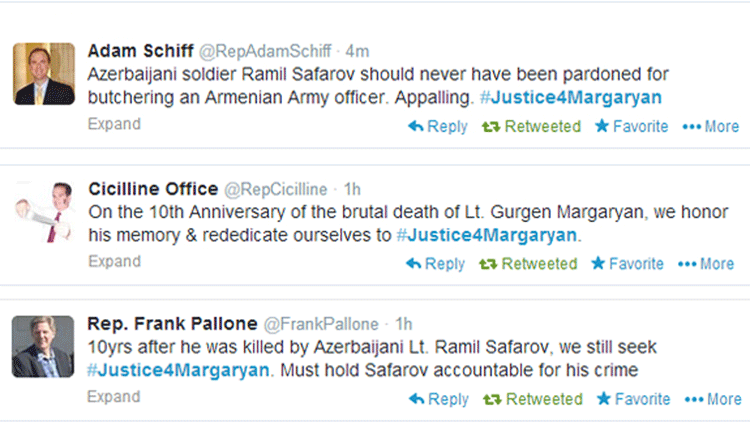
MEMBERS OF CONGRESS JOIN GLOBAL PROTEST ON 10TH ANNIVERSARY OF SAFAROV MURDER OF GURGEN MARGARYAN

schiff_cicilline_pallone_tweets— Reps. Schiff, Cicilline and Pallone Participate in Social Media Campaign Condemning Azerbaijan’s Pardon, Praise and Promotion of Unrepentant Axe Murderer Ramil Safarov
WASHINGTON, DC – Ten years after the brutal murder of Armenian Lt. Gurgen Margaryan, Representatives Adam Schiff (D-CA), David Cicilline (D-RI) and Congressional Armenian Caucus Co-Chair Frank Pallone (D-NJ) joined with Armenians worldwide in condemning the Azerbaijani government’s pardon, praise and promotion of his confessed but still unrepentant murderer, Lt. Ramil Safarov, reported the Armenian National Committee of America (ANCA).
“Thanks to the AYF for launching this global initiative, to a worldwide legion of online activists for sending our message of peace and justice across the internet, and, of course, to our friends, Representatives Adam Schiff, Frank Pallone, and David Cicilline, for adding their vital voices to this far-reaching awareness-raising campaign,” stated ANCA Executive Director Aram Hamparian.
The U.S. Representatives joined a targeted Twitter, Facebook, and Instagram campaign, spearheaded by the Armenian Youth Federation (AYF) in the United States and Canada, to raise awareness about Safarov’s brutal axe murder of Margaryan, in his sleep, during a NATO sponsored English language peace training program.  In August, 2012, Safarov, who had been tried, convicted and imprisoned for his actions in Hungary, was inexplicably extradited back to Azerbaijan, where he was given a hero’s welcome by President Ilham Aliyev, in addition to financial compensation and a promotion in military rank.  A chilling video featuring Azerbaijani Government officials openly and proudly praising the axe-murderer can be viewed at:http://youtu.be/ualn6CqJltU
In a tweet timed with the AYF international effort, Rep. Schiff stated “Azerbaijani soldier Ramil Safarov should never have been pardoned for butchering an Armenian Army officer. Appalling. #Justice4Margaryan”  In an expanded statement shared with the ANCA, Rep. Schiff explained, “Ten years later, we remember Armenian Lt. Gurgen Margaryan, who was hacked to death by Azerbaijani soldier Ramil Safarov while participating in a NATO training exercise in Hungary.  Safarov should be in prison, but inexplicably, he was extradited back to Azerbaijan from Hungary in 2012.  Instead of serving out his sentence in an Azeri jail, he was pardoned, promoted to Major, given back pay and paraded through the streets of Baku in a disgusting and bloodthirsty welcome home.”
Rep. Cicilline echoed these thoughts in his tweet, noting “On the 10th Anniversary of the brutal death of Lt. Gurgen Margaryan, we honor his memory & rededicate ourselves to #Justice4Margaryan.”  Upon Aliyev’s release of Safarov in 2012, Rep. Cicilline commented that, “Over the years, serious questions have been raised about whether the Azerbaijani government is truly committed to developing a peaceful, nonviolent relationship with the people of Armenia. Its reckless actions this week do nothing to address these concerns.”

Rep. Pallone was equally adamant about the need for justice for Margaryan’s murder, in this tweet:  “10yrs after he was killed by Azerbaijani Lt. Ramil Safarov, we still seek #Justice4Margaryan. Must hold Safarov accountable for his crime.”  Following Safarov’s release, Rep. Pallone had stated that Azerbaijan’s actions “only further confirm their desire to facilitate and condone violence against Armenia and its people.”
All tweets honoring Margaryan’s memory can be viewed by searching #Justice4Margaryan in the Twitter feed.
Azerbaijan’s glorification of Safarov in 2012 sparked international outrage, but did not result in his return to prison.  A statement issued by the White House on August 31, 2012, stated, “President Obama is deeply concerned by today’s announcement that the President of Azerbaijan has pardoned Ramil Safarov following his return from Hungary. Safarov confessed to the murder of Armenian Army officer Gurgen Margaryan in Budapest in 2004, and was serving a life sentence in Hungary for this brutal crime. We are communicating to Azerbaijani authorities our disappointment about the decision to pardon Safarov. This action is contrary to ongoing efforts to reduce regional tensions and promote reconciliation.”  The OSCE Minsk Group Co-Chairs expressed “their deep concern and regret for the damage the pardon and any attempts to glorify the crime have done to the peace process and trust between the sides.” Over dozen U.S. Senate and House members condemned the Azerbaijani action.

Armenia &Turkey Clash Over Genocide At UN Security Council

By Harut Sassounian

Publisher, The California Courier 

Foreshadowing next year’s Centennial commemorative events, the Armenian Genocide issue was discussed for the first time at the UN Security Council on January 29.

Armenia’s Ambassador Garen Nazarian, addressing the main topic of the Security Council session, ‘War, its Lessons, and the Search for a Permanent Peace,’ began his remarks with a subtle hint to Turkey on UN’s peacemaking role: “to forge a deeper reconciliation among peoples, based on a shared narrative and memory of a troubled past. Often this process entails more than simply adopting declarations and resolutions, visiting and laying down flowers at victims’ memorials or signing agreements or protocols and shaking hands. To be lasting, reconciliation may require the settling of the past, recognition and acceptance of responsibility for committed crimes.”

Regarding lessons learned from the Armenian Genocide, Amb. Nazarian specifically mentioned that the “reconciliation process could be delayed for decades or even generations. This was the first modern genocide perpetrated under the cover of the First World War.” Armenia’s representative went on to insist that “ending impunity for heinous mass atrocity crimes is vital for restoring justice and normalcy.”

Amb. Nazarian also outlined the steps necessary for proper reconciliation between nations: “successfully reconciled societies and nations usually undergo an extensive process of restoring justice, including reparations to victims and their heirs in order to re-establish their national dignity and identity. It is also imperative to speak with one voice against the distortion of history, the denial of historical crimes, and negationism.”

In his response, Turkey’s UN representative Halit Cevik, not surprisingly, focused on the future rather than his country’s bloody past. Without realizing that he was condemning his own country, the Turkish delegate insisted that “those responsible for the most serious crimes, crimes against humanity, genocide, and war crimes, must be held accountable.” Amb. Cevik then went on to repeat his government’s worn-out denials, claiming that “allegations of genocide regarding the 1915 events have never been legally or historically substantiated. In this same vein, there is neither political nor legal consensus as to the nature of those events…. We believe that deriving animosity from history by trying to imprint on others an incriminating and one-sided view of the past, and calling for selective compassion, is not the proper way of respecting the memory of many Turks, Armenians, and others who lost their lives during the First World War. It is therefore important to face history in its entirety, and through impartial scientific examination of historical records and archives, so that the right lessons may be drawn from history and the common fair memory can be reached.”

Amb. Nazarian, in his right of reply, expressed deep regret to hear the Turkish representative’s “distorted explanations about the undeniable fact of the Armenian Genocide which took the lives of 1.5 million Armenian children, women and men living in the Ottoman Empire during the regime of Young Turks…. It began on April 24, 1915, and went on until 1923 — the systematic and planned slaughter of the entire nation.”

Describing in detail the deportations and massacres culminating in genocide, Amb. Nazarian asserted that “this crime has been recognized by a number of [UN] member states and international organizations, including the United Nations and its subsidiary body — the Sub-Commission on Prevention of Discrimination and Protection of Minorities.”

In a second reply to Amb. Nazarian, Turkey’s representative became more subtle in his denialism: “We did not say that nothing happened in 1915. These events do not fit in the description of genocide which was defined in the [UN] Convention of 1948. Now, an Armenian delegation is raising that the 1915 events are genocide in the absence of any resolution or any decision of the International Court. So how do you expect us…,” before he could finish his statement, his cell phone rang, interrupting him in mid-sentence.

It is very likely that more such confrontations will take place with Turkey leading up to the Centennial of the Armenian Genocide. Turkish officials do not seem to realize that the more they deny and counter the Armenian activities, the more they help publicize the Genocide and the just demands of the Armenian people. Meanwhile, thanks to the Turkish delegation’s two responses to Amb. Nazarian statements, the Armenian Genocide was extensively discussed at the UN Security Council for the first time ever!

Armenian Genocide Recognition: Necessary but not Sufficient

By Harut Sassounian

Publisher, The California Courier

With the approaching Centennial of the Armenian Genocide in 2015, Turkish leaders are coming under increasing pressure from the international community to face their country’s sordid past and acknowledge the Genocide. Significantly, public statements regarding the Armenian Genocide were made in the last few days by heads of three European states: France, Germany, and the Czech Republic.

During his last month’s visit to Turkey, French President Francois Hollande, without using the genocide term, called on Turkish leaders to confront their history: “Memory work is always painful… but must be done. What we need is to carry out reconciliation through research and recognition of what has happened…. By recognizing the historical events you will be elevated not only in your own eyes, but also in the eyes of the world.” Pres. Hollande also held a private meeting with Rakel Dink, the widow of martyred Turkish-Armenian journalist Hrant Dink.

Similar wise counsel was offered last week by German Chancellor Angela Merkel to visiting Turkish Prime Minister Recep Erdogan: “Turkey must come to terms with its history.” Ironically, Erdogan was the one who brought up this issue by complaining that Germany was planning to allocate funds for the commemoration of the Armenian Genocide Centennial.

The President of the Czech Republic, Milos Zeman, went even further than the French and German leaders by actually using the term Armenian Genocide during Pres. Serzh Sargsyan’s visit to Prague two weeks ago: “Next year marks the 100th anniversary of the Armenian Genocide. In 1915, 1.5 million Armenians were killed.”

While international pressure on the Turkish government is expected to become progressively more intense with the approach of the Genocide Centennial, Armenians should be wary not to be misled by such well-meaning, but at times, self-serving statements. If such pressures would prompt a Turkish leader to admit the Ottoman government’s guilt in committing massacres or even genocide, that would be insufficient to satisfy the just demands of the Armenian people. In fact the raising of expectations for Turkish recognition could be counter-productive because if and when Turkey does acknowledge it, everyone including Armenians may wrongly assume that their long-anticipated objective has been realized!

Several decades ago, when the world was still unaware of the basic facts of the Armenian Genocide, its recognition by the international community and the Turkish government was imperative. However, at this stage, when over two dozen countries, many international organizations, and the International Association of Genocide Scholars have acknowledged the Armenian Genocide, mere recognition is no longer the ultimate goal.

Rather than recognition, Armenians and all people of goodwill now seek justice for the genocide committed by Ottoman Turkish leaders. Just as Germany paid compensation to Holocaust survivors, the government of Turkey, as successor to the Ottoman Empire, has to pay billions of dollars in restitution, and return the stolen Armenian properties and occupied lands.

To strive for restitutive justice, Armenians should use every possible means — political pressure, economic boycotts, public protests, and lawsuits — to convince Turkey’s leaders that they would be better off to negotiate with representatives of the Armenian government and Diaspora, seeking a just resolution for this long-lasting injustice. As there are considerable disparities between the political, economic and military capabilities of the two sides, Armenians may not be able to obtain all their demands overnight, but should insist that Turkish officials offer them as much restitution as possible in a phased manner towards eventual full justice.

The just settlement of the Armenian Genocide issue would have many benefits for Turkey which would be hailed by the international community as a progressive and civilized country. Its leaders may even be considered for the Nobel Peace Prize. Recognition followed by restitution would also facilitate Turkey’s entry into the European Union. Otherwise, the continued refusal to come to terms with the Armenian Genocide would prolong the Turkish people’s embarrassing predicament of being constantly reminded of the crimes committed by their forefathers and continuously humiliated before the entire world as genocide denalists.

Should Turkish leaders have the courage to resolve their Armenian conundrum, the Armenian people would finally begin obtaining long-awaited compensation for their losses, enjoy an economically and geopolitically more viable and secure homeland, with the expectation that a repentant neighbor would be more inclined toward peaceful coexistence.

Setcreasea pallida ‘Purple Heart’

setcreasea1Botanical Name: Setcreasea pallida ‘Purple Heart’set-KREE-see-ah PAL-ih-duhSynonyms: Setcreasea purpurea ‘Purple Heart’, Tradescantia pallida ‘Purpurea’, T. pallida ‘Purple Heart’
‘Purple Heart’ is a trailing, tender perennial with purple stems and violet-purple leaves that produces pink flowers in summer. This plant is mainly grown for its foliage (leaves can reach 7 inches in length); best color is achieved in bright sunlight and a dry, cramped root zone. It is excellent as a groundcover or in containers or hanging baskets. It grows 8-12 inches tall and 16 inches wide.
Noteworthy characteristics: Foliage may irritate skin.
Care: Provide moist soil in part to full sun. Pinch to encourage bushiness and cut back flowering stems after blooming. Water moderately and fertilize monthly during active growth.
Propagation: Insert 2- to 3-inch-long stem-tip cuttings in soil mix or water and pot up in soil-based mix.
Problems: Viruses, aphids, spider mites.

European Court of Human Rights Intervenes in Artsakh Conflict

Հարութ Սասունյան


By Harut Sassounian

Publisher, The California Courier


It is noteworthy that the European Court of Human Rights (ECHR) is holding simultaneous hearings on two rival lawsuits filed by Armenians and Azerbaijanis. Is this a mere coincidence or an attempt by the Court to intervene in a thorny dispute that political leaders have failed to resolve for over 25 years?


This week, ECHR is hearing the case of “Sargsyan vs. Azerbaijan,” dealing with Minas Sargsyan’s complaint against the Republic of Azerbaijan, claiming that he was forced to flee his Gulistan home in the Shahumyan region, after his property was destroyed by Azeri armed forces in June 1992. The Sargsyan case was first filed with ECHR on August 11, 2006. Interestingly, the Court held hearings on both the Armenian and Azerbaijani complaints on the same day: it heard the “Chiragov and Others vs. Armenia” case in the morning of September 15, 2010, and later that afternoon, the “Sargsyan vs. Azerbaijan” case.


In a preliminary decision on December 14, 2011, ECHR found Sargsyan’s complaint to be partly admissible. The Court rejected Azerbaijan’s contention that the case should be dismissed because it covered events prior to Azerbaijan’s ratification of the European Convention on Human Rights in 2002. Unfortunately, applicant Minas Sargsyan passed away in 2009, but his two children are continuing the complaint. ECHR will further probe the merits of the Sargsyan case during its February 5, 2014 hearing.


Two weeks earlier, ECHR heard the rival case of “Chiragov and Others vs. Armenia,” in which six Azerbaijani Kurds had filed a complaint against the Republic of Armenia. They claimed to be unable to return to their homes and properties in the Lachin district since May 17, 1992, having been forced to flee because of the Karabagh (Artsakh) war.


The Azeri complaint against Armenia was first filed with ECHR on April 6, 2005. In a preliminary decision on December 14, 2011, ECHR agreed to take up the case, finding that the ongoing negotiations between Armenia and Azerbaijan did not preclude the Court from dealing with this contentious situation. ECHR held a subsequent hearing on January 22, 2014, to consider the following questions:


1) does Armenia exercise effective control over the territory of Artsakh?

2) do the six Azeri citizens possess sufficient documentation proving their identity and ownership of the claimed properties?

3) should the Azeri applicants have exhausted all domestic remedies (ECHR requirement) by applying first to Artsakh courts prior to filing a complaint with ECHR, considering the further complication that Artsakh is not a recognized state?


Here are some thoughts about ECHR’s crucial role in these two conflicting cases:


1) Both complaints were filed with ECHR almost 10 years ago and cover alleged human rights violations that had occurred over two decades earlier. Since the Armenian applicant and one of the six Azeris had died in the intervening years, neither one will ever see the justice that they had sought from the European Court. As the popular saying goes, “justice delayed is justice denied!”


2) ECHR’s obvious effort to take simultaneous action on these two separate yet opposing cases indicates that the Court might be trying to resolve not only these two complaints, but also lay the groundwork for the resolution of the Artsakh conflict, at least the refugees’ right to return to their homes.


ECHR’s even-handed treatment of Armenian and Azerbaijani applicants thus far would lead one to believe that the Court would eventually rule in favor of both cases opening the door to thousands of additional complaints from refugees on both sides who suffered a similar fate during the Artsakh war. Since all member countries of the European Council are obliged to comply with ECHR’s decisions, the Court may order that these refugees be allowed to return to their native homes, thereby imposing a partial humanitarian solution on an intractable conflict that the leaders of both countries and international mediators have been unable to resolve for over 25 years!


Անկախ

Former Grit Cabinet ministers could run in next election

Sarkis AssadourianBy ABBAS RANA |

Published: Monday, 01/27/2014 12:00 am EST
(Page 2 of 2)

“As you know, there is an open nominations process. We are surely noticing a lot of interest from people to run for the Liberal Party and are looking forward to the beginning of the nomination process,” wrote Ms. Lyne-Hallé.
“This also shows that the interest of Canadians for the Liberal Party and its leader Justin Trudeau across the country is strong and increasing and that Canadians are looking for a change in politics.”
Meanwhile, three-term former Liberal MP Sarkis Assadourian, who did not seek re-election in the 2004 federal election and has since been out of federal politics, is already running a nomination campaign in the Ontario riding of Richmond Hill against Elizabeth Wilfert, wife of former Liberal MP Bryon Wilfert.
Mr. Assadourian, 66, is seeking the Liberal nomination in the Ontario riding of Richmond Hill. Currently represented by Conservative MP Costas Menegakis, the riding was previously represented by five-term former Liberal MP Bryon Wilfert. He lost the last federal election and is now working for Tactix, a government relations and public affairs firm in Ottawa as a strategic adviser.
Mr. Wilfert told The Hill Times last week that he decided not to seek re-election because he’s in the process of receiving an honorary diplomatic appointment from a foreign country in Canada, which restricts him from seeking any political office in the country.
Mr. Assadourian served as an MP from 1993 until 2004. He was first elected in the riding of Don Valley North and then twice in Brampton Centre. Prior to the 2004 federal election, then-party leader Paul Martin appointed Ruby Dhalla as a “star” Liberal candidate who served until the last election when she was defeated by Conservative MP Parm Gill.
The Martin government appointed Mr. Assadourian as a citizenship judge in 2005. Currently, he’s a member of the Ontario Deputy Judges Council.
Mr. Assadourian ran unsuccessfully in the 2010 Richmond Hill municipal election, finishing fifth out of seven candidates for a council seat.
Ms. Wilfert is currently the president of the College of Dieticians of Ontario.
As of last week, no nomination date had been fixed but already potential candidates have been campaigning.
arana@hilltimes.com
The Hill Times

Syrian President Finally RecognizesThe Armenian Genocide

հարութ


By Harut Sassounian

Publisher, The California Courier


In a lengthy interview last week with Agence France Presse (AFP) on the tragic situation in Syria, Pres. Bashar al-Assad made an unexpected reference to the massacres of 1.5 million Armenians. This is the first time that any Syrian head of state has acknowledged the Armenian mass murders and identified the perpetrator as Ottoman Turkey.

During the interview, Pres. Assad compared the Armenian Genocide of 1915 to the brutal killings of civilians by foreign fighters nowadays in Syria: “The degree of savagery and inhumanity that the terrorists have reached reminds us of what happened in the Middle Ages in Europe over 500 years ago. In more recent modern times, it reminds us of the massacres perpetrated by the Ottomans against the Armenians when they killed a million and a half Armenians and half a million Orthodox Syriacs in Syria and in Turkish territory.”

Not surprisingly, two days later, Bashar Jaafari, Syria’s Ambassador to the United Nations in Geneva, made a similar remark: “How about the Armenian Genocide where 1.5 million people were killed?”

The only other high ranking Syrian official who has acknowledged the Armenian Genocide was Abd al-Qader Qaddura, Speaker of the Syrian Parliament, when he inscribed a poignant statement in the Book of Remembrance of the Armenian Genocide Monument and Museum in Yerevan on July 16, 2001: “As we visit the Memorial and Museum of the Genocide that the Armenian nation suffered in 1915, we stand in full admiration and respect in front of those heroes that faced death with courage and heroism. Their children and grandchildren continued after them to immortalize their courage and struggle…. With great respect we bow our heads in memory of the martyrs of the Armenian nation — our friends — and hail their ability for resoluteness and triumph. We will work together to liberate every human being from aggression and oppression.”

While the Parliament Speaker’s 2001 statement was a candid and heartfelt message with no political overtones, the same cannot be said about Pres. Assad’s words on the Armenian Genocide as he clearly intended to lash back at the Turkish government’s hostile actions against the Syrian regime. It is well known that Turkey has played a major role in the concerted international effort to topple Pres. Assad, by dispatching heavy weapons and arranging the infiltration of foreign radical Islamist fighters into Syria.

Relations between Syria and Turkey were not always hostile. Before the start of the Syrian crisis in 2011, the two countries were such close political and economic allies that the Assad regime banned the sale of books on the Armenian Genocide, and did not permit foreign film crews to visit Der Zor, the killing fields of thousands of Armenians during the Genocide. Mindful of possible Turkish backlash, Pres. Assad’s staff cancelled my courtesy meeting with the President in 2009 after they discovered on the internet my countless critical articles on Turkey. Moreover, during the honeymoon period between the Syrian and Turkish governments, Pres. Assad advised the visiting Catholicos Aram I that Armenians should maintain good relations with Turkey and not dwell on the past!

In his recent interview with AFP, Pres. Assad also complained about the failure of Western leaders to comprehend developments in the Middle East: “They are always very late in realizing things, sometimes even after the situation has been overtaken by a new reality that is completely different.” Frankly, one could make the same criticism about Pres. Assad for realizing at his own detriment only too late the dishonesty and duplicity of Turkey’s leadership.

Regrettably, the Syrian President is not the only head of state who has failed to decipher the scheming mindset of Turkey’s rulers. Countless Middle Eastern, European, and American leaders have made the same mistake, trusting Turkey’s feigned friendship, only to be let down when the time came for Turkey to keep its end of the bargain.

In recent months, with the increasing dissatisfaction of the international community with Prime Minister Erdogan’s autocratic policies and belligerent statements, it has become crystal clear that no one knows the true face of Turkey better than Armenians, Assyrians, Greeks and Kurds, who have suffered countless brutalities, massacres and even genocide under despotic Turkish rule.

Despite Pres. Assad’s political motivations, Armenians should welcome his belated statement on the Armenian Genocide. After refraining from acknowledging the Genocide for all the wrong reasons for so long, at least now the Syrian President is on record telling the truth about past and present Turkish atrocities!

Անկախ


National Defense In Public Spotlight

նիստ

A Cabinet sitting was held today, chaired by Prime Minister Tigran Sargsyan.


Opening the meeting, the Prime Minister gave the floor to Minister of Defense Seyran Ohanyan. The latter reported that after the failed attempt of sabotage act committed by the special units of the enemy on the night of 19 to 20 January, there is some tension on the Azeri side. Meanwhile, our people should not have any safety concerns, since our soldiers are on the watch as always.


Reminding that the Government has been providing financial assistance to vulnerable households for gas, Prime Minister Tigran Sargsyan said this policy will be continued, and 1 cubic meter of gas will still cost 100 drams for such families. A decision to that effect is due within a week.


The Government approved a timetable for implementation of the program of activities (road map) to accede to the Customs Union and Common Economic Space of the Republic of Belarus, the Republic of Kazakhstan and the Russian Federation, through which public agencies will have a clear view of their participation in the activities and the timing provisions to implement them in accordance with the established procedure.


The Government agreed to the proposal for signing an agreement between the Government of Armenia and the United Nations on emergency import, export and transit of relief supplies and humanitarian assistance.

On the basis of reciprocity, the Government decided to exempt Japanese citizens with diplomatic passports from the requirement to obtain Republic of Armenia entry visas.


The meeting decided to extend until July, 2014 the temporary import customs regime for goods and equipment imported and not re-exported by Golden Field LLC. Note that the company has been manufacturing high pressure motorcar gas cylinders since 2007. The company employs some 150 people, with around 70 percent of the output exported abroad. Golden Field LLC has signed three major export contracts enabling them to export the entire volume of cylinders.


With another decision, the Executive granted a temporary import customs regime extension till September 2015 to VKS Armenia LLC, which is providing clothing services to a number of foreign organizations and, to this end, has set up production units in Yerevan, Vanadzor and Amasia. All the needed machinery and equipment is imported from abroad.


In conclusion, the Government decided to reorganize the Yerevan State University of Architecture and Engineering into National Fund of Architecture and Engineering. The newly established Fund will be in a better position to improve the quality of education through flexible and efficient use of property, closer cooperation with foreign investors and thereby increase its fiscal contributions.

The meeting discussed some forty items altogether.
Անկախ

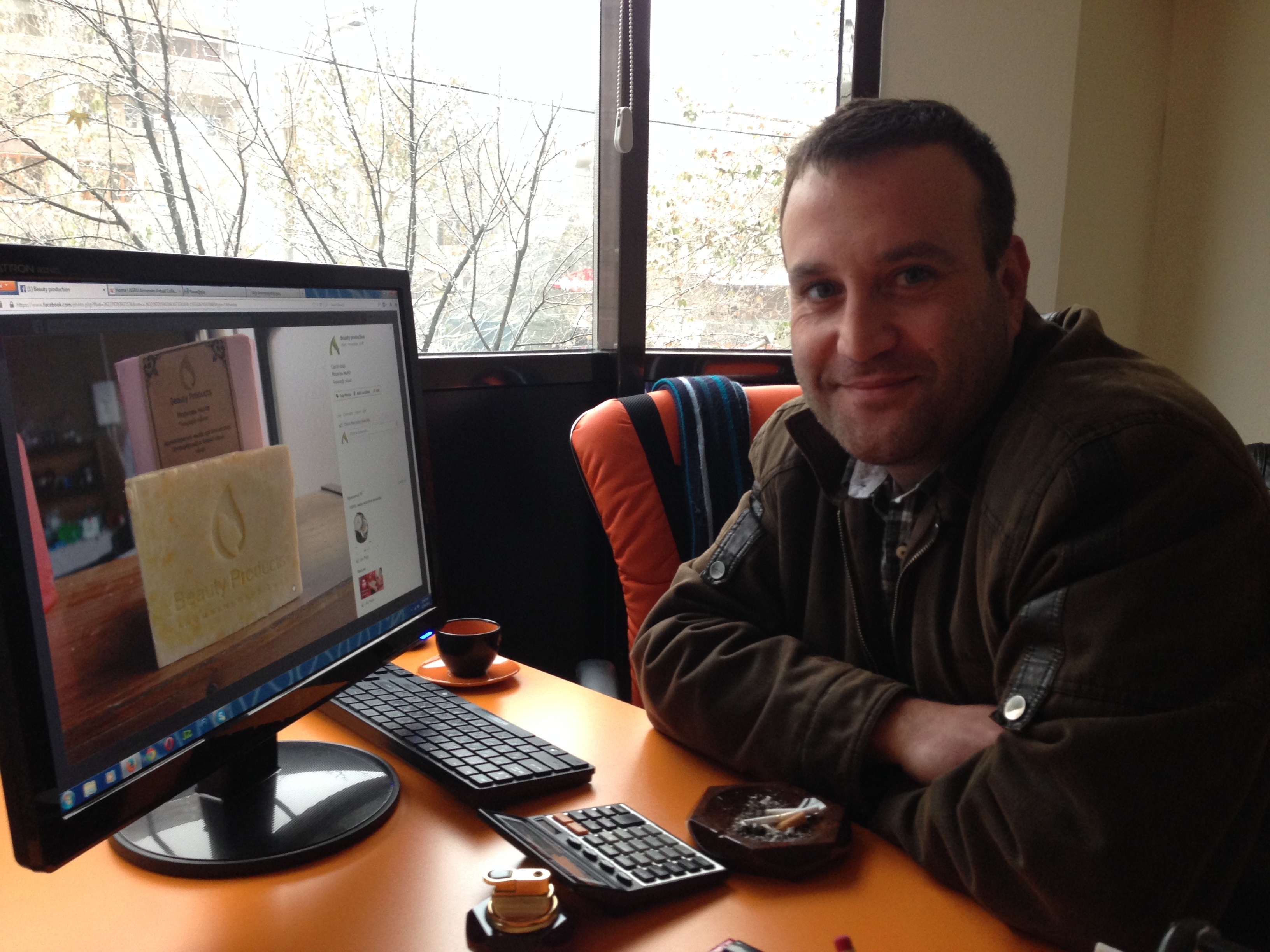
Shant could never imagine that this hobby would one day become his main source of income

IMG_2203Shant Khayalian was born in Aleppo in 1976. He attended Armenian school there, and continued his education in England attaining a degree in Advertising and Marketing.

After returning to Syria, Shant established several of his own enterprises, each one different from the other – an automotive spare parts shop, olive oil production, an advertisement company and a car repair center. Shant struggles to recall all of his businesses. For curious, restless, and innovative Shant, even Sundays were boring, so he decided to fill this day of rest with something new and asked his friend, a chemist, to suggest something interesting for him to learn and practice. The friend suggested making soap and Shant liked the idea. He learnt how to make soap, and he started creating soap using the olive oil he produced.

Around three months later, Shant managed to produce his first soaps. He also developed his production and invented new kinds of soaps using milk, carrot juice, parsley, chamomile, honey and other items. “I would produce the soaps not to gain an income, but because I enjoyed doing it. It was like a hobby – I would make gifts for my relatives and friends”, says Shant.

շանթ

Shant could never imagine that this hobby would one day become his main source of income.

The organic soaps produced by Shant do not contain chemical colors or aromas. They are entirely natural. However, in Armenia organic products are not fully appreciated. Shant noticed that when buying soap, people in Armenia smell it and if they like how it smells they will buy it. Shant thinks that this is the wrong attitude, because a good smell does not mean good quality. Instead, it shows existence of additional chemicals.

In 2012, when the situation in Syria became critical, Shant left his birthplace and moved to Armenia with his wife and daughter. Luckily, years ago Shant had bought an apartment in Yerevan, with the thought that his children might live there one day. “When we left, it had already been a month since I had closed the shops, because it was impossible to work in those conditions. Even on the last day, when I went to work I witnessed terrible scenes – burnt bodies in the streets”. “Before that, my car had been shot at twice by a sniper trying to kill me. Once there was such a huge blast near our house which injured my back due to the pressure it created. Another time, when we were sleeping, the window of our house broke because of a bullet. So we understood that it was the time to leave the country.”

While arranging his family’s move to Armenia, Shant’s friend from Jordan suggested he move there to begin a soap production business, so Shant left for Jordan alone. “My friend’s wife had a business of non-natural cosmetics and soap. I suggested to them that I produce my own soaps and we develop the business together.”

“I participated in a charitable fair in Jordan where I presented my production. After a month, I received a call from the Royal Palace informing me that the Queen liked our soaps very much and had invited us to the palace for a dinner reception”. But there was not only a dinner invitation. The soap makers also received appreciation letters, royal souvenirs and badges. They tried to convince Shant to stay and develop their soap business in Jordan, but Shant was determined to move to Armenia.

Observing the soap market of Armenia, he has met many people who produce soap and discovered that they all work in house and kitchen conditions – they bring the material from abroad, melt it, add colors and aromas, shape the soap and sell them. “I do everything myself. I even make the essential oils myself. The glycerin is also natural, and as far as I understand no one produces glycerin in Armenia – I am the first to do so.”

As Shant left Syria without financial means and there was no money to start a business, he applied to Small and Medium Business Development Center for a loan. He introduced his business plan and it got approved. The money was transferred six months later, during which Shant could hardly bear the idleness – he tries to do different jobs: teaching at the Eurasia University, giving private English lessons, even driving a taxi with his own car. “Life is hard, you have to run here and there. If you sit back you’ll get nothing. There are people who had a good life in Syria, but after losing what they had, they are not able to adjust to the idea that they will earn less in Armenia. I used to live well – I would spend several thousands of dollars within a week, but now I cannot earn that money in months. What should I do? Get disappointed? Do nothing? On the contrary, one shouldn’t get disappointed, one should act, be flexible and adjust to new situation.”

933943_270904829727398_597397948_n

Shant’s first product in Armenia – the Beauty Products – is already out. It has 8 kinds of soaps with olive oil, lemon and glycerin, apricot and blackcurrant. In Armenia, doctors advised him to also use frankincense flower, which is very beneficial for skin.

The label of the soaps note that they are handmade. Indeed, doing everything by hand is very difficult, but Shant considers it to be the uniqueness of his produce. He uses the technologies of 1688, so everything is done by hand.

Despite the huge volume of work and high quality, Shant wants to make the price of his produce available for the consumers, so that many people can use them in Armenia. A 110 gram bar of soap will cost around 600 AMD.

This is indeed wonderful. But Shant has not made it to the market yet. Currently he is looking for specialists to help him with marketing because he will not be able to manage it on his own. If his business is well established in Armenia, then Shant will seriously consider exporting his produce to external markets. Currently he has exported his products to Norway, France, Korea, China, Ukraine and other countries, where he received positive responses.

Despite the fact that the social and economic situation is not wonderful in Armenia, and starting things from scratch is very difficult, Shant still does not want to move to another country. He doesn’t want to return to Syria either, because he thinks that even if the war stops and businesses re-open, the situation and the atmosphere will not be the same as before. “I have chosen my path. I don’t need much. If I can provide for my family to a decent level, then I will not leave Armenia”, he says.

Shant thinks that the Syrian crisis has given him an opportunity to return to the homeland and live there. “History teaches us lessons, but we still don’t take them into consideration. After the massacres of 1915, we were scattered and during the 1988 events we scattered again. Then, with the war in Iraq, the Armenians came and left again. Now the Syrian Armenians are arriving here… Eventually, everyone should understand that we don’t have space in a foreign land. Indeed, we are born and raised there, we lived there and are thankful for that, but an Armenian should live on Armenian land”, says Shant Khayalian, who is already a member at Repat Armenia and considers himself a true repatriate.

Translated by Irena Grigoryan

Edited by Liz McFadden

Society Should Be Enabled To Monitor Government Activities

նիստ2

The first Cabinet sitting of 2014 was held today, chaired by Prime Minister Tigran Sargsyan.

Opening the meeting, the Prime Minister addressed the audience: “Good afternoon, dear colleagues. I wish you all a happy New Year and Merry Christmas. May 2014 bring us new achievements in public service. We are in for a hard work’s year. We have approved per-agency priorities for 2014. My first directive therefore is that you get them through to the public-at-large so that society could monitor the activities of ministries and agencies.

Down to the agenda, the meeting approved a substantiated 100-point program of government activities, as well as 77 priorities for the year 2014. The Government decided that the Industrial Development Fund shall be the main operator of the activities of export-oriented industrial strategy policy of the Republic of Armenia and the Government-approved annual program of State support for activities under the strategy of export-oriented industrial policy.

The Government next established that the Enterprise Incubator Foundation would be the main operator on the activities of the program of State support of the technology center of Gyumri. The decision provides that upon completion of the building at Gai-1 in Gyumri, before registration of the building, the maintenance of said real estate will be carried out by the Enterprise Incubator Foundation. Any such assets acquired with a view to implementing the annual programs of Gyumri Techno Park to a total book value of about AMD70mn shall be donated to Enterprise Incubator Foundation.

The Government approved the concept of a model disability assessment system based on the World Health Organization-drafted international classification of functions, as well as a timetable for its implementation.

The Government agreed to the proposal on signing an agreement between the governments of Armenia and Ukraine on cooperation in the field of seismic protection and a memorandum of understanding between the Governments of the Republic of Armenia and the Republic of India on founding a telemedicine network in Armenia.

Canadian Turks Should Condemn, Not Condone, Genocide Denial

Հարութ Սասունյան

By Harut Sassounian

Publisher, The California Courier


Canadian Turks launched a petition last month seeking the removal of all references to the Armenian Genocide from the 11th grade curriculum of Toronto high schools.


This petition is a part of Turkish denialists’ long-standing efforts to reverse the Toronto District School Board’s (TDSB) 2008 decision to educate students about the Armenian, Jewish, and Rwandan genocides. TDSB’s action follows the recognition of the Armenian Genocide by the Canadian Senate in 2002 and the House of Commons in 2004. In addition, since 2006, successive Canadian Prime Ministers have issued official annual statements acknowledging the Armenian Genocide, despite intensive political pressure and economic blackmail by the Turkish government.


Back in 2008, a similar Turkish petition failed to sway TDSB to amend the genocide curriculum, after gathering over 11,000 signatures, mostly from Turkey. Indeed, the Ankara government and its Turkish proxies in Toronto have done everything possible during the past seven years to undermine this curriculum.


Below are the baseless claims made by the Turkish petition against TDSB’s genocide curriculum, followed by my rebuttal:


— Turkish Petition: “As the Turkish/Turkic speaking parents of students attending the Toronto District School Board, we are deeply concerned about the negative impact of the current curriculum module on ‘Armenian Genocide’ and the learning resources adopted by the Board since 2008.”


My response: There has been NO violence or intimidation against a single Turkish student in Toronto schools even though the genocide curriculum has been taught there for several years. The reason is that Armenians do not hold today’s Turks responsible for the crimes committed by the Government of Ottoman Turkey almost 100 years ago, except those who associate themselves with these crimes by their denial. The Republic of Turkey, on the other hand, as successor to the Ottoman Empire, is responsible for the continuing consequences of the Armenian Genocide. Denying the facts of the Genocide has a far more serious negative psychological impact on Armenians than its inclusion in the curriculum on Turks. Furthermore, the truth cannot be concealed in order not to offend the sensibilities of those who wish to cover up historical facts. Would anyone advocate erasing all references to the Jewish Holocaust from history books not to offend present-day Germans?


— Turkish Petition: “The textbook on the Genocide of the Armenians and other readers, such as Barbara Coloroso’s Extraordinary Evil, unremittingly discredits one community’s narrative over the other; and, adversely affects the students of TDSB with Turkish and Turkic heritages.”


My response: There cannot be two narratives or two versions of the proven facts of the Armenian Genocide. There can only be one version — the truth!


— Turkish Petition: “We firmly believe that the values of mutual respect, understanding and peaceful coexistence can be achieved through an honest and open dialogue on history. Moreover, fair and unprejudiced learning should be based on historical facts and not solely on the narratives of select communities while ignoring others. It should also be noted that there are no court decisions on any of these historical claims and the opinions of historians differ regarding the details and the definitions of these events.”


My response: ‘Mutual respect, understanding and peaceful coexistence’ cannot be achieved through distortions and lies. Only after acknowledging the truth and making appropriate amends, Canadian Turks can talk about such lofty ideals. Furthermore, contrary to the Turkish claims, there are several court verdicts on the Armenian Genocide, starting with the Turkish Military Tribunals of 1919, and judgments by Argentinean, Swiss, and U.S. courts. Significantly, the UN Sub-Commission on Prevention of Discrimination and Protection of Minorities adopted in 1985 a report acknowledging the Armenian Genocide. The ultimate arbiter of any genocide is the United Nations, since the Genocide Convention is a UN document.


To sum up, this latest Turkish petition is a total failure since its initiator, the Federation of Canadian Turkish Associations, has so far collected less than 2,000 signatures out of a claimed membership of 200,000 in Canada. Interestingly, most of the signatories are not from Canada, but Turkey where the petition has been widely circulated.


A more worthwhile initiative for Canadian Turks would be to start a petition urging the Turkish government to acknowledge the Armenian Genocide and make proper restitution to the descendants of this heinous crime on the occasion of the Genocide’s Centennial.

Անկախ

“It is very difficult for a Diaspora Armenian to become adapted to the local life because in our imaginations Armenia is different; a more idyllic place, but the reality is starker”.

418168_10151981011647814_595704366_nHarut Lakhoyan moved to Armenia before the crisis in Syria began. In 2001, he was accepted to study at the Department of Programming at the State Architectural University of Yerevan. After finishing his studies, he decided to stay in Armenia. Like many locals, he had difficulties finding a job in this profession, so he started to work in a completely different field while adjusting to life in Armenia.

“It is very difficult for a Diaspora Armenian to become adapted to the local life because in our imaginations Armenia is different; a more idyllic place, but the reality is starker,” he shares.

Harut’s parents were not pleased with his decision to stay in Armenia. They would have preferred for him to return to Aleppo where he could find a good job and have an easier life. “For me, it would be easier to live in almost any foreign country other than Armenia. Armenia is the most difficult option, but the most preferable to me, as well”, he says.

The so-called well-off life of Syria was not for Harut because he aspired for more than Syria could offer. “In terms of culture, Syria, my birthplace, was on a lower and limited level. Having lived in Armenia for five years, the contrasts between Yerevan-Aleppo have become more obvious to me,” he mentions.

“Despite this, the human relationships are on a higher level in Aleppo, than in Yerevan. Even Arab people were more likely to reach out and be helpful”, he adds.

Despite many disappointments in Armenia, Harut has also met many good people and these interactions and friendships make him see Armenia in a positive way too.

In 2006, Harut graduated university and because he couldn’t find a job in his profession, he began to work as a real estate agent. When, in 2006, the inflow of Armenians started as a result of the Syrian crisis, he observed many controversial phenomena in Armenia. He discovered that many people took the opportunity to take advantage in the field of real estate, directly harming Syrian Armenians. In the meantime, there were people who lived abroad, but provided their apartments in Yerevan for the repatriates.

Harut has been married for over a year to a local Armenian. They rent an apartment because he finds that buying an apartment is difficult not only for him, but also for many local young people, especially those who don’t receive state assistance or an inheritance from their parents.

Despite the difficulties, currently Harut is developing a serious business with two partners. As a result of long negotiations, last year they became the exclusive representatives of the famous Swiss company Swissbacks not only in Armenia, but also in 20 countries, including Russia, Ukraine, Belarus, Iran and others.

The company offers innovative works of jewelry, like new locks for earrings, invented by the French jeweler Sebastian Barier. It is a one piece flexible lock which easily clips the earring onto the ear. Swissbacks was established in 2006 and, since then, there have been many attempts to create this type of locks. The first model didn’t succeed, because it would break after clipping several times. The current model of locks can be used around 15,000 times, but before reaching this result, 60,000 pair of earrings were broken. Today the locks have such an advanced mechanism that even Chinese companies cannot copy it. The only company that could develop it is the world-known Swiss company Rollex.

On the basis of these locks the Armenian jeweler also developed 70 models of earrings, which will be displayed and sold at the “Dalma Garden Mall” soon.

Being an innovation, the locks of Swissbacks are more expensive than the gold of the earrings. The advantage of the locks is not only how it looks, but also the usability. Firstly, it is attached to the earring, so its loss is less likely. Also, they don’t hurt the ear, one can even wear them when sleeping, without any discomfort.

Harut hopes that his business will succeed, because it is innovative and there are no competitors in the field. He and his partners do everything according to the law. Despite this, he thinks that there are problems with legislative regulations in Armeia. “If we want to become a developed country, then we should do it gradually rather than by bringing in a model and trying to apply it directly. It’s the same as putting a Ferrari engine on an old Soviet car. That car will not run”, he says.

He finds that in terms of business and entrepreneurship Armenia has a sad picture. Instead of developing the laws to support a business environment, they hinder the development.

Nonetheless, he loves Armenia and emphasizes this. “I cannot imagine my life outside of Armenia. Maybe I have a lot of patience to continue living here after many disappointments or I am not yet completely disappointed. Besides, I have overcome the fear that every repatriate experiences when moving to Armenia – the fear of being deceived. I have been deceived many times, I have lost many things and I have overcome that stage”, he laughs.

Harut is among more than 500 repatriates who are registered at the Repat Armenia Foundation. People who, by their own example, call to the Armenians living abroad to repatriate.

Translated by Irena Grigoryan

Edited by Liz McFadden

Turkey Joins UN Cultural Committee: Wolf in Charge of Guarding Sheep

ՄԱԿ-ի մշակութային հանձնաժողով

By Harut Sassounian

Publisher, The California Courier


Earlier this year, I wrote a column describing the Turkish government’s bullying tactics to reclaim antique objects from European and American museums. It is ironic that Turkey, one of the greatest looters and pilferers of other nations’ cultural heritage, would so aggressively demand the return of these antiquities.


Just in case its threats fail to work, Turkey embarked on a new course of action last month — bribery! Turkish Education Minister Nabi Avci announced on November 10: “Turkey has doubled its contribution to the United Nations Educational, Scientific and Cultural Organization (UNESCO) amid the financial crisis it faces with the United States and Israel not paying their membership fees.”


Minister Avci did not even attempt to hide the real reason for Turkey’s generosity. He disclosed that “significant progress has been made in Turkey’s candidacy for the UNESCO World Heritage Committee elections to be held on November 19.” Indeed, the Turkish Minister’s prediction came true when his country was elected to the 21-member World Heritage Committee for the next four years.


The Turkish Foreign Ministry immediately announced that as a member of that Committee, “Turkey intends to share, at the international scale, the experience and knowledge it has accumulated in managing and protecting its own 11 world heritage areas representing different layers of Anatolian civilization, including Neolithic, Hellenistic, Roman, Byzantine, Seljuk and Ottoman periods.”


Electing Turkey to a body that is supposed to preserve cultural assets is akin to putting a wolf in charge of guarding sheep. Turkey should not be eligible to serve on the UNESCO committee or on any other UN agency because of its long record as a major violator of human rights and the hegemonic threat it presents to the peace and security of neighboring states.


Not surprisingly, the Foreign Ministry’s announcement made no mention of the numerous Armenian religious and cultural monuments in present-day Turkey. Only in recent years, with the intent of easing the way for its European Union candidacy as well as generating income from foreign tourists, the Turkish government has renovated a handful of Armenian and Greek churches, after decades of neglect and systematic desecration and destruction.


Now that Turkey has undeservedly become a member of the World Heritage Committee, Armenia’s UNESCO representative has the opportunity during each meeting for the next four years to point out the irony Turkey faces — tasked with preserving cultural monuments, while remaining one of the biggest confiscators of other nations’ cultural heritage.


Murat Suslu, Turkey’s director-general of cultural heritage and museums, told the New York Times with a straight face: “We only want back what is rightfully ours…. If you come to my house and you steal precious objects from me, do I not have the right to get them back?” Mr. Suslu, who insisted that thievery and looting are wrong no matter when they occurred, must be reminded that Turkey can make such claims only after returning to Alevis, Arabs, Armenians, Assyrians, Cypriots, Greeks, and Kurds, what is rightfully theirs!


Just as ironic was the statement made by Ertugrul Gunay, Turkey’s Culture Minister, to the Economist magazine: “I wholeheartedly believe that each and every antiquity in any part of the world should eventually go back to its homeland. Even if these objects are made of stone, just as people have souls, so do animals, plants and monuments. Taking a monument away destabilizes the world and is disrespectful to history.”


Instead of falsely presenting their country as a looting victim, Turkish officials should acknowledge that they are in possession of numerous antiquities confiscated by their Ottoman predecessors while occupying over a dozen neighboring countries. For example, the sarcophagus of Alexander the Great, discovered near Sidon, Lebanon in 1887, was shipped to Istanbul’s ArchaeologyMuseum under orders from Sultan Abdul Hamid II, where it is still kept as one of its most prized possessions. It’s now up to Lebanon to demand the return of this precious cultural treasure from Turkey! Also, Saudi Arabia has the right to reclaim a plethora of sacred Islamic relics removed from Mecca by the Ottoman authorities in the 19th century.


Turkey’s membership in UNESCO’s World Heritage Committee provides a unique opportunity for Armenians and other dispossessed nations to draw the world’s attention to the Turkish government’s illegal confiscation of their cultural heritage and demand their immediate return.

Անկախ

WikiLeaks Discloses Confidential U.S. Report on Armenian-Americans

Հարութ Սասունյան


By Harut Sassounian

Publisher, The California Courier


It is always interesting to see how the Armenian community is viewed by outsiders. That perspective becomes more fascinating when the assessment is made by a U.S. diplomat in an internal report.


The large number of classified U.S. government documents released by WikiLeaks include cables sent by the American Embassy in Armenia to the State Department. One of those dispatches, dated Nov. 17, 2009, is a ‘Confidential’ report by Amb. Marie L. Yovanovitch covering her 2009 tour of Los Angeles, Boston, New York City, and Washington, D.C.


Here are highlights of the ambassador’s report, titled: “Experience Engaging Diaspora Communities — Armenia.”


1) The Diocese of the ArmenianApostolicChurch “is under the authority of the Holy See of Etchmiadzin,” while the Prelacy “recognizes the jurisdictional authority of the Armenian Catholicos (head of the Armenian Church) based in Antelias, Lebanon. This is only for administrative purposes though, as, doctrinally, the Prelacy recognizes the theological supremacy of the Catholicos in Etchmiadzin in Armenia. The Prelacy is associated with the Armenian Revolutionary Federation (ARF)/Dashnaks, founded in 1890, and constitutes one of the three largest sectors of the Armenian-American community and are considered conservative in nature.” The report explains that “the ARF/Dashnaks have two goals: recognition that the massacres of Armenians in Turkey in 1915 constitute genocide, and the recovery of the traditional Armenian lands in eastern Turkey.” In all certainty, the Turkish government would not be pleased that a US diplomat has described parts of Turkey as “traditional Armenian lands.” Furthermore, the report states that the ARF “supports a ladies auxiliary association…known as the Armenian Relief Society (ARS), in addition to youth and cultural associations and a large media operation in the United States including newspapers, radio, and television.”


2) The report describes U.S. Armenian Catholics as “the smallest religious denomination…. The Armenian Catholic Church supports a small number of schools and orphanages but has almost no activities in Armenia.”


3) “The Armenian Protestant community is considered the oldest Armenian community in the United States and is very active through their Armenian Missionary Association of America (AMAA).”


4) “The Armenian General Benevolent Union (AGBU), established in 1906, is the second major sector and is the largest charitable organization in the Armenian community…. They are affiliated with the Armenian Democratic Liberal Party (ADL), also known as Ramkavars, which is active (but marginal) in Armenia, the American Diaspora community, and in the Middle East, such as Lebanon.”


5) “The Hnchag, or Armenian Social Democrat Party, is the third of the politically based Armenian community cluster of organizations and the smallest Armenian-community based political party. It functions as a political club in California and publishes a weekly paper.”


6) The report also lists “independent organizations that are non-partisan in character,” such as the Armenian Assembly of America [AAA], Lincy Foundation, Cafesjian Foundation, and Tufenkian Foundation. Interestingly, the Armenian National Committee of America (ANCA) is placed in this category even though the report acknowledges that ANCA is “generally recognized as the lobbying organization of the Dashnaks.”


7) In the humanitarian group, the report includes the Fund for Armenian Relief, Hayastan All Armenian Fund, Children of Armenia Fund, Jinishian Foundation, Armenian EyeCare Project, and Armenia Tree Project, but fails to mention the United Armenian Fund which has delivered close to $700 million of humanitarian aid to Armenia since the earthquake of 1988.


8) Amb. Yovanovitch describes the Ministry of Diaspora and the National Competitiveness Foundation as examples of the Armenian government’s outreach efforts to the Diaspora.


9) The report criticizes the Armenian Diaspora for not supporting “the promotion of democracy, electoral reform, and civil society development in Armenia.” However, it states that Armenian-Americans provide financial support to two think tanks: the ArmenianCenter for National and International Studies, and Civilitas Foundation.


The most interesting aspect of Amb. Yovanovitch’s report is the section on the Armenian-Turkish Protocols. She asserts that Armenian-American groups “pay close attention to Armenia’s foreign policy decisions and are quick to mobilize their supporters against the Armenian government if the Diaspora groups believe the government is not acting in Armenia’s best interests. Many groups oppose the government’s regional reconciliation efforts on the grounds that such reconciliation does not include resolution of the simmering conflict in Nagorno-Karabagh or recognition that the Ottoman Empire engaged in genocide in 1915. Other groups though, such as the Armenian Assembly of America and AGBU, have publicly supported the government’s policies of regional cooperation and an end to Armenia’s isolation in the Caucasus. In September [2009], AAA, AGBU, the Eastern and Western Diocese Churches, and the Ramkavars issued a public statement supporting President Sargsyan’s foreign policy to normalize relations with Turkey.”


Although the Ambassador’s report is informative, it does not accurately and comprehensively cover the full spectrum of the Armenian-American community.