Museum mystery: Spinning statue turns heads

130625083346-newday-pkg-cursed-egyptian-statue-00012219-story-topThe museum officials were stumped. A statue is supposed to stand still, not rotate all by itself.

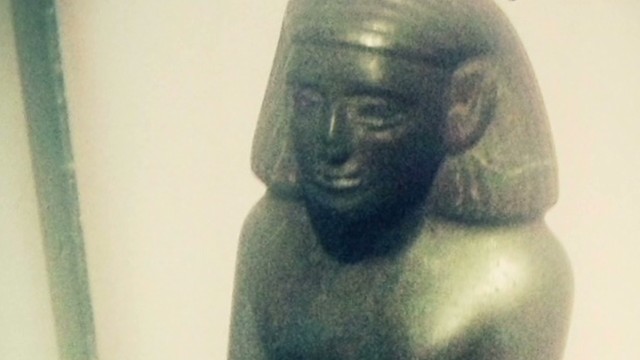
But this one at the Manchester Museum seemed to have done just that. Turned around 180 degrees — revealing an inscription on its back asking for beer.

No other figure in the display had moved — nor had any other in the museum.

For the staff, it was a bona fide mystery. One that called for some serious sleuthing.

A simple statue

Spinning statue stumps museum officials

Statuette no. 9325 doesn’t appear to go by any proper name. It’s a prefabricated figure — an off-the-shelf product — that was placed into a small tomb around 1800 B.C.

A private collector in Britain donated it to the museum in 1933. The inscription on the back, requesting a sacrifice of beer, bread and animals, was a standard prayer for the deceased.

For decades, the figurine stood perfectly still — until museum workers moved its case a few feet from its original position.

Turn, turn, turn

In February, curator Campbell Price noticed something curious was afoot.

The statue seemed to have slightly turned.

When he looked next, it was facing another direction. A day later, another.

The turns were subtle. But at the end of each day, you could tell the statue was angled differently.

Caught in the act

In April, museum officials installed a time-lapse camera that snapped an image of the statue every minute of every day for a week.

When they ran the images in fast motion, they came across a surprising revelation: the statue only moved during the day, when visitors were walking past.

It seemed, Price wrote, that vibrations caused by foot traffic in room was the culprit.

Mysterious structure found at bottom of ancient lake

Mystery solved?

Though officials now have a logical explanation, it still seems a bit mysterious.

“What is very strange is that the statue has spun in a perfect circle,” Price said. “It hasn’t wobbled off in any particular direction.”

Some are in awe of the spirit nature of the figurine, and don’t quite accept Price’s explanation.

One of the blog’s readers left his own theory for no. 9325’s movements in the comments section: “The statue is cursed,” wrote benabrahamse.

A museum guide has suggested saying a prayer for the statue.

But Price is unmoved.

“Most Egyptologists are not superstitious people,” he said.

No one has bought the statue a beer.

After all, they don’t want it wobbling.


President Serzh Sargsyan participated at the closing ceremony of the Armenian-Polish Business Forum

Սերժ Սարգսյան

In the framework of his official visit to the Republic of Poland, President Serzh Sargsyan together with the Polish President Bronisław Komorowski today in Warsaw participated at the closing ceremony of the Armenian-Polish Business Forum.

Serzh Sargsyan greeted the organizers and participants of the Business Forum, spoke about the centuries-long Armenian-Polish friendship, cooperation of the two countries in different areas, the Armenian-Polish trade and economic relations and briefly presented the business environment in modern Armenia, tendencies of economic development and investment opportunities.

In his welcoming remarks, the President spoke with esteem about the Polish authorities, in the person of President Komorowski and the Polish businessmen who, according to President Serzh Sargsyan, in the difficult conditions of the global economic and financial crisis have registered great success and through their daily work have further empowered their country.

“The Armenian-Polish friendship is centuries old and soon we will be celebrating the thousand year anniversary of the establishment of the first Armenian settlements in Poland. Becoming stronger with centuries, the Armenian-Polish relations are encompassing every area. The Armenians not only fought for independence of Poland but also made an important contribution to the country’s development. It is no accident that in order to advance the trade and crafts, the kings and princes of Poland were inviting Armenians to settle in different parts of the country, endowing them with numerous privileges and rights.

The high level of our current political relations and achievements registered in different areas, has its origin in the spiritual and cultural community, friendship and mutual sympathy formed during the ages.

Regrettably, today the Armenian-Polish trade and economic ties are substantially lagging behind the relations established in other areas. To fill that void, we, the two Presidents have decided on the necessity to organize a business forum – two years ago in Yerevan, and now here, in Warsaw. It should be noted that there are already some results, especially with regard to the presence of the Polish companies in Armenia and their participation in different Armenian projects. However, it is still not enough, and I urge you to be much more active.

Distinguished Entrepreneurs,

I would like to present briefly the business environment in modern Armenia, tendencies of economic development, as well as the investment opportunities.

Continuous improvement of the business and investment climate is a chief prerequisite of our economic development. Toward that end, in recent years, we have undertaken large-scale economic reforms, particularly related to the opening a business venture in Armenia, construction permits, registration of property, acquisition of loans, protection of investments, filing taxes and some other areas. The achieved results have been reflected in the international ratings, particularly, in the Doing Business-2012 annual report published by the World Bank’s International Financial Corporation. According to the mentioned report, Armenia compared to the previous year, improved her position by 18 points, occupying the 32nd position among 185 countries. Please note that it makes the business climate in Armenia the best in the CIS region.

Nevertheless, we don’t believe that our efforts aimed at the liberalization of the investment field and business climate and improvement of the state governance structure in general stop there. There is still a long road to go and we are passing that road with the assistance of our European friends.

In this context, it is warranted to speak about the Association Agreement to be signed with the European Union and the Deep and Comprehensive Tree Trade Agreement which constitutes its part. It will put our cooperation with the EU member states, including Poland, on a qualitatively new and more comprehensive basis.

Last December, we signed the agreement on visa facilitation with the European Union which was immediately followed by the cancelation of visa requirements for the EU citizens visiting Armenia. Considering also the Polish LOT airlines five times a week flights to Yerevan, I trust that all obstacles for visiting our country and observing the created conditions first hand have been removed.

Along with all this, I believe that Polish entrepreneurs would like to know that Armenia, being a member of the CIS Free Trade Zone agreement and closely cooperating with the Customs Union, has a competitive advantage in the CIS region. It definitely creates extra opportunities to enter the CIS market with more favorable conditions through the capital invested in Armenia.

Steps are also taken toward the improvment of infrastructure and full utilization of the existing opportunities which will allow to decrease the transportation fees.

Ladies and Gentlemen,

I would like to highlight a number of areas which, in my opinion, could possess potential for the further development of the Armenian-Polish cooperation.

The area of information technologies in Armenia is growing rapidly. It ensures high profitability and is really attractive for major foreign investments. It is proved by the presence in Armenia of 360 companies working in the IT area, 151 of which are branches of foreign companies. Many of the major international companies are represented in Armenia, among them Synopsys, National Instruments, Microsoft, D-Link, Mentor Graphics, and others.

Everything is being done to staff the field with professional cadre and, of course, to retrain them. The Armenian National Engineering Laboratories program is being implemented, and retraining programs have been launched at the Microsoft innovation center and laboratories of the Mobile Solutions.

The Tumo supermodern center of creative technologies for 12-18 years old children has been functioning in Yerevan since 2011, and now we are planning to extend the programs of the center to the regions of the Republic as well.

Traditional areas which brought the international recognition to the Armenians are jewelry making and diamond cutting. The Armenian jewelry is sold in many countries of the world, including Poland. We have serious programs on making Armenia a regional and why not, also an international hub for jewelry production through the creation in Armenia of the free zone for the jewelry production.

Armenia attaches importance to the establishment of free trade zones as a strong incentive for the attraction of direct foreign investments, introduction of advanced technologies, implementation of innovative methods, and creation of new jobs.

In coming years, we are planning to make large investments in the area of agriculture, through the technical re-equipment and enhancement of productivity, as well as through the modernization of processing capabilities.

I would like to see the growth of the Polish investments also in the area of tourism, mining, and health care which are continually modernized areas with great potential for development and which the state has declared the priority areas for development.

Distinguished Entrepreneurs,

I am hopeful that today’s Forum will enhance the establishment and expansion of the long-term and mutually beneficial economic programs for the prosperity of the Armenian and Polish peoples. I wish you all success and I hope that soon I will hear of success of the Polish businessmen in Armenia,” President Serzh Sargsyan told the participants of the Armenian-Polish Business Forum in his welcoming remarks.

World’s top places of refuge: where could Snowden go?

Edward SnowdenFleeing US law enforcement, the NSA whistleblower Edward Snowden seems stuck for where to go next. CNN Travel’s own top secret document reveals which countries should be on his list …

Snowden has sown a global trail of confusion in his flight from the United States. Journalists and diplomats have been scrambling to anticipate where he might pop up next.

What should Snowden be looking for in a decent place of refuge?

A willingness to grant “quickie” citizenships and the lack of an extradition treaty are obvious attractions, says Professor Ruth Wedgwood, an expert in international law and diplomacy at Washington’s Johns Hopkins University.

Decent plumbing and good weather probably wouldn’t go amiss, either.

Snowden will have to be quick, though. Fugitives should be careful in choosing their destinations as diplomatic allegiances shift fast, says Michael Abbell, a former director of the US Department of Justice’s Office of International Affairs and a key extradition negotiator under Ronald Reagan.

“Especially when you’re dealing with such things as are arguably political in nature,” Abbell told CNN. “From time to time there have been countries that people could more or less get lost in [but] it depends on the nature of the case.”

What Snowden and other fugitives clearly need is a guide to the world’s political safe havens. This constitutes something of a niche travel guide, and it’s unlikely Lonely Planet or Frommer’s have one in the pipeline.

Fortunately, CNN Travel has compiled just such a list. Until now, it has been encrypted in secure computer servers located deep in the basement behind several locked doors. And then someone went and leaked it…

1. Iceland

Iceland makes for an excellent fugitive destination, particularly for someone with a wintry name such as Snowden. It professes a love for internet freedoms and once checkmated extradition efforts by offering citizenship to tax-evading US chessman Bobby Fischer.

For Snowden it might feel chilly after Hawaii, Hong Kong and midsummer Moscow, but he could easily warm up with a dip in the geothermal waters of the Grindavik Blue Lagoon.

Why stay: Ash-spewing volcanoes could help to shroud your location.

Why leave: New laws to aid whistleblowers are not yet in place. Also, they eat puffins.

2. Ecuador

It’s a two-way deal: exiles get a sub-tropical shelter while the Ecuadorean President, Rafael Correa, gets to burnish anti-American credentials and a distraction from his clampdowns on press freedom.

Why stay: Plenty of Inca ruins and colonial Spanish buildings to admire.

Why leave: Ecuador still has an extradition deal with the United States.

3. The UK

It might be heavily in diplomatic hock to Washington, but the UK remains a popular place of refuge — particularly among Russian exiles drawn by its liberal outlook, robust legal system and miserable weather. OK, maybe not the weather.

Despite security cameras on every corner, plenty of people have managed to lose themselves in London. And if all else fails, it has an Ecuadorian embassy, although since Assange has already snagged the spare room, you’ll be on the sofa.

Why stay: Strong tradition of political radicalism

Why leave: Did we mention the awful weather?

4. The Philippines

The Filipino police have a strong track record of helping foreign agents hunt down their quarry, but with more than 7,000 islands to choose from, it could take them some time.

Why stay: Boracay’s beaches, Banaue’s scenic rice terraces and — as it happens — more colonial Spanish architecture!

Why go: Rampant corruption. Even if you’re not on the lam, you’ll still be bilked for backhanders.

5. Spain

Southern Spain’s enduring popularity among expat UK villains has earned its coastline the unfortunate soubriquet of “Costa del Crime.” A spate of arrests has tarnished its appeal, though.

Why stay: The sunshine, the paella, the sangria.

Why leave: British pubs selling greasy breakfasts to greasier Brits. Abject lack of Spanish colonial architecture.

6. France

The French have a rep for being rude to foreigners — unless they are fleeing justice. The country has ignored extradition deals in the past, refusing to give up US-wanted hijackers in the 1960s and 70s. If you’ve done something political — or you are Roman Polanski — you’re probably safe.

Why stay: France has it all: Culture, countryside and cheese.

Why leave: France also has the French.

7. United States

Why not hide in plain sight? It’s a big, frequently beautiful country and there are parts of America where folks don’t even know who their president is, let alone who’s on his most wanted list.

Why stay: Land of the free.

Why go: Pressure to have plastic surgery. Even if you’re not changing your identity.

8. North Korea

Clearly this would be madness. But as extradition expert Abbell notes, North Korea and Iran are two countries where fugitives are almost guaranteed to be beyond the reach of international justice.

US soldier Charles Jenkins demonstrated this principle between 1965 and 2004 after deserting to the north during the Korean War, and living — albeit rather wretchedly — to tell the tale.

Why stay: Don’t stay.

Why leave: It won’t be your emails that are monitored, just your every waking thought.

9. Cuba

Embargoes didn’t stop Jay Z from heading to Havana, but you probably won’t have to worry about facing the other kind of rap as Cuba seems happy to ignore its extradition treaties.

Why stay: Salsa, cigars and those great old cars held together with washing machine spares.

Why go: Worrying proximity to Guantanamo

10. Transit

Snowden appears to have spent several days airside at Moscow’s Sheremetyevo airport, a location that Kremlin authorities insist does not fall within Russian borders.

Perhaps he could stay there, following the footsteps of Iranian exile Mehran Karimi Nasseri, whose eight years stranded at Charles de Gaulle airport inspired the movie “The Terminal”.

Why stay: Limitless supplies of Dan Brown books and giant Toblerones.

Why go: Audacious flight from justice will be rendered into a lame Tom Hanks comedy.
 

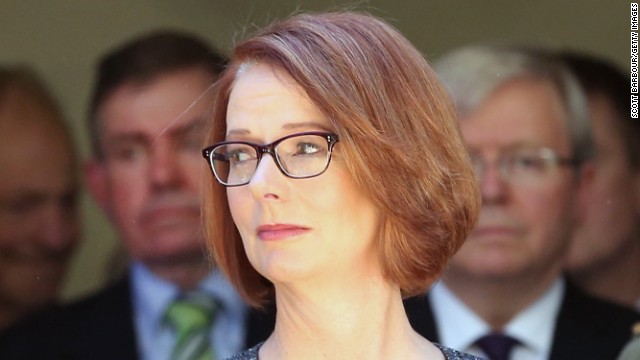
Australian Prime Minister Julia Gillard has resigned, after the Australian Labor Party voted her out of its leadership Wednesday.

130321174405-gillard-australia-story-topShe had called for the vote herself after months of inner-party friction.

Her rival, former Prime Minister Kevin Rudd, takes her place as party leader, after winning the internal ballot by a margin of 57 to 45 votes, according to an ALP spokesman.

He is now Australia’s de facto prime minister and could be sworn in within hours, if Australian Governor-General Quentin Bryce approves him for the office. The governor-general shares the role of head of state with Britain’s Queen Elizabeth II.

In a news conference after the vote, Gillard said she was grateful to have had the opportunity to lead her country.

“This privilege was truly humbling. I thank the Australian Labor Party for that privilege and I thank the Australian people for their support,” she said.

“When I first put myself forward for consideration for Labor leader in 2010, I had the overwhelming support of my colleagues to do so. I thank them for that. And I thank them for giving the opportunity to me not only to serve the nation but to serve as the first female prime minister of this country.”

Gillard said she had written to the governor-general to inform her of the ballot result and asking her to commission Rudd as prime minister. She will go to see Bryce later Wednesday.

Rudd is widely popular with Australian voters, who go to the polls in September to pick a new parliament and government. The ALP has not felt confident it could take an election victory with Gillard at its helm.

Supporters within the ALP circulated a petition calling for Rudd to challenger Gillard’s leadership, but he initially refrained. In the meantime, at least eight of the ministers in Gillard’s Cabinet resigned, purging decades of experience from her government.

This week the prime minister had had enough. Despite no official challenge from any rival, she put her power on the chopping block and handed her party the ax.

“I do think it’s in the best interests of the nation — and in the best interests of the Labor Party — for this matter to be resolved,” she said as she called the vote.

Reluctant Rudd

In a jab at her rival, Gillard complained in an interview with CNN affiliate Sky News Australia this week that no one had approached her to mount a leadership ballot in a traditional manner.

“Call me old fashioned, but the way in which these things are normally done is a challenger approaches the leader of the Labor Party and asks them to call a ballot for the leadership, you shake hands and then a ballot is held,” she said.

Gillard called for any challengers to put their names on the ballot, which would be the last one she would call to challenge her position.

Three hours before the vote, Rudd picked up the gauntlet.

“Various ministers have been free and frank in their public advice to me as to the desirability to contest the leadership in recent days. For the nation’s sake, I believe it’s time for this matter to be resolved,” he said in a statement sent to journalists.

The showdown was set in stone.

Rudd has said that he will not use his win against party rivals.

“Every effort I have in my being will be dedicated to uniting the Australian Labor Party. No retributions, no pay backs, none of that stuff. It’s pointless, it’s old politics,” he said.

Loser leaves

In March, Gillard threw down a similar challenge to her power as the rivalry sapped strength from her government. Rudd refused back then to challenge her, and she won the vote of confidence from her party and kept her job.

But she continued to lose support within her party.

In her interview with Sky News, Gillard said the loser of Wednesday’s vote should get out of the way for the sake of a functioning government.

“If you win, you’re Labor leader,” she said. “If you lose, you retire from politics.”

In her post-vote news conference, Gillard confirmed she will not seek to retain her constituency seat in September’s general election.

CNN’s John Raedler, Brian Walker and Elizabeth Joseph contributed to this report

Indian journalist criticised for filing report from the SHOULDERS of a rescued flood victim in disaster region where 1,000 people died

An Indian journalist has been criticised for appearing on television reporting from a disaster zone while sitting on the shoulders of one of a flood victim.

Narayan Pargaien was in the state of Uttarakhand reporting on floods which have devastated the region when he made his unorthodox broadcast for News Express.

But he has denied the suggestion that he exploited the man by sitting on his shoulders while on camera, insisting that the flood victim ‘wanted to show respect’ because he had never met anyone as important as the journalist before.

A video of Mr Pargaien reporting on the floods swept the internet when it was posted to YouTube earlier this month, with many Indian web users criticising him for apparently using a disaster victim to keep his feet dry.

One commenter denounced him as ‘a disgrace to journalism’, while another said he was ‘a ridiculous reporter’.

In an interview Mr Pargaien, who has nearly two decades of reporting experience, admitted that he was wrong to file the unorthodox report, but said that he only sat on the man’s shoulders after the victim had invited him to do so.

He also blamed his cameraman for revealing the bizarre arrangement, claiming that he had been told he would only be filmed from the waist up.

‘It wasn’t my idea to begin with, but there was this man who took me to his home and asked me to report the damage he had suffered,’ Mr Pargaien told News Laundry.

‘His house was in a miserable condition and he had lost a lot in the flood, and was left with very little food and water.

‘We helped him with some food and some money and he was grateful to us and wanted to show me some respect, as it was the first time someone of my level had visited his house.’

The reporter added that he had paid the man, whom he refused to name, 50 rupees (55p) for his troubles.

He admitted that his actions were ‘journalistically wrong’, adding that he had ‘no problem getting my feet wet’.

The horrific floods in the northern state are believed to have killed 1,000 people, with many thousands more stranded in remote mountainous areas.

Now you can even use your mobile in the sea: Sony unveils WATERPROOF phone that can also take underwater pictures and video

Sony has launched a new waterproof android smartphone.

The Xperia Z Ultra can be used underwater up to a depth of 1.5m, even allowing people to take pictures and film video in full HD below the surface, the company said.

Launching it today, Sony claimed the handset, which has a 6.4-inch screen, has the biggest display and is the thinnest large-screen smartphone on the market.

The phone will include a Qualcomm Snapdragon 800 processor which Sony says is the world’s fastest processor.

The phone was launched today at the Mobile Asia Expo in Shanghai, alongside the Sony SmartWatch 2 SW2, a ‘second screen’ for any Android phone worn on the wrist.

Riots Kill 27 in Minority Region of Far West China

Riots in a restive far western region of China on Wednesday killed 27 people and left at least three injured, state media said.

The official Xinhua News Agency said knife-wielding mobs attacked police stations, a local government building and a construction site Wednesday morning in a remote town in the Turkic-speaking Xinjiang (shihn-jahng) region.

The unrest in in Lukqun, a township in Turpan prefecture, left 17 people dead, including nine policemen, before police shot and killed 10 rioters, the agency reported. Xinhua cited officials with the region’s Communist Party committee.

Xinjiang is home to a large population of minority Muslim Uighurs (WEE’-gurs) but is ruled by China’s Han ethnic majority. It has been the scene of numerous violent incidents in recent years, including ethnic riots in Urumqi in 2009 that left nearly 200 people dead.


Japan imports wolf URINE and plays recordings of lions roaring in bid to keep deer from running onto the highway

deerWolf urine and lion roars are being used by transport bosses in northern Japan to tackle the growing problem of collisions caused by deer.

The number of accidents caused by the animal has more than doubled in Hokkaido – the northernmost of Japan’s four main islands – in the past ten years.

As a result, transport officials have taken drastic action. As well as spraying wolf urine near roads and railways they will also be broadcasting the roar of lions to try to keep the deer away.

The urine is being imported from the United States to spray on the island’s highways.

The deer population in Hokkaido was nearly wiped out in the early 20th century because of overhunting and sometimes brutal winters.

But conservation efforts – and the extinction of the indigenous wild wolf population – led to their recovery.

Hokkaido Railway Co earlier this year erected equipment that broadcasts the roar of lions in an effort to keep the timid animals away from its tracks, a spokesman said.


ANCA-GREATER WASHINGTON WELCOMES BROAD BACKING FOR JAMGOCHIAN MARYLAND DELEGATE CAMPAIGN

jamgochian_pallone_lsiBETHESDA, MD – Congressional Armenian Caucus Co-Chair Frank Pallone (D-NJ) joined an enthusiastic crowd of more than a hundred Maryland community leaders and activists in a strong show of support for House of Delegates candidate Hrant Jamgochian’s June 17th campaign fundraising kick-off, reported the Armenian National Committee of America – Greater Washington (ANCA-GW).

The reception, graciously hosted by Mrs. Nancy Greenspan at her Bethesda home, was an opportunity for area voters and supporters, including a diverse cross-section of the local Armenian American community, to stand with Jamgochian’s campaign and support Hrant’s positions on a broad range of local and state-wide issues, ranging from health care and education to the environment and economy.

jamgochian_group“We’re pleased to see Hrant in the lead as the front-runner in this race, and proud to support his campaign every step to victory,” said ANCA Greater Washington Chairwoman Sevan Kolejian. “We look forward to helping Hrant spread his message to Maryland voters and to playing our part in electing Maryland’s first-ever Armenian American to state-level office.”

Photos from the event can be found at: https://www.facebook.com/media/set/?set=a.506150389453664.1073741826.181565881912118&type=1

In remarks voicing his support for Hrant’s campaign, Congressman Pallone cited his own long and productive working relationship with him on healthcare issues, saying: “He [Jamgochian] is an extraordinarily respected and strong voice on patients’ rights and works tirelessly in the non-profit sector to advance healthcare rights to the most vulnerable members of our society. As the Ranking Member in the House Energy and Commerce Health Subcommittee, I can tell you that Hrant has got it right when it comes to good democratic values and a true commitment when it comes to access affordability and quality of care for all Maryland residents.”

Jamgochian explained, “This election is about values, and communicating those values to our neighbors. We believe in protecting the most vulnerable members of society, in fostering an affordable and accessible educational system, and in an economy where people pay their fair share and we are able to find jobs in the fields we have spent years preparing for.”

On hand to lend their assistance to the Jamgochian campaign that evening were three of this year’s ANCA Leo Sarkisian summer interns: Manoug Alemian, Taleen Lachinian and Tamar Purut. “Hrant’s enthusiasm and commitment to community outreach and empowerment was inspirational,” said Lachinian, who had met Jamgochian and his wife, Lenna, the day before at the Soorp Khatch Armenian Church Father’s Day Picnic. “We need more Armenian Americans in elected office, and it’s encouraging to see dedicated professionals like Hrant devoting their lives to public service.”

To learn more about or to support the Hrant Jamgochian for Maryland State Delegate campaign, visit:http://www.gojamgo.com


Russian scientist wants ‘Satan’ missile shield to shoot down meteorites in wake of Urals strike

soviet era missile A Russian scientist has said a Soviet-era ballistic missile system dubbed ‘Satan’ should be put back into use defending the earth from asteroids. Senior rocket researcher Sabit Saitgarayev – who spoke out after a meteor burst over Russia’s Ural Mountains earlier this year damaging thousands of buildings – said the old 1960s missiles were ideally suited to destroying any potential threats streaking towards the planet from space. The researcher said the missiles, which use standard liquid fuel based on hydrazine, were ‘well-suited’ to fighting ‘suddenly discovered small [space] objects, according to a report on news.com.au. It means a missile could be launched against an approaching asteroid with a mere 20 minutes warning, in contrast to modern missile systems, which require several days of preparation ahead of a launch. Scientists claimed the meteorite that exploded over the Urals was the biggest space rock to hit earth in more than a century. Mr Saitgarayev claimed Satan missiles would be capable of destroying objects with a diameter of up to around 300ft. If equipped with a booster, the 1960s missile would be able to destroy a space object hurtling towards earth while it was still five to six hours away, he said.

Woman’s breast implant explodes after lying on her stomach for four hours playing game on her iPhone

breast implantA Chinese woman’s breast implant ruptured after lying on her stomach for four hours playing a game on her phone.

According to Chinese news reports, the woman from Beijing had been playing the game in bed when she felt a pain in her chest.

She was taken to hospital and SZNews reports that a doctor said the low quality of the implant, combined with the pressure of lying on it for an extended period of time, had caused the rupture.

It is not clear if the woman had the breast implant replaced – she apparently had the surgery to boost her low self-esteem.

In 2011, a woman’s breast implant was apparently ruptured when she was shot in the chest while paintballing.

The 26-year-old was hit at close range during the game in Croydon, south London.

Last year a Texas woman filed a lawsuit claiming that one of her breast implants ruptured because a police officer used excessive force during her arrest.


Talaat Killed the Ottoman Crown Prince For Opposing the Armenian Genocide?

Harut Sassounian

By Harut Sassounian

Publisher, The California Courier


It is not often that I cover murder mysteries, but I am making an exception given the unusual circumstances of an Ottoman Crown Prince’s death in 1916 and its possible link to Talaat and the Armenian Genocide.


The first clue was an article I came across in the April 3, 1921 issue of The Pittsburgh Press, titled: “Patiently Tracked to His Hiding Place and Killed: How the Bloodthirsty Turkish Grand Vizier, Talaat Pasha, Who Planned the Murders of a Million Armenians Met His Fate.” This news report was occasioned by Soghomon Tehlirian’s assassination of Talaat on March 15, 1921, in Berlin.


One paragraph, in particular, buried in the middle of the lengthy article, contained a shocking revelation: “Perhaps the strangest fact of all in connection with Talaat’s career is that he paved his way to this supreme office by murdering the heir to the throne, Crown Prince Youssouf Eddine, a nephew of the reigning Sultan. The young prince had protested strongly against Talaat’s announced policy of exterminating the Armenians. Talaat, seeing a prospect of serious opposition, shot the prince like a dog.”


To ascertain the veracity of this surprising news item, I conducted a lengthy internet search and consulted publications in English, French, Turkish, Spanish, and Armenian, based on the different spellings of the Prince’s name: Youssouf Eddine, Yusuf Izzeddin, Yusuf Izzettin, etc.


While most of these sources agree that the Crown Prince died under suspicious circumstances, they present three distinct narratives on how he met his untimely death. There is even an entire Turkish book on this mystery, titled: ‘Shehzade Yusuf Izzedin olduruldu mu, intihar mi etti?’ [Crown Prince Yusuf Izzedin was killed or committed suicide?].


The first account is the one mentioned by The Pittsburgh Press claiming that the Crown Prince was killed by Talaat for opposing the extermination of the Armenian people.


The second explanation for the premature death of the Crown Prince is that he committed suicide by slashing his wrists. The Young Turk government issued the following official announcement on Feb. 3, 1916: “In consequence of the malady from which he suffered so long, His Highness the Heir to the throne committed suicide at half-past seven this morning in the bedroom of the harem pavilion of the summer-house at Zindjirly, by opening the veins of his left arm.”


This formal statement was met with widespread skepticism, giving rise to a third explanation for the Crown Prince’s demise. French Minister of State Yves Guyot, in the preface to his book’s English edition, ‘The Causes and Consequences of the War,’ published in 1916, wrote that those who had read the official communiqué were convinced that the Young Turks “made the heir to the throne ‘commit suicide.’ Information from many quarters confirms that suspicion.”


Guyot and other chroniclers asserted that War Minister Enver Pasha had Izzeddin killed for opposing the Ottoman alliance with Germany during WorldWarI. “After the bombardment of Odessa by the Turkish fleet he [Izzeddin] indicated his disapproval in no uncertain manner. From that moment he was doomed,” wrote the French Minister.


Guyot also described in detail a secret meeting in 1915 attended by Talaat, Enver and other Young Turk leaders, during which Enver advocated the elimination of the Crown Prince, who was “assassinated on the day before he was to start for Europe,” according to Guyot.


Bishop Grigoris Balakian, a prominent survivor of the Armenian Genocide, affirms in his memoirs, ‘Armenian Golgotha,’ that the Crown Prince was “killed by Enver and Talaat’s criminal clique…. Enver himself killed Yusuf Izzedin at the imperial farm of Balmomji.” Having witnessed the dead bodies of thousands of Turkish soldiers at the Battle of the Dardanelles, the Crown Prince protested to Enver that “the Dardanelles is the grave of the Turkish Army.” He was murdered after threatening Enver with a pistol.


Those who think that the assassination of a Crown Prince is too far-fetched to be credible should realize that such palace intrigues were a common practice during the long history of the Ottoman Empire. All too often, Sultans would orchestrate the murder of scheming heirs, and rival siblings would kill each other to pave the way for their own accession to the throne. In fact, 15 of the 36 reigning Sultans either abdicated (3), were overthrown (7) or were murdered (5).